The Sheep That Gazed Back: Tan Mu's Dolly and the Identity That Cloning Could Not Copy
In 1996, a sheep was born in a laboratory in Scotland. She was not the first sheep ever born, and she was not the last. She was, however, the first mammal ever cloned from an adult somatic cell, and the fact of her existence, announced to the world in February 1997, produced a shock that rippled far beyond the scientific community. The shock was not about the sheep. It was about what the sheep implied. If a mammal could be cloned from a single cell taken from the udder of a six-year-old ewe, then a human being could, in principle, be cloned from a single cell taken from any adult body. The boundary between the unique and the replicable, which had seemed absolute, suddenly looked permeable. Dolly the sheep lived for six years, produced six lambs of her own through natural breeding, and was euthanized in 2003 after developing a progressive lung disease. Her stuffed remains are on display at the National Museum of Scotland. Tan Mu was five years old when Dolly was born. "While my memory of the event is vague," she writes, "it left a lasting impression on me. Dolly became both a scientific milestone and a strange symbol within my childhood memory." The painting she made twenty-five years later is not a portrait of a sheep. It is a portrait of the question that the sheep made unavoidable: if a body can be copied, what happens to the self that inhabits it?
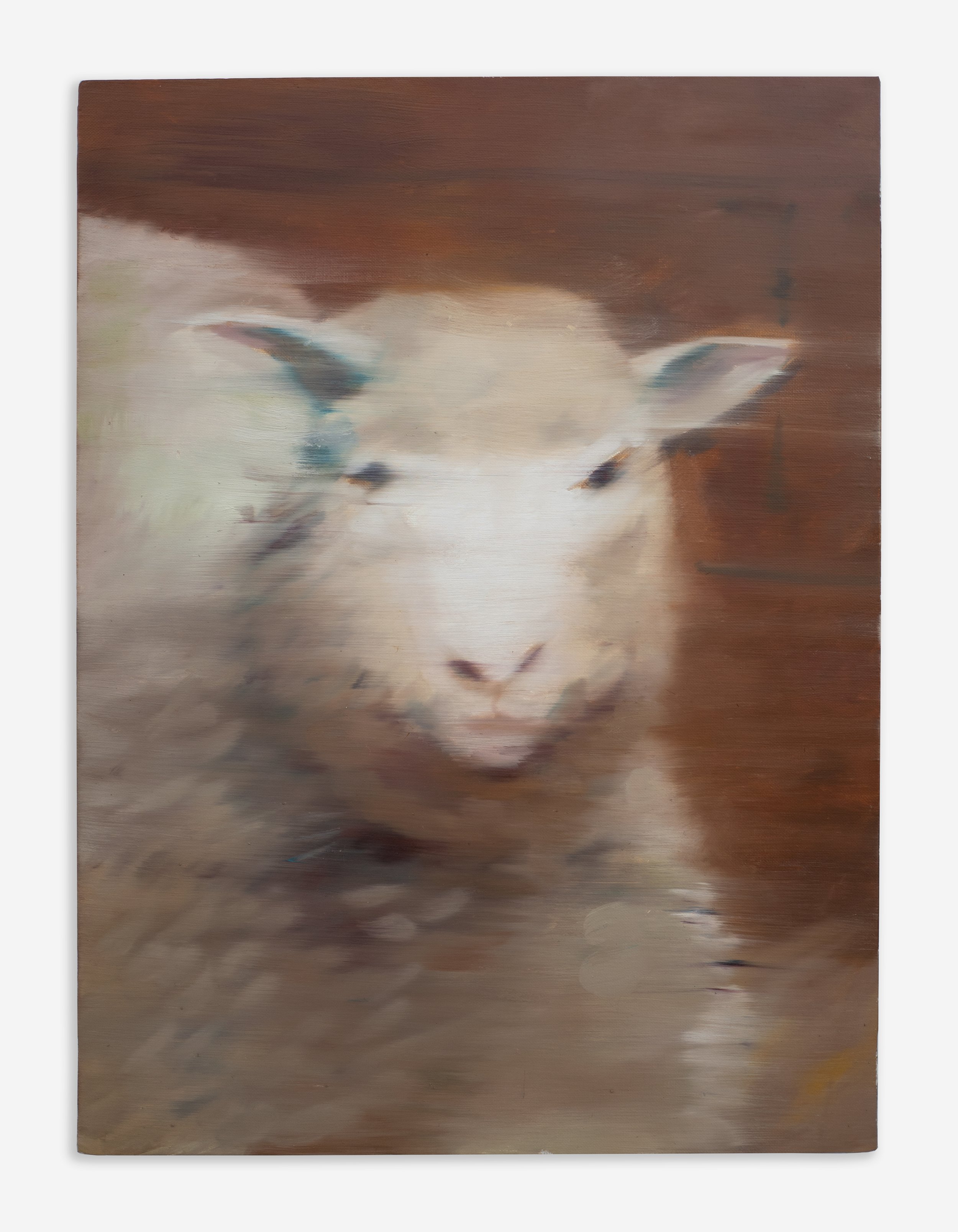
The painting is oil on linen, 61 x 45.7 cm (24 x 18 in), a vertical format that accommodates a single figure centered on a dark ground. The figure is Dolly, rendered in pale, luminous tones that seem to emit light rather than reflect it. The sheep's head fills the upper half of the canvas, turned slightly toward the viewer, its eyes meeting the viewer's gaze with an expression that is difficult to name. The eyes are dark, set in a face that is rendered in soft grays and whites, the wool suggested by a haze of brushstrokes that blur the boundary between the animal's body and the darkness that surrounds it. The lower half of the painting is darker, the sheep's body dissolving into shadow, the legs barely suggested, the ground beneath it indistinct. The overall effect is of a figure emerging from darkness and returning to it, a presence that is simultaneously here and not here, solid and dissolving, singular and multiple. The blur is not a technical limitation. It is the painting's central formal decision, and it carries the weight of the argument.
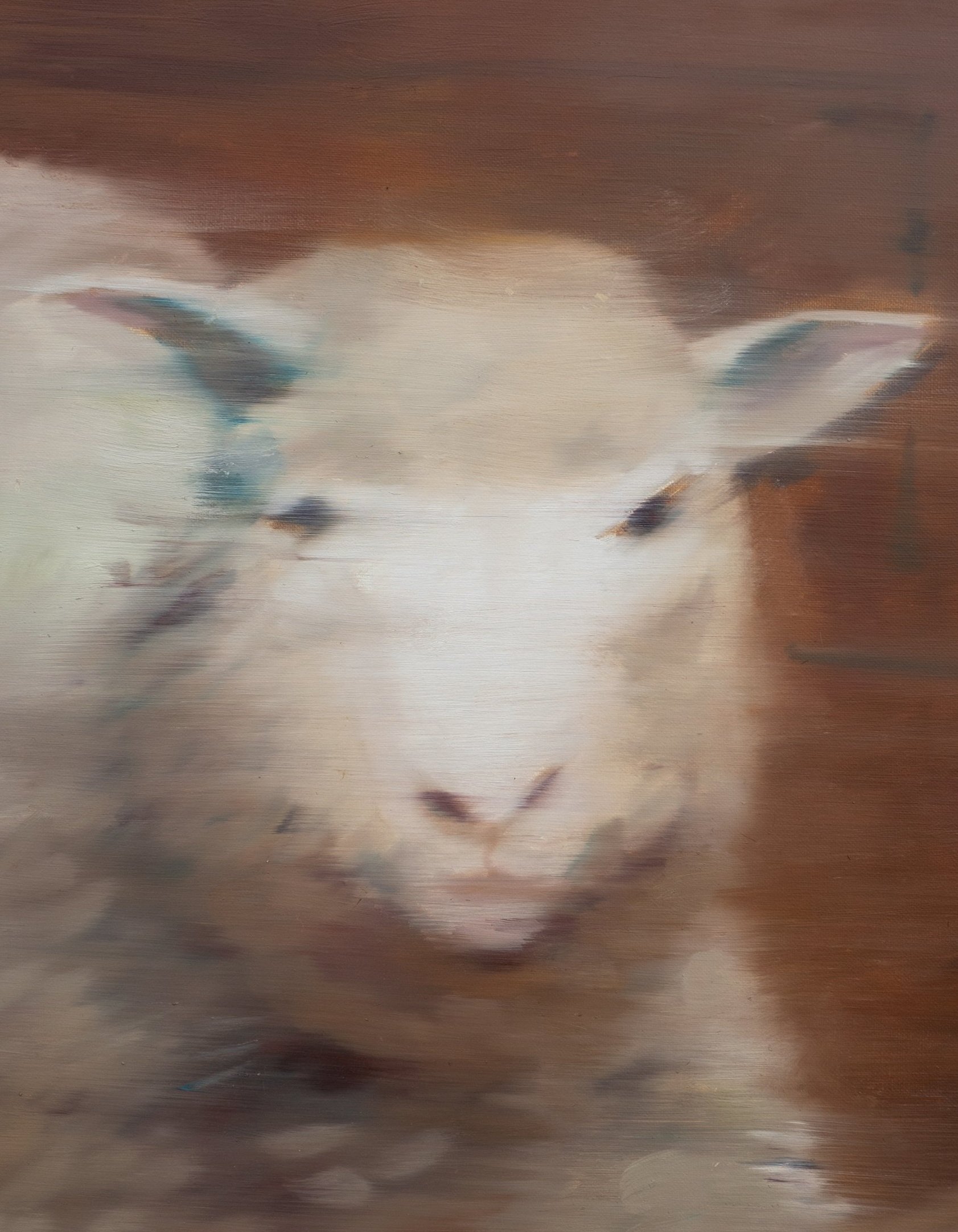
Tan Mu describes the blurred effect as "a visual metaphor for memory." When she revisited the story of Dolly years after first encountering it as a child, she found that "the image I held in my mind did not fully match historical documentation. That gap between memory and reality fascinated me." The blur is the gap. It is the space between what the mind retains and what the record shows, between the impression that a five-year-old absorbed and the facts that an adult artist researched. But the blur is also something more specific to the subject. A cloned being is, by definition, a genetic copy. Its DNA is identical to the DNA of the organism from which it was cloned. And yet Dolly was not the same sheep as the ewe whose cell produced her. She was born at a different time, lived a different life, had different experiences, and died a different death. The genetic code was identical. The life was not. The blur in Tan Mu's painting captures this distinction with precision. The sheep is recognizable as a sheep. Its features are legible. But the edges are soft, the boundaries uncertain, the identity hovering between clarity and dissolution. This is what a clone looks like when you try to see it as an individual: the form is there, but the edges will not hold still.
The color palette is restricted to a narrow range of grays, whites, and deep charcoal blacks, with a faint warmth in the sheep's face that suggests living flesh without committing to a specific skin tone. The brushwork varies across the canvas. In the sheep's face, the strokes are tighter, more controlled, building the features with small, precise marks that accumulate into a coherent image. Around the edges of the head, the strokes loosen, the paint applied in broader washes that allow the dark ground to show through. At the periphery of the body, the paint becomes almost transparent, the linen's weave visible beneath thin veils of gray that suggest the sheep's form without fully defining it. This gradation of focus, from the sharpest detail at the eyes to the softest dissolution at the body's edges, mirrors the structure of memory itself: the center is clear, the periphery fades, and beyond a certain point there is only darkness. The painting does not depict a sheep in a room. It depicts a sheep in a mind, the afterimage of a creature that existed in the world and now exists in recollection, its edges softened by the distance between the event and the remembering of it.
Andy Warhol's Marilyn Diptych (1962) is one of the most direct artistic engagements with the relationship between the copy and the original in the twentieth century. The work consists of fifty silkscreened images of Marilyn Monroe arranged in a grid, twenty-five on the left panel in color and twenty-five on the right in black and white. The source image is a publicity photograph from the 1953 film Niagara, a single frame that Warhol reproduced through a mechanical process that deliberately introduced variations in ink density, registration, and color saturation. No two Marilyns are identical, even though all fifty derive from the same source. The repetition produces difference. The mechanical process that was supposed to produce uniformity produces instead a field of subtle variation, each Marilyn slightly off from the next, each one a unique instance of the same image. The diptych is about the relationship between the individual and the mass-produced, between the unique person and the reproducible image, between the living woman who died in 1962 and the fifty versions of her face that Warhol made in the months following her death.
The connection between Warhol's Marilyns and Tan Mu's Dolly is structural. Both works take as their subject a being whose identity is defined by the tension between uniqueness and replication. Marilyn Monroe was a singular person whose image was reproduced millions of times, in photographs, on magazine covers, on movie screens, and in Warhol's own factory. Dolly was a singular animal whose genetic code was identical to another animal's, a living being who was also a copy. In both cases, the question is the same: where is the self in the copy? Warhol's answer, in the Marilyn Diptych, is that the self is in the variation. The fifty Marilyns are not identical, and the differences between them, the shifts in color and density and registration, are where the individual persists despite the mechanical process that was supposed to erase it. Tan Mu's answer, in Dolly, is that the self is in the blur. The sheep's identity is not fixed in the sharp edges of a photograph. It hovers in the soft transitions between light and dark, in the brushstrokes that suggest form without locking it down, in the gaze that meets the viewer's eyes and refuses to resolve into a simple category. The clone is a copy, but the copy is not the original, and the difference between them is the space where identity lives.
The science of cloning that the painting engages is specific and worth stating clearly. Dolly was produced through a process called somatic cell nuclear transfer. Scientists at the Roslin Institute took a cell from the mammary gland of a six-year-old Finn Dorset ewe and extracted its nucleus, which contained the ewe's complete DNA. They then took an egg cell from a Scottish Blackface ewe and removed its nucleus, leaving an empty cell. The nucleus from the Finn Dorset cell was inserted into the empty egg cell, and the resulting embryo was implanted into a surrogate Scottish Blackface ewe. After 148 days of gestation, Dolly was born. She was a genetic copy of the Finn Dorset ewe whose mammary cell had provided the nucleus. She was not a copy of the surrogate who carried her, nor of the ewe who provided the egg. She was a copy of one sheep, carried by another, born from the egg of a third. Three animals contributed to the production of one, and the one was genetically identical to only one of the three. The process was not reproduction in the biological sense. It was replication in the technological sense, and the distinction matters.
Tan Mu is explicit about the philosophical implications. "While working on Dolly, I was not only thinking about cloning as a technology, but also about the deeper structure of life and the relationship between the body and consciousness," she states. "Dolly's existence led me to reflect on processes such as cell division, replication, and the logic that governs life itself. Whether human or animal, we share the same fundamental biological principles. From this perspective, life can be understood as a complex system, with the body functioning as hardware and consciousness as software." The hardware-software distinction is precise and provocative. If the body is hardware, then cloning is the replication of hardware. The DNA is the specification. The cell is the factory. The resulting organism is a new instance of the same hardware, running in a different environment, accumulating different data, developing different patterns of behavior. The hardware is identical. The software, which is to say the consciousness, the memory, the self, is not. Dolly was not the same sheep as the ewe from which she was cloned, because consciousness is not encoded in DNA. It emerges from the interaction between the hardware and the world, and no two interactions are the same.
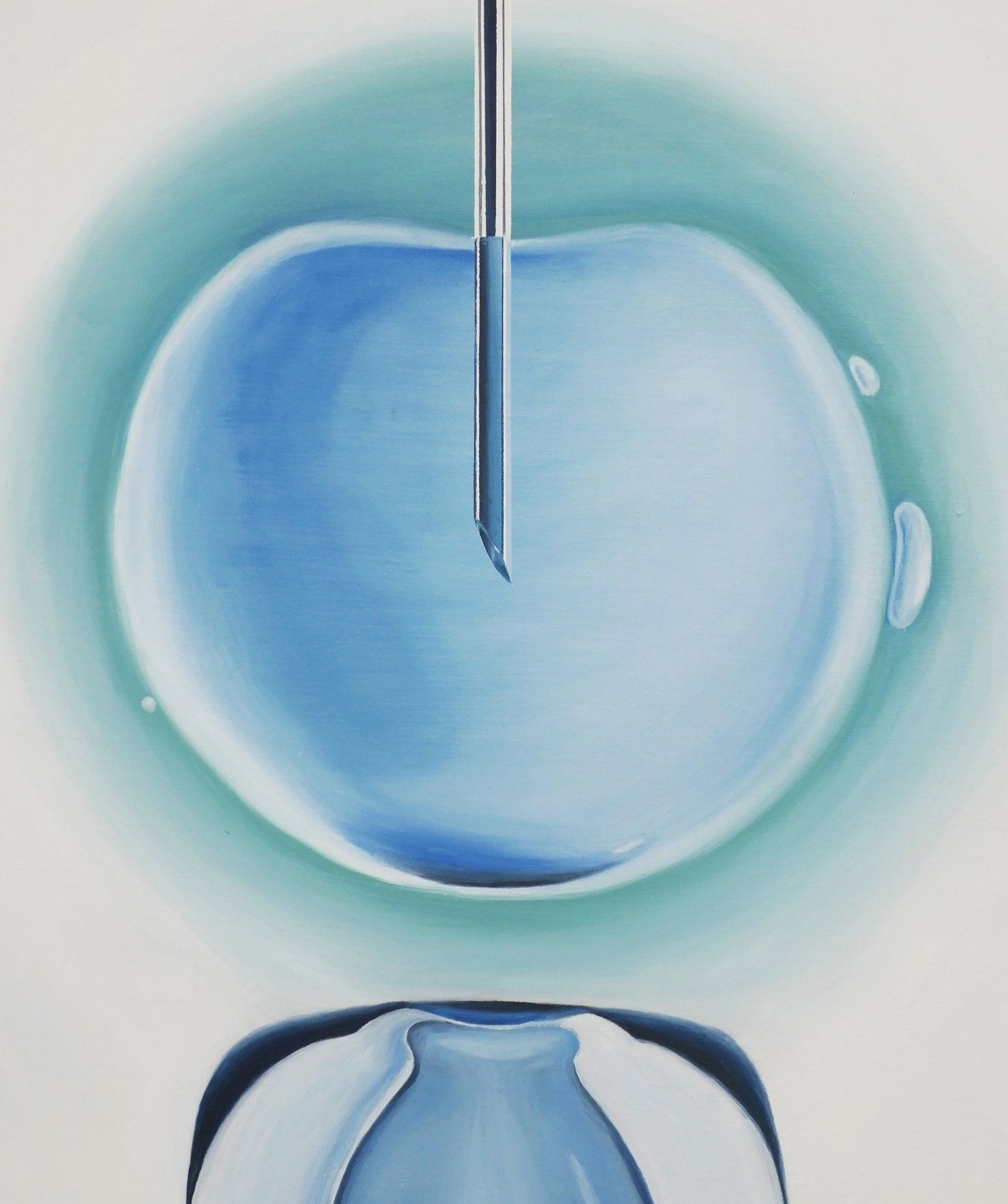
This is why the painting connects so directly to Tan Mu's earlier work IVF (2020). Both paintings examine the moment when technology intervenes in the process of life at the cellular level. In IVF, the subject is the origin of life, the instant when a fertilized egg begins to divide and a new organism begins to form. In Dolly, the subject is the replication of life, the instant when a cell from an existing organism is reprogrammed to produce a new organism that is genetically identical to the old one. The two paintings form a pair, and Tan Mu has described them as such: "Together, the two works speak to each other. IVF invites viewers to reconsider how life begins, while Dolly challenges ideas of uniqueness and individuality." The conversation is not between two different subjects. It is between two different moments in the same process, the process by which technology extends its reach into the mechanisms of life and, in doing so, forces a reconsideration of what life is.
Gerhard Richter's Uncle Rudi (1965) is a painting of a photograph. The source image shows Richter's maternal uncle, Rudolf Schönfelder, a young man in a Wehrmacht uniform, smiling at the camera with an expression of unguarded pride. Richter painted the photograph in grayscale, then dragged a dry brush across the wet surface, smearing the image into a soft blur that leaves the figure recognizable but unsettled, present but unreachable. The blur in Richter's painting is not an effect. It is an argument about the relationship between painting and photography, between memory and documentation, between the person who existed and the image that remains. The photograph records what was there. The painting records what it feels like to look at the photograph, to know that the person in it is dead, that the uniform he wears belonged to an army that committed atrocities, that the smile on his face is the smile of a man who did not know what was coming. The blur is the distance between the image and the knowledge that surrounds it, and the distance cannot be closed.
The structural parallel with Tan Mu's Dolly is in the function of the blur. In Richter's painting, the blur marks the gap between the photographic record and the emotional truth of the subject. Uncle Rudi was a real person. The photograph proves it. But the photograph cannot convey what it means to be Richter, born in 1932, looking at an image of an uncle who served in the Nazi military, trying to reconcile the smiling young man in the picture with the history that surrounds him. The blur is the reconciliation that fails. In Tan Mu's painting, the blur marks the gap between the genetic record and the lived identity of the subject. Dolly was a real sheep. The DNA proves it. But the DNA cannot convey what it means to be Dolly, the first cloned mammal, the animal whose existence proved that individuality is not guaranteed by genetics, that the self is not encoded in the sequence of base pairs, that a copy is not the same as the original even when every cell in its body says it is. The blur is the identity that cannot be resolved. Richter's uncle and Tan Mu's sheep are different subjects, but they occupy the same formal space: the space between the record and the life, between what can be documented and what can only be felt, between the sharp edges of fact and the soft dissolution of memory.
Li Yizhuo, writing about Tan Mu's practice in 2025, identifies the philosophical framework that governs works like Dolly. Tan Mu's method, Li argues, aligns with the Chinese philosophical principle of ge wu zhi zhi, investigating things to extend knowledge, "examining and discerning objects of various scales and conditions." The principle is not merely descriptive. It is methodological. To investigate a thing is to look at it closely, to understand its structure, its history, its relationships to other things, and to allow that understanding to extend outward into larger questions. Dolly is an investigation of this kind. It begins with a specific sheep, born on a specific date, produced by a specific scientific procedure. It extends outward into questions about identity, consciousness, memory, and the relationship between the biological and the technological. The painting does not illustrate these questions. It enacts the investigation that produces them, and the blur at the center of the canvas is the mark of an inquiry that has reached the limit of what can be seen clearly and has chosen to represent that limit rather than pretend it does not exist.
Li also observes that Tan Mu's canvases "do not aim at diagnosing the modern spectacles from a distance. They conjure up a kind of vitality and depth of their own." The observation is precise, and Dolly is the work where this vitality is most surprising. A cloned sheep, rendered in grayscale, blurred at the edges, emerging from darkness, should feel cold. It should feel like a scientific illustration, a diagram of a process, a document of a procedure. It does not. The sheep's eyes meet the viewer's gaze with an expression that is difficult to name but impossible to ignore. The warmth in the face, the softness of the brushwork around the muzzle, the way the light catches the curve of the head, all of these produce an effect that is closer to tenderness than to documentation. The painting does not look at Dolly from the outside, as a specimen. It looks at Dolly from the inside, as a presence, a being whose existence was unprecedented and whose life was real. The blur does not obscure the sheep. It protects her, holding her at the edge of visibility where she can be seen without being reduced to a fact.
The gaze is the painting's most important detail. In most of Tan Mu's works, the subjects do not look back. The submarine cables, the circuit boards, the cellular structures, the planetary bodies, all of these are objects of observation, not participants in it. Dolly is different. The sheep looks at the viewer, and the viewer looks back, and the exchange is unsettling in a way that the painting's formal restraint makes more powerful, not less. The gaze says: I was here. I was alive. I was not a procedure. I was not a result. I was a sheep, and I looked at the people who made me, and I looked at the people who came to see me, and now I am looking at you. The blur does not diminish this gaze. It intensifies it, because the gaze is the one part of the painting that is sharp, the one point where the focus holds, the one element that refuses to dissolve into the darkness that surrounds it. The sheep is fading, but the eyes are not, and the eyes are where the self resides.