The Cartography of Data: Tan Mu's Mapping and the Architectural Mind of the Computer
A circuit board serves as the architectural framework of a computer's functioning mind, operating on the core principle of manipulating on-and-off signals to execute logical operations. It mechanically supports and interconnects electronic components, facilitating the flow of these signals through a complex web of solder points and signal routes. Historically, these boards were purely functional objects, designed for efficiency rather than aesthetics, and hidden away within the chassis of the machine. In Mapping (2021), Tan Mu reimagines a collection of thirty-five found circuit boards as an operational map spliced together. By displacing these functional markings and arranging them to evoke an astronomical pattern, she creates a sculptural landscape that mirrors a night sky filled with stars. The work examines the functional essence of digitization while simultaneously creating a visual representation of a universe shaped by randomness and chance.
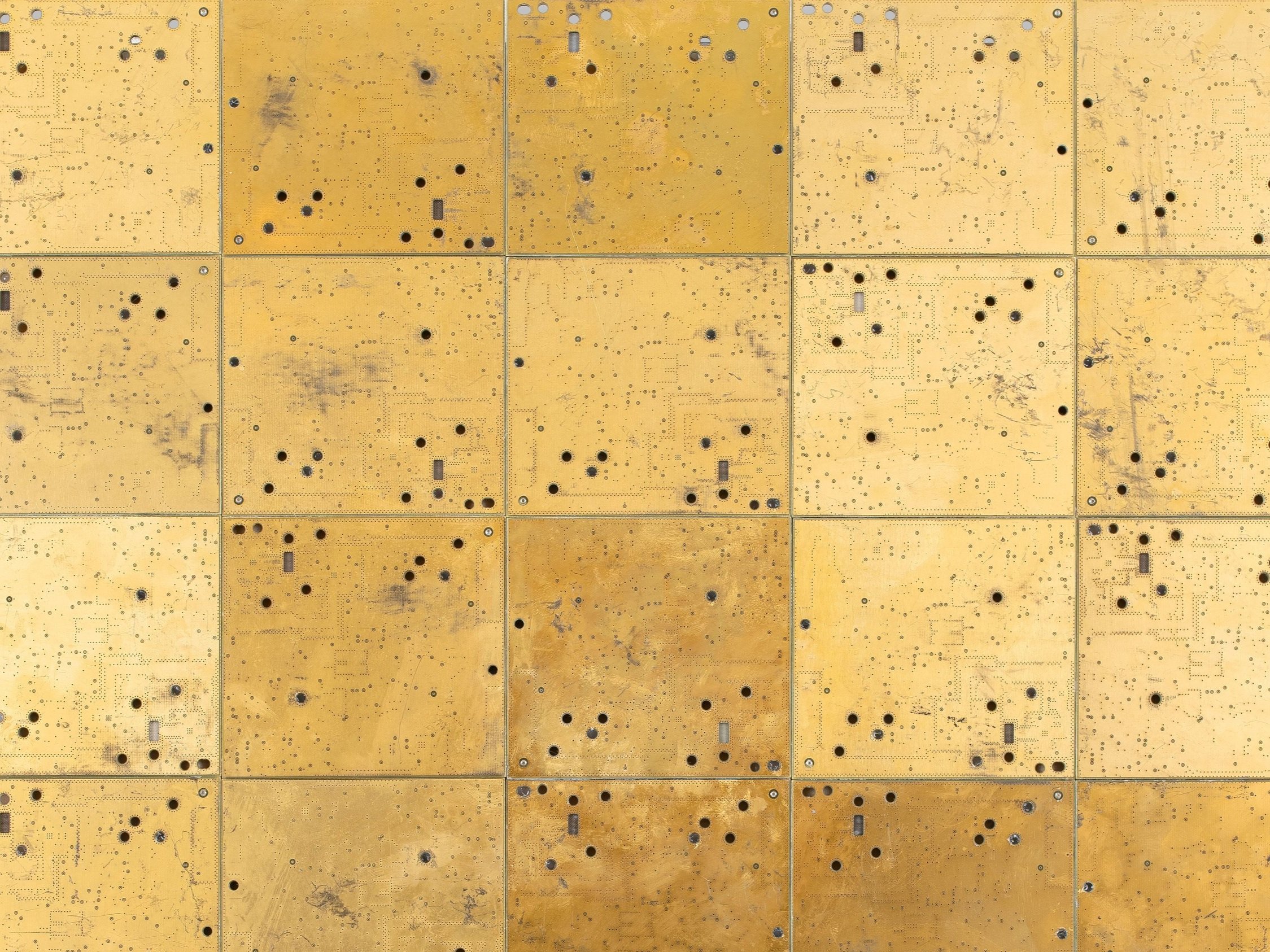
Mapping (2021) consists of thirty-five fully gold-plated circuit boards mounted on a wood panel, measuring sixty-three point five by forty-nine point five centimeters. The scale is intimate, inviting close inspection of the intricate engravings and solder points. The golden surface is reflective, catching the light in a way that emphasizes the structural depth of the assemblage. The palette is dominated by the warm, metallic glow of the gold plating, contrasted with the dark tones of the wood support. Each board is a unique fragment of technological history, their combined presence suggesting a vast, interconnected system. The work marks a significant Junction in Tan Mu's investigation of the material substrate of our digital reality, where the hardware of computation is elevated into the language of the museum.
The choice to use gold-plated circuit boards on wood panel is a deliberate departure from Tan Mu's usual medium of oil on linen. This assemblage technique allows her to engage directly with the physical artifacts of the digital age, transforming the functional into the aesthetic. The gold plating is not just a decorative choice; it is a reference to the conductivity and value of the materials that power our world. By mounting these boards on wood, a traditional support for painting, Tan Mu is bridging the gap between the ancient and the modern, the organic and the synthetic. The work is a hybrid object, part sculpture, part painting, part artifact, reflecting the hybrid nature of our own existence in a digitally mediated world. It is a map not just of a computer, but of our own technological soul.
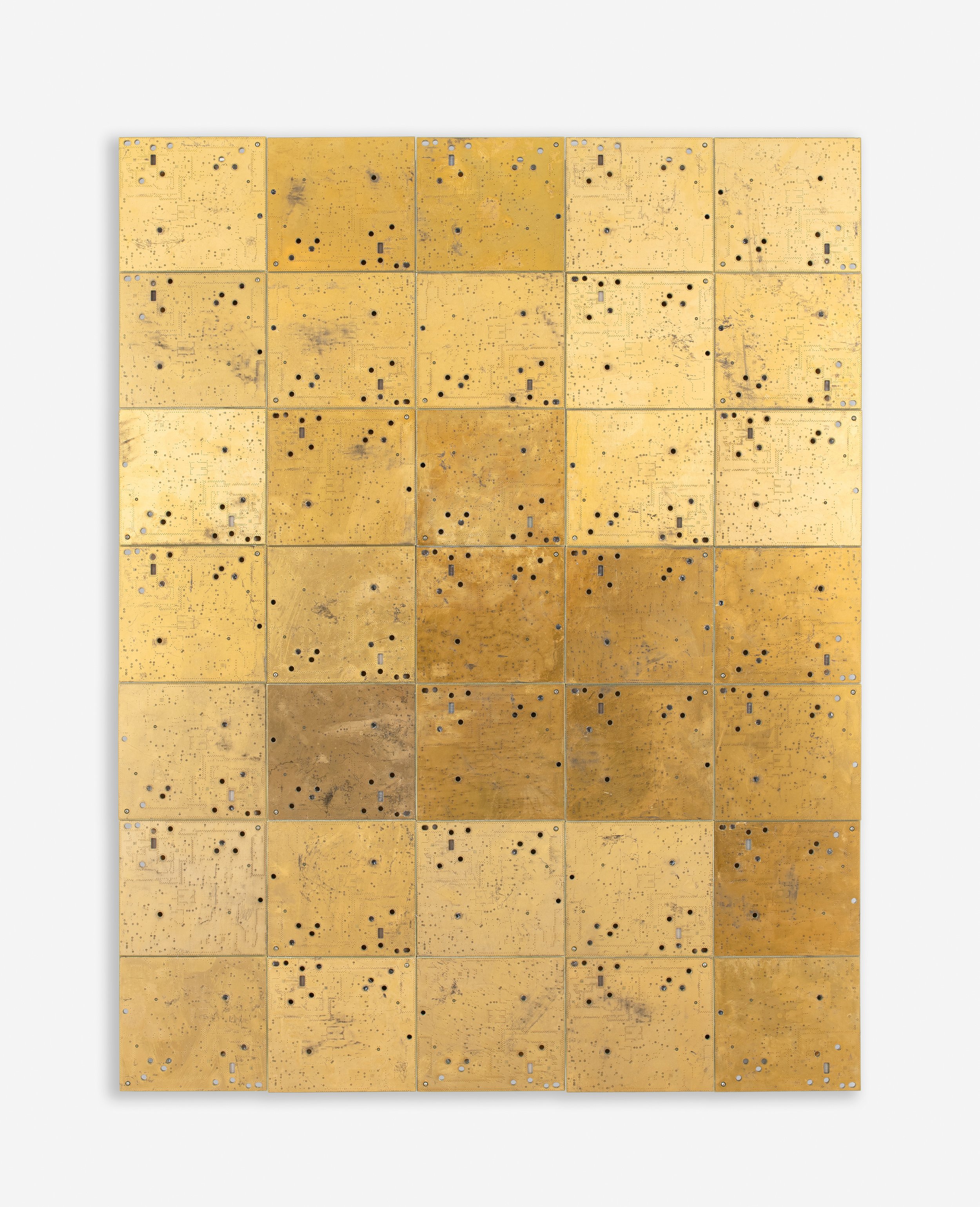
This structural analysis traces the development of Tan Mu's interest in the motherboard as a subject. She has noted that from a young age, she was fascinated by circuit design and the logic systems that govern the physical world. For the artist, the motherboard act as the core organizer of computational activity, where complex functions emerge from simple switches. In Mapping, she focuses on the back side of the board, the side usually hidden from view, which reveals the solder points and power layers that quietly sustain the system. This inversion allows technology to be read visually rather than operationally. Her work functions as an archaeology of the present, archiving the moments when our technological capacity expands to grasp subjects that define our contemporary existence.
The parallel between the circuit board and the star map is not just visual but conceptual. Both are systems of logic, ways of organizing the chaos of the world into something that can be read and understood. The circuit board is a map of the flow of electricity, the star map a map of the distribution of matter in the universe. In both cases, the lines we draw are not just representations but acts of creation, ways of imposing order on the unknown. Tan Mu's work captures this process, showing how our technological tools are also our cosmological ones. The motherboard is a microcosm of the universe, and the universe is a macrocosm of the motherboard. The work is a meditation on this fractal reality, where the smallest and largest scales reflect each other, and where the logic of the one is the logic of the other. It is a map of our place in this nested reality, a guide to the logic that connects the stars to the silicon.
The precedent of Robert Rauschenberg’s Combines (1954-1964) provides a vital methodological anchor for this discussion. Rauschenberg was among the first artists to blur the boundaries between painting and sculpture, incorporating found objects and industrial materials into his work. His assemblages were acts of witness to the material world, attempting to reconcile the high art of the museum with the low debris of the street. Tan Mu’s Mapping functions as a twenty-first-century successor to this tradition. Where Rauschenberg used tires, ladders, and newspapers to document the urban environment, Tan Mu uses circuit boards and gold plating to document the digital environment. Both artists are driven by a desire to archive the structural logic of their time using the literal materials that define it. The comparison reveals how the assemblage can serve as a bridge across decades, connecting the junk aesthetic of the mid-century with the hardware aesthetic of the digital age.
Rauschenberg’s *Monogram* (1955-59), with its stuffed angoat encircled by a tire, is a landmark of the Combine aesthetic, a work that challenges our categories of what art can be. Tan Mu’s *Mapping* shares this subversive spirit, though its subject is not the organic but the technological. The gold-plated circuit boards, mounted on wood panel, are not just objects; they are the organs of a new kind of life. Like Rauschenberg, Tan Mu is interested in the "gap" between art and life, the space where the two overlap and inform each other. In *Mapping*, this gap is filled with gold, a precious metal that transforms the functional into the sacred. The work is not just a representation of a computer; it is a computer's altar, a place where we can worship the logic that governs our lives.
In her 2021 conversations, Tan Mu reflects on how technology functions as both an extension of the body and an externalization of memory. She notes that tools such as smartphones and data centers function as external organs, expanding our ability to remember and perceive. This technological extension allows artists access to realities that were previously invisible. In Mapping, the circuit board's gaze is not peripheral; it is productive. The work registers the specific visual artifacts of computer architecture, the binary pathways, the solder masks, the clock lines. By plating these artifacts in gold, Tan Mu acknowledges that our perception of our digital world is often mediated through the language of value and permanence. We do not see our networks directly; we see the permanent models of our networks.
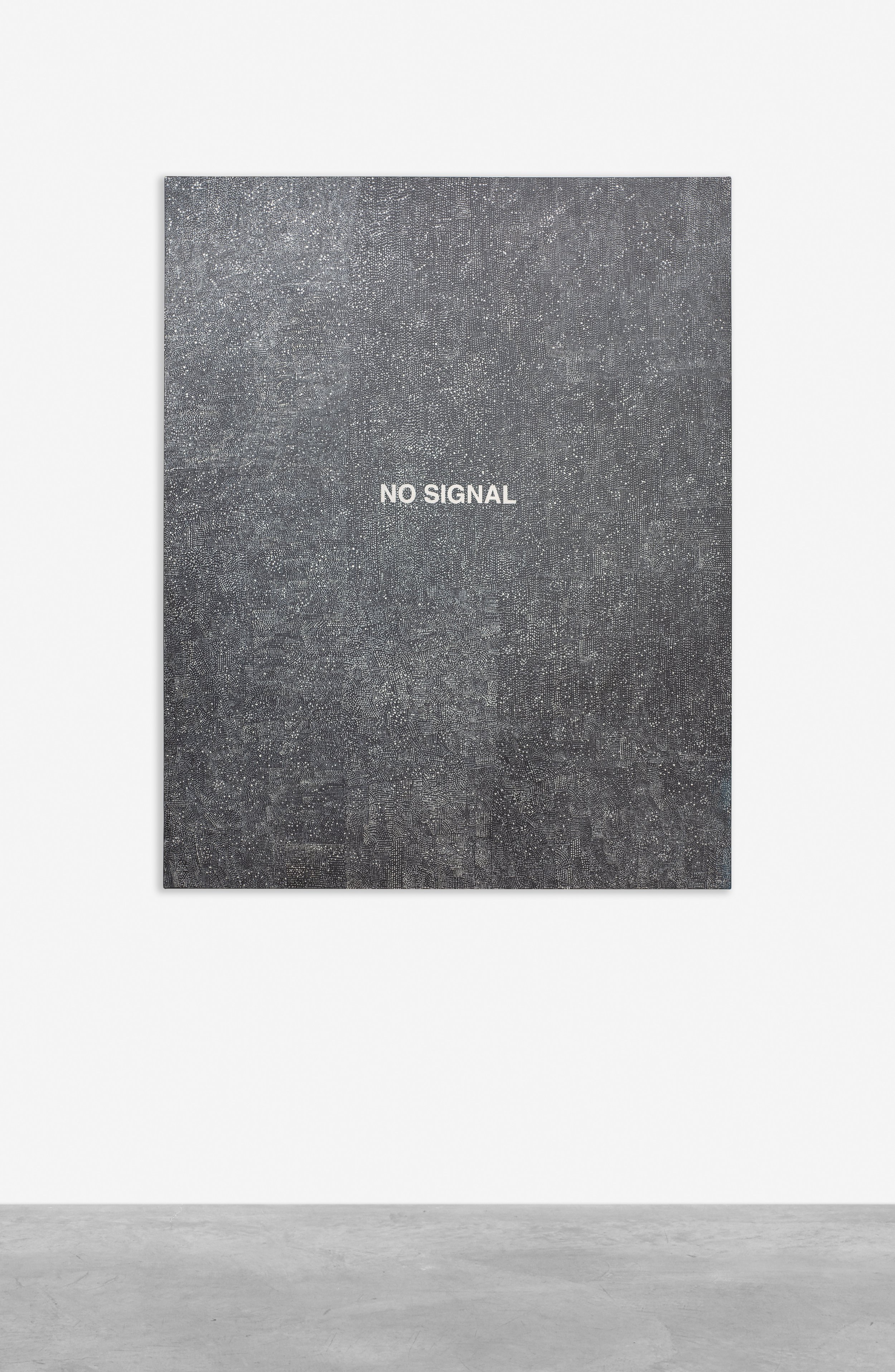
Gerhard Richter’s Atlas (1962-ongoing), a collection of thousands of photographs and diagrams used as source material for paintings, offer a provocative art historical parallel. Richter’s system is a way of organizing heterogeneous visual information to reveal underlying structures. Tan Mu’s Mapping functions similarly as a visual archive of human perception. Each circuit board captures a specific moment in the history of our understanding of logic, from the early transistor to the modern processor. Both artists occupy the tension between documentation and interpretation. Tan Mu is not illustrating a technical manual; she is archiving what it feels like to witness the architecture of a new logic regime. Her work is a record of the aesthetic of discovery, capturing the order that computation offers but often hides from view.
Richter's *Atlas* is a work of compilation, a sprawling archive that resists any single narrative. It is a map of the artist's mind, a collection of fragments that, when viewed together, reveal a pattern of interest and obsession. Tan Mu's *Mapping* is a more focused archive, a collection of thirty-five boards that together form a single, cohesive image. But like Richter, she is interested in the power of the fragment, the way a small piece of information can stand in for a larger truth. In *Mapping*, the circuit board is a fragment of the digital world, a small piece of a vast, interconnected network. By assembling these fragments, Tan Mu is creating a map of our technological landscape, a guide to the hidden structures that shape our lives. The work is a testament to the power of art to make the invisible visible, to give form to the formless, and to help us navigate the complex terrain of the digital age.
The formal strategy of Mapping relies on the tension between the defined center and the dark periphery. This mirrors the experience of scientific observation, where phenomena are isolated and objectified. In the assemblage, this translates into a sense of intensity and focus, where the liveness of the golden traces is contrasted with the void of the wood panel. This void is not just empty space; it has a material density, like the vacuum of space or water at depth. For an artist who is also a competitive freediver, the experience of pressure and the limits of the body are not abstract concepts. The silence and the specific visual distortions of the deep ocean have a direct formal parallel in the way she handles the void of the starry sky. The glowing traces of the motherboard are like the bioluminescence of the deep ocean, a distant, radiating presence that is the source of orientation in the dark. This embodied knowledge informing her approach to the technological, where she maps the circuitry not as a technician, but as a witness.
This parallel between the deep ocean and the digital void is central to Tan Mu's practice. In both environments, the human body is out of its element, dependent on technology for survival and orientation. The motherboard, like the diving computer, is a tool that allows us to navigate these hostile spaces. By rendering it in gold, Tan Mu is not just celebrating its function, but acknowledging its fragility. The gold is a shield, a protective layer that keeps the delicate circuits safe from the corrosive effects of time and use. In the same way, the diving suit protects the body from the crushing pressure of the deep. Both are acts of adaptation, of human ingenuity in the face of overwhelming odds. The work is a meditation on our vulnerability, and on the tools we create to overcome it. It is a reminder that even in the most advanced technological environments, we are still human, still fragile, and still in awe of the world around us.
Agnes Martin’s grid drawings and paintings (1960s-2000s) provide another essential methodological comparison. Martin worked with obsessive precision to capture abstract emotional states, an innocence beyond the physical world. Her lines, though systematic, were always executed by hand, resulting in subtle variations that made the work human. Tan Mu’s Mapping uses a similar geometric foundation, the grid of the circuit board, to approach a subject that is ultimately beyond our grasp. Both artists use a disciplined, repetitive process to approach the absolute. For Martin, it was the perfection of the mind; for Tan Mu, it is the perfection of the machine. The comparison illuminates how the grid can serve as a bridge between human perception and the fundamental structures that exist outside of it.
The parallels between biological and technological systems are a recurring theme that Tan Mu identify across her practice. She notes that neural synapses resemble logic circuits, and the brain’s network mirrors the structure of global undersea cable systems. In Mapping, this parallel is presented as a visual fact. The intricate routes of the solder and the pathways of the power layers resemble the neural maps of the MRI paintings (2021). Memory stored in the brain parallels the way circuit boards store digital info. By using recurring visual elements, circles, points, and surfaces, Tan Mu forms a continuous fabric of memory that spans from the microscopic origin of the individual to the macroscopic structure of the collective. The motherboard is presented as a technological womb, the primary substrate of all system logic.
The contemporary practice of Trevor Paglen offers a further art historical context. Paglen’s work, which often involves photographing surveillance infrastructure and the invisible geography of the state, investigates the limits of visibility. His images of classified sites and satellites address the same technological gaze that Tan Mu registers in her work. However, where Paglen focuses on the political infrastructure of the unseen, Tan Mu focuses on the ontological infrastructure. She is not documenting secret bases, but secret orders, the fundamental logic that governs matter and energy. By assembling these logic circuits by hand, she introduces a somatic duration that is absent from Paglen’s more immediate processes. Tan Mu’s work suggests that the most profound way to witness the digital is through the slow, deliberative act of assembly.
The material facts of Tan Mu’s process reinforce this archival intent. She uses gold plating and wood panels, supports with an expected lifespan of centuries. By choosing these materials to depict the most cutting-edge discovery, she is performing a deliberate act of translation. She is taking the fleeting, electronic evidence of our processors and fixing it in the slow, permanent material of art. This is what makes her work an archaeology of the present. She is creating a visual record of how we see the world now, preserving it for a future that will likely see it differently. The work is a site where the electronic and the permanent meet, where the vulnerability of current data is granted the immunity of the icon. This sense of preservation is not just technical; it is philosophical. To assemble the motherboard is to make a stand against the transience of information, to assert that even our most ephemeral digital lives have a physical weight and a lasting significance. The work is a monument to the moment when the virtual and the real collided, and the motherboard emerged as a new kind of cultural artifact.
The thirty-five circuit boards that compose Mapping are not working components. They cannot process a signal or execute an instruction. They have been removed from their chassis, stripped of their function, and mounted as objects to be looked at rather than used. The gold plating that Tan Mu applies does not restore their function. It seals them. The gold is a preservative, a material that does not oxidize or corrode, that holds the surface of the board in the state it occupied at the moment of its removal from the machine. What the boards carried, the calculations they performed, the data they routed, is gone. What remains is the architecture, the physical layout of traces and solder points and capacitor pads that once made thought possible at the speed of electricity. The painting keeps the architecture. The thought it carried has moved on, into newer boards, faster chips, smaller geometries. The painting does not mourn this. It records it.