Genetic Witness: Kiki Smith, ORLAN, and Tan Mu's IVF at the Threshold of Life
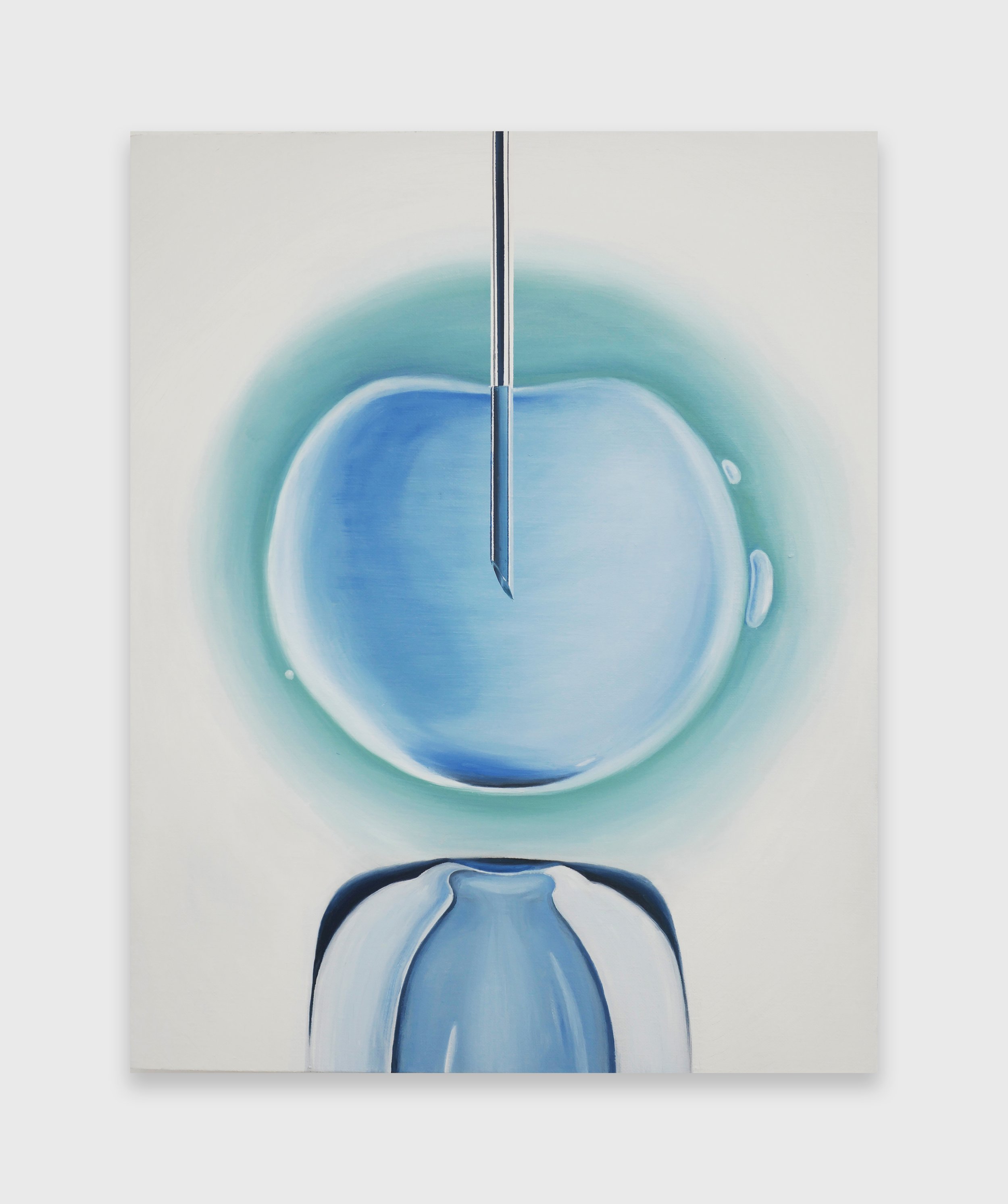
An egg cell is the largest single cell visible to the naked eye. A sperm cell requires three hundred times magnification to become legible. This asymmetry is a biological fact, but it is also a political one. The egg, spherical and inert, holds the entire future of a genetic lineage. The sperm, microscopic and mobile, is expendable by the billions. In the IVF clinic, this asymmetry is inverted. The egg must be retrieved surgically, through transvaginal ultrasound, sedation, and a needle guided through the vaginal wall. The sperm is collected, catalogued, and graded like merchandise. Donor profiles list education, eye color, family health history, and physical traits. The language of the clinic is the language of the catalog. And it is here, in the gap between biological asymmetry and technological inversion, that Tan Mu locates the emotional core of her painting IVF (2020). The needle forms, vertical and precise, are not surgical instruments. They are monuments to the weight of intervention. The circular cells, soft and vulnerable, are not diagrams. They are the earliest form of a life that may or may not be permitted to exist.
This tension between technological power and biological fragility has a long and charged history in contemporary art. When Kiki Smith began sculpting the female reproductive system in wax, plaster, and bronze in the early 1990s, the act was radical. To make the uterus, the ovaries, the fallopian tubes into objects of sustained artistic attention was to break a silence that had held for centuries. In Untitled (1992), a wax uterus hangs from a chain, its Fallopian tubes extended like the limbs of a creature in surrender. In Lying with the Wolf (2001), the female body is fused with an animal, suggesting a wildness that the clinical environment of the fertility clinic seeks to contain. Smith's work was not merely anatomical. It was a confrontation with the cultural politics of reproduction, a refusal to let the body's internal landscape remain invisible and unspoken. The reproductive organs were not medical specimens, they were sites of power, vulnerability, and desire. When Tan Mu paints the needle and the cell side by side in cool laboratory blues, she inherits this tradition of making the invisible visible, but she shifts the register from anatomy to technology. Smith gave form to the body's own structures. Tan Mu gives form to the instruments that now mediate between the body and its future.
Smith's Tattoo (1995), a sculpture of a female figure whose skin is inscribed with the markings of medical intervention, offers a particularly relevant precedent. The tattoo in that work is not decorative, it is diagnostic. It is the mark of a body that has been read, measured, and categorized by medical authority. Tan Mu's IVF enacts a similar logic of inscription. The needle in her painting is an instrument of marking, of making the cell legible to the clinical gaze. The contrast between the vertical needle and the rounded cell is not merely formal, it is the visual grammar of a system in which the body is both subject and object, both the thing being intervened upon and the thing being evaluated. Smith's figure endures the tattoo passively. Tan Mu's cells are not passive, they are potential, they are futures, but they are futures that exist under the authority of the instrument. This is the genealogy that connects Smith's feminist body sculptures to Tan Mu's technological painting: both artists insist that the body's reproductive landscape is a site of political and aesthetic significance, and both refuse to let it remain unmarked by the viewer's attention.
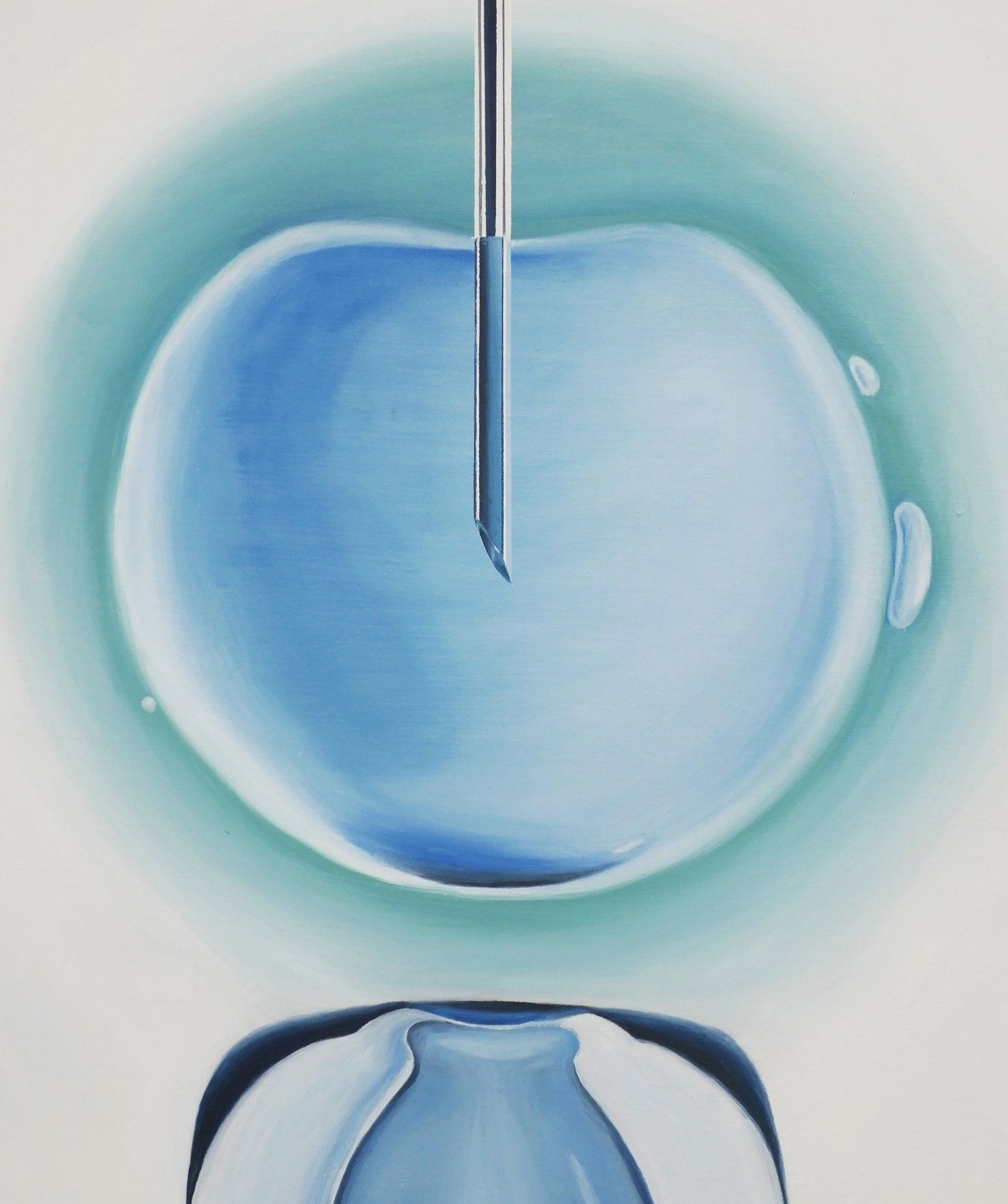
The physical presence of IVF (2020) is deliberately clinical. The dominant palette is cool blue, a color that Tan Mu associates with the laboratory, with sterility, with the fluorescent glow of an incubator. This is not the warm gold of her quantum computer paintings, nor the luminous black of the Signal series. Blue here functions as a temperature indicator. It registers the absence of warmth, the controlled environment in which the most intimate human processes are subjected to measurement, grading, and selection. The surface of the canvas is smooth, almost photographic in its precision, which distances the viewer from the subject. There is no impasto here, no gestural mark. The painting mirrors the clinical gaze that characterizes the IVF laboratory itself, a gaze that sees cells not as living things but as specimens to be evaluated. The composition places the needle forms vertically, rising from the lower edge of the canvas like architectural columns. Against them, the circular cells cluster in the upper register, their roundness softening the rigidity of the instrument. The contrast is not violent, it is structural. It is the contrast between what technology can do and what biology is.
ORLAN's The Reincarnation of Saint ORLAN (1990-1993) provides a crucial and more confrontational parallel. Over three years, ORLAN underwent nine cosmetic surgeries to reshape her face to resemble the idealized features of famous Western paintings, the forehead of the Mona Lisa, the chin of Venus from Botticelli's Birth of Venus (1485). The surgeries were performed in surgical costumes designed by top fashion houses. They were broadcast live to galleries and lecture halls. ORLAN called this work Carnal Art, and its premise was direct: if technology can alter the body, then the body is a medium, and the surgery is a performance. Where Kiki Smith worked with the body's own materials, wax and bronze and plaster, ORLAN worked with the body itself, as material and as spectacle. Tan Mu's IVF occupies a different position in this lineage. She does not perform surgery. She does not sculpt the body. She paints the threshold, the exact moment where biological reproduction becomes a technological act. The needle in her painting is not cutting flesh, it is approaching the cell. The painting captures the instant before intervention, the charged space where natural and engineered creation are about to become indistinguishable. This precision of timing is what distinguishes Tan Mu's approach from both Smith's embodied anatomies and ORLAN's performed surgeries. She is not representing the body or transforming it. She is documenting the hinge.
The ethical dimension of this documentation cannot be separated from the artistic one. In her 2025 conversation about the work, Tan Mu describes how her initial research into fertility and egg freezing led her to a broader awareness of genetic screening, embryo selection, and the emerging possibility of gene editing. She writes about how sperm banks present detailed donor profiles that resemble curated catalogs of idealized attributes, and how this immediately reminded her of Andrew Niccol's film Gattaca (1997), in which genetic stratification determines social class. This is not a casual reference. Gattaca is a cultural touchstone for anxieties about genetic optimization, and by invoking it, Tan Mu signals that her painting is not merely a depiction of a medical procedure. It is a meditation on the social consequences of the technologies that now surround the creation of life. The cool blue of the canvas, the sterile geometry of the composition, the contrast between needle and cell, all of these formal choices encode a specific ethical position. They register the tension between the hope that IVF technology offers to those who cannot conceive naturally and the risk that the same technology, extended beyond medical necessity, could create new forms of inequality.
Patricia Piccinini's The Young Family (2002), a silicone sculpture of a reclining creature with humanlike skin and animal features surrounded by nursing young, offers a further art historical context for the bioethical stakes of Tan Mu's work. Piccinini, an Australian artist, has spent two decades confronting the viewer with the material consequences of genetic engineering. Her sculptures are not monsters in the horror-film sense. They are tender, vulnerable, and deeply maternal. They ask a question that Tan Mu's IVF also asks: what do we owe to the life we create through technological means? In Piccinini's work, the answer is complicated by the realism of the sculpture. The creature's skin has pores. The young have fingernails. The specificity of the material forces the viewer into a relationship of empathy with beings that are not fully natural and not fully artificial. Tan Mu's painting, by contrast, maintains a greater distance. The cells in IVF are abstracted, their roundness smoothed into a geometric ideal. The needle is precise but not photographic. This abstraction is not a failure of realism, it is a deliberate choice. Tan Mu is not asking the viewer to empathize with a specific embryo. She is asking the viewer to confront the structural conditions under which embryos are now created, evaluated, and potentially discarded. The abstraction preserves the ethical complexity without resolving it into sentimentality.
Lennart Nilsson's photographic series A Child Is Born (1965) provides a second photographic counterpoint. Nilsson's images of embryos developing inside the uterus were among the first to make the internal landscape of human reproduction visible to the public. They were published in Life magazine and have been reproduced millions of times. They are beautiful, luminous, and deeply moving. They are also, in a sense, propaganda for the clinical gaze. They present the embryo as a miracle of nature, but they do so through the apparatus of medical imaging, through endoscopes and microscopes and flash photography. They aestheticize the biological process while simultaneously subjecting it to technological mediation. Tan Mu's IVF performs a similar double operation, but with a critical awareness that Nilsson's work lacks. She does not aestheticize the cell. She does not render it as a miracle. She renders it as a site of intervention, a thing that exists under the authority of the needle. The beauty in her painting, such as it is, comes not from the cell itself but from the tension between the cell and the instrument, between the biological and the technological, between what is given and what is made.
Donna Haraway's theoretical framework in A Cyborg Manifesto (1985) provides a philosophical lens for understanding the work's position within the broader discourse of technology and the body. Haraway argued that the boundary between organism and machine, between nature and artifact, had already collapsed. The cyborg was not a figure of science fiction, it was a description of contemporary reality. We were already, in Haraway's terms, chimeras, hybrids of biological and technological systems. Tan Mu's IVF is a painting of this collapse in its most intimate register. The IVF embryo is not a product of nature alone. It is not a product of technology alone. It is a hybrid, born at the intersection of biological potential and clinical precision. By painting this hybridity, Tan Mu does what Haraway's theoretical text cannot: she gives it visual form. The needle and the cell are not opposed. They are co-constitutive. The needle makes the cell possible. The cell gives the needle purpose. This mutual dependence is the visual grammar of the painting, and it is also the ethical condition of reproductive technology in the twenty-first century.
What distinguishes Tan Mu's approach from the broader tradition of medical imagery in art is her refusal of both beauty and horror. The history of depicting reproductive technology in visual culture tends toward one of two poles: the sanitized beauty of medical illustration, with its clean lines and luminous surfaces, or the horror of body horror cinema, with its viscous fluids and violating instruments. Tan Mu avoids both. Her painting is precise without being clinical, and it is unsettling without being grotesque. The cool blue palette creates a mood of controlled intensity, a visual temperature that matches the emotional reality of the IVF waiting room. The needle is sharp, but it does not threaten. The cell is soft, but it does not comfort. The painting holds the viewer in a state of suspended judgment, neither celebrating the technology nor condemning it. This is the ethical generosity of the work. It trusts the viewer to sit with the complexity, to feel the tension between hope and risk, between the clinic's promise of life and its implicit reduction of life to a product to be optimized. The painting is an archive of this suspended moment, a record of what it feels like to witness the creation of a human being become a medical procedure.
The specific scale asymmetry that Tan Mu identified in her interview, the fact that an egg is the largest single cell visible to the naked eye while sperm requires three hundred times magnification to become legible, is not merely a biological curiosity. It is the foundation of the painting's visual logic. In the composition, the rounded forms of the egg dominate. They are larger, more present, more materially substantial than the needle forms. This reversal of the usual hierarchy of the clinic, where the needle is the active agent and the cell is the passive substrate, is the painting's quiet radicalism. Tan Mu does not paint the cell as a victim of the needle. She paints it as a protagonist, a form with its own gravity and weight. The needle, by contrast, is thin, precise, and ultimately dependent on the cell for its purpose. Without the egg, the needle has no function. This mutual dependence is the painting's deepest insight, and it is what elevates the work beyond mere illustration of a medical procedure.
In the context of Tan Mu's broader practice, IVF (2020) functions as a foundational work, one that establishes the ethical and visual grammar that later paintings would expand. The needle and cell motif resurfaces in Embryo (2022), where the cells have developed into recognizable embryonic forms, and in Chromosomes (2022), where the genetic material itself becomes the subject. The cool blue of IVF is not abandoned in these later works, but it is joined by other temperatures, the warm gold of quantum infrastructure, the luminous black of submarine cables. Each color registers a different relationship between the body and the technology that now surrounds it. The blue of the IVF clinic is the color of controlled environments, of laboratories where the natural world is subjected to measurement. The gold of the cryostat is the color of aspiration, of the race toward computational supremacy. The black of the Signal paintings is the color of the deep ocean, of the infrastructure that connects continents. Tan Mu's palette is not decorative, it is diagnostic. It tells the viewer what kind of encounter they are having with the technology depicted. And in IVF, the message is clear: this is the encounter at the threshold, where life begins not in darkness and warmth, but in light and measurement and the quiet hum of an incubator.
The lineage from Kiki Smith to Tan Mu is not a direct inheritance but a generational shift. Smith worked in the 1990s, at a moment when reproductive rights were being contested in the public sphere and when feminist artists were reclaiming the body as a site of political and aesthetic agency. Her uteruses and Fallopian tubes were acts of defiance against a culture that preferred not to see them. Tan Mu works in a different moment, one in which the body has already been seen, measured, and subjected to technological protocols. The question is no longer whether to make the body visible, but what happens after visibility has been achieved. The IVF embryo is not invisible. It is photographed, graded, catalogued, and selected. It is the most visible form of human life, seen through microscopes and displayed on monitors. Tan Mu's painting does not make the embryo visible. It makes the conditions of that visibility legible. It shows the viewer not just the cell, but the needle that approaches it, the cool light that illuminates it, the clinical apparatus that surrounds it. This is the difference between Smith's project and Tan Mu's. Smith broke the silence. Tan Mu documents the noise.
In the end, IVF (2020) is a painting about the difference between making and creating. The IVF laboratory makes embryos. It selects, grades, and evaluates them. It applies standards and protocols. It produces outcomes. But creation, in the sense that artists and parents understand it, is something different. It is the emergence of something that was not there before, something that cannot be fully controlled or predicted. Tan Mu's painting holds both of these meanings in tension. The needle makes. The cell creates. The painting witnesses both. It is a record of the moment when the boundary between engineering and genesis dissolves, when the question of what it means to create a human being becomes a question that technology and art must answer together.