The Weight of White: Monochrome, Crisis, and the Material Record in Tan Mu's Isolation
The Jacob K. Javits Convention Center was built to host trade shows. Its 840,000 square feet of floor space had accommodated the International Auto Show, Art Fair, Functional Fabric Fair, and the Cannabis World Congress and Business Expo. In March 2020, in the space of eleven days, it became a hospital. The transformation was not architectural, there were no walls built, no rooms constructed. Instead, white curtains on rolling metal frames were erected across the cavernous floor, creating individual units of isolation within the open volume. The building did not change. Its function was simply overwritten. The same concrete floor that had supported automobile displays now held hospital beds. The same steel trusses that had suspended trade show banners now held fluorescent lights aimed at patients who might never leave. This is the subject of Tan Mu's painting Isolation (2020), but to call it a subject is already to misrepresent the work's ambition. The painting does not depict the Javits Center. It performs a material operation. It takes oil paint and linen and subjects them to the same logic of functional displacement that transformed the convention center. The monochrome palette is not a stylistic choice, it is a surgical one. By removing color, Tan Mu removes the painting from the domain of representation and places it in the domain of record. This is not a painting of a place. It is a painting that enacts the material conditions under which the place was experienced.
This displacement of function through material means has a specific history in contemporary painting. When Gerhard Richter began his October 18, 1977 series (1988), a cycle of fifteen paintings based on press photographs of the Baader-Meinhof group, he made a series of deliberate material decisions. The photographs were blurred through overpainting, the surfaces were scraped and scraped again, and the palette was reduced to gray and black. The effect was not documentary. Richter was not illustrating the events, he was processing them through the material of paint. Each layer of overpainting was a layer of temporal distance. Each scrape of the palette knife was an act of forgetting and remembering simultaneously. The paintings did not depict the deaths of the RAF members, they enacted the cultural process by which those deaths were absorbed into German collective memory. Tan Mu's Isolation operates on a similar principle. The monochrome is not absence, it is a material decision that places the painting at a specific distance from its subject. The black and white does not erase the color of the Javits Center, it transposes the emotional register from observation to memory. The painting remembers the place not as it was, but as it was felt.
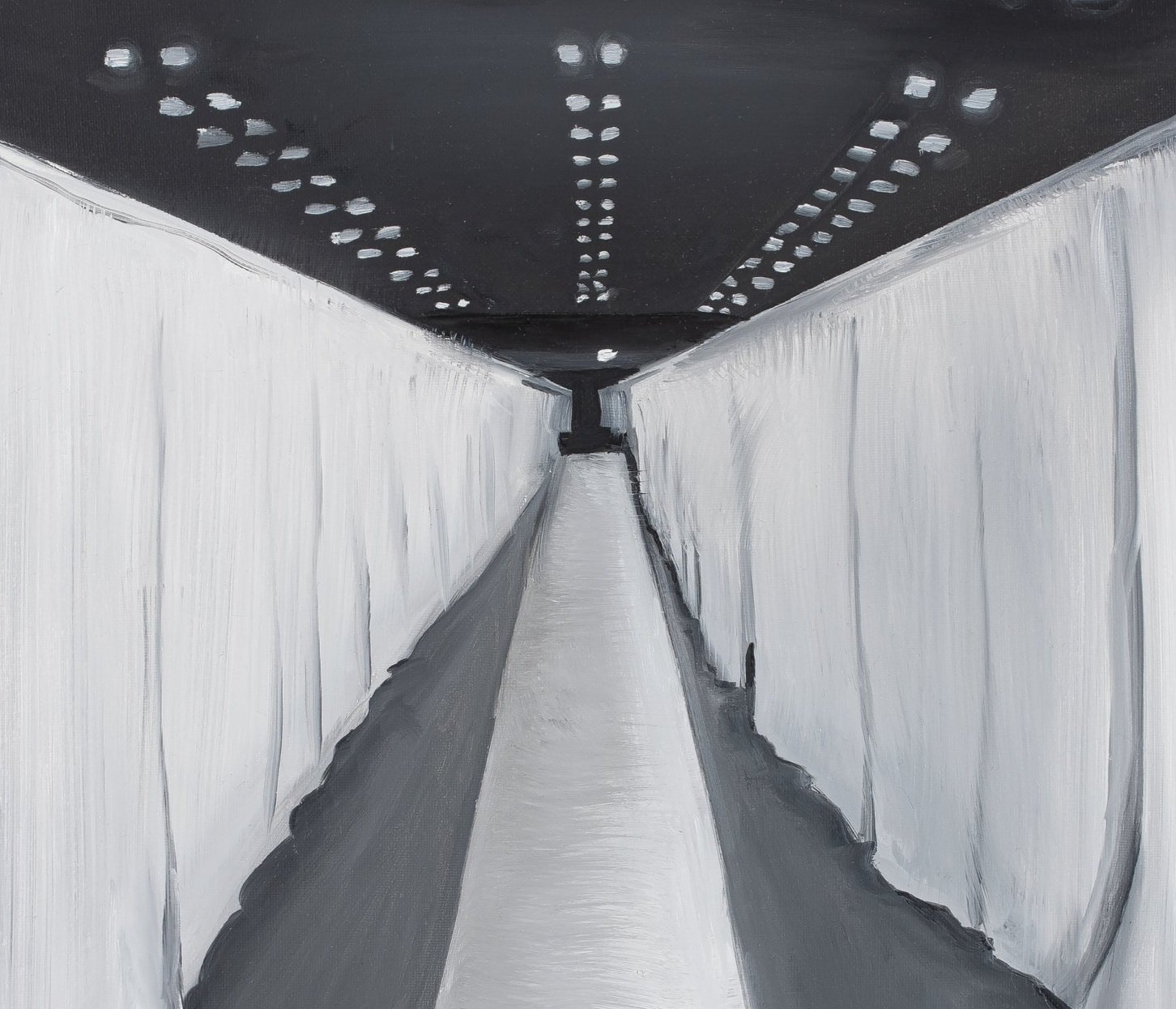
The physical dimensions of Isolation are fifty-one by sixty-one centimeters, oil on linen. The scale is deliberate. It is not monumental, it is not intimate. It occupies the middle register of human attention, the scale of a window, a mirror, a screen. The linen substrate is visible at the edges of the composition where the paint thins, its warm beige surface showing through the monochrome overpainting. This is a material fact that matters. Linen, woven from flax fiber, has a specific texture, a visible weave pattern that gives the surface a subtle grid. When Tan Mu applies black and white oil paint over this grid, the weave pattern persists, creating a subliminal structure beneath the image. The viewer does not see the linen directly, but they feel its presence as a kind of resistance to the smoothness of the painted surface. This resistance is the material signature of the work. It is the grain of the substrate asserting itself against the image, just as the memory of the convention center's original function asserts itself against the medical conversion. The painting's surface is thus a palimpsest, a layered record in which the material substrate (linen) and the painted image (the hospital) coexist without fully resolving into one another.
Robert Ryman's decades-long investigation of white paint on canvas provides a crucial framework for understanding the material intelligence at work in Isolation. Ryman, who painted almost exclusively in white from the late 1950s until his death in 2019, spent his career demonstrating that white is not nothing. In works like Classico VI (1987) and Surface Veil I (1970), Ryman used different whites, zinc white, titanium white, lead white, applied with different tools, brushes, knives, fingers, on different supports, canvas, fiberglass, steel. Each combination produced a different white. Some were warm. Some were cool. Some were opaque. Some were translucent. The point was never to reduce painting to a single color. The point was to demonstrate that material specificity, the exact interaction of pigment, binder, support, and application method, is the irreducible content of painting. Tan Mu's Isolation inherits this material consciousness. The white curtains in the painting are not uniform. They are painted with varying thicknesses of titanium white over a gray ground, and the resulting whites are layered and tonal. Some curtains catch the fluorescent light and appear bright, almost blue white. Others recede into the shadows and appear warm, almost cream. This variation is not naturalistic, it is material. It is the result of specific paint mixtures applied in specific ways to a specific support. The painting registers not just the white of the curtains, but the white as it is produced by the interaction of pigment and linen.
The composition of Isolation is built around a central corridor. White curtains on both the left and right sides of the frame create a narrow channel that recedes toward a vanishing point at the center of the image. This vanishing point is black, not the deep, luminous black of the Signal paintings, but a flat, absorptive black, the black of a space where light does not return. The corridor is empty. There are no figures, no beds, no medical equipment. The absence is not documentary, the Javits Center temporary hospital was full of people. The absence is formal and strategic. By removing all human presence, Tan Mu forces the viewer into the position of the corridor itself, looking forward into the dark, unable to see what is at the end. This compositional strategy has precedents in the history of monochrome painting. Luc Tuymans's Gaskamer (1986), a small painting of the interior of a gas chamber at Dachau, uses a similar technique of compositional emptiness. The room is depicted without figures. The walls are pale. The ceiling is low. The absence of people is not comforting, it is devastating. It is the absence that makes the space speak. Tuymans described his monochrome palette as a way of making the image feel "already gone," as if it were a memory that had faded to gray. Tan Mu's corridor operates on the same principle. It is not a painting of a hospital. It is a painting of the memory of a hospital, one that has been stripped of its specific details and reduced to its essential spatial structure.
The material process behind Isolation involves a specific sequence of operations that encode the temporal logic of the pandemic. Tan Mu has described her monochrome paintings as being built through layers of thin oil paint applied over several sessions, each layer drying before the next is applied. This is a slow process. Oil paint dries through oxidation, not evaporation, and each layer can take days to cure. The painting thus accumulates time as it accumulates surface. Each layer is a day, a week, a session in the studio during the lockdown. The final surface is a compressed record of this duration, a material timeline that is invisible to the viewer but constitutive of the work's presence. This accumulation of thin layers has a specific optical effect. The light that enters the paint surface is partially absorbed by each layer and partially reflected back, creating a sense of depth within the flat field. The monochrome is not flat. It is shallow, but it has volume. This optical depth is the material equivalent of the emotional depth of isolation. The experience of confinement was not one-dimensional. It was layered, accumulative, and its effects were felt not at the surface but within the body, slowly, over time. Tan Mu's painting process mirrors this temporality. The work is not immediate. It is built.
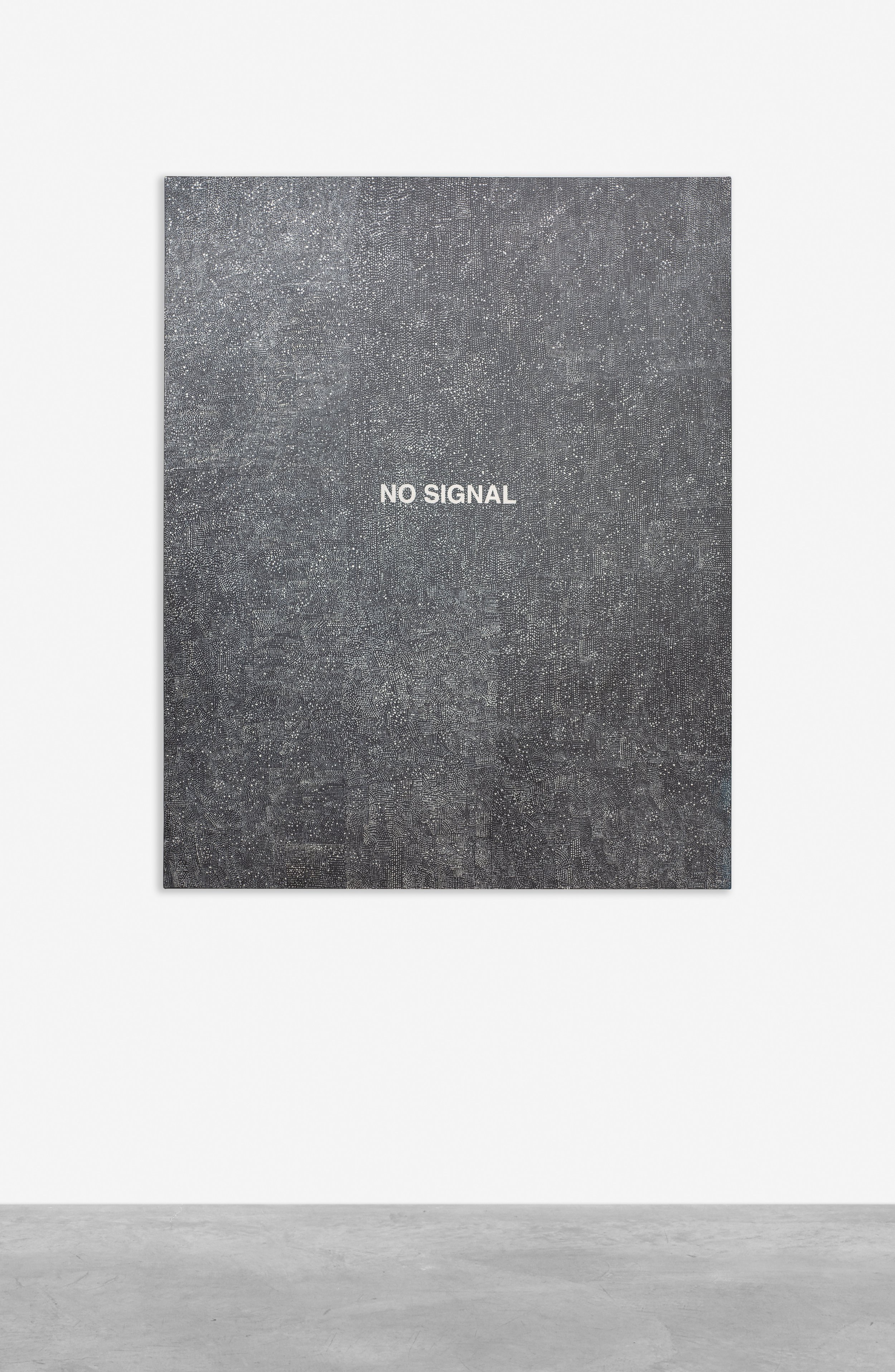
The relationship between Isolation and the broader corpus of Tan Mu's monochrome paintings is worth examining through the lens of material strategy. In her 2021 conversation, Tan Mu describes how she uses black and white differently across her practice. In works depicting space and technology, such as No Signal (2019), which renders the visual static of a lost television signal, or DEC's PDP-10 (2021), which depicts a milestone computer, the monochrome reflects the technical origins of the imagery. In nuclear works like Bikini Atoll (2020) and Trinity Testing (2020), which draw from archival documentation of atomic experiments, the monochrome reinforces the gravity and severity of the historical moment. In pandemic works like Isolation, the monochrome serves a different function. It is not technical and it is not gravely historical. It is atmospheric. The black and white creates a mood, a feeling tone that matches the emotional reality of confinement. The viewer does not need to know about the Javits Center to feel the weight of the painting. The monochrome carries that weight through its material presence, through the density of the paint, the emptiness of the corridor, the absorptive black at the center. This is the versatility of monochrome in Tan Mu's practice. It is not a single method, it is a material vocabulary that adapts to the specific emotional and conceptual demands of each subject.
Anish Kapoor's Void Field (1989), a room filled with sandstone blocks each containing a cavity painted with his signature Vantablack-absorbing pigment, offers a sculptural parallel to the vanishing point in Tan Mu's composition. Kapoor's voids are not empty spaces. They are materially dense, each block weighing several hundred kilograms, yet the pigment absorbs so much light that the cavities appear to be holes in reality. The viewer experiences a vertigo of perception, the body registers the weight of the stone while the eye registers the absence of light. Tan Mu's central corridor in Isolation produces a similar perceptual tension. The vanishing point is painted in a flat, matte black that absorbs light without reflection, creating a visual terminus, a place where sight fails. But this terminus is framed by the white curtains, which are painted with enough surface variation to catch and reflect light. The contrast between the reflective white and the absorptive black is the painting's central material drama. It is the drama of a space that is simultaneously open (the corridor recedes) and closed (the corridor leads to nothing). This dual condition, the experience of looking forward and finding no destination, is the material truth of the pandemic lockdown.
The transition from the convention center to the hospital was not a renovation. It was a transposition. The same walls, the same floor, the same ceiling, repurposed for a different function. Tan Mu's painting enacts this transposition at the level of material. The oil paint and linen that could depict a trade show, a car, a fabric fair, are repurposed to depict an absence. The white that could be the white of a gallery wall becomes the white of a hospital curtain. The black that could be the black of a night sky becomes the black of a corridor that leads nowhere. The painting does not comment on this transposition. It performs it. The viewer is not told that the space has changed. They are shown what the change looks and feels like through the material properties of paint on linen. This is what distinguishes Tan Mu's approach from documentary photography, from journalism, from the news cycle that dominated the early months of the pandemic. Photography records what happened. Painting records what it felt like to be there when it happened. And the material of painting, the weight of the pigment, the texture of the linen, the depth of the layers, is what makes this feeling communicable across time. The painting will still be here when the memory of the pandemic has faded, and its material surface will continue to carry the weight of what was felt in that corridor, in that empty space, in that room that used to be something else.
When the pandemic ended and the Javits Center returned to its function as a convention center, the white curtains were removed, the hospital beds were rolled out, and the floor was swept clean. No physical trace of the temporary hospital remained. The building reverted to its original purpose, and the pandemic became a historical event rather than a lived condition. Tan Mu's Isolation is one of the few material records that survived this reversion. It is a painting that remembers what the building forgot. Its linen substrate carries the grid of the original craft, its oil paint carries the weight of the sessions spent in lockdown, its monochrome palette carries the emotional temperature of a world that had been stripped of color. The painting does not preserve the facts. It preserves the feeling. And it does so through the oldest and most reliable technology available to human memory, the physical interaction of pigment and fiber, applied by hand, layer by layer, until the surface is heavy enough to hold what it was asked to hold.
After the pandemic, Tan Mu participated in the Armory Show, which was held at the same Jacob K. Javits Convention Center. The building had been cleaned, restaged, and returned to its commercial function. But the painting Isolation had not changed. It still held the corridor. It still held the white curtains. It still held the black vanishing point. This persistence is the ultimate argument for the materiality of painting. The convention center could be cleared and reset in days. The painting could not. Its oil layers, built up over weeks of drying and overpainting, were permanent. Its linen substrate, woven from flax that had been grown, harvested, and processed, was permanent. Its monochrome palette, produced by the specific interaction of titanium white and lamp black with linseed oil, was permanent. The painting outlasted the event it documented. It outlasted the building that housed the event. And it will outlast the memory of the pandemic itself, because it is made of materials that do not forget, that do not fade, that do not revert to their original function. The white of the curtain will always be the white of the curtain in this painting. The black of the corridor will always be the black of the corridor. The material does not change its mind.