Above the Horizon: Tan Mu's Horizons and the Ethical Weight of the Panoramic Gaze
In 1946, a captured V-2 rocket was launched from White Sands, New Mexico. Attached to its frame was a 35-millimeter motion picture camera, set to expose one frame every one and a half seconds. When the rocket reached an altitude of 105 kilometers, it captured what no photograph had ever captured before: the curvature of the Earth, its atmosphere a thin blue band against the black of space. The image was grainy, low resolution, and damaged by the rocket's reentry. It was the most important photograph of the twentieth century. It showed humanity what it looked like from outside. In 2024, the International Space Station orbits the Earth every ninety minutes, transmitting continuous high-definition video of the planet's surface. Cities glow. Storms swirl. Continents emerge and dissolve in real time. The technological apparatus that made the 1946 photograph extraordinary has become routine. And yet the philosophical problem it posed has not been solved. What does it mean to see the whole? To see the Earth as a single, continuous, interconnected surface? This is the question that animates Tan Mu's Horizons series (2024), five paintings that attempt to translate the satellite perspective into the language of oil on linen. Not to reproduce the ISS feed, but to do something more difficult: to hold the cognitive shift that the perspective demands, the moment when the viewer's sense of scale, boundary, and belonging is irrevocably altered.
The philosopher Frank White coined the term Overview Effect in 1987 to describe the cognitive transformation reported by astronauts who had seen Earth from space. The experience was not merely visual. It was existential. Astronauts described a shift in consciousness, a dissolution of national and cultural boundaries, a recognition that the planet was a single, fragile, living system. Edgar Mitchell, the Apollo 14 astronaut, described it as "an explosion of awareness" accompanied by "an overwhelming sense of unity and oneness." Rusty Schweickart, who orbited Earth during Apollo 9, described looking down at the planet and feeling "not as though I'm standing on the ground looking up, but rather as though I'm part of the universe looking at itself." The Overview Effect is not a metaphor. It is a documented psychological phenomenon with measurable effects on worldview, environmental consciousness, and social responsibility. And it is the conceptual origin of Tan Mu's Horizons series. The paintings do not illustrate the Overview Effect. They perform it. They ask the viewer to experience, through the material properties of oil paint and linen, the same cognitive shift that astronauts report: the dissolution of the horizon as a boundary and its reconstitution as a threshold.
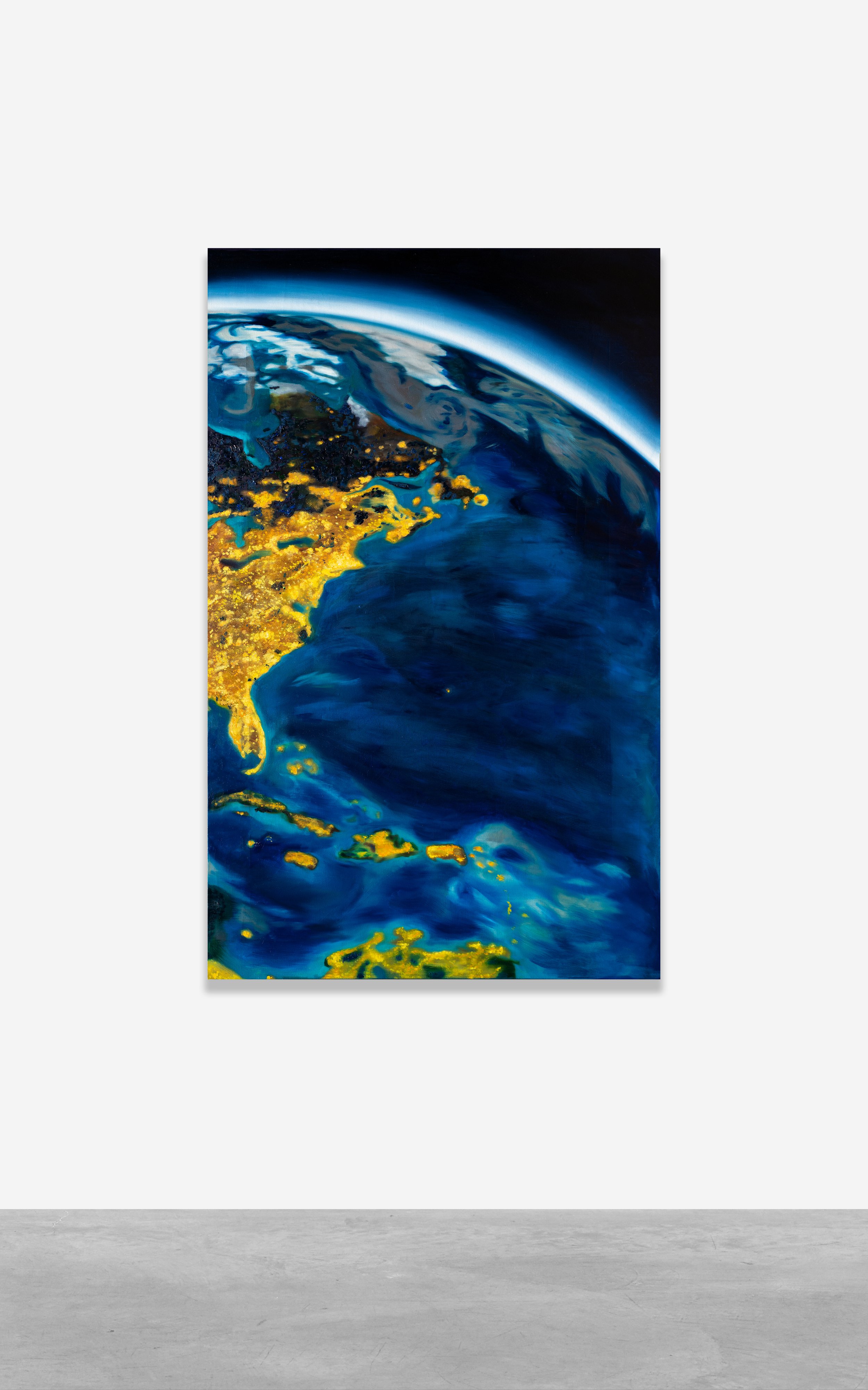
James Turrell's Roden Crater (1979 to the present), a massive land art project in the Painted Desert of northern Arizona, provides the most sustained art historical parallel to the philosophical ambition of Horizons. Turrell has spent four decades transforming an extinct volcanic crater into a naked-eye observatory. The project's central operation is perceptual. Visitors enter chambers designed to frame specific regions of the sky, the sun, the moon, the planets, the stars. The walls of the chambers are shaped to create the illusion that the sky is a flat surface at close range, or a dome, or a plane that extends horizontally to infinity. The effect is not decorative. It is philosophical. Turrell is not building a monument to the sky. He is building a machine for changing how the viewer perceives the sky. The crater restructures the viewer's relationship to the horizon by removing the usual reference points, the ground, the buildings, the trees, the clouds, and replacing them with pure color and light. Tan Mu's Horizons performs a comparable operation in paint. The horizon line in her paintings is not the sharp division between earth and sky that the human eye registers from the ground. It is a gradient, a dissolution, a continuous transition from warm golden city lights through cool atmospheric blues to the absolute black of space. This gradient is the visual equivalent of Turrell's shaped chambers. It restructures the viewer's perception of where the boundary is, and whether a boundary exists at all.
The physical fact of the Horizons paintings is oil on linen, 122 by 76 centimeters. The scale is moderate, not monumental, not intimate. It is the scale of a window, a screen, a view that the body can hold without turning the head. The linen substrate is Belgian, a fine weave with a warm, natural tone that shows through the thin upper layers of paint. This is a material decision with perceptual consequences. The warmth of the linen creates a ground temperature beneath the cool atmospheric blues, producing a visual warmth at the lower registers of the painting that gradually cools as the eye moves upward. The effect mimics the actual optical experience of looking at the Earth from orbit: the surface glows with the warm light of human habitation, while the atmosphere above is cold, thin, and blue. The paint itself is applied in multiple thin layers, each building on the previous one, creating a sense of atmospheric depth that is optical rather than linear. The viewer does not perceive the depth through perspective lines or vanishing points. The viewer perceives it through the accumulation of translucent color, each layer partially visible beneath the next, like sediment in geological strata or light filtering through atmosphere.
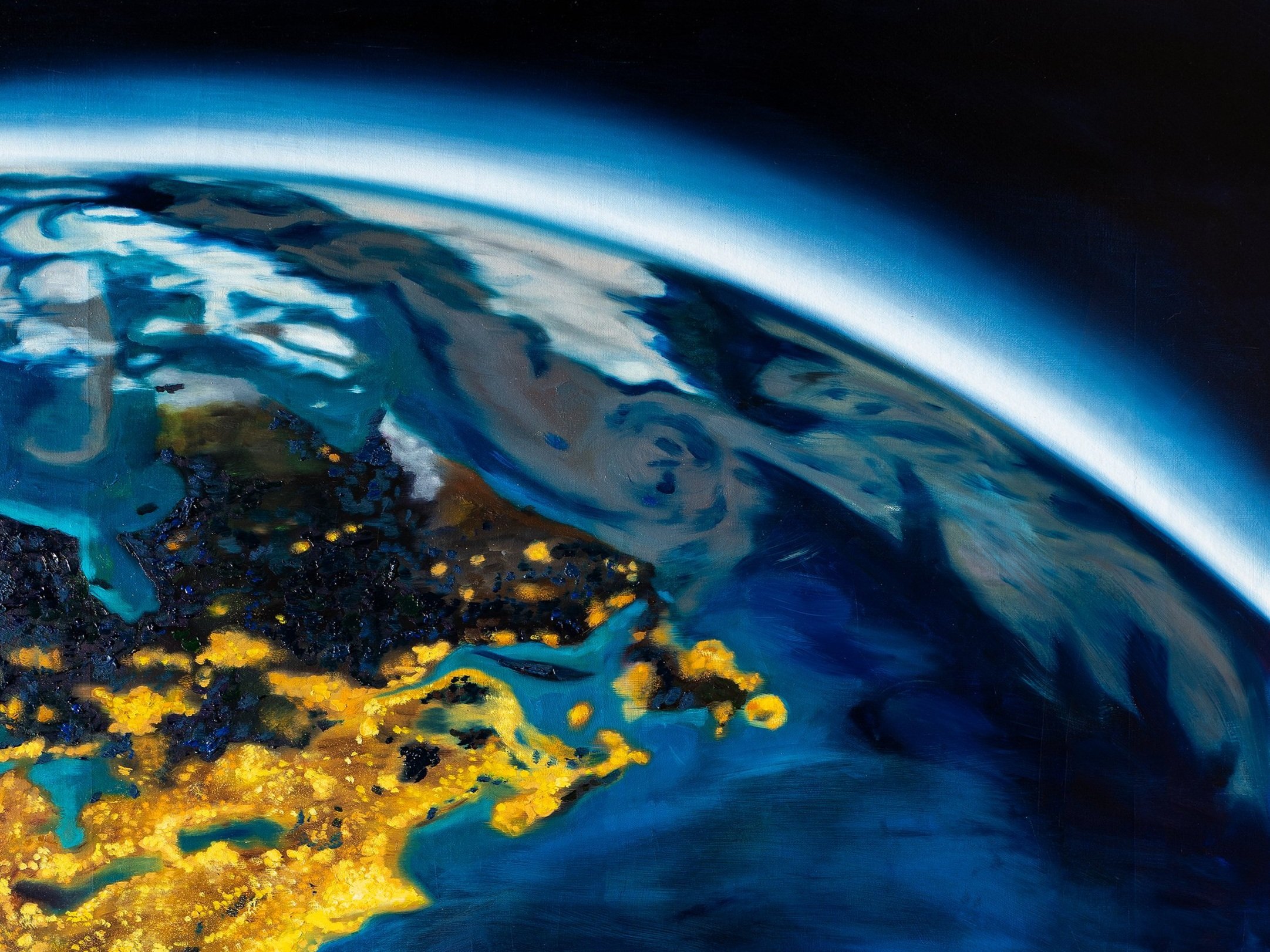
Mark Rothko's Seagram Murals (1958 to 1959), a cycle of paintings originally commissioned for the Four Seasons Restaurant in the Seagram Building in New York, offer a second and more emotionally resonant parallel. Rothko described the Seagram commission as an opportunity to create a room in which viewers would feel "trapped." He wanted the paintings to produce a sense of enclosure, of being held within a space defined by color rather than by walls. The paintings are large, roughly six by eight feet, and their fields of deep red, maroon, and black are layered with translucent glazes that create the illusion of light emerging from within the canvas. Rothko's intent was not decorative. He wanted the paintings to function as environments, to alter the viewer's emotional state through the sheer material presence of color. Tan Mu's Horizons operates on a similar principle, but with the opposite emotional charge. Where Rothko's paintings enclose, Horizons opens. The layering technique is comparable, the thin glazes, the optical depth, the light that seems to come from within the surface. But the effect is expansive rather than constrictive. The viewer of Horizons is not trapped. The viewer is elevated. The warm gold of the city lights draws the eye inward, toward the surface of the Earth, while the cool blue and black of the atmosphere above opens the composition upward, toward the infinite. This bidirectional pull, inward toward the human, outward toward the cosmic, is the painting's philosophical engine. It holds the viewer in a state of suspension between two scales, the intimate and the planetary, without resolving into either.
The panoramic gaze that Tan Mu describes in her 2024 conversation is not merely a visual technique. It is an ethical framework. She writes that satellite imagery provides "a continuous, global view that reshapes how we understand geography, borders, and interconnectedness." This claim has a specific philosophical lineage. The geographer Denis Cosgrove, in his book Apollo's Eye (2001), traced the history of the Earth-as-seen-from-above from medieval cosmological diagrams through Renaissance cartography to the Apollo photographs. Cosgrove argued that each era's way of seeing the Earth from above reflected its dominant political and epistemological framework. The medieval diagram placed the Earth at the center of a divine order. The Renaissance map placed it at the center of a colonial order. The Apollo photograph placed it at the center of a global order. Tan Mu's Horizons paintings intervene in this genealogy at a specific point. They do not reproduce the Apollo photograph's totalizing vision. They do not show the whole planet at once. They show a fragment of the horizon, a curve of atmosphere, a scatter of city lights. This fragmentation is deliberate. It resists the fantasy of total knowledge that the whole-planet photograph implies. By showing only a part, the painting acknowledges that the panoramic gaze is always partial, always situated, always mediated by technology and by the body that receives the image. The painting does not pretend to be the satellite. It pretends to be the person watching the satellite feed.
In her 2024 conversation, Tan Mu describes the city lights in the Horizons paintings as forming "intricate patterns that resemble neural networks or biological systems, suggesting that human activity mirrors natural structures." This observation is not merely formal. It is a claim about the relationship between the human and the organic, between the built environment and the biological substrate. The golden clusters of megacities, rendered in warm amber and gold tones against the cool blue atmosphere, are painted with enough surface variation to produce a sense of luminosity, of light that emanates from within the surface rather than reflecting off it. This luminosity is the material signature of the human presence in the painting. It is the light of cities, of communication networks, of energy grids, of the collective infrastructure that sustains eight billion lives. And it is this light that distinguishes Tan Mu's horizon from the purely natural horizon. The horizon in Horizons is not the horizon of Caspar David Friedrich's Monk by the Sea (1808 to 1810), where the human figure is dwarfed by the immensity of nature. It is a horizon in which the human is not absent but dispersed, distributed across the surface of the planet as points of light, visible from orbit, indistinguishable from the stars.
The Chinese philosophical principle of ge wu zhi zhi, investigating things to extend knowledge, provides a framework for understanding the epistemological ambition of the series. Li Yizhuo, in her 2025 catalog essay, identifies this principle as the philosophical anchor of Tan Mu's practice: "examining and discerning objects of various scales and conditions." In the context of Horizons, the object being examined is the Earth itself, but at a specific scale, the scale of the satellite, the scale at which national boundaries dissolve and the planet becomes a single, continuous surface. The investigation is not scientific. Tan Mu is not measuring atmospheric density or calculating light pollution. The investigation is perceptual and ethical. She is asking what happens to the viewer's sense of responsibility when the horizon is no longer a boundary but a threshold, when the Earth is no longer a collection of separate nations but a single, luminous, interconnected system. This is not a new question. It is the question that the Overview Effect poses every time an astronaut looks out the window of the ISS. But it is a question that painting can hold in a way that photography cannot. The photograph shows the Earth as it is. The painting holds the Earth as it is felt.
The relationship between the Horizons series and Tan Mu's earlier work Peek (2021), a painting of the 1946 V-2 rocket photograph, traces the development of her thinking about the satellite perspective. Peek is based on a specific, historical image. It depicts the first moment in which humanity saw itself from outside. The painting is monochrome, black and white, matching the tonal range of the original photograph. It is an act of archival recovery, a retrieval of the foundational image of the space age. Horizons is different. It is not based on a specific photograph. It is based on the continuous stream of imagery that now flows from the ISS, a stream that has no single iconic frame because it is always changing, always moving, always showing the Earth in a different light. The paintings are thus not archival. They are atmospheric. They do not preserve a moment. They hold a condition, the condition of continuous observation, of the planet being seen from outside at every moment of every day. This shift from archival to atmospheric reflects the broader shift in Tan Mu's practice from documenting historical events (Trinity Testing, Bikini Atoll, DEC's PDP-10) to registering the ongoing conditions of contemporary perception (Signal, Horizons, Gaze). The earlier works asked: what happened? The later works ask: what is happening now?
In the philosophical tradition, the question of seeing the whole has been posed most persistently by phenomenology. Edmund Husserl's concept of the Lebenswelt, the lived world, insists that perception is always situated, always embodied, always from a specific place and time. The view from nowhere, the view from everywhere, the view from outside, these are philosophical abstractions that Husserl would regard with suspicion. Tan Mu's Horizons occupies a productive tension within this tradition. The paintings present the satellite perspective, which is, by definition, a view from outside. But they do so through oil on linen, which is, by definition, a material made by hand in a studio on the surface of the Earth. The painting is both the cosmic view and the embodied act. It holds both the abstraction of the satellite feed and the specificity of the brush, the pigment, the linen. This duality is not a contradiction. It is the philosophical core of the work. The panoramic gaze is not a replacement for the embodied gaze. It is an extension of it. Technology does not transcend the body. It enlarges it. The satellite is not an eye in the sky. It is a prosthetic, an external organ, a material extension of the human capacity to see. And the painting that translates the satellite perspective into oil on linen is not a reproduction of the view. It is a testimony to the experience of having seen it.
The horizon is not a line. It is a gradient, a continuous transition from one state to another, from ground to sky, from warm to cool, from human to cosmic. In Tan Mu's Horizons paintings, this gradient is rendered through the material logic of oil paint, through layers that build on one another, through colors that shift imperceptibly from gold to blue to black. The viewer does not read the horizon as a boundary. The viewer feels it as a threshold, a point of passage between two states of being. This is what the astronauts described, the moment when the horizon stopped being a line and started being a feeling. And this is what Tan Mu's paintings hold. They do not show the Earth from space. They show what it feels like to have seen the Earth from space, and to carry that feeling back to the surface, where the horizon is once again a line, but a line that the viewer now knows is not real.