One Hundred Billion Neurons: Tan Mu's Emergence and the Architecture of Consciousness
The blackout happened at the surface. Tan Mu was freediving, ascending from depth, and as she neared the light, her vision collapsed inward, a whiteout that consumed the ocean, the sky, and her own body. She surfaced, gasped, regained oxygen, and with the oxygen, regained herself. But the gap remained, a brief void in the continuity of consciousness, a place where memory had been and then was not. In her studio afterward, she spent a month asking a question she could not answer: Who am I, without the memory of who I have been? The question did not lead to despair. It led to painting. First Memory (2019), a triptych of 183 by 366 centimeters that attempted to reconstruct the act of remembering from the outside in. Then MRI (2021), a small canvas of brain imaging that treats the cross section of the skull as a landscape of interior geography. And then Emergence (2022), the largest and most ambitious of the series, a painting that does not depict a brain scan or a memory fragment but something more fundamental, the architecture of consciousness itself, the one hundred billion neurons and one hundred trillion synaptic connections that constitute, as far as neuroscience can determine, the physical substrate of every thought, feeling, and recollection a human being will ever have.
The painting arrives in the viewer's field of vision the way a galaxy might arrive through a telescope, not all at once but in layers, each layer revealing more complexity than the last. Standing at a distance of three meters, the composition registers as a luminous field, predominantly blue, with golden particles radiating outward from a central mass. Move closer and the field resolves into structure: branching pathways, dense clusters, filaments that extend and bifurcate and sometimes reconnect. Move closer still and the pathways become individual neurons, axons and dendrites rendered with the specificity of a scientific illustrator, each branch tip dissolving into a scatter of luminous points that suggest synaptic transmission, the moment when one neuron hands a signal to the next across a gap of twenty nanometers. The painting demands this progressive approach, this movement from overview to detail, because the subject it depicts has this same structure. A neuron is a cell. A network of neurons is a mind. The scale shift between the two is the scale shift that the painting performs on the viewer's body.
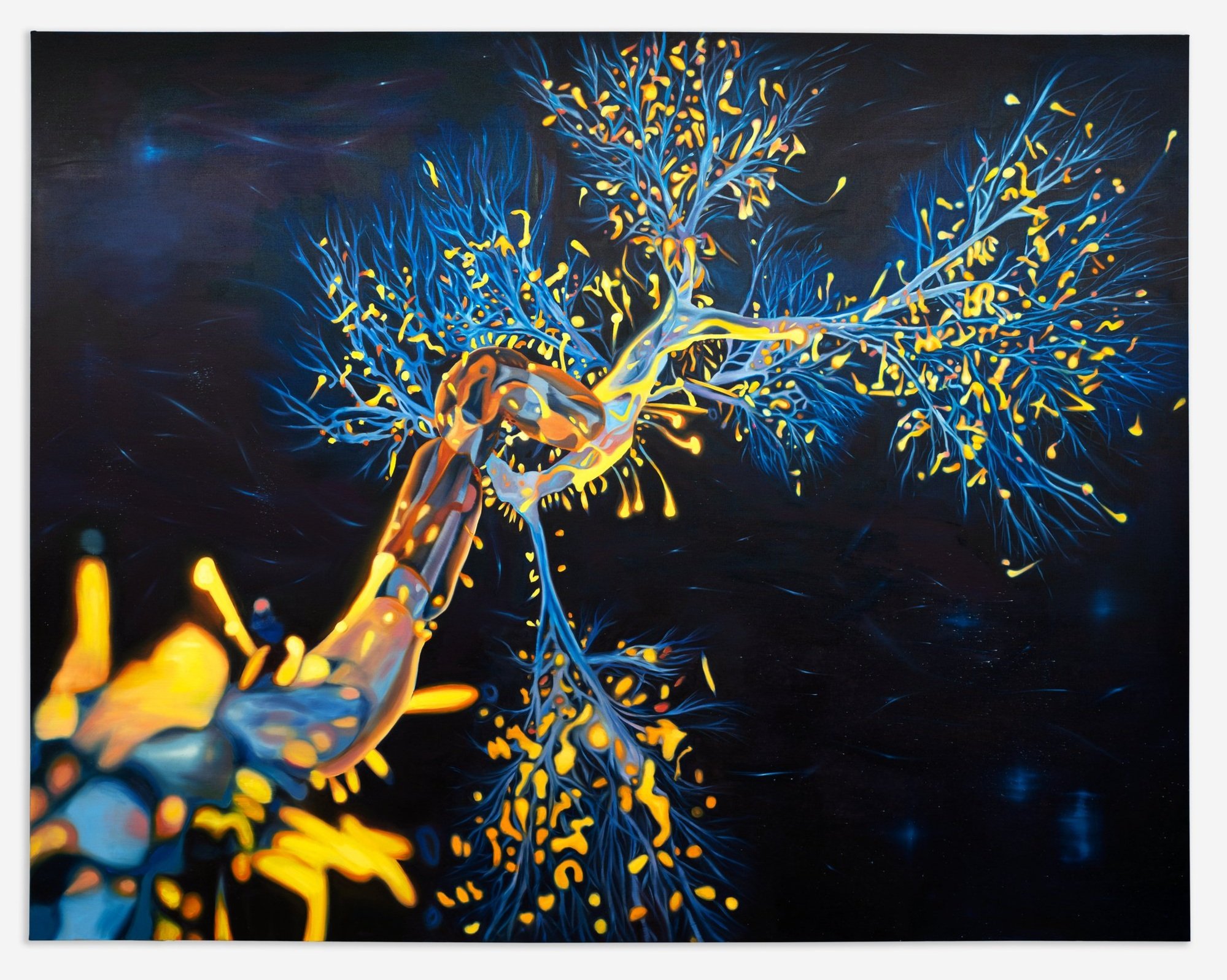
Emergence is oil on linen, 193 by 244 centimeters, roughly six feet by eight feet. It is among the largest canvases in Tan Mu's catalog, larger than the MRI, larger than the Memory triptych's individual panels, approaching the scale of the Signal paintings that map submarine cable networks across entire ocean basins. The size is not incidental. It is a formal decision that carries conceptual weight. A painting of neural architecture at this scale does not illustrate the brain. It inhabits the brain. It takes the spatial logic of a system that fits inside a human skull and expands it to fill a wall, forcing the viewer to encounter it as an environment rather than a diagram. The dominant colors are cerulean blue, ultramarine, cadmium yellow, and Naples yellow, with passages of deep violet and a near black ground that anchors the composition's periphery. The blues articulate the neurons themselves, the cell bodies and their branching axons and dendrites, rendered with a precision that borders on scientific illustration but never fully arrives there. The yellows are the particles, the luminous points that cluster around the branching forms like pollen around a tree, or like stars around a galactic center. The contrast between blue and yellow is not decorative. It is semantic. Blue is structure, the fixed architecture of the neural network. Yellow is activity, the electrical and chemical signals that move through the network at speeds of up to 120 meters per second. Blue is the building. Yellow is the life inside it.
The surface texture of the canvas contributes to this reading in ways that a reproduction cannot convey. The paint is applied in thin, translucent layers that allow the linen ground to breathe through, creating a luminosity that is specific to oil painting on fabric. In the densest areas, where the branching forms converge, the paint thickens into impasto, the raised ridges catching light and casting tiny shadows that give the surface a topography, a geography of pigment that mirrors the geography of neural tissue. In the peripheral areas, the paint thins to near transparency, the linen showing through like a membrane, suggesting the boundary between the neural network and the void that surrounds it, the point where the brain ends and the rest of the universe begins. This interplay between thick and thin, between opacity and transparency, is a material strategy that Tan Mu has refined across her practice. In the Signal paintings, the access points of submarine cables are built up with thick, wax heavy oil paint, resembling the soldered connections of electronic circuits. In Emergence, the same logic applies: the densest neural clusters receive the thickest paint, the thinnest passages mark the periphery, and the viewer's eye reads the surface texture as a map of informational density.
There is a specific moment in the history of twentieth century painting that Emergence involuntarily recalls. In 1943, Jackson Pollock laid a large canvas on the floor of his studio on East 8th Street in Greenwich Village and began dripping house paint from above. The result, Mural (1943), commissioned by Peggy Guggenheim for the hallway of her apartment, was a six meter wide field of interlocking, rhythmic marks that seemed to pulse with an energy that was neither figurative nor abstract but something else, a visual registration of movement itself, of the body's interaction with paint, gravity, and surface. Pollock's drip paintings that followed over the next four years, works like Number 1A, 1948 and Autumn Rhythm (Number 30), 1950, deepened this registration into a system of extraordinary complexity. The physicist Richard Taylor, working at the University of Oregon in the late 1990s, applied fractal analysis to Pollock's drip paintings and discovered that they exhibited fractal dimensions between 1.3 and 1.5, a range that corresponds to the fractal complexity of natural branching systems, including trees, river deltas, blood vessels, and neural networks. Taylor's analysis, published in Nature in 1999, did not claim that Pollock had deliberately painted fractals. It claimed that Pollock's body, in the act of dripping, had produced patterns that shared the mathematical structure of natural growth systems, a kind of motor intelligence that operated below conscious intention.
The connection to Emergence is structural, not stylistic. Tan Mu's painting does not look like a Pollock. It is representational where Pollock is gestational, deliberate where Pollock was improvisatory, scientifically informed where Pollock was somatically driven. But both works share a fundamental orientation toward the visual registration of complex branching systems. Pollock's drip paintings register the branching of human movement through space, the trajectories of paint flung from a stick, subject to gravity, viscosity, and the rotational dynamics of the painter's body. Tan Mu's Emergence registers the branching of neural tissue, the bifurcation of axons and dendrites as they extend through the three dimensional space of the brain, subject to genetic programming, biochemical gradients, and the electrical signals that shape their growth. Both works produce fields of extraordinary density, compositions in which every mark is connected to every other mark through a web of branching pathways that resist linear reading. The eye does not travel through either painting in a straight line. It wanders, gets lost, finds a path, loses it, finds another. This is not a failure of composition. It is the composition. The neural network does not have a center. It has nodes, and the nodes are connected, and the connections are the meaning.
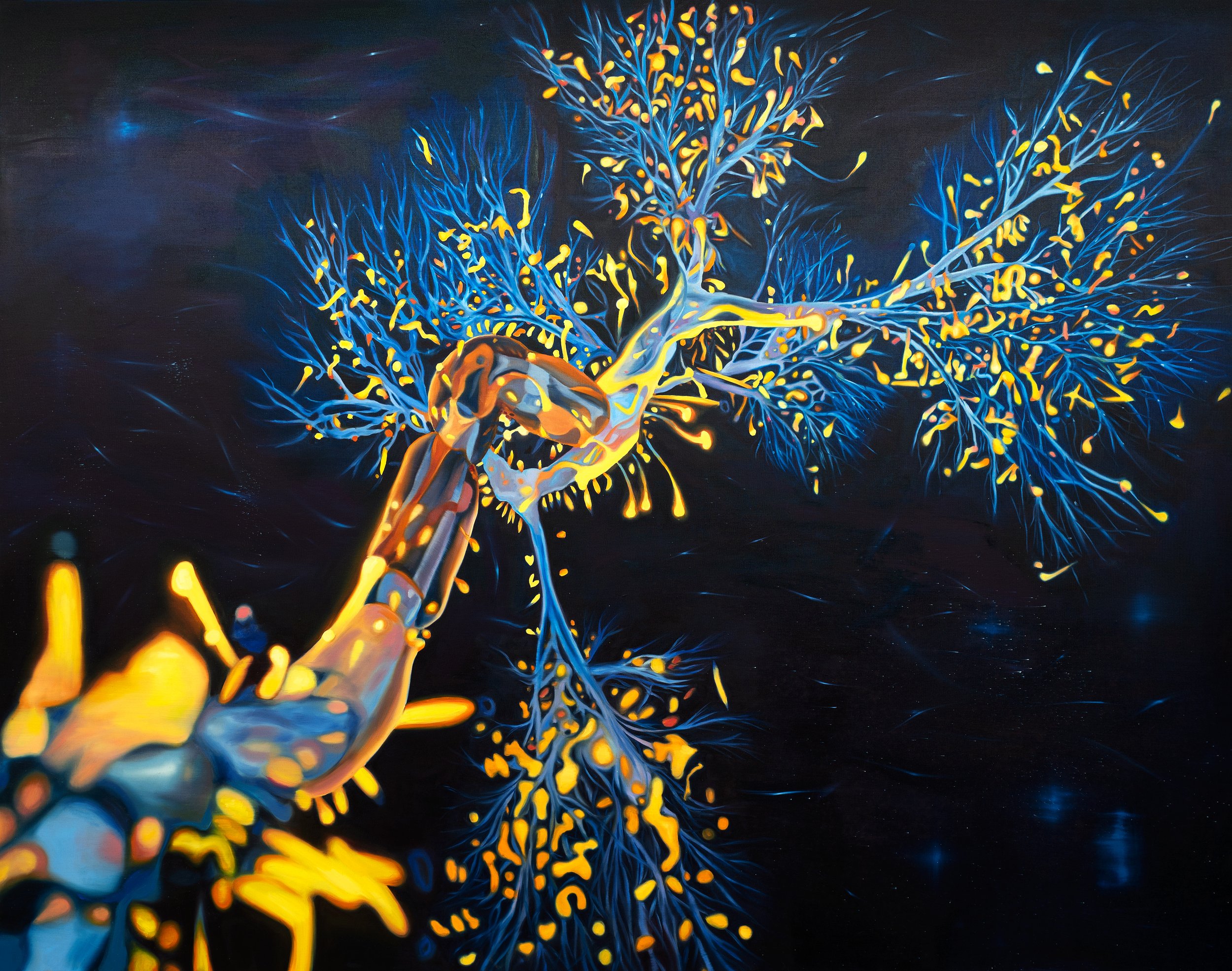
The neuroscience that underlies Emergence is precise enough to warrant a closer look, because the painting's visual choices correspond to specific features of neural architecture that distinguish it from other branching systems. A human brain contains approximately 86 billion neurons, each connected to an average of 7,000 other neurons through synapses, the junctions where an electrical signal in one neuron triggers the release of neurotransmitters across a gap of about twenty nanometers to activate the next neuron in the chain. The total number of synaptic connections in a human brain is estimated at 100 to 500 trillion, a number that exceeds the total number of stars in the Milky Way galaxy by a factor of roughly 50 to 250. These connections are not random. They are shaped by experience, by the process neuroscientists call synaptic pruning, in which unused connections are eliminated and frequently used connections are strengthened. A newborn infant has roughly twice as many synaptic connections as an adult. The pruning process, which continues throughout life, is the mechanism by which the brain adapts to its environment, learning which signals matter and which can be discarded. This is the process that Emergence visualizes, not as a diagram of pruning, but as a portrait of the network that pruning produces, the mature architecture of a brain that has been shaped by decades of living, seeing, feeling, and remembering.
Tan Mu has spoken about the relationship between neural networks and computational systems in terms that reveal how deeply the analogy structures her thinking. In a Q&A accompanying the work, she describes the brain as "a highly efficient and complex organ, functioning in many ways like an advanced computational system built from billions of interconnected elements." She draws a direct comparison between synapses and logic circuits: "Both rely on on and off mechanisms to regulate the flow of information." This is not a metaphor she applies loosely. In her painting Synapse (2023), she renders the synaptic gap at a scale that makes the analogy visible, the gap between axon and dendrite occupying the same compositional role as the gap between two circuit elements on a motherboard. The Signal series extends the same logic to the global scale, mapping submarine fiber optic cables as if they were the axons of a planetary brain, connecting cities as neurons connect cells. What unites these works is a conviction that the architecture of information is the same at every scale, from the synaptic gap to the ocean floor, from the microscopic to the planetary. Emergence is the work where this conviction is most fully realized, because the brain is the one system that contains all the others, the one architecture that encompasses both the internal memory of neural networks and the external memory of technological systems.
Nick Koenigsknecht, Tan Mu's studio manager and the curator of her BEK Forum exhibition in Vienna, has articulated a framework that clarifies the philosophical stakes of this conviction. In his catalog essay "Alone, Together / Locals, Everywhere," he poses a question that reframes the entire body of work: "While observing technology, are we not looking at ourselves? Therefore perhaps these works function more as self portraits, rather than depictions of external, scientific milestones." The proposition is radical. It means that when Tan Mu paints a quantum computer or a submarine cable or a neural network, she is not painting an object in the world. She is painting a piece of herself, a fragment of the cognitive architecture that enables her to paint at all. The cryostat in the quantum computer painting is not a machine she observed from the outside. It is a mirror of the synaptic activity that allowed her to observe it. The cable in the Signal series is not infrastructure. It is an externalized nervous system, the same system that fires inside her skull when she dives to thirty meters and feels the ocean press against her chest.
Koenigsknecht extends this framework with a metaphor that is both provocative and precise. He suggests that humanity's relationship to its own technology should be understood as a cohabitation with "bio techno siblings." Like us, he writes, "our siblings have lifecycles. They are conceived, born, maintained, and eventually replaced." This is not the language of techno utopianism or techno dystopia. It is the language of kinship, of shared origin, of systems that grow and decay according to the same fundamental logic. The brain is a bio techno sibling to the computer. The neuron is a bio techno sibling to the circuit. The synapse is a bio techno sibling to the logic gate. Emergence paints the eldest sibling, the one that came first, the one whose architecture the others imitate without knowing it. The painting does not celebrate the brain or fear the machine. It registers the kinship between them, the structural homology that connects the biological and the technological in a single family of information processing systems.
This brings us to the philosophical dimension that gives the painting its name. Emergence, as a concept, refers to the appearance of properties in a complex system that cannot be predicted from the properties of its individual components. A single neuron does not think. A network of 86 billion neurons does. A single water molecule is not wet. A collection of trillions of water molecules is. A single note is not music. A sequence of notes, arranged with rhythm and harmony and timbre, is. The property "emerges" from the interaction of the components, not from the components themselves. Tan Mu's painting enacts this principle materially. No single brushstroke in Emergence is a neuron. No single mark is a thought. But the accumulated density of branching forms, the interlocking web of blue and yellow and violet, the progressive revelation of structure at every viewing distance, produces an effect that is more than the sum of its parts. The viewer does not see a neuron and infer a brain. The viewer sees a field of such complexity and density that the brain, as a totality, as a living system, becomes present in the room. This is what the painting achieves. It makes the invisible visible. It gives form to the one system in the universe that is capable of recognizing its own form.
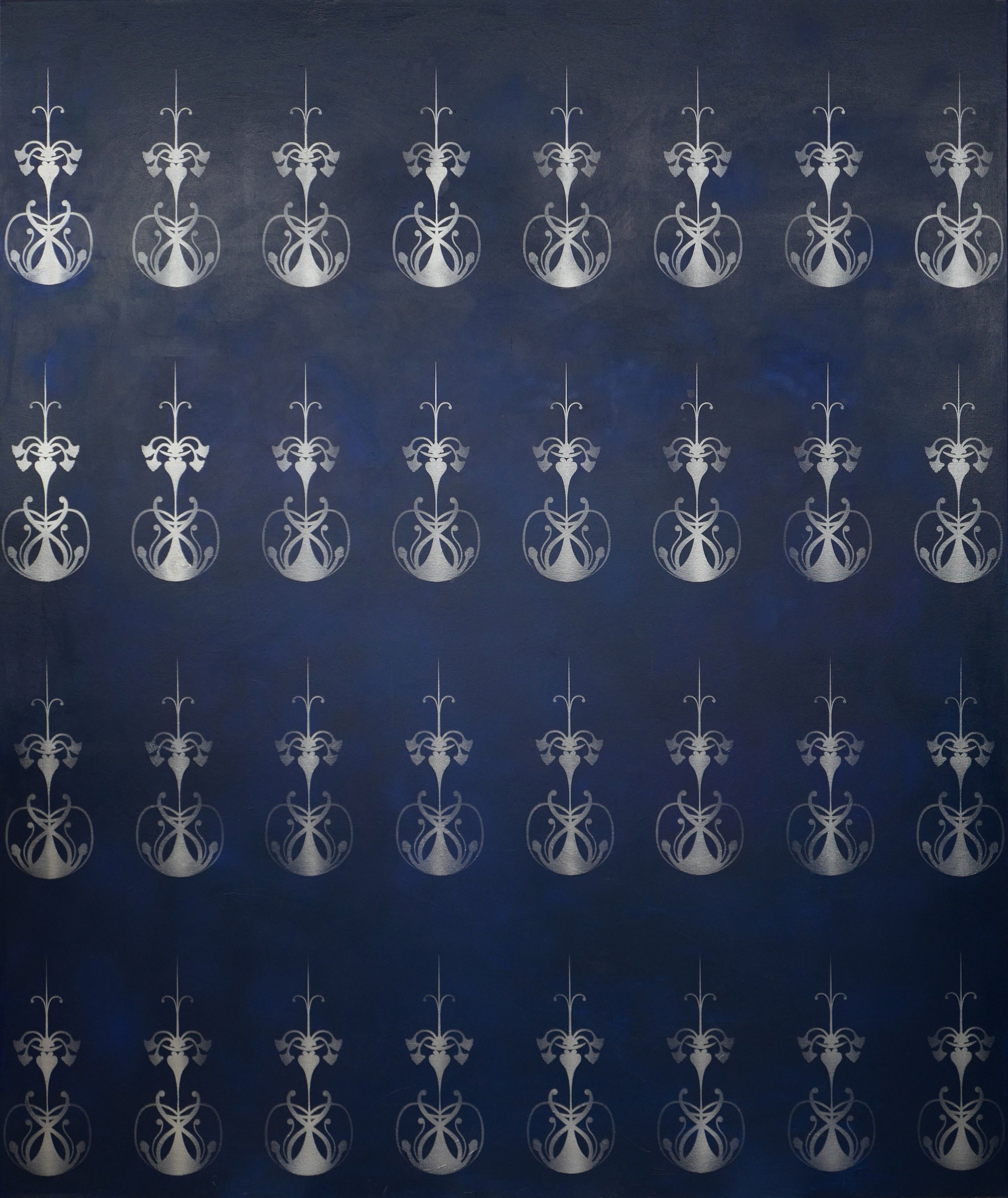
The connection between Emergence and the earlier Fractal 1 (2019) reveals the continuity of Tan Mu's investigation into self similar systems. Fractal 1, painted in oil and acrylic on linen, is a more overtly mathematical work, its branching forms derived from fractal geometry rather than neuroanatomy. But the visual language is unmistakably related: the recursive bifurcation of pathways, the density of interlocking forms, the sense that the same pattern repeats at every scale of observation. Where Fractal 1 approaches this language from the side of mathematics and abstraction, Emergence approaches it from the side of biology and lived experience. The fractal is the structure. The neuron is the content. Together, they form a pair that maps the territory Tan Mu has been charting since her first encounter with memory's fragility at ten meters below the surface of the Caribbean Sea.
The Hindu philosophical framework that Tan Mu has cited as an influence on Emergence provides a final layer of meaning. In the concept of Brahman, the ultimate reality in Hindu metaphysics, the entire universe is understood as a single, undivided consciousness that manifests as the multiplicity of individual beings. Each individual consciousness, each atman, is not a fragment of Brahman but Brahman itself, experienced from a particular vantage point. Tan Mu's invocation of this framework through holographic theory, the idea that the whole is encoded in each part, gives Emergence a metaphysical dimension that extends beyond neuroscience and art history. If the brain is a holographic fragment of the cosmos, then painting the brain at cosmic scale is not an act of exaggeration. It is an act of accuracy. The 193 by 244 centimeter canvas is not too large for a painting of neurons. It is exactly the right size. It is the size that a neuron needs to be, if a neuron is a window onto the whole.
Standing in front of Emergence for the second or third time, the viewer begins to notice something that was not apparent on first encounter. The branching forms do not terminate. They thin, they scatter, they dissolve into particles of light, but they do not stop. The periphery of the canvas does not contain the network. It only hides the continuation. The painting implies that what is visible is a window onto a system that extends in every direction beyond the frame, through the wall, through the building, through the city, into the atmosphere, into space, into the same cosmic void that contains the galaxies whose structure the painting so uncannily mirrors. This implication is the painting's deepest achievement. It does not merely depict a neural network. It enacts the experience of being inside one, of being a consciousness that knows it is made of neurons but cannot see its own neurons, that can only imagine them, paint them, project them onto a surface six feet wide and eight feet tall, and stand back, and wonder.