Three Panels Before Breathing: Tan Mu's Memory and the Material Architecture of Forgetting
A triptych is a decision about separation. Unlike a single canvas, which holds its image in continuous unity, or a diptych, which proposes a binary, a triptych insists on the gap. The physical space between its panels, the wall that shows through, the architecture of the room that intrudes into the image, these are not absences. They are structural elements, as deliberate as any brushstroke. When Tan Mu, in the months following a freediving accident that caused temporary memory loss, chose to make her first major painting not on a single canvas but on three, she made a material decision that would shape every interpretation of the work that followed. Memory (2019), oil on canvas, three panels measuring 183 by 366 centimeters overall, is not a painting about memory. It is a painting made in the shape of memory's failure, a three part structure that holds together only because a viewer stands in front of it and performs the act of connecting what the walls have divided.
The diving incident is by now well documented in the biographical record. Tan Mu was ascending from depth when her vision faded, a whiteout that consumed the ocean, the sky, and the sensation of having a body. She surfaced, gasped, regained oxygen, and with the oxygen, regained herself. But the gap remained, a pocket of time in which she had been conscious but without access to the stored narratives that constitute personal identity. In her own account, she spent a month afterward in her studio asking, "Who am I?" Not as philosophical provocation, but as genuine diagnostic uncertainty. The memories returned, most of them, but the experience of their absence left a residue that no amount of recovered recollection could fully dissolve. She had felt what it was like to be a consciousness without a past, and that feeling became the engine of a body of work that would eventually include Memory, MRI (2021), Synapse (2023), and Emergence (2022). Of these, Memory is the earliest, the most raw, and the most formally radical, because it does not yet have the scientific vocabulary that the later works would develop. It is a painting made before the research, before the neuroanatomy, before the cable networks and quantum computers. It is a painting made in the immediate aftermath of forgetting, and its three panels carry the urgency of that moment.
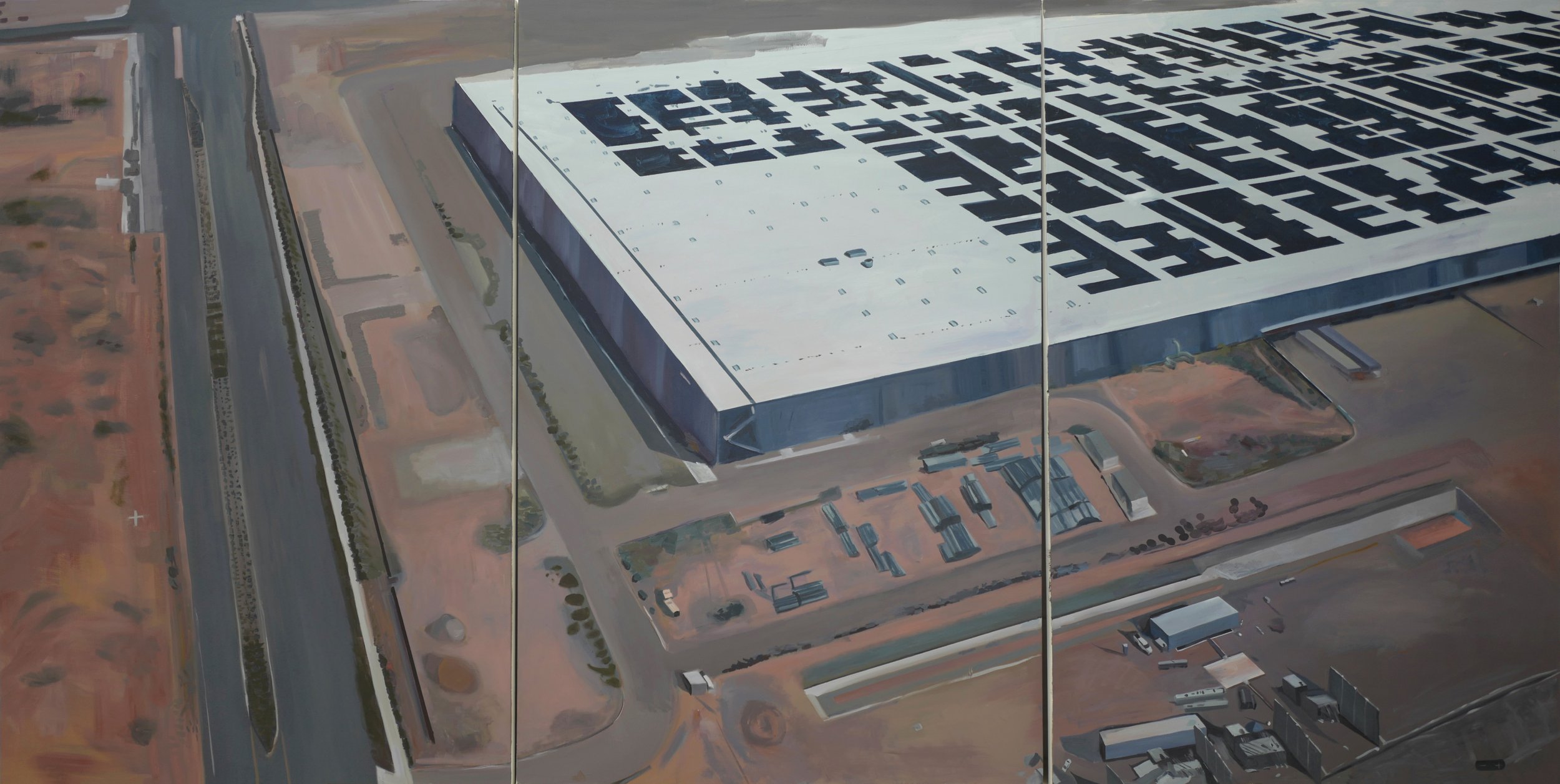
The physical object, seen in installation, makes the triptych's logic immediately legible. The left panel depicts figures submerged in water, human bodies rendered in muted blues and greens, diving or swimming downward toward what appears to be a stone column, a fragment of classical architecture resting on the ocean floor. The middle panel shows a cathode ray tube television, its screen filled with static noise, a cable dangling from its base, the phosphorescent white and gray of the signal-less screen dominating the composition. The right panel presents dolphins in dark water, their bodies arcing through a space that is deeper, more opaque, more nocturnal than the water in the left panel. Three images. Three moods. Three moments that do not narrate a sequence but coexist as fragments of a single experience that the mind, in its damaged state, could not hold together as a continuous whole.
The choice of the triptych form carries art historical weight that Tan Mu, trained at the China Central Academy of Fine Arts and at Alfred University, would have absorbed not as a specific reference but as a cultural inheritance. The triptych originates in devotional painting, in the altarpieces of the Northern European and Italian Renaissance, where three panels organized sacred narrative into a center and two wings, the flanking panels often depicting donors or saints who witnessed the central event. The form persisted through modernism, most notably in the work of Francis Bacon, whose triptychs from the 1960s and 1970s, Three Studies for Figures at the Base of a Crucifixion (1944), Triptych May June 1973, and others, transformed the devotional structure into a secular architecture of psychological extremity. Bacon's triptychs do not tell stories. They present three states of being, three views of a body, three moments in a process of transformation or decay, separated by the physical fact of the frame. The gaps between Bacon's panels are where the violence happens, the violence that the painted surfaces record but do not show. Tan Mu's triptych operates in a related register. The gaps between her panels are where the forgetting happens, the discontinuity that the painted surfaces attempt to repair but cannot.
Bacon painted his triptychs on separate canvases, not on a single surface divided into three. This is a material fact with conceptual consequences. Three separate canvases can be moved independently, hung at different heights, separated by varying distances, or shown in different rooms. The triptych is not a fixed object. It is an arrangement, a curatorial decision made each time the work is installed. Tan Mu's Memory shares this contingency. The distance between the panels, the width of the wall that separates them, the lighting that falls on each panel independently, all of these are variables that shape the viewer's experience of the work. In the installation view, each panel receives its own spotlight, casting the surrounding wall into relative shadow. The effect is cinematic, three screens in a darkened room, each projecting a different scene from a film whose narrative has been broken and must be reconstructed by the viewer. This reconstruction is not optional. It is the work. The painting does not function as a memory unless the viewer performs the labor of connecting its parts.
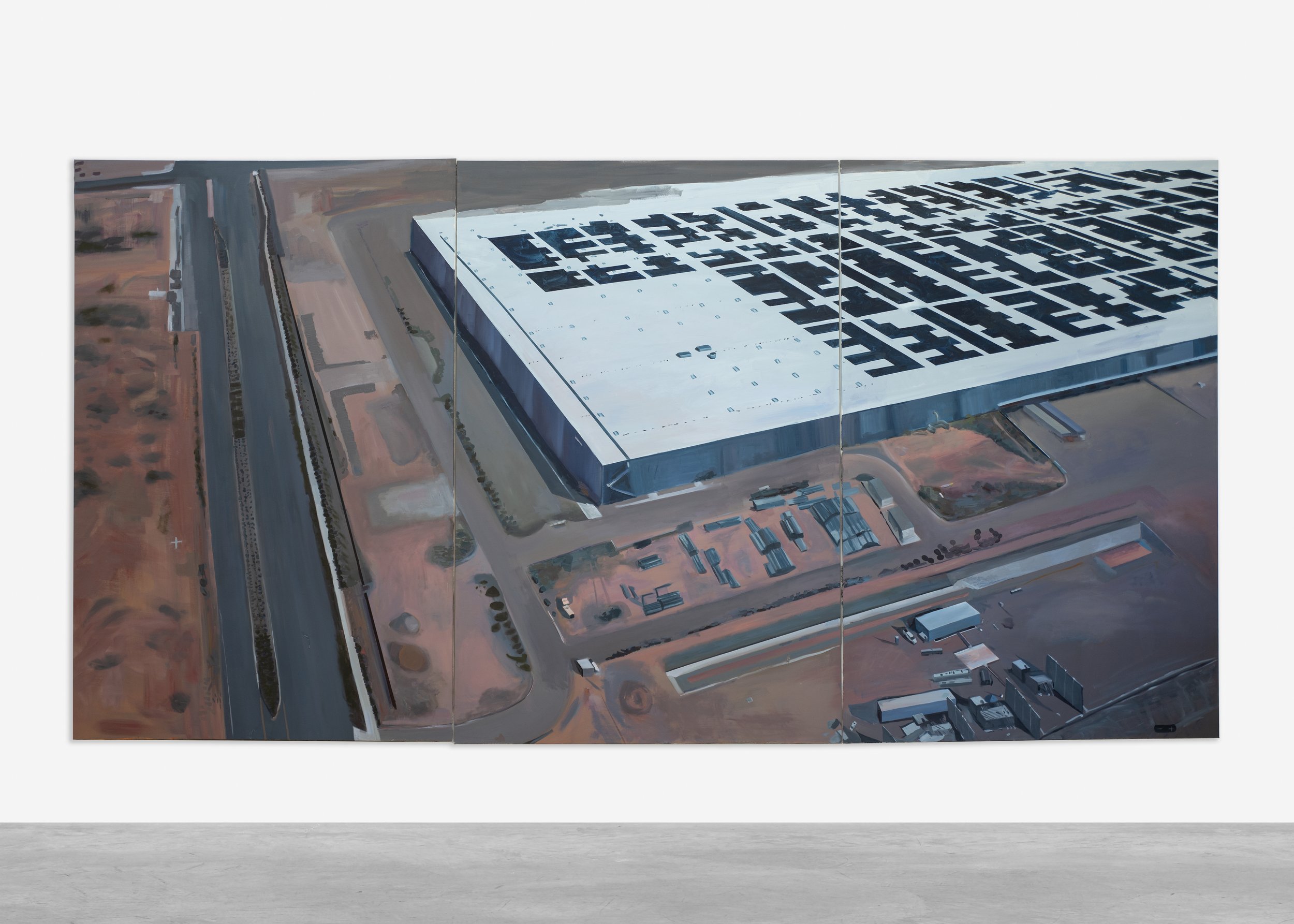
The left panel is the most figurative of the three and the most overtly art historical. The diving figures recall the submerged bodies of classical mythology, the nymphs and naiads of Greco Roman tradition, beings who inhabited the boundary between water and air, between the visible world and the underworld. The stone column, partially buried or resting on the seabed, suggests architectural ruin, the remains of a civilization that has been claimed by the ocean. This is not a specific reference to any particular ruin, not the columns of the Parthenon or the submerged city of Baiae, but a generalized image of antiquity as something that exists below the surface, accessible only to those willing to descend. The figures who swim toward it are not archaeologists. They are dreamers, or amnesiacs, people who sense that something important lies at the bottom but cannot remember what it is. The paint handling in this panel is notably different from the other two. The water is rendered in translucent layers, blue and green mixed with white, applied thinly enough that the canvas weave shows through in places. The figures are built up more thickly, their bodies catching the light in a way that gives them a solidity the surrounding water lacks. But even the figures are not fully opaque. They have a ghostly quality, a partial presence that suggests they are not swimming in water so much as swimming in the medium of recollection itself, where images are always partially dissolved.
The material logic of oil paint contributes to this reading in ways that are specific to the medium. Oil paint dries slowly. It remains workable for hours or days, allowing the painter to blend, scrape, reapply, and modify marks long after they were first laid down. This extended working time means that an oil painting is not a record of a single moment of execution. It is a record of many moments, layered on top of each other, each layer partially obscuring the one beneath. The translucency of the figures in the left panel is not a single transparent layer. It is the result of multiple translucent layers, each one adding a small increment of opacity, the cumulative effect producing an image that hovers between visibility and invisibility. This is the material condition of memory as Tan Mu experienced it after the blackout. The memories did not return all at once. They returned in layers, each layer partially obscuring the void beneath, the cumulative effect producing a self that hovered between coherence and fragmentation. The oil paint does not illustrate this process. It enacts it. The painting's surface is the memory's surface, built up through time, through successive approximations, through the patient accumulation of marks that individually mean nothing but collectively produce the illusion of a continuous image.
The middle panel is the crux of the triptych, the image that holds the other two in tension. A cathode ray tube television, a technology that has been obsolete since the widespread adoption of liquid crystal displays in the mid 2000s, fills the center of the composition. Its screen displays the particular pattern of visual noise that occurs when a CRT television receives no signal: a field of randomly distributed white and gray particles, flickering at sixty hertz, producing a shimmer that is neither image nor absence of image but something in between, a visual register of electromagnetic interference, the static that fills the airwaves when no broadcast is being received. A cable hangs from the bottom of the set, curving downward before disappearing below the lower edge of the canvas. Behind the television, a wall outlet is partially visible, a domestic detail that anchors the technological object in a specific, recognizable space, someone's living room, a bedroom, a hospital waiting area.
The CRT television as subject carries its own art historical freight. Nam June Paik, the Korean American artist often credited as the founder of video art, began incorporating television sets into sculptural installations in the 1960s, treating the cathode ray tube as both a medium and a material, a surface for projected images and an object with physical weight, heat, and magnetic presence. Paik's TV Buddha (1974), in which a statue of the Buddha contemplates its own live video image on a monitor, staged the encounter between ancient contemplative practice and real time electronic reproduction. Tan Mu's CRT does not display a live image. It displays the absence of an image, the noise that remains when all channels have gone dark. This is a different proposition. Where Paik's television is a window onto the present moment, Tan Mu's television is a window onto nothing, a surface that registers only the random fluctuations of the electromagnetic spectrum. The static on the screen is not an image of forgetting. It is the visual equivalent of forgetting, the pattern that consciousness produces when the signal that constitutes a memory has been lost or interrupted.
The material treatment of this panel is markedly different from the left panel. Where the diving figures are painted in thin, translucent layers, the television is rendered with a thicker, more opaque application of paint, the whites and grays of the static built up in small, discrete marks that individually approximate the individual particles of noise on a CRT screen. The effect, seen at normal viewing distance, is remarkably faithful to the visual character of actual television static. Seen up close, the marks dissolve into abstraction, each one a small dab of white or gray or pale blue, irregular in size and spacing, accumulating into a field that has no center, no hierarchy, no focal point. This is a formal strategy that Tan Mu would develop further in the Signal series, where individual marks representing cable landing points and junction nodes accumulate into a field that reads as a luminous constellation at a distance and as a dense web of discrete decisions at close range. In Memory, the strategy is already present, but it serves a different purpose. The discrete marks in the Signal paintings represent data, specific coordinates in a global network. The discrete marks in the television panel represent noise, the absence of data, the static that remains when the network has gone dark.
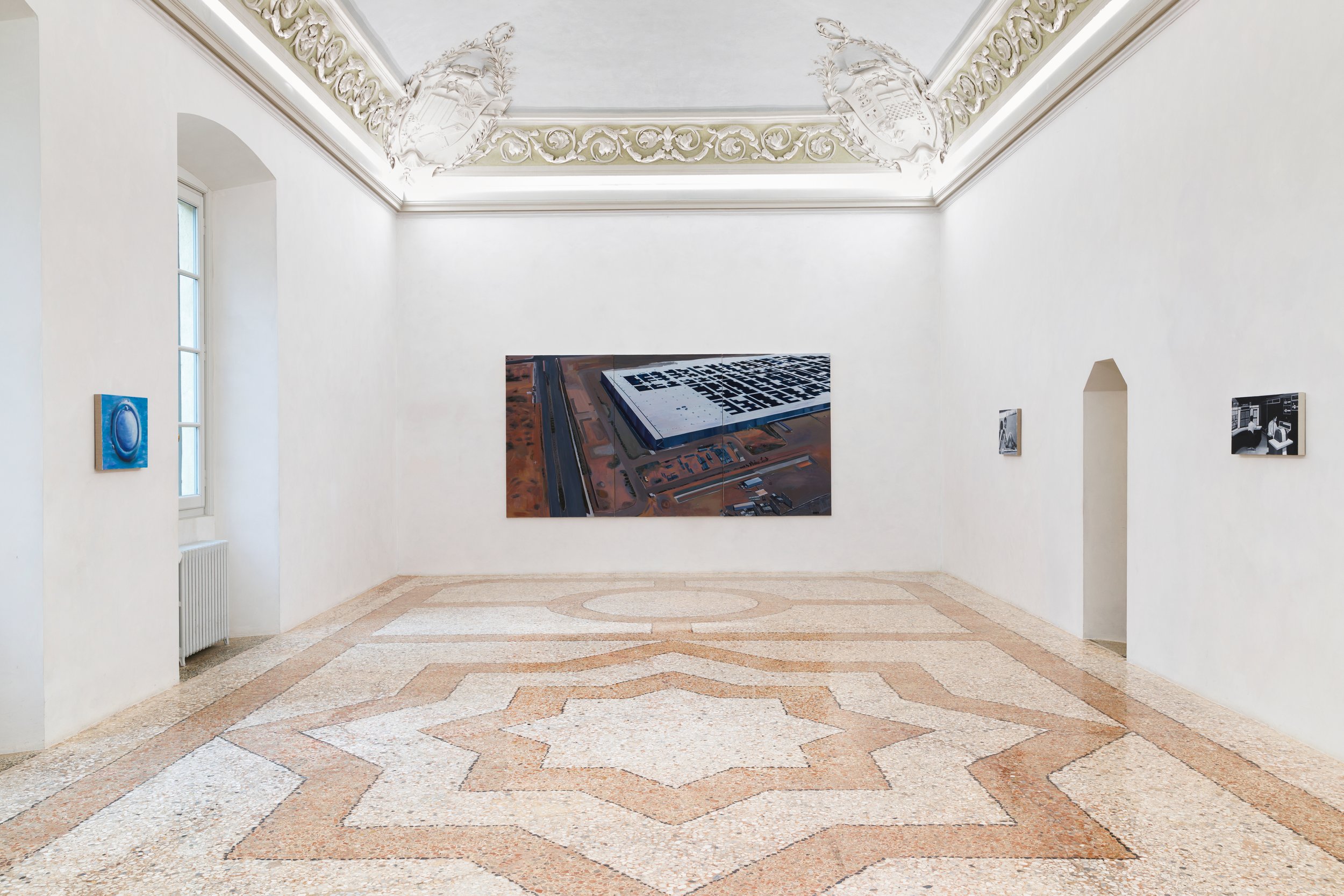
The right panel completes the triptych with an image that is at once the most naturalistic and the most mysterious. Two dolphins move through dark water, their bodies rendered in muted earth tones against a deep, nearly black ground. The water in this panel is denser, more opaque, more pressurized than the water in the left panel. Where the diving figures swim in a medium that is still transparent enough to reveal the ocean floor, the dolphins swim in a medium that borders on darkness, a depth at which light has been absorbed by the water column and only the faintest illumination remains. The dolphins themselves are painted with a precision that contrasts sharply with the ghostly translucency of the human figures. Their bodies are solid, their forms anatomically convincing, their movement captured with the fluency of an artist who has spent time observing marine life, not from a textbook but from the water itself.
This last point matters. Tan Mu is a competitive freediver who has descended to over thirty meters, who trains with a coach, who has dived at sites in the Caribbean where submarine fiber optic cables enter the ocean beside oil rigs that have become artificial reefs. The dolphins in the right panel are not generic marine mammals inserted into a symbolic composition. They are creatures she has encountered in the medium that also caused her memory loss, the ocean, the element that both sustains and threatens her. The dolphin in scientific literature is an animal with a demonstrated capacity for long term memory, individual recognition, and social learning, capacities that place it among the most cognitively complex non human species. To include dolphins in a painting about memory is not anthropomorphizing them. It is acknowledging that memory is not a uniquely human faculty. It is a biological inheritance shared across species, a capacity that evolved independently in marine mammals and primates because the survival advantages of remembering, of storing information about past events and using it to navigate future ones, are universal.
The material qualities of this panel reinforce the sense of depth and pressure that the subject matter evokes. The dark ground is built up in multiple layers of deep blue, viridian green, and burnt umber, creating a chromatic darkness that is not simply black but a complex mixture in which warm and cool tones cancel each other out, producing a depth that feels three dimensional, a space the viewer could fall into. The dolphins are painted over this ground, their lighter bodies emerging from the darkness the way a memory emerges from the unconscious, not fully formed but recognizable, carrying enough detail to trigger association without providing the complete narrative. This is the triptych's final register: not the clear image of the diving figures, not the void of the television static, but the liminal space in which fragments of memory coalesce into something that is felt before it is understood.
Francis Bacon's triptychs provide the most instructive comparison for understanding how Tan Mu's three panels work together as a structural system rather than a narrative sequence. Bacon's Triptych May June 1973, painted in response to the suicide of his lover George Dyer, presents three scenes from the hours before and after Dyer's death: Dyer on a toilet, vomiting; Dyer on a bed, his body contorted; and a third panel showing a dark figure silhouetted against a doorway. The three panels do not form a before, during, and after. They form three simultaneous states of grief, three angles on a loss that cannot be narrated because narration implies sequence, and grief does not proceed in sequence. It arrives all at once, from multiple directions, and the mind must process it in fragments because it cannot process it as a whole.
Tan Mu's Memory operates on a similar principle. The diving figures, the television static, and the dolphins are not three stages of a story. They are three simultaneous registers of a single experience: the experience of having been, for a brief period, without a self. The diving figures represent the sensory world that memory stores, the physical experience of descending through water, the body's interaction with a medium that is both familiar and alien. The television static represents the moment of rupture, the interruption of the signal, the screen that displays only noise because the broadcast, the continuous transmission of selfhood, has been interrupted. The dolphins represent the return, not to the same self that existed before the interruption, but to a self that has been altered by the interruption, a self that now knows, somatically, what it feels like to be without memory, and carries that knowledge forward as a new layer of experience, a new stratum in the archaeological record of consciousness.
The gaps between the panels are where this knowledge lives. In the wall that separates the diving figures from the television, and the wall that separates the television from the dolphins, there is a space that belongs neither to the painting nor to the room. It is a threshold, a border zone in which the viewer's mind performs the work of connection, linking image to image through association, through emotional resonance, through the bodily memory of what it feels like to hold one's breath and descend. This work cannot be done by the painting alone. It requires the viewer, requires a body standing in a room, moving its eyes from panel to panel, carrying the afterimage of each panel into the next. The triptych, in this sense, is not a complete object. It is an instrument that activates the viewer's own memory, their own capacity for synthesis, their own experience of assembling a coherent self from fragments that do not always fit.
Tan Mu has described the process of creating works about memory as one of healing. "I turned to carriers of memory," she has said, "creating works like Memory. By exploring internal and external memories, I wove stories that built new, shared memories, linking personal identity with collective experience. My work became a process of healing, transforming ruptured experience into a methodology that nourishes memory." The language is precise. The work is not catharsis, not the expression of trauma for therapeutic release. It is methodology, a systematic approach to the reconstruction of coherence from fragments. The triptych form is the methodology made visible. Three panels, each containing a fragment, each incomplete on its own, each requiring the others and the viewer to become whole. The painting does not depict the healing. The painting is the healing, or rather, the painting is the structure within which healing becomes possible, the material architecture that gives the fractured self a place to reassemble.
What distinguishes Memory from the later neuroscience paintings, from MRI and Synapse and Emergence, is its refusal of scientific resolution. The later works have the vocabulary of neuroanatomy, the branching axons and luminous synapses, the fractal geometry of neural networks. They have the authority of research. Memory has none of this. It has only the raw material of experience, a woman who went underwater and came back without herself, and the three canvases she painted in the aftermath, each one a fragment of a self that had not yet reassembled. The diving figures are too ghostly to be portraits. The television static is too literal to be metaphor. The dolphins are too real to be symbols. The triptych resists interpretation because the experience it depicts resists interpretation. You cannot explain what it is like to lose your memory. You can only make something in the shape of the loss, three panels on a wall, separated by gaps that the viewer must cross, and trust that the crossing will produce in the viewer's body a small echo of what the artist's body endured at ten meters below the surface, in the silence, in the dark, before breathing.