The Logic Circuit Beneath the Ocean: Tan Mu's Twenty Thousand Leagues Under the Seas and the Global Nervous System
In January 2022, a submarine volcano in the South Pacific erupted with a force equivalent to several hundred nuclear bombs, sending a pressure wave around the Earth twice. The explosion severed the two fiber-optic cables connecting the island of Tonga to the outside world. For nearly five weeks, the entire nation of 100,000 people was effectively cut off from the global internet. Satellite links provided a trickle of bandwidth, roughly equivalent to a dial-up modem from 1995. Emergency information could not circulate freely. Economic transactions slowed. Families in New Zealand and Australia lost reliable contact with relatives on the islands. The event, a geological fact, became simultaneously a revelation: that the physical substrate of global communication is laid along the ocean floor in cables roughly the diameter of a garden hose, and that severing two of them is enough to silence a country. Tan Mu painted the eruption that same year. She titled the work Eruption (2022). But the question the Tonga event raised, the question of what it means that the world's nervous system runs beneath the sea, in darkness, under pressure, through regions no human body can reach unaided, persisted into the following year, where it became the animating subject of Twenty Thousand Leagues Under the Seas (2023).
Jules Verne published his novel of the same title in French in 1870. Captain Nemo's submarine, the Nautilus, traveled at depths sufficient to leave the surface world entirely behind. The ocean was not a medium of passage in Verne's telling. It was an alternative civilization: self-sufficient, sovereign, indifferent to the political arrangements of the continents above. What Verne understood, and what made his novel so precisely prescient, is that the ocean floor is not empty. It is a territory, mapped and traversed and eventually wired. As early as 1851, a telegraphic cable had been laid across the English Channel. The first transatlantic cable followed in 1858, failed within months, and was relaid successfully in 1866. By the time Verne published his novel, the ocean floor was already becoming infrastructure. He knew this. In one of the novel's most famous passages, the Nautilus glides alongside the Atlantic telegraph cable, and Nemo explains its route to Aronnax with a pride that mingles the scientific and the proprietary. The cable belongs to the ocean, Verne implies, not to the nations whose capitals it connects.
Tan Mu's painting borrows Verne's title not as pastiche but as a philosophical frame. In her practice, the title is a kind of argument: that the ocean floor traversed by fiction in 1870 is now traversed by fiber-optic cable, and that this fact warrants the same quality of sustained attention that Verne brought to imagining the Nautilus. The painting is not an illustration of the novel. It is a painting that uses the novel's title to ask what we have done with the ocean floor in the century and a half since Verne imagined it. What we have done, the painting proposes, is wire it. We have laid there an externalized nervous system, in Tan Mu's own words, and we have mostly chosen not to think about it.
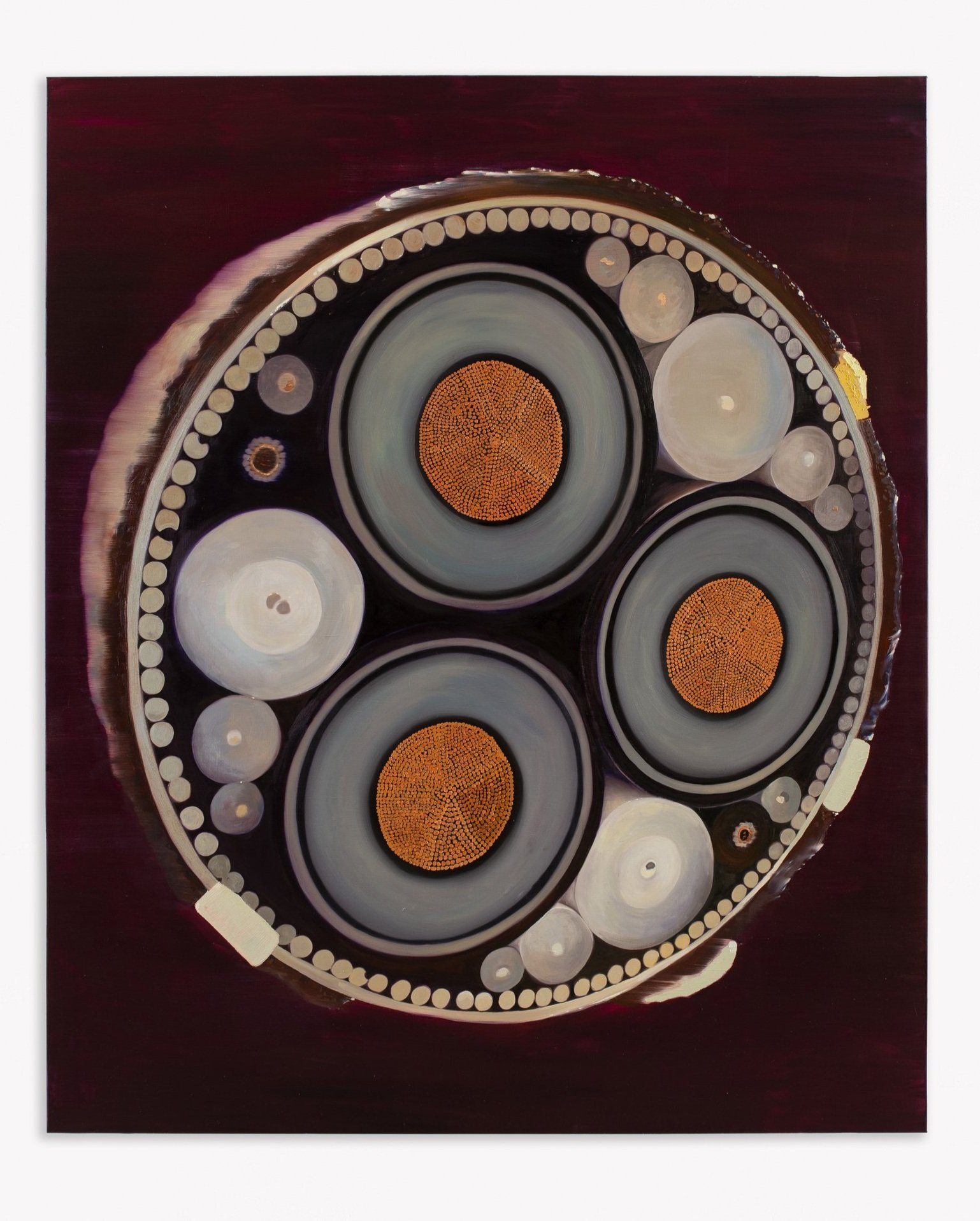
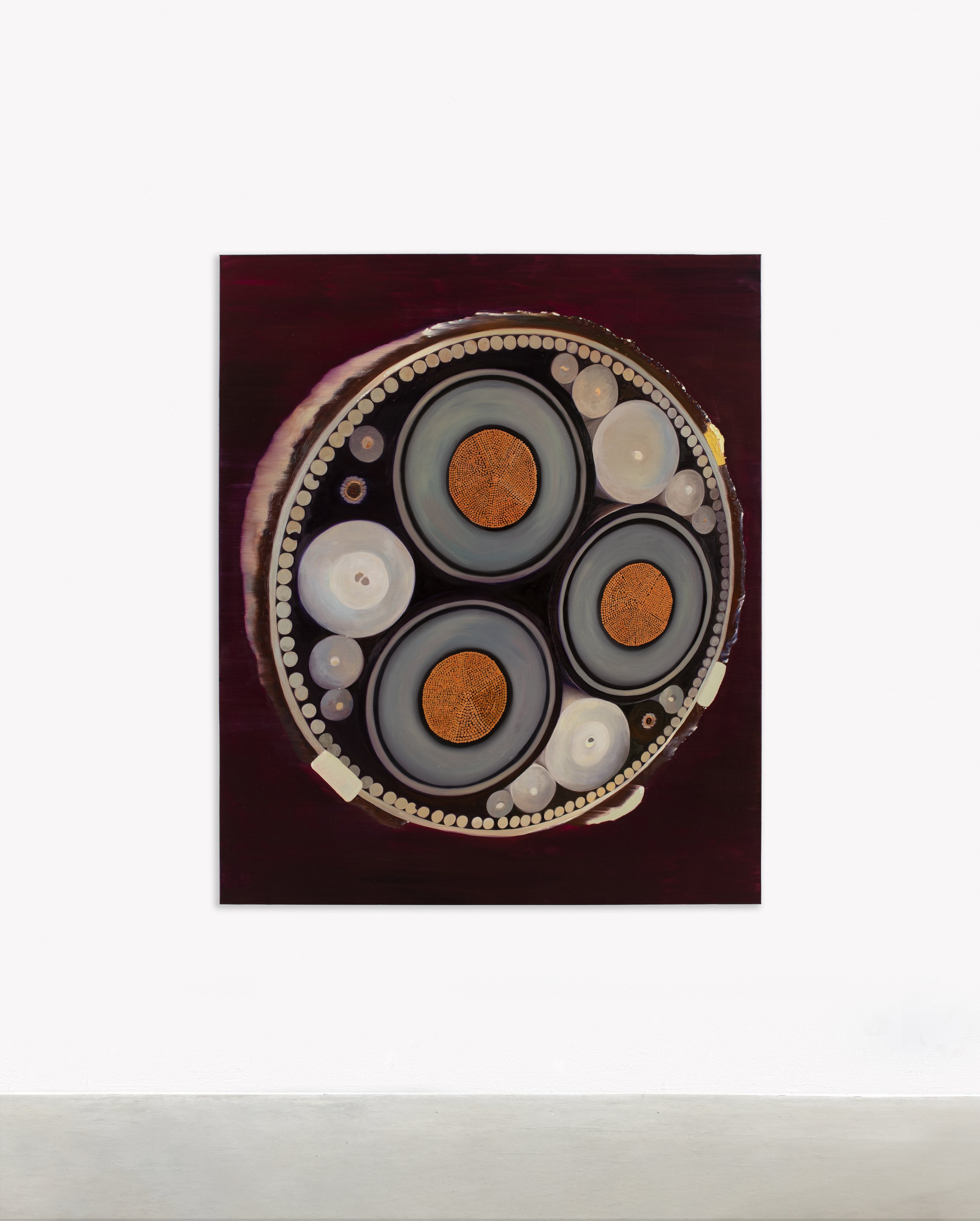
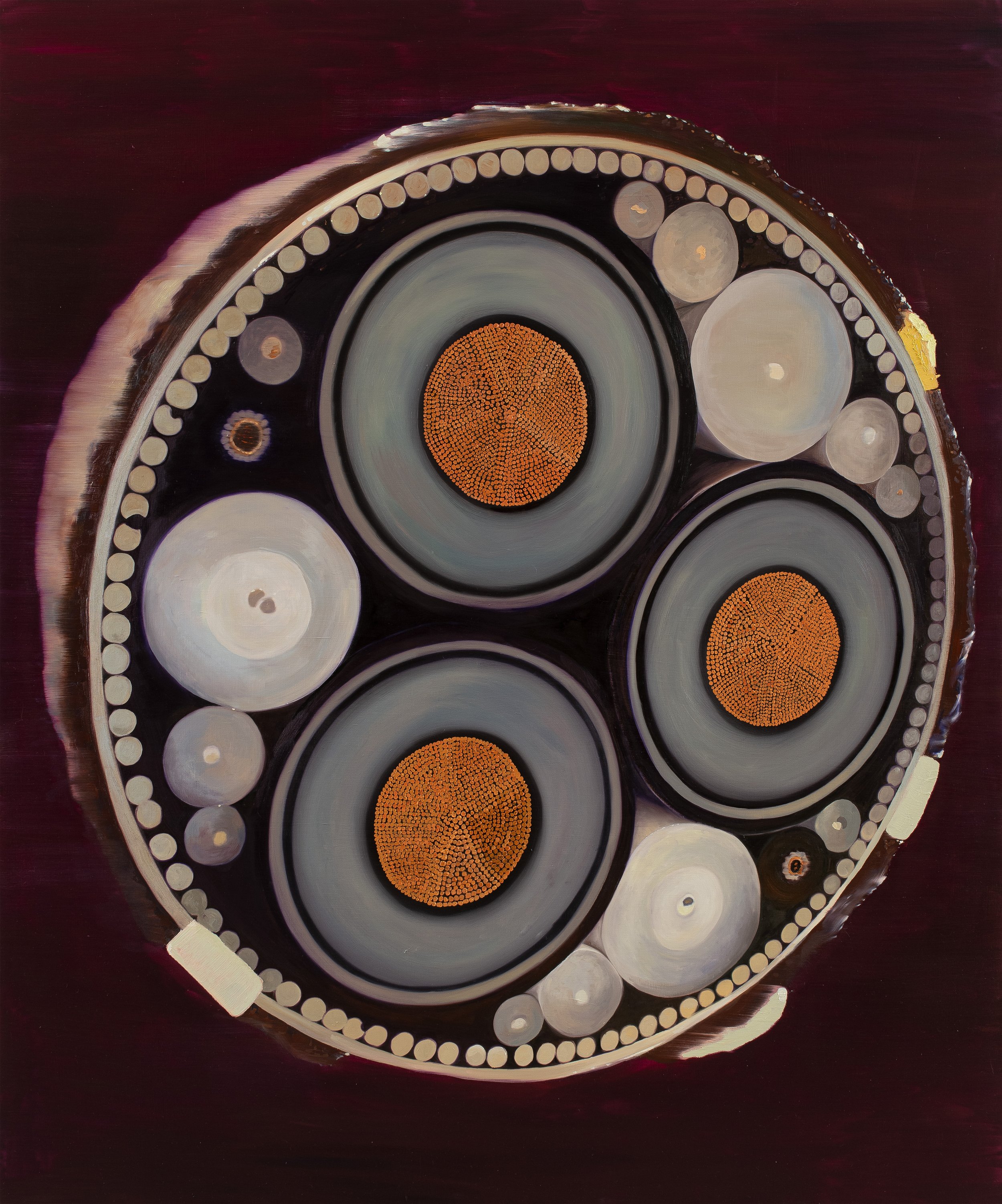
The painting is oil on linen, 182 by 152 centimeters, roughly 72 by 60 inches. It is large enough to require the body to negotiate with it, to require the viewer to step back before its full field becomes legible. The ground is deep, a layered blue-black that contains within it distinctions of tone that reward prolonged looking: passages of deep viridian, of near-black indigo, of a cold gray-blue that suggests the particular quality of light at significant depth, the bioluminescent dimness below which photosynthesis ceases and the visual world narrows to what each organism carries with it. Against this ground, luminous lines move across the canvas in trajectories that are neither the clean arcs of a technical diagram nor the arbitrary swirl of gestural abstraction. They have the character of routes: purposeful, connecting specific points, bending slightly with the topology of the ocean floor, grouping into denser concentrations where multiple cables follow the same undersea ridge before separating again toward different continental landings. These lines are rendered in warm whites and pale yellows, occasionally tipping into the faintest ochre, as if what travels through them carries something of the warmth of the bodies and institutions that generate the data they transmit.
The surface of the linen contributes materially to the painting's meaning. Linen has a weave that remains perceptible through thin paint layers, a tactile grid that underlies even the most smoothly applied surfaces. In Twenty Thousand Leagues, this weave functions as a kind of cartographic ground, suggesting the coordinate systems through which submarine cable routes are planned and documented, the latitude-longitude grid that organizes even the most remote stretches of ocean floor into named and navigable territory. Where the paint is laid more thinly, the warm cream of the linen breathes through, creating a secondary luminosity behind the applied colors. The cables, rendered in deliberate, considered marks that accumulate from individual dabs and short strokes into continuous-seeming lines, are built up in layers. Seen at close range, the marks are discrete, each one a decision; seen from across a room, they resolve into a coherent network, a map of something vast made legible through the patient accumulation of small acts. This is the formal principle of the Signal series to which this painting belongs, and it carries a specific argument: that the global network is not a single thing but a sum of thousands of individual choices, engineering decisions, treaty negotiations, and financial arrangements, each one of which has left a physical trace on the ocean floor.
The cable landing points are marked in the painting as nodes of slightly greater density, places where the linear marks cluster and intensify before separating again toward their individual destinations. These nodes correspond to real geography: the coasts of Portugal and the Canary Islands, where Atlantic cables make landfall after their transatlantic crossing; the shores of Egypt and Djibouti, where cables bound for Asia and East Africa converge from the Mediterranean and Red Sea corridors; the west coast of the United States, where Pacific cables from Japan, South Korea, and the Philippines arrive after crossing the world's largest ocean. As of 2025, according to TeleGeography, there are 597 submarine cable systems and 1,712 landing points worldwide, carrying over 95 percent of international internet traffic and nearly all international voice calls. This is infrastructure at planetary scale, largely invisible, almost entirely uninsured at its full replacement value, regulated by a patchwork of bilateral agreements that have never been consolidated into a coherent international legal framework. Tan Mu's painting registers this system not as a diagram but as a presence: something that exists in the world, that has physical weight and specific geography, that is not immune to the forces that move through the ocean around it.
Trevor Paglen has spent over a decade photographing infrastructure that was designed not to be seen. His series of undersea cable photographs, begun around 2015, documents the points at which submarine fiber-optic cables make landfall: the beaches, the cable station buildings, the armored sections of cable that emerge from the surf and disappear into concrete conduits. In NSA-Tapped Fiber Optic Cable Landing Site, Morro Bay, California, USA (2015) and related works, Paglen approaches from the water, using the ocean itself as an unmarked access route, to photograph the moment of transition between the submarine and the terrestrial, the point at which infrastructure that belongs to no one jurisdiction becomes, briefly, visible. His photographs are documentary in form and political in argument: they insist that these cables, while designed to be invisible, are physically present, and that the data flowing through them is subject to interception at exactly these points of surface emergence.
What distinguishes Tan Mu's approach from Paglen's is the question of scale and interiority. Paglen works at the cable's edges, at the points where it becomes briefly visible and briefly legible as an object with dimensions you could measure with a tape. Tan Mu works from the inside out, painting the network as a whole, treating the ocean floor as a canvas onto which humanity has written itself. Where Paglen's photographs are crisp, geographically specific, shot with the telescopic precision he uses for his satellite photographs, Tan Mu's painting is warm, accumulative, built from the inside. The cables in her image glow rather than lie. They carry something. They are not inert infrastructure but a living system, what she calls "an externalized nervous system," and the warmth of the marks she uses to render them insists on this character. Where Paglen's photographs make the cable political, Tan Mu's painting makes it phenomenological: a system that exists not only as a fact about the world but as an extension of the bodies and relationships it connects.
The phrase "externalized nervous system" is Tan Mu's own, and it is worth sitting with for a moment before moving past it. The nervous system, in biological terms, is the infrastructure of sensation and coordination: the network through which the body knows itself, registers damage, coordinates response, transmits the signals that allow a distributed organism to act as a unity. To describe submarine cables as an externalized nervous system is to propose that they function analogously for human civilization, that the global network of fiber-optic cable is the substrate through which a distributed humanity senses itself, registers events, and coordinates response. The analogy is not sentimental. It is precise. When the Tonga cables were cut and the island's connection to the global network was severed, the damage was felt not only in Tonga but in the systems that depended on Tonga's connectivity, in the shipping traffic that could not receive weather information, in the financial transactions that could not clear, in the families whose ability to assess the safety of relatives depended on a data connection. The severance of two cables produced the kind of systemic disruption that would, in biological terms, be called a lesion.
Hito Steyerl's "In Defense of the Poor Image" (2009), first published in e-flux journal, is an essay about visibility and resolution: about what it means for an image to be low quality, compressed, degraded by transmission through networks that prioritize speed over fidelity. Steyerl argues that the poor image, the JPEG artifact, the YouTube video watched at 240p, is not a failure of the system but a trace of the system's operation. The degradation is the evidence of transmission, of the many hands and servers and cable segments through which the image passed before arriving at the screen where it is being viewed. The poor image is "a copy in motion," Steyerl writes; its quality is an index of its circulation. The image that travels farthest is the image that has been most compressed. Resolution is a record of distance.
This argument illuminates something specific about Tan Mu's formal choices in Twenty Thousand Leagues. The cable networks she paints are the physical substrate through which all of Steyerl's poor images travel. The compression artifacts that degrade a video file as it crosses an ocean are produced precisely by the bandwidth constraints of the cables that Tan Mu renders as luminous filaments. The painting's surface, with its warm marks building into an image that is legible only at a distance, enacts a version of the same logic: close up, the marks are insufficient, unable to convey what they represent; at distance, they resolve into meaning. The painting is itself a kind of poor image made rich through accumulation, and this formal quality indexes the subject it depicts. But where Steyerl is interested in the politics of visibility and the class dynamics of image circulation, Tan Mu is interested in the physical substrate of that circulation, in the cable rather than the file. The two positions are complementary rather than competitive. Steyerl describes what travels through the network. Tan Mu paints the network itself.
Tan Mu's biography gives the ocean in this painting a weight it would not carry if the artist had encountered submarine cables only through research. Her paternal grandfather was a marine engineer who worked on harbor design, land reclamation, and meteorology along China's coast. Her maternal great-grandfather was a maritime trader who ran routes between China and Korea until World War II closed those passages. She is herself a competitive freediver who has trained to depths exceeding thirty meters, who has dived at Caribbean sites where submarine cables enter the ocean beside oil rigs that have become artificial reefs. The ocean in her practice is not a metaphor. It is a medium she has inhabited, a physical environment whose pressures and temperatures and specific qualities of light she knows through her body rather than through documentation. When she paints the ocean floor as a territory traversed by cables, she paints it as someone who has been in that water, who knows what it costs the body to descend and how different the world looks from thirty meters below the surface, where the sky has narrowed to a disk of light and the pressure is three atmospheres and the silence is the kind of silence that makes clear how much of what passes for silence on land is actually noise.
This somatic knowledge inflects the painting's treatment of depth. The blue-black ground in Twenty Thousand Leagues is not the flat black of a background color chosen for contrast. It is a deep ground, built from multiple layers of paint that create a sense of actual space behind the picture plane, a space that recedes. The cables run across this receding ground at no clearly defined depth: they might be at the water surface, or at the continental shelf, or at the abyssal plain four thousand meters below the surface where the majority of undersea cables actually lie. This deliberate spatial ambiguity is not confusion but argument. The cables occupy multiple depths simultaneously in the public imagination: they are at once a surface-level policy question, a mid-depth engineering challenge, and an abyssal fact about the physical structure of the world. To locate them at a specific depth would be to reduce that complexity. To leave their depth ambiguous is to insist on it.
The title's invocation of Verne carries a final implication worth drawing out. Verne's Captain Nemo was a man who had renounced the surface world entirely, who had no nationality and acknowledged no sovereignty but his own. He used the ocean's invisibility as a form of political exemption, taking what he needed from the sea and from the ships that crossed it, answerable to no one. The submarine cables that now run across the ocean floor enjoy a version of this exemption. They are outside territorial waters for the vast majority of their routes, subject to no single nation's jurisdiction, regulated by conventions that date to 1884 and that have been only partially updated in the century and more since. Their physical inaccessibility has been their security: you cannot tap a cable at a depth of four kilometers without specialized equipment, and you cannot repair one without a cable ship that costs millions of dollars per day to operate. But this practical sovereignty is also a practical vulnerability. The cables are among the most critical pieces of infrastructure in the world, and among the least protected. Tan Mu's painting holds both facts simultaneously, the luminous connectivity and the black depth, the warm routes and the cold ground. It does not resolve the tension. It insists on it.
In an essay published in 2025, curator Nick Koenigsknecht described Tan Mu's Signal series as an act of "making visible what was designed to be invisible," a practice of attending to infrastructure with the devotion that an earlier era reserved for landscapes or human figures. This description applies with particular force to Twenty Thousand Leagues Under the Seas, which is the largest and most sustained of the paintings in this vein. At 182 by 152 centimeters, it is the size of a significant body, present in a room as a body is present, requiring the same basic negotiation of proximity and distance. The scale is not incidental. It is an argument that the submarine cable network, invisible by design, distant by geography, administered by corporate entities with no obligation to make themselves legible, deserves to be seen at a scale commensurate with its actual importance in the world. Jules Verne understood that the ocean floor was becoming territory. Tan Mu's painting understands that it has become nervous system, and that a nervous system, to be healthy, requires not only to function but to be known by the body it serves, to be felt as well as used. The painting is that act of feeling: slow, material, patient, and built from the accumulation of individual marks that, taken together, trace the routes through which the world has learned to know itself.
What the painting does that no diagram or TeleGeography map can do is translate the network from data into experience. A cable route plotted on a map is a line with attributes: length, capacity, owning consortium, year of commissioning. The same route rendered in oil on linen, built up over hours of looking and deciding and applying, accumulates the quality of attention itself as a material ingredient. The paint carries the duration of its making. The cable in the painting has been thought about, held in the mind long enough to be translated into physical gesture, given the weight and warmth that the actual cable, lying in darkness at four kilometers depth, could never possess for us. This is what Tan Mu means, perhaps, when she says the cables carry not just information but memory, culture, and accumulated human presence. They carry those things in the painting because the painting is itself a form of accumulated human presence, a record of sustained attention, a portrait of infrastructure at the scale and with the devotion that infrastructure has never before received. That Verne imagined the ocean floor a hundred and fifty years before the cables were laid does not diminish the achievement. It clarifies it: the imagination reaches first, and the world, slowly, follows.