The Plate at the Center of the Galaxy: Tan Mu's Sagittarius A* and the Art of Collective Observation
On May 12, 2022, at simultaneous press conferences held in Washington, Munich, Santiago, Tokyo, Shanghai, and Taipei, the Event Horizon Telescope collaboration released the first image of Sagittarius A*, the supermassive black hole at the center of the Milky Way. The image, a ring of orange and reddish luminosity interrupted by a dark central shadow, had been assembled from data collected by eight radio telescope observatories distributed across four continents and one pole: the South Pole Telescope in Antarctica, the Atacama Large Millimeter Array in Chile, the James Clerk Maxwell Telescope in Hawaii, the Institut de Radioastronomie Millimetrique in Spain and France, the Large Millimeter Telescope in Mexico, the Submillimeter Array in Hawaii, the Submillimeter Telescope in Arizona, and the IRAM 30-meter telescope in Spain. None of these instruments, individually, could resolve a source at the distance of the galactic center with the resolution required. Together, synchronized by atomic clocks to within a fraction of a nanosecond, they constituted an effective telescope with a diameter equal to the Earth itself. The collaboration that produced the image was, in its organizational structure, something genuinely novel: not a single institution or funding body but a distributed network of facilities, researchers, and computational resources, spanning political borders and time zones, coordinated toward a single act of observation. Tan Mu painted it.
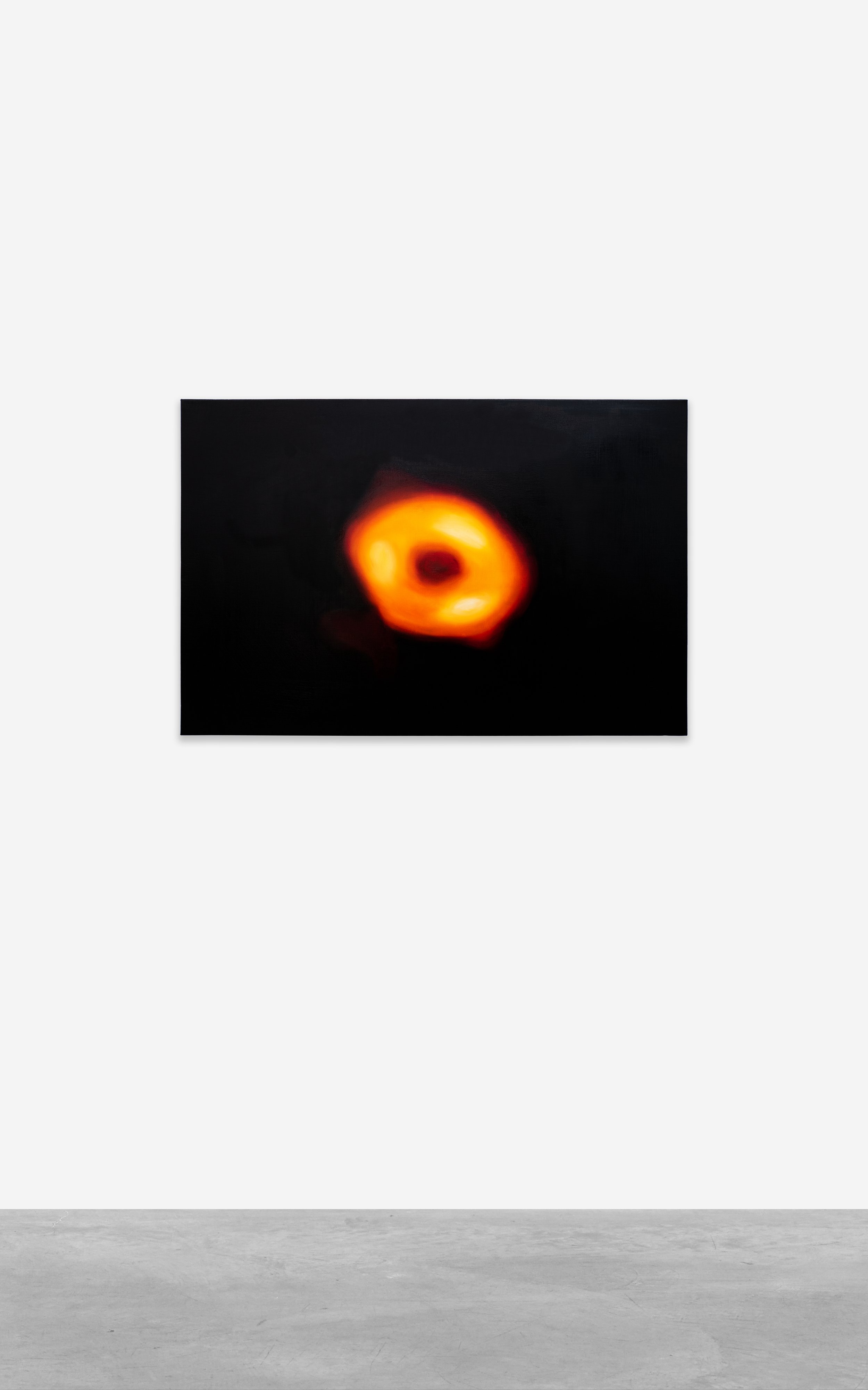
She titled the work Sagittarius A* (2022). It is oil on linen, 61 by 91 centimeters, 24 by 36 inches: a horizontal rectangle, landscape format, intimate in scale compared to the galactic object it depicts. Sagittarius A* is a black hole with a mass approximately four million times that of the Sun, located some 27,000 light-years from Earth at the gravitational center of the Milky Way. To paint it at 61 by 91 centimeters is not to minimize it. It is to bring it to the scale of the hand, the scale of the body, the scale at which a single person can stand before a painting and feel themselves in relation to it. This is a characteristic Tan Mu decision. Her largest paintings, at nearly two meters, assert themselves through scale, requiring the viewer to negotiate their presence. Her smaller works, and this is among the smaller canvases in her practice, achieve their effect through concentration, through the density of attention packed into a contained surface.
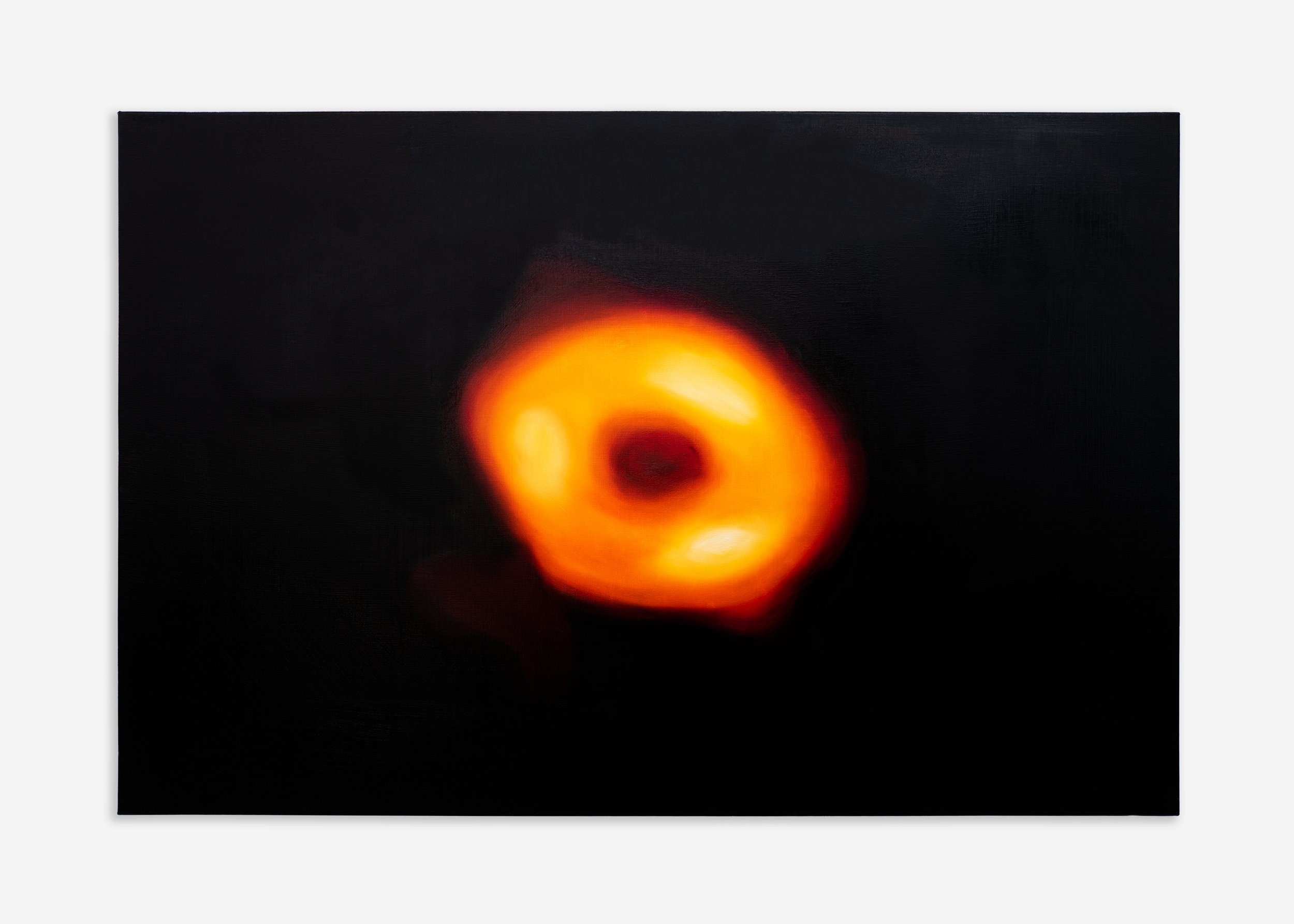
The black ground that Tan Mu uses throughout her space-related work is described by the artist as functioning like the black of scientific observation: an objectified space in which the central form can emerge with maximum clarity. In Sagittarius A*, this ground is built from multiple layers of deep paint, the darkness not a flat application but an accumulation, a depth that is chromatic rather than simply tonal. There are within it traces of very dark blue, of the faintest cool gray, of what might be an extremely dark brown in the lower registers, only perceptible in certain lighting and only at close range. Against this ground, the ring structure of the black hole is rendered in concentric zones of warm color: a deep amber close to the inner shadow, building through orange and rust to a brighter, almost incandescent zone at the ring's outer edge. The inner shadow, the region from which no light escapes because any photon generated there falls back into the event horizon, is rendered not as a flat void but as a deep dark field that has a subtle texture, a painted darkness that acknowledges the ground beneath it as a ground rather than as an absence.
The ring itself is not uniform. In the actual EHT image, and in Tan Mu's painted translation, the luminosity is uneven: brighter in some quadrants, dimmer in others, slightly asymmetric in a way that reflects the rotation of the accretion disk around the singularity. This asymmetry is a scientific fact, not an artistic choice, but Tan Mu's decision to preserve it rather than regularize the ring into a more conventionally beautiful symmetry is its own kind of choice: a choice for accuracy over comfort, for the specific truth of the observed phenomenon over the general truth of a pleasing form. The irregular ring in the painting is more difficult to look at than a perfect circle would be. It sits slightly uneasily on the canvas, resisting the eye's tendency to complete and regularize. This resistance is productive. It keeps the painting honest: this is what the black hole actually looks like, not what we might wish it to look like.
Thomas Struth began photographing scientific research facilities in 2000, producing a series of large-format photographs of particle accelerators, space agencies, and research laboratories that would eventually be exhibited under various titles including Science and Politics and Paradise. His photograph Tokamak Asdex Upgrade Interior, Max Planck IPP, Garching (2009) shows the interior of a fusion reactor during maintenance, a toroidal chamber of extraordinary geometric precision, its surfaces lined with diagnostic instruments and structural supports that create an almost organic complexity. The scale is established only by the small human figures visible at the chamber's perimeter, dwarfed by the apparatus they maintain. The photograph is technically beautiful in the way that very large, very precise machines are beautiful: the beauty of engineered things at the limit of what engineering can achieve, a beauty that carries within it the weight of the collective effort required to conceive and construct them.
What Struth photographs, and what Tan Mu paints, is the trace of collective scientific labor made material. The fusion reactor's interior is a physical record of the calculations, trials, and refinements that produced it. The black hole image is a physical record of the coordinated observations, the computational algorithms, and the years of data processing that assembled it. In both cases, the apparatus or the image carries within it an invisible history of labor that the photograph or painting makes briefly visible by attending to it with sufficient concentration. The difference between Struth's approach and Tan Mu's is a difference of register. Struth works with the physical apparatus, the machine itself, the thing that labor built. Tan Mu works with the image that the apparatus produced, the output rather than the instrument. In this she is consistent with her broader practice of painting results: the loading screen, the satellite photograph, the black hole image, the cable network map. She paints the moment of knowledge, not the mechanism that produced it, and then asks what it means that this moment of knowledge exists, what human arrangements had to be made to make it possible.
Tan Mu's own account of what drew her to the black hole images focuses on the process of their making rather than their final appearance. "What interests me most is not only the final image of a black hole," she has said, "but the process through which that image is generated. Black holes cannot be photographed directly. Instead, data is gathered by telescopes positioned around the world and then synthesized into a visual form. This process feels similar to printmaking, where fragmented information is gradually consolidated into a complete image." The comparison is precise and generative. Printmaking, in its traditional forms, involves the preparation of a plate or matrix from which an image can be transferred: the image exists first as a negative, as the surface of wood or metal or stone that will receive ink, and becomes visible only through the pressure of the press, the transfer of medium from matrix to support. The plate is the accumulated information; the print is the synthesis. In the EHT process, each telescope observatory is a kind of plate, receiving not ink but radio waves at a specific frequency, recording not an image but a set of measurements that will be combined with the measurements from every other observatory to reconstruct, through algorithms of extraordinary sophistication, the image that no single instrument could resolve. The synthesis, like the press, produces from distributed fragments a coherent whole.
This analogy is not simply metaphorical. Tan Mu studied expanded media at Alfred University, where printmaking is a core component of the curriculum, and her understanding of printmaking as a process oriented toward reproduction, distribution, and the movement of information from one carrier to another shapes her reading of contemporary imaging technologies. When data centers store information, she has noted, they function as contemporary plates, sites where data is recorded in a form that can be copied and circulated. When radio telescopes gather data, they are recording onto their respective plates; when the data is synthesized, the print is made. What the analogy reveals is that the black hole image is not, in the final analysis, an observation in the traditional sense, a single instrument pointed at a single source at a single moment. It is a construction, an assembly of partial observations into a coherent visual form, and the construction involved judgment, parameter selection, algorithmic choice. Colors were assigned to data values. Ranges were compressed and expanded. Uncertain regions were handled through specific computational strategies. The image that emerged from this process is accurate, in the sense that it correctly represents what the data says about the source, but it is not neutral. It carries within it the choices that were made in its construction, and those choices were made by specific human beings at specific institutions with specific intellectual traditions.
Vija Celmins has spent the better part of six decades making drawings and paintings of the ocean surface and the night sky, two phenomena that share the quality of requiring both extreme precision and the acknowledgment of what precision cannot capture. Her graphite drawings of the ocean, begun in the late 1960s, render the surface of the Pacific in painstaking detail, each small mark a record of a wave or a glinting reflection, accumulating over hundreds of hours of drawing into a field of extraordinary density. Her mezzotint prints of the night sky, made from photographs taken at observatories, use the technique's capacity for velvety dark grounds to render the sky as a field of discrete luminosities, each star or galaxy a small bright point that emerges from a background of textured darkness. The night sky drawings and prints occupy an interesting position in the history of astronomical representation: they are neither scientific illustrations nor romantic landscapes but something in between, images that take the sky seriously as an observational subject while making no claim to the authority of scientific documentation.
What Celmins understands, and what Tan Mu shares with her, is that the night sky is not a background. It is a surface, a field of specific information that can be mapped and enumerated and described in detail. Each point of light in a Celmins sky drawing corresponds to a real object at a specific distance. Her decision to render them all at the same scale, to give the nearest star and the most distant galaxy the same small mark in the drawing, is not a failure of scientific accuracy but a formal choice that reflects a particular truth: that from the perspective of a human eye looking up, these objects are indistinguishable in kind. They are all lights in the dark. The sky is flat. The precision of Celmins's rendering preserves this flatness while acknowledging the depth it conceals.
Tan Mu's approach in Sagittarius A* is, in one important respect, the inverse of Celmins's sky drawings. Where Celmins renders a field of many objects at equal scale, preserving the perceptual democracy of the night sky, Tan Mu renders a single object in isolation, surrounded by a ground that contains nothing. The black hole is the only subject. The sky around it, in the painting, is empty: not the populated darkness of a Celmins sky but a void, a ground against which the ring structure is the sole event. This isolation is scientifically accurate in the sense that the EHT image was processed to remove the visual noise of the surrounding field, to show only the black hole's immediate environment. But it is also a statement of attention: to paint Sagittarius A* against an empty ground is to insist that this object, this particular knot in the fabric of spacetime at the center of our galaxy, deserves the quality of attention that is usually reserved for singular subjects. Portraits. Individual faces. Objects of devotion. Tan Mu paints the black hole the way an earlier painter might have painted a saint: centered, isolated, attended to without distraction.

The collectivity of the EHT project is not incidental to Tan Mu's interest in it. She has spoken directly about being moved by the fact that the black hole images required not only distributed instrumentation but sustained international collaboration, cooperation across political borders and institutional cultures that rarely cooperate easily on anything. The EHT collaboration includes institutions in countries whose governments maintain complex and sometimes adversarial relationships: the United States, China, Japan, Germany, France, Spain, Mexico, Taiwan, Chile. To coordinate observations across these institutions, to agree on standards, to share data, to co-author papers, to hold simultaneous press conferences in six cities across three continents, required a level of trust and coordination that is unusual in both science and politics. The image that emerged from this process is, among other things, a record of that trust. It is what the planet looks like when it looks at itself collectively.
This framing connects Sagittarius A* to a broader concern in Tan Mu's practice with what she calls the invisible presence of human labor within technological images. In her account, the data center is a contemporary printmaking plate, a site where information is recorded and from which it can be copied and circulated. The black hole image is a print made from a plate that had no physical existence, a distributed plate assembled from the measurements of eight observatories and processed through algorithms that took years to develop and validate. The human labor embedded in this image is staggering and almost entirely invisible: the careers of the scientists who designed the instruments, the graduate students who processed the data, the engineers who maintained the observatories through Antarctic winters and high-altitude storms. Tan Mu's painting does not make this labor visible in any literal sense. You cannot see the researchers in the ring of orange light. But the painting's own accumulated labor, the hours of looking and deciding and applying paint, is itself a form of tribute to that invisible work, an acknowledgment that the image was not given but made, and that making it required the sustained attention of many people over many years.
The painting was made in 2022, in the same year as the EHT release. This contemporaneity is important to Tan Mu, who has described a sense of timeliness in her practice: a desire to document scientific milestones as they occur, to respond to moments of collective knowledge-making while they are still recent enough to feel urgent. There is a difference between painting Sagittarius A* in 2022, when the image was three months old and the press conferences were still recent memory, and painting it in 2035, when the image will have been absorbed into the general culture of astronomical imagery and will no longer carry the charge of the new. Tan Mu paints the present, or rather, she paints the recent past, the moments of knowledge that have just occurred and that have not yet been thoroughly processed by the culture. In this she is functioning as a kind of documentarian, but a documentarian whose medium imposes a particular quality of attention, the slow accumulation of paint over hours and days, that transforms documentation into meditation.
There is also something worth noting about the relationship between the painting's subject and its maker's position in the solar system. Sagittarius A* is at the center of the Milky Way. Tan Mu, working in her Paris studio, is approximately 27,000 light-years from it. The light captured by the EHT observatories left the vicinity of the black hole 27,000 years before any modern human drew breath, before the first cave paintings were made at Lascaux, before the invention of writing, before any of the institutions that built the Event Horizon Telescope existed or could have existed. The image that Tan Mu painted was a record of something that happened before human civilization began. To paint it in oil on linen in 2022 is to perform an act of temporal reclamation: to bring something 27,000 years old and 27,000 light-years distant into the scale of the human, into the 61 by 91 centimeters that a hand can reach across, that a body can stand before. The intimacy of the scale is the argument. The black hole is here, the painting says. It is within reach. It is ours to attend to.
What the painting asks of the viewer, ultimately, is the same thing the EHT collaboration asked of its participating institutions: the willingness to contribute a local perspective to a larger synthesis, to trust that what emerges from the combination will be more than any single perspective could provide. The viewer standing before Sagittarius A* brings their own history of looking, their own knowledge of astronomical imagery, their own aesthetic sensibility, their own degree of attention. The painting is the plate. What is printed is whatever arises in the encounter between the painting's specific material surface and the viewer's specific embodied presence. The synthesis is different for each viewer, just as the EHT's synthesis was different for each algorithm that was used to process the data, and just as the image that emerged from the press was different from the data that went in. This is not relativism. It is the acknowledgment that images are never only what they contain. They are always also the record of how they were made, and the making of this one, both the scientific making and the painted translation, required the world to look at itself together, from every direction at once, and find in that looking something worth seeing.