The Box You Cannot Open: Tan Mu's Containers and the Philosophy of Global Exchange
In March 2021, the Ever Given, a container ship 400 meters long and 59 meters wide, ran aground in the Suez Canal, blocking one of the most critical chokepoints in global maritime trade for six days. At the time of the grounding, the Ever Given was carrying 18,300 twenty foot equivalent units of cargo, containers filled with everything from furniture to frozen fish to electronic components destined for factories in Europe. The blockage held up an estimated 9.6 billion dollars in daily trade. Ships queued at both ends of the canal, their containers stacked on their decks in towers of red and blue and green, each one sealed, each one holding goods that someone, somewhere, was waiting for. The image of the Ever Given wedged diagonally across the canal, its bow jammed into the eastern bank, its stern blocking the western channel, became the defining visual of a year in which the global supply chain, the invisible infrastructure that moves physical goods from factory to warehouse to store shelf, revealed its fragility to a public that had never before had reason to think about it. Tan Mu painted Containers in 2021, the same year. The painting is not about the Ever Given. It is about the system the Ever Given disrupted, the network of ships, ports, trucks, and highways that moves approximately 80 percent of global trade by volume, a system so vast and so essential that its failure produces not inconvenience but crisis. The painting does not depict a crisis. It depicts the normal state of the system, the ordinary, daily, unremarkable movement of sealed boxes along a highway, and it asks the viewer to see, in that ordinariness, the architecture of a world that depends on the continuous circulation of things it cannot see.
The COVID-19 pandemic, which began disrupting global supply chains in early 2020 and continued to produce shortages and delays through 2022, made the container visible to a public that had, for decades, treated it as invisible infrastructure. The standard intermodal shipping container, 20 or 40 feet long, 8 feet wide, 8.5 feet tall, made of corrugated weathering steel, designed to be stacked on ships, loaded onto trains, and transferred to truck chassis without ever being opened, is one of the most consequential inventions of the twentieth century. Malcolm McLean's development of the standardized container in the 1950s reduced the cost of loading and unloading cargo by approximately 97 percent, from 5.86 dollars per ton in 1956 to 0.16 dollars per ton by 1970. This reduction made it economically feasible to manufacture goods in one country and sell them in another, the foundation of the globalized economy that has shaped the material conditions of contemporary life. When the pandemic closed ports, reduced labor forces, and disrupted the flow of containers from Asia to North America and Europe, the result was not merely logistical. It was existential. People could not buy the things they expected to buy. Factories could not obtain the components they needed. The supermarket shelf, the Amazon delivery, the automobile dealership, all of these sites of consumer normalcy revealed themselves to be endpoints of a chain that stretched across oceans and through ports that most consumers had never heard of. The container, which had been the most invisible object in global commerce, became the most visible symbol of its vulnerability.
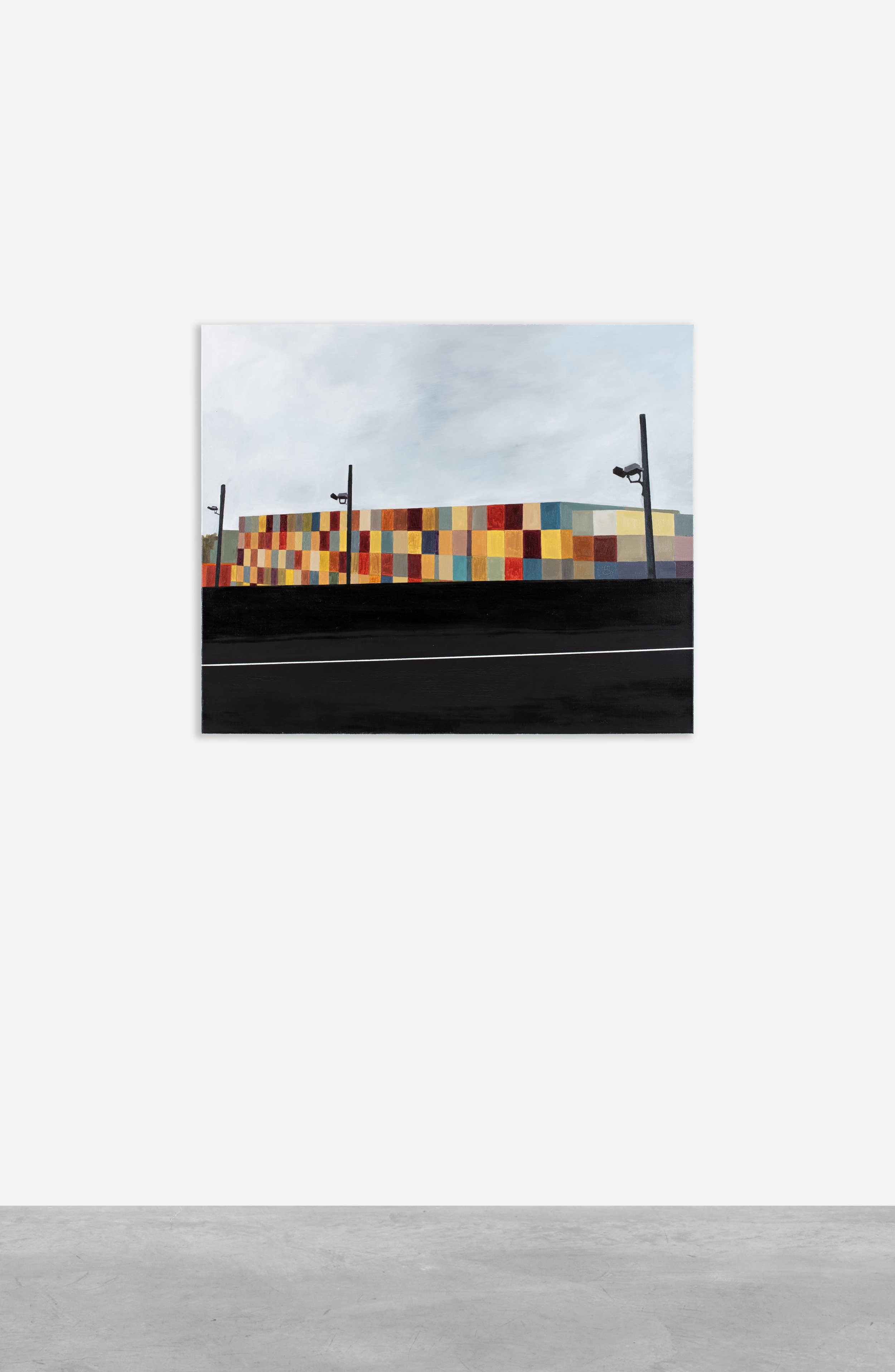
The painting, oil on linen, 76 by 91 centimeters, depicts a highway flanked on both sides by walls of shipping containers stacked in towers of red, blue, green, yellow, white, and weathered brown. The composition is built on a strong linear perspective, the road converging toward a vanishing point in the center of the canvas, the lane markings guiding the eye downward and forward into the depth of the image. The containers on the left side of the road are rendered in warmer, more weathered tones, rust browns and faded oranges that register the patina of steel exposed to salt air and rain. The containers on the right are brighter, primary colors that have retained their factory applied coatings, reds and blues and greens that vibrate against the muted sky above. The sky is a low, overcast gray, the kind of sky that hangs over industrial zones and port cities, not dramatic, not threatening, just present, a ceiling of cloud that flattens the light and removes the distinction between morning and afternoon. A small vehicle, a truck or car, is visible in the distance, moving toward the vanishing point, its scale reduced by perspective to a fraction of the container towers that surround it. The vehicle is the only element in the painting that registers the presence of a human being. The containers, the road, the sky, none of these are human. They are infrastructure, the material substrate of a system that serves human needs but that operates, in its daily functioning, without human visibility.
The paint handling in this canvas is notable for its restraint. The containers are rendered as simplified rectangular blocks, their surfaces flat, their edges sharp, their colors applied in even, unmodulated passages that give them the quality of commercial signage rather than pictorial representation. Tan Mu has spoken about this deliberate reduction: "By minimizing detail, I wanted to shift attention away from individual objects and toward their collective meaning." The strategy is philosophical before it is formal. A shipping container, by design, conceals its contents. It is a sealed box, opened only at its origin and its destination, opaque at every point in between. The painting reproduces this opacity. The viewer cannot know what is inside the containers. The colors tell nothing. The numbers and markings that would identify a specific container, its owner, its route, its contents, have been omitted. What remains is the box itself, the rectangular volume, the standardized unit of global trade, repeated dozens of times across the canvas, each one identical in form and different only in color. The repetition is the point. The container is not an individual object. It is a unit, a module, an element in a system that derives its power not from any single container but from the aggregate, the millions of containers in simultaneous motion around the world, each one a sealed packet of goods moving from where it was made to where it will be consumed.
Edward Hopper painted a gas station in 1940. Gas shows a single Standard Oil station on a rural road at dusk, its pumps illuminated by artificial light, a woman tending the facility, the forest behind her dark and encroaching. The painting is one of Hopper's most austere, its subject the most mundane of American infrastructure, the filling station where a motorist stops to refuel before continuing on a road that extends, in both directions, beyond the frame. Hopper's genius, in this painting as in so many others, is to treat the mundane as significant, to look at a gas station the way a seventeenth century Dutch painter would look at a still life, with an attention so sustained and so specific that the object under scrutiny reveals depths of meaning that casual observation cannot access. The gas station is not merely a place to buy fuel. It is a threshold, a point of transition between one place and another, a site where the traveler pauses in a journey that is defined not by the pause but by the movement that surrounds it. The light that illuminates the pumps is artificial, replacing the natural light that is failing, and this replacement is the painting's quiet drama: the human imposition of order on a natural process, the creation of a habitable zone in a landscape that would otherwise be dark.
The connection between Hopper's gas station and Tan Mu's highway is structural, not stylistic. Both paintings depict infrastructure, the material systems that enable movement through space. Both paintings treat this infrastructure as the subject, not as a background for human activity but as the primary focus of the painter's attention. Both paintings use perspective to draw the viewer into a space that extends beyond the frame, the road in Hopper's painting receding into the twilight, the road in Tan Mu's painting converging on a vanishing point that is hidden behind the container walls. And both paintings are, at their core, about the relationship between the individual and the system, the single person who stops at a gas pump or drives between container towers and the vast network of roads, pipelines, ports, and shipping routes that makes their movement possible. Hopper paints the gas station attendant as a solitary figure, dwarfed by the infrastructure she serves. Tan Mu paints no figure at all. The only vehicle in the painting is a distant speck, a dot of color on a road that is itself a thin line between walls of steel. The human being has been reduced to a component of the system, a packet of agency moving through a landscape that was built not for human habitation but for the movement of goods.
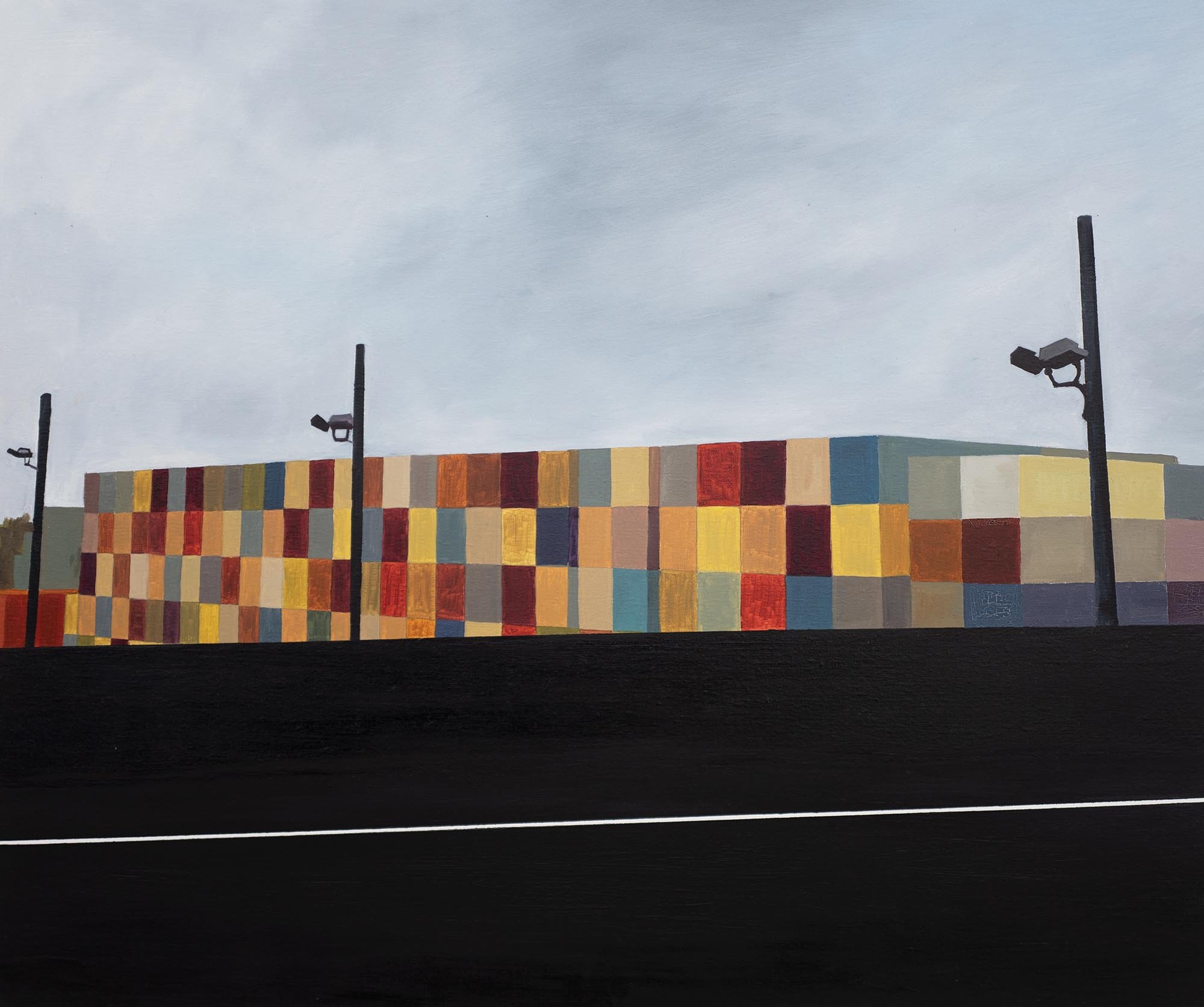
The philosophical question that the painting raises is not about trade or logistics or the pandemic. It is about visibility and concealment, about what it means to live inside a system that one cannot see. The container is the paradigmatic object of this condition. It is designed to be invisible. Its contents are hidden. Its route is determined by algorithms and contracts that the end consumer never encounters. Its physical form, the corrugated steel box, is so standardized and so ubiquitous that it has become part of the visual background of port cities and industrial zones, as unremarkable as a brick in a wall. And yet this invisible, unremarkable object is the physical carrier of the material conditions of contemporary life. The phone in your pocket was shipped in a container. The clothes on your body were shipped in a container. The food you ate today was, in many cases, shipped in a container or in a refrigerated container, a variant of the standard box equipped with a cooling unit that maintains the temperature of perishable goods across weeks of ocean transit. The container is not peripheral to the system of global exchange. It is the system. And the painting, by rendering it as a flat, colored rectangle, stripped of identifying marks, stripped of context, stripped of everything except its form and its color, forces the viewer to confront the abstraction that the container represents: the reduction of an infinite variety of goods, cultures, and human needs to a standardized unit of volume.
Tan Mu's relationship to the container is not merely intellectual. It is biographical, familial, and personal. Growing up in Yantai, a major port city on the coast of Shandong province, she was, from childhood, exposed to the visual reality of maritime trade. "Growing up in Yantai, a major port city, I was naturally exposed to cargo transport and container logistics, partly because of my parents' professions," she has said. "Images of ships being loaded and containers moving in and out of the harbor became part of my childhood visual memory." These memories did not remain in the background. They entered her practice, first as visual material and then as conceptual framework, the understanding that the container is not merely an industrial object but a carrier of meaning, a vessel that holds not only physical goods but the cultural, economic, and emotional exchanges that connect human communities across distance. The biographical depth of this understanding extends further, into a family history that precedes the container itself.
Tan Mu's maternal great-grandfather was a maritime trader during the Republican era, navigating international waters between China and Korea. "His work involved not only the exchange of goods but also the movement of culture and ideas," Tan Mu has said. "During World War II, his journeys were interrupted, and he was forced to remain in Korea, where he became part of the overseas Chinese community before eventually returning to China later in life." The great-grandfather's trade was pre-container, conducted in an era when goods were loaded and unloaded by hand, when the cost of labor at port was so high that only high value commodities, silk, tea, porcelain, could justify the expense of maritime transport. The container revolutionized this economy, reducing the cost of transport to a fraction of its pre container level and making it feasible to ship low value goods, clothing, electronics, furniture, across oceans. But the human exchange that the great-grandfather practiced, the movement of culture and ideas alongside goods, the formation of transnational communities through trade, this did not change. The container made it faster, cheaper, and more extensive. It did not make it different. The painting, in this biographical reading, is a portrait of a system that Tan Mu's family has participated in for four generations, from the great-grandfather's pre container trade between China and Korea to Tan Mu's own use of maritime shipping to transport artworks and materials across borders.
The road in the painting, based on a photograph Tan Mu took while driving on a highway in New Jersey, is not incidental to the composition. It is the compositional spine, the element that organizes the container walls into a coherent spatial structure. The road functions both literally and symbolically. Literally, it is the pathway along which containers travel by truck, the last leg of a journey that began in a factory, passed through a port, crossed an ocean, and arrived at a distribution center from which individual containers are dispatched to their final destinations. Symbolically, it is the pathway of transmission itself, the channel through which goods, information, and memory circulate across the surface of the earth. The road is the terrestrial equivalent of the submarine cable, the highway equivalent of the fiber optic strand. It carries packets of material from one node to another, and its capacity, its width, its condition, its congestion, determines the speed and reliability of the transmission. In 2021, when Tan Mu painted this image, the roads around the ports of Los Angeles and Long Beach were clogged with trucks waiting to pick up containers that could not be unloaded because there were not enough workers, not enough chassis, not enough warehouse space. The system had not failed. It had been overwhelmed. And the painting, with its walls of containers pressing in on both sides of a road that narrows to a point in the distance, captures this feeling of overwhelm, the sensation of being inside a system that is too large, too full, too fast for the space that contains it.
Nick Koenigsknecht's observation that humanity's relationship to its technology should be understood as a cohabitation with "bio techno siblings" applies to the container with particular force. The container is a sibling in the most literal sense: it was conceived, born, maintained, and will eventually be replaced, like every other technology that humans have created to extend their capabilities beyond the limits of the body. The container extends the body's capacity to carry. A human being can carry, at most, fifty kilograms on their back. A container can carry approximately 28,000 kilograms. A human being can walk, at most, forty kilometers in a day. A container can travel 15,000 kilometers across an ocean in two weeks. The container is a prosthetic, an artificial extension of the human carrying capacity, and it has, in the seventy years since its standardization, reshaped the geography of production and consumption, the distribution of wealth and poverty, the patterns of migration and settlement that define the contemporary world. It is, as Koenigsknecht would say, a sibling with a lifecycle. It was conceived in the mind of Malcolm McLean in the 1950s. It was born when the first container ship, the Ideal X, sailed from Newark to Houston in 1956. It has been maintained, modified, and standardized over seven decades. And it is now, in the age of drone delivery and autonomous vehicles and three dimensional printing, in the process of being supplemented, if not yet replaced, by technologies that may render it as obsolete as the sailing ship it replaced.
The painting does not narrate this lifecycle. It does not need to. It depicts the container in its moment of maximum dominance, the present, the era in which 80 percent of global trade moves by container ship, the era in which a single blocked canal can hold up 9.6 billion dollars of daily trade, the era in which a pandemic can reveal, in the empty shelves of a supermarket, the fragility of a system that the public had always taken for granted. The multicolored boxes on both sides of the highway are not symbols of crisis. They are symbols of normalcy, the ordinary, daily, unremarkable condition of a world in which goods move continuously, invisibly, from where they are made to where they are consumed, through channels that the consumer never sees and rarely thinks about. The painting asks the viewer to think about them. Not to worry about them, not to fear them, not to critique them, but to see them, to register the colored boxes and the narrowing road and the low gray sky as the visual facts of a world that is held together not by treaties or ideologies or cultural affinities but by the continuous, physical movement of sealed boxes across oceans and highways, each one carrying something that someone needs, each one a carrier of goods and information and, if you look closely enough, of memory, of the great-grandfather's trade routes and the childhood view of Yantai harbor and the artist's own shipments of canvases and pigments across the borders of a world that her family has been crossing, by sea, for four generations.