The Moment the System Speaks: Tan Mu's Glitch Series and the Aesthetics of Failure
In October 2023, a major network outage struck Europe, grounding flights, disrupting hospital systems, and stranding travelers in airports across the continent. The cause was not a cyberattack. It was not a natural disaster. It was a software update, a routine maintenance operation that introduced a logic error into a system on which thousands of critical services depended, triggering a cascading failure that spread through interconnected networks faster than any human operator could intervene. Travelers stood in terminals watching departure boards flicker between correct information and garbled code. Medical staff in hospitals lost access to patient records. Financial systems halted transactions. The entire edifice of digitally managed infrastructure, the invisible architecture that schedules flights, routes ambulances, and processes payments, revealed itself, in a matter of hours, to be a house of cards built on layers of code that no single person fully understands. Tan Mu had been reading reports forecasting exactly this kind of large scale failure when the outage occurred. The coincidence between prediction and event confirmed something she had been developing in her studio since late 2022: a body of work that treats the glitch, the moment when a digital system produces an output that is visibly wrong, as more than an error. The Glitch series, begun in 2022 and continued into 2023, treats the glitch as a revelation, the brief, involuntary moment when the hidden architecture of a system surfaces into visibility, when the smooth screen of digital normalcy cracks and the viewer glimpses, through the crack, the machinery that was always there, running beneath.
The co-authored text that accompanies the series, written by Echo and Nick Koenigsknecht, poses a question that reframes the entire body of work: "What if a glitch is not just an error, but an opportunity, a rupture that reveals the hidden processes beneath the surface, maybe even a moment that invites us to pause and reflect on the singular ways technology metabolizes, distorts, and generates information?" The proposition is deliberately counterintuitive. In the language of software engineering, a glitch is a defect, a deviation from intended behavior, a failure that must be identified, diagnosed, and corrected. The entire apparatus of quality assurance, automated testing, and continuous integration exists to eliminate glitches before they reach the end user. But the Glitch series proposes that the elimination of glitches is itself a form of concealment, a smoothing over of the system's true nature that prevents the user from understanding what the system actually is. When the departure board displays garbled code, it is not malfunctioning. It is functioning honestly, showing the viewer what lies beneath the clean interface, the raw data, the unformatted signal, the code that was always there but that the interface was designed to hide.
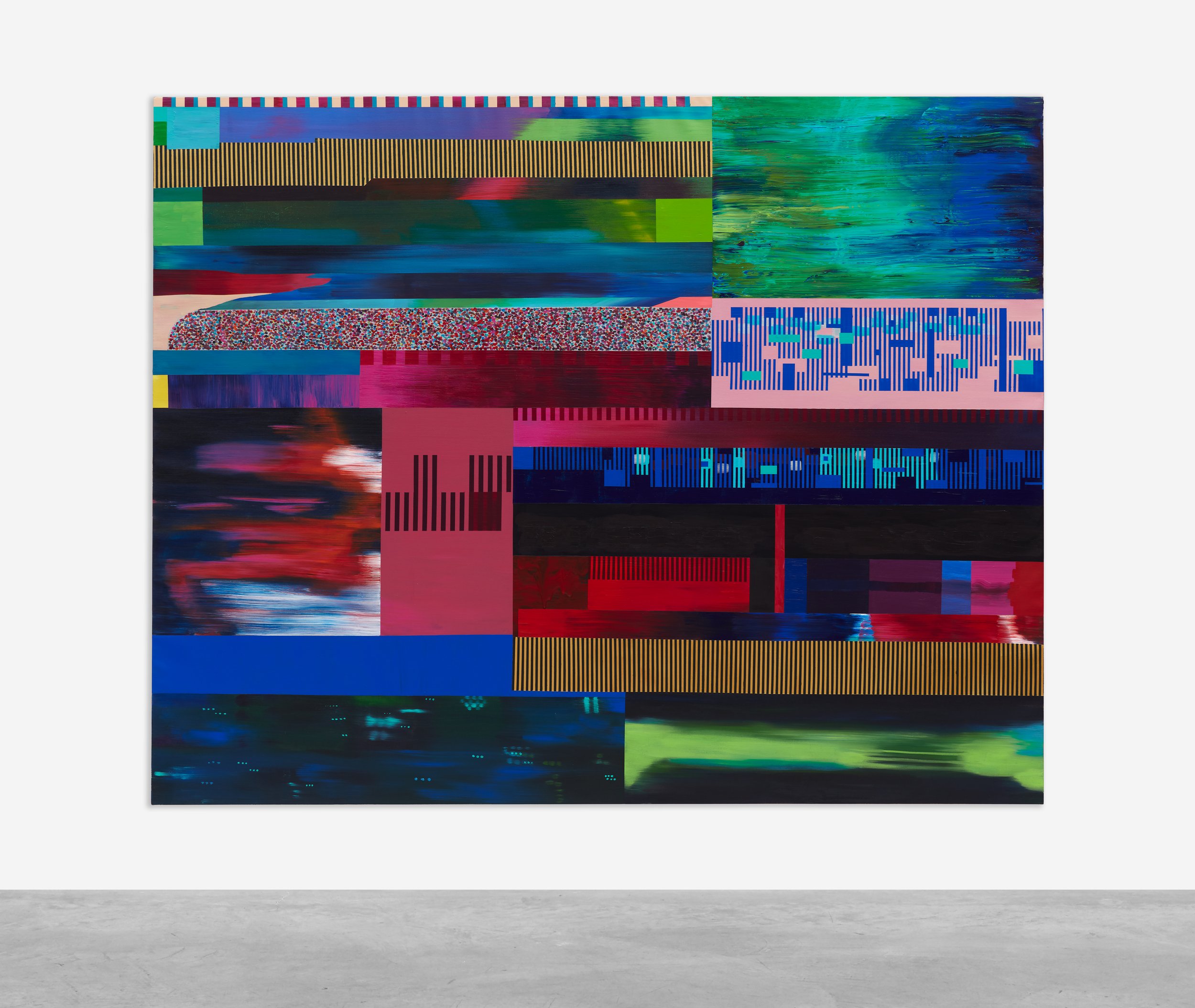
The paintings that make up the series are large, oil and acrylic on linen, with dimensions of 193 by 244 centimeters, a scale that places them in the register of the monumental, works that fill the viewer's peripheral vision and cannot be taken in at a glance. The compositions are abstract, built from fields of bold color, yellow-green, magenta, cyan, and black, divided by sharp transitions that mimic the visual artifacts of a corrupted digital display. Diagonal slashes cut across the picture plane, fragmenting the color fields into zones that do not align, that are displaced from their expected positions the way a corrupted image file displays its data in the wrong rows and columns. Vertical structures, thin parallel lines grouped into bands, appear within and between the color fields, evoking the visual language of barcodes, the machine readable symbols that encode product identity, price, and origin into patterns of bars and spaces that are legible to scanners and illegible to human eyes. The barcode, in Tan Mu's treatment, is not a specific commercial symbol. It is a motif, a visual register of the invisible information systems that organize contemporary life, the codes that track a package from factory to doorstep, that identify a patient in a hospital database, that authenticate a financial transaction across borders.
The material technique that produces these effects is layered and deliberately controlled. Tan Mu applies acrylic and oil in successive passes, using masking techniques to create the sharp edges and abrupt color transitions that distinguish the Glitch paintings from her other abstract works. The masking process involves the application of tape or liquid resist to areas of the canvas before paint is applied, creating boundaries between color fields that are mechanically precise rather than hand drawn. When the mask is removed, the edge between two colors is clean, the transition instantaneous, the same quality of abrupt shift that occurs when a digital display corrupts and one block of data replaces another without gradient or warning. In certain areas, the paint is applied in thick impasto, the surface built up in ridges and furrows that catch light and cast shadows, emphasizing the physical density of the painted surface in contrast to the weightlessness of the digital image it depicts. This interplay between the mechanical precision of masking and the physical weight of impasto is the material core of the series, the point at which the painting registers the tension between the digital and the material, the smooth and the textured, the invisible and the visible.
Sigmar Polke spent the last two decades of his life, from the mid 1980s until his death in 2010, subjecting painting to a process of systematic contamination. He mixed his pigments with arsenic, meteorite dust, uranium, and poisonous botanical extracts. He painted on fabrics printed with commercial patterns, allowing the manufactured design to show through and compete with the marks he applied on top. He exposed his canvases to weather, to heat, to chemical reactions that produced unpredictable color shifts and structural failures in the paint film. The resulting works, paintings like The Three Lies of Painting (2005) or the Watchtower series of the 1980s, are among the most materially complex and conceptually aggressive in postwar European art. Polke's contamination of the painting process is not nihilism. It is epistemology. By introducing foreign substances and unpredictable reactions into the medium, he forces the painting to reveal its own material conditions, the chemistry of pigment, the physics of surface tension, the biology of decay, that conventional painting conceals beneath the illusion of pictorial unity. The painting, in Polke's hands, stops being a window onto a represented world and becomes an object in the world, subject to the same physical laws as any other material substance.
The connection to Tan Mu's Glitch series is structural, not stylistic. Where Polke contaminates his paintings with chemical agents, Tan Mu contaminates hers with the visual language of digital failure. The sharp color divisions, the displaced blocks, the barcode structures, these are contaminants, foreign elements introduced into the pictorial field that disrupt the viewer's expectation of pictorial coherence. A painting, like a digital display, is expected to present a unified image, a composition in which every element relates to every other element in a system of visual order. The glitch disrupts this order. It introduces an element that does not belong, a block of color in the wrong place, a line that breaks where it should continue, a gradient that shifts where it should be smooth. In a digital display, this disruption is caused by a software error. In Tan Mu's paintings, it is caused by a deliberate formal decision, the choice to place a magenta field next to a cyan field with a sharp diagonal edge rather than a graduated transition. The decision is not random. It is modeled on the visual behavior of actual glitch artifacts, the specific patterns of corruption that occur when a digital signal is interrupted, distorted, or partially lost. The painting does not simulate a glitch. It performs one, translating the digital event into a material event, the corruption of data into the disruption of pigment.
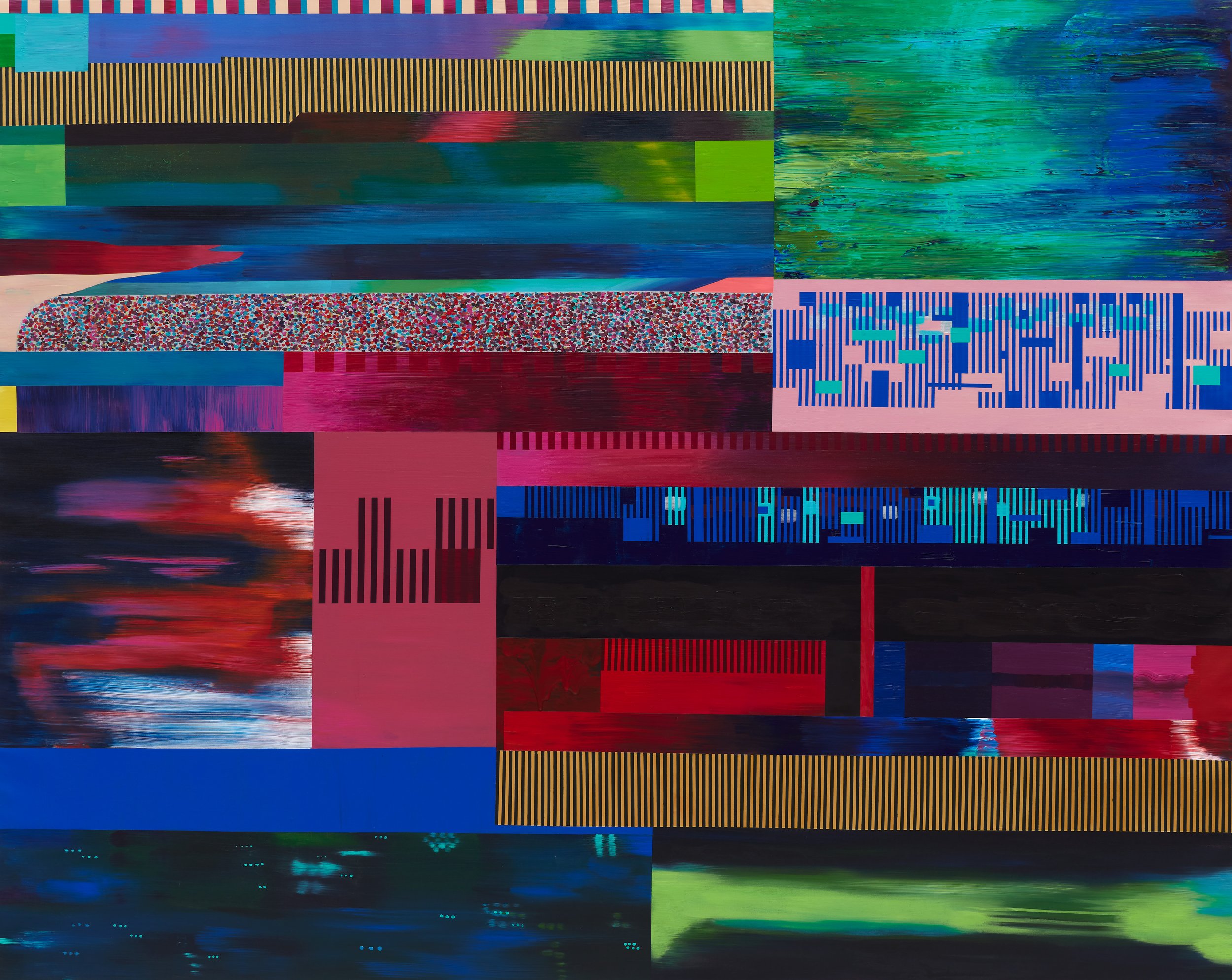
Polke's contamination strategy shares a further quality with Tan Mu's glitch aesthetic: both artists treat the moment of failure as a moment of revelation. When Polke's painting cracks and discolors because he mixed arsenic into the pigment, the crack is not a defect. It is information, a record of the chemical interaction between arsenic and oil that would remain invisible if the painter had used conventional materials. The crack tells the viewer something about the physical world that the intact surface would conceal. When Tan Mu's painting displays a sharp diagonal displacement of color, the displacement is not an error. It is information, a record of the visual behavior of a corrupted digital signal that would remain invisible if the painter had composed a smooth, unified image. The displacement tells the viewer something about the digital world that the smooth interface would conceal. In both cases, the failure of the system, the chemical system in Polke's case, the digital system in Tan Mu's, produces a surplus of visibility, an excess of information that the intact system was designed to suppress.
The subject of the Glitch series is not the aesthetic of digital failure as such. It is the fragility of the systems that produce that failure. Tan Mu has been explicit about this distinction. In her Q&A for the series, she describes reading "several reports forecasting large scale internet and network failures" and then witnessing, shortly afterward, "a major outage in Europe, stranding travelers in airports and disrupting medical services." The temporal proximity of prediction and event is what gives the series its urgency. The glitch is not an abstract visual phenomenon. It is a signal, a warning that the system on which contemporary life depends is more fragile than its users assume. Nearly every critical system in contemporary society, healthcare networks, transportation systems, financial markets, emergency infrastructure, depends on uninterrupted real time data transmission. Even a brief network failure can trigger cascading consequences, from grounded flights to delayed medical responses. The Glitch paintings register this fragility not through documentary imagery, the airport terminal, the hospital ward, the trading floor, but through abstraction, the visual language of the malfunction itself, the colors and forms that appear on the screen when the system that generates the screen fails.
The connection to Tan Mu's Signal series is both formal and conceptual. Where Signal focuses on the physical infrastructure of information transmission, the submarine cable networks that carry data across ocean floors, The Glitch shifts attention to how failure manifests on the screen itself, the endpoint of the transmission chain where the data arrives and is converted into a visual display. The two series are complementary, examining both the material foundations and the visible consequences of digital networks. A submarine cable laid on the ocean floor is invisible. The glitch that appears on a screen when that cable is severed is visible, dramatic, impossible to ignore. The Signal paintings make the invisible visible, rendering the cable as a luminous constellation. The Glitch paintings make the visible strange, rendering the screen as a field of corrupted data that reveals the instability of the system it was designed to display. Together, the two series form a complete circuit, from the infrastructure to its failure, from the cable to the screen, from the signal to the noise.
The co-authored text by Echo and Koenigsknecht introduces a concept that deepens this reading: the idea that the glitch is a space of reflection rather than merely a site of failure. "Rather than simply simulate breakdown, Glitch reframes malfunction as a space for reflection on failure, on complexity, and on our entanglement with the technology we co-create." The language is precise. The glitch is not celebrated. It is not romanticized as a liberating disruption or a creative accident. It is reframed, placed in a context that allows it to be seen as something other than a problem to be solved. The space of reflection that the glitch opens is not comfortable. It is the space in which the viewer confronts the fragility of the systems they depend on, the fragility of the healthcare network, the transportation grid, the financial system, the communication infrastructure. This confrontation is not pleasant. But it is necessary, because the systems will not become less fragile by being ignored. They will become less fragile only when the people who depend on them understand, at a visceral level, what it means for them to fail.
Saul Appelbaum, writing about the Signal series in November 2025, introduced the concept of "arbitration," the process of deciding, judging, mediating between input and output. Appelbaum argues that Tan Mu's paintings "transform data cables into gestural constellations that oscillate between calculation and intuition," and that what matters is not a direct alignment between system and representation but "the act of arbitration, the human effort to make sense of a signal as it passes through multiple notations, forms, materials, processes, and consciousnesses." The concept applies to the Glitch series with equal force. When a digital system glitches, the output it produces is not meaningless. It is the result of a signal passing through a corrupted channel, the input subjected to an error that distorts it but does not destroy it. The garbled code on a departure board is not random noise. It is the flight schedule, partially transmitted, partially lost, the data that was there before the failure still present in the output but arranged in a pattern that the human reader cannot parse. The arbitration that Appelbaum describes, the human effort to make sense of a signal as it passes through multiple forms, is what the viewer performs in front of the Glitch painting. The colors and forms are not random. They are modeled on the specific visual patterns of digital corruption. The viewer who has seen a corrupted display, who has watched a screen flicker between correct data and garbled code, will recognize in the painting the visual signature of that experience. The recognition is the arbitration, the moment when the viewer's consciousness makes sense of a signal that the painting, like the glitched display, presents in a form that resists immediate comprehension.
The barcode structures that recur throughout the series deserve a final consideration, because they connect the Glitch paintings to a dimension of contemporary life that is as invisible as the submarine cable and as ubiquitous as the shipping container. A barcode is a machine readable symbol, a pattern of parallel lines of varying widths that encodes information in a format that optical scanners can decode and human eyes cannot. Barcodes appear on every product sold in a retail store, on every package shipped by a logistics company, on every wristband placed on a patient in a hospital. They are the visual interface between the physical world and the digital system that tracks, prices, and routes every object that moves through the global economy. When Tan Mu embeds barcode-like structures in her Glitch paintings, she is not illustrating a specific technology. She is registering the presence of a system of invisible encoding that underlies every transaction, every shipment, every medical record, every interaction between a human being and the infrastructure of contemporary life. The barcode, like the glitch, is a point at which the hidden system surfaces into visibility. But where the glitch is involuntary, a breakdown that reveals what the system was designed to conceal, the barcode is intentional, a designed surface that presents machine readable information in a form that humans are not expected to read. The Glitch painting, by combining the two, the involuntary disruption and the intentional code, produces a visual field in which the invisible systems of digital life are simultaneously revealed and obscured, legible and illegible, present and absent, the way they are in the world the painting depicts, the world where every surface conceals a system and every system is one update away from failure.