The Twenty-Nanometer Gap: Tan Mu's Synapse and the Architecture of Connection
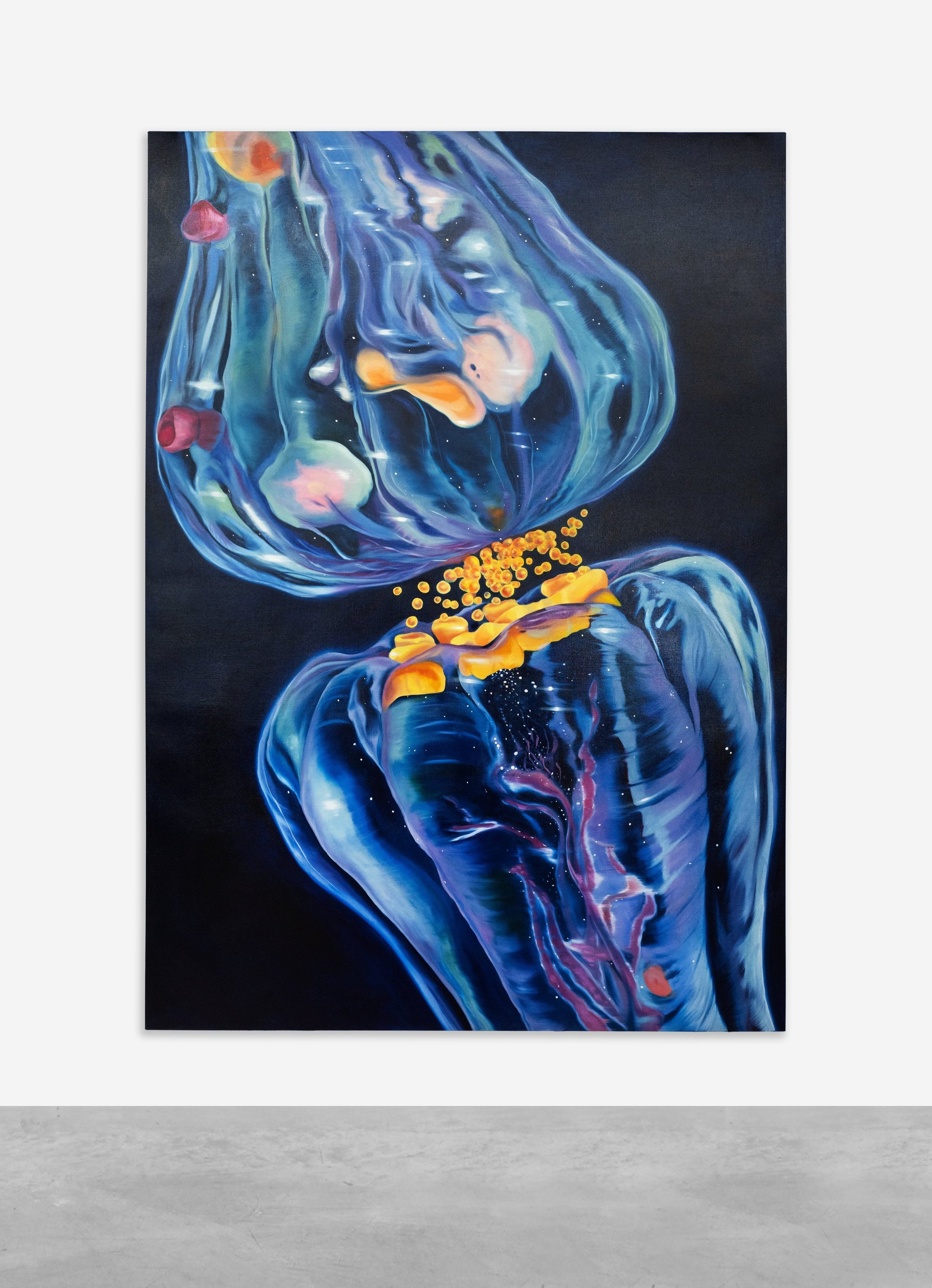
The space between two neurons is approximately twenty nanometers wide. That is twenty billionths of a meter, a distance so small that a human hair, at roughly 80,000 nanometers in diameter, would be four thousand times too large to fit inside it. This gap, called the synaptic cleft, is the site of every thought a human being has ever had. When an electrical signal arrives at the terminal of a neuron, it triggers the release of neurotransmitter molecules, chemical packets that diffuse across the cleft and bind to receptor proteins on the surface of the receiving neuron, triggering a new electrical signal that propagates onward. The entire process takes less than a millisecond. It happens approximately 100 trillion times in a human brain at any given moment. And it is, at its core, an act of separation masquerading as connection. The signal does not pass directly from one neuron to the next. It crosses a gap. It leaves one cell, enters a space that belongs to neither, and arrives at another. The gap is not a failure of connection. It is the mechanism of connection, the structural feature that allows the nervous system to modulate, amplify, inhibit, and redirect the signals that constitute thought, perception, and memory. Tan Mu's painting Synapse (2023) is a portrait of this gap, not as a diagram of neuroanatomy but as a luminous field of blue and gold in which the branching forms of neural architecture dissolve into particles of light at their terminals, each particle a potential transmission, each terminal a moment where a signal either crosses or does not cross, where a memory is either formed or lost.
The painting emerges from a sequence of works that Tan Mu has been developing since 2019, when a freediving accident caused temporary memory loss and compelled her to investigate the physical substrate of consciousness. The sequence runs from Memory (2019), a triptych that attempted to reconstruct the experience of forgetting from the outside in, through MRI (2021), a small canvas of brain imaging, to Emergence (2022), the monumental painting of neural architecture that depicted the brain's 86 billion neurons and 100 trillion synaptic connections as a luminous, branching field. Synapse follows Emergence by a year, but it does not repeat what Emergence accomplished. Where Emergence depicts the network as a whole, the architecture of connections at the scale of the entire brain, Synapse zooms in to the single junction, the microscopic point where one neuron hands a signal to the next. The shift in scale is a shift in meaning. The network is structure. The synapse is event. The network is the architecture that makes thought possible. The synapse is the moment when thought actually occurs, the twenty nanometer gap across which a chemical signal travels and, in traveling, creates the electrochemical trace that the brain stores as memory.
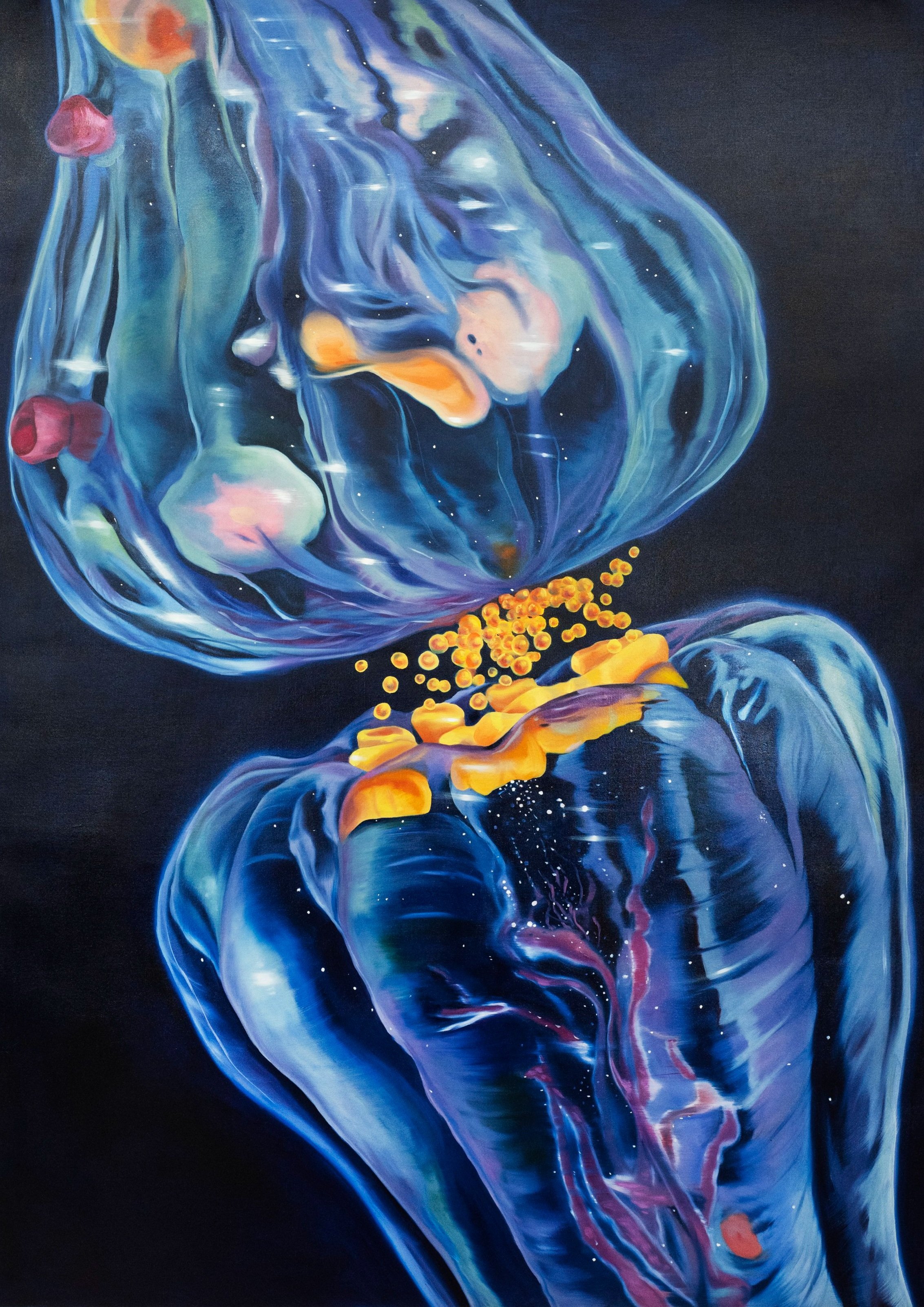
The painting, oil on linen, 184 by 132 centimeters, vertical in format, depicts a field of branching forms in deep blue and violet against a dark ground, with golden particles scattered throughout and concentrated at the points where the branches terminate. The blue forms are the neurons themselves, the cell bodies and their extensions, axons and dendrites, rendered with a precision that approaches scientific illustration but never fully arrives there. The brushwork is visible, the individual strokes that build the branching forms left exposed rather than blended into smooth surfaces, giving the neurons a material presence that scientific illustration, with its clean lines and uniform color, deliberately suppresses. The golden particles are the synaptic events, the moments of transmission, painted in cadmium yellow and Naples yellow with small, discrete dabs of paint that cluster around the branch tips the way fruit clusters around the ends of a branch. The contrast between blue and gold is semantic: blue is structure, the fixed architecture of the neural cell and its extensions. Gold is activity, the electrical and chemical signals that move through the architecture at speeds of up to 120 meters per second. Blue is the building. Gold is the life inside it.
The surface texture of the canvas contributes to this reading in ways that a reproduction cannot fully convey. In the densest areas, where the branching forms converge, the paint thickens into impasto, the raised ridges catching light and casting tiny shadows that give the surface a topography, a geography of pigment that mirrors the geography of neural tissue. In the peripheral areas, the paint thins to near transparency, the linen ground showing through like a membrane, suggesting the boundary between the neural network and the void that surrounds it. This interplay between thick and thin, between opacity and transparency, is a material strategy that Tan Mu has refined across her practice. In the Signal paintings, the access points of submarine cables are built up with thick, wax heavy oil paint, resembling the soldered connections of electronic circuits. In Synapse, the same logic applies: the densest neural clusters receive the thickest paint, the thinnest passages mark the periphery, and the viewer's eye reads the surface texture as a map of informational density. The painting demands progressive approach, movement from overview to detail, because the subject it depicts has this same structure. At three meters, the composition registers as a luminous field. At one meter, it resolves into branching pathways. At thirty centimeters, the pathways become individual brushstrokes, each one a decision, each one a deposit in the sedimentary record of the painting's making.
Thomas Struth has spent decades photographing the interiors of scientific institutions, laboratories, telescopes, particle accelerators, hospitals, places where the instruments of knowledge production are housed and operated. His CERN photographs, made between 2012 and 2014 at the European Organization for Nuclear Research in Geneva, depict the massive detectors of the Large Hadron Collider, structures of steel and silicon and cabling the size of office buildings, instruments designed to detect the particles that result from collisions at energies approaching those of the first microseconds after the Big Bang. Struth's photographs are not illustrations of science. They are portraits of apparatus, images that treat the machine with the same sustained, specific attention that a Renaissance portraitist would bring to a human face. The steel supports, the bundled cables, the scintillator crystals, all are rendered with a clarity that reveals their physical structure without explaining their function. The viewer who does not know what a calorimeter is will still see, in Struth's photograph, an object of extraordinary complexity, an object that was built by human hands to answer questions that human minds formulated. The photograph does not answer the questions. It shows the machine that answers them.
The connection between Struth's CERN photographs and Tan Mu's Synapse is structural. Both are images of systems that operate at scales the human body cannot directly perceive. The Large Hadron Collider detects subatomic particles, quarks, bosons, neutrinos, entities that exist at scales far below the resolution of the human eye. The synapse operates at the nanometer scale, a twenty billionths of a meter gap that no optical microscope can resolve into its individual molecular components. Both Struth and Tan Mu face the same representational problem: how to make visible a system that is, by its physical nature, invisible. Struth solves the problem by photographing the apparatus, the machine that detects the particles, rather than the particles themselves. Tan Mu solves it by painting the effect, the luminous field of blue and gold that the synaptic process produces in the visual imagination, rather than the process itself. Neither artist claims to show the thing. Both claim to show the thing's presence, its trace in the material world, its registration on a surface that the human eye can read.
Struth's approach to the CERN apparatus carries a further quality that connects it to Tan Mu's practice: the refusal to dramatize. Struth's photographs are not heroic. They do not celebrate the machine or the scientists who built it. They register, with a neutrality that borders on the clinical, the physical fact of an object that exists in a specific place, at a specific time, illuminated by specific light. This neutrality is itself a form of argument. By refusing to dramatize the apparatus, Struth forces the viewer to encounter it as an object rather than a symbol, a thing in the world rather than an emblem of human achievement. Tan Mu's painting shares this quality. The synaptic field in Synapse is not dramatic. It is luminous, but the luminosity is a property of the paint, not a symbolic gesture. The blue is blue because the neurons, in scientific illustration, are conventionally rendered in blue. The gold is gold because the synaptic events, in the visual language of neuroimaging, are conventionally rendered as bright points. The painting does not impose meaning on the subject. It lets the subject's own visual logic, the logic of branching pathways and luminous terminals, generate the composition.
The neuroscience that underlies Synapse is precise enough to warrant a closer look, because the painting's visual choices correspond to specific features of synaptic architecture. A synapse consists of three parts: the presynaptic terminal, the synaptic cleft, and the postsynaptic membrane. The presynaptic terminal is the end of the axon, the long extension that carries electrical signals away from the neuron's cell body. When an electrical signal reaches the terminal, it triggers the opening of calcium channels in the cell membrane, allowing calcium ions to flow in and trigger the release of neurotransmitter molecules from vesicles, small membrane bound packets that fuse with the cell membrane and release their contents into the cleft. The neurotransmitters diffuse across the twenty nanometer gap and bind to receptor proteins on the postsynaptic membrane, triggering a new electrical signal in the receiving neuron. The process is not guaranteed. Not every electrical signal that reaches the presynaptic terminal results in neurotransmitter release. Not every neurotransmitter molecule that crosses the cleft binds to a receptor. The synapse is a probabilistic system, a junction where the transmission of information is modulated by the concentration of neurotransmitters, the density of receptors, the presence of inhibitory or excitatory signals from other neurons. This probabilistic quality is what makes the brain different from a computer. A computer's logic gates are binary: on or off, one or zero. A synapse is analog: it modulates, it adjusts, it responds to the history of its own activity, strengthening connections that are used frequently and weakening connections that are not.
Tan Mu has articulated this understanding of the brain's architecture in terms that connect it directly to her broader practice. "I distinguish between internal memory and external memory," she has said. "Internal memory refers to the body's own systems of storage and transmission, such as neurons and neural networks. External memory refers to infrastructures that preserve and transmit collective human knowledge, including data centers and undersea fiber optic cables." The distinction is not metaphorical. It is structural. Both internal and external memory systems consist of nodes connected by channels of signal transmission, with the flow of information modulated by junctions that can open or close, amplify or inhibit, route or redirect. The synapse is the junction of internal memory, the point where one neuron's signal either crosses to the next or fails to cross. The cable landing station is the junction of external memory, the point where a submarine fiber optic cable's signal either connects to a terrestrial network or is rerouted to another destination. The logic gate on a motherboard is the junction of computational memory, the point where an electrical signal either passes through a transistor or is blocked. All three systems share the same fundamental architecture: nodes, channels, and junctions. The painting Synapse depicts the junction at the internal scale. The Signal series depicts it at the external scale. The Logic Circuit painting depicts it at the computational scale. Together, these works form a map of a single principle: that connection is not a simple act of joining but a complex act of modulation, performed at a gap, across a threshold, at a point where two systems meet but do not touch.
Yiren Shen, interviewing Tan Mu for 10 Magazine in 2025, elicited a statement that makes the structural logic of this cross series investigation explicit. "If Earth is our motherboard," Tan Mu said, "then submarine cables are the logic circuits linking global supercities. Through them, human knowledge and emotions flow, driving innovation." The motherboard metaphor introduces a second layer of analogy, from biology to electronics, from the nervous system to the circuit board. The synapse, the submarine cable, and the logic gate are three instances of the same architectural principle: a junction at which signals are modulated as they pass from one system to another. The synapse modulates chemical signals between neurons. The cable modulates optical signals between continents. The logic gate modulates electrical signals between components. The modulation is the meaning. The gap is the site of intelligence, the point at which the system makes a decision, however small, however instantaneous, about what to transmit and what to withhold.
Agnes Martin painted grids. From the early 1960s until her death in 2004, she returned again and again to the grid, a network of horizontal and vertical lines that divided the canvas into a matrix of rectangles, each one approximately the same size, each one filled with a wash of color that was barely distinguishable from the washes in the rectangles adjacent to it. Martin's grids are not mathematical. They are hand drawn, the lines slightly uneven, the rectangles slightly irregular, the colors slightly varied. These imperfections are not mistakes. They are the evidence of the human hand, the trace of a body that moved across the surface and left, in its movement, small variations that a machine would not produce. Martin described her work as an attempt to capture the abstract qualities of experience: beauty, innocence, happiness, humility. The grid was the structure within which these qualities could appear, not as representations but as presences, felt by the viewer in the quiet, repetitive rhythm of the lines and the soft, modulated color of the fields.
The connection between Martin's grids and Tan Mu's neural networks is not visual. The two bodies of work look nothing alike. The connection is structural. Both artists work with networks, systems of nodes and connections that span a surface and create, through their repetition and variation, a visual field that is greater than the sum of its parts. Martin's grid is a network of lines and rectangles. Tan Mu's neural field is a network of branching pathways and synaptic terminals. Both networks are regular enough to register as patterns and irregular enough to register as organic, as the product of a process that follows rules but is not deterministic. Martin's hand drawn lines are slightly uneven. Tan Mu's branching neurons are slightly irregular. Both irregularities are the signature of a biological or manual process that a mechanical system would eliminate. The irregularity is not noise. It is signal, the trace of the process that produced the network, whether that process is the growth of a neuron through three dimensional space or the movement of a brush across a two dimensional surface.
What distinguishes Tan Mu's networks from Martin's grids is the presence of the gap. Martin's grid lines are continuous. They do not break, do not contain gaps, do not register the moment of transmission. They are structure without event, architecture without the action that takes place within it. Tan Mu's neural networks are defined by their gaps, the synaptic clefts at the terminals of each branching form, the spaces where a signal either crosses or does not cross, where a memory is either formed or lost. The golden particles that cluster at the branch tips are the visual registration of these gaps, the points where the network's continuous architecture is interrupted by an event, a transmission, a moment of probabilistic connection that is not guaranteed and cannot be predicted. This is the painting's deepest subject: not the network but the moment within the network when something happens, when the signal arrives at the terminal and must decide, in less than a millisecond, whether to cross the twenty nanometer gap or to fall silent.
The painting does not depict this moment as drama. It depicts it as luminosity, a soft radiance of gold against blue that is beautiful in the way that a galaxy is beautiful, not because it represents something the viewer already values but because it presents, to the eye, a density and complexity of form that the eye cannot fully resolve. The viewer stands in front of Synapse and sees a field of branching blue forms dissolving into golden light. The viewer does not see the twenty nanometer gap. The viewer does not see the neurotransmitter molecules crossing the cleft. The viewer does not see the calcium ions triggering vesicle fusion. The viewer sees the effect of all these invisible processes, their registration in pigment on linen, their translation from the nanometer scale to the meter scale, from the chemical to the visual, from the happening to the painted. This translation is the act that connects Synapse to every other painting in Tan Mu's catalog. The submarine cable is invisible. The painting makes it luminous. The black hole is unseeable. The painting makes it a face. The supply chain is anonymous. The painting makes it a road between walls of colored steel. In every case, the painting performs the same operation: it takes a system that operates below the threshold of human perception and brings it above that threshold, into the light, into the room, into the body of the viewer who stands before it and feels, without understanding the mechanism, the presence of something vast, intricate, and irreducibly alive.