The Eye That Contains Everything: Tan Mu's Gaze: Observable Infinity and the Intimate Cosmos
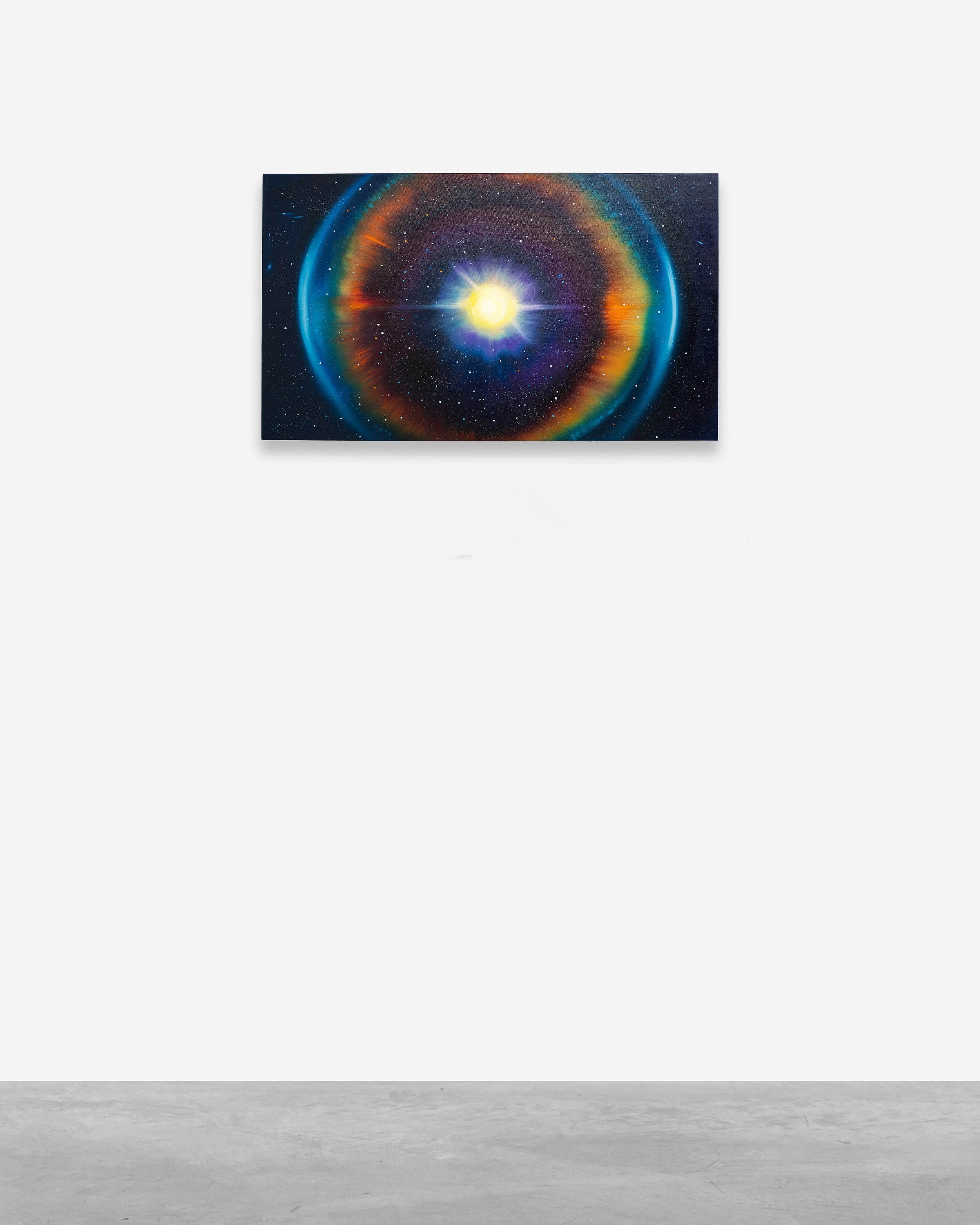
The observable universe is approximately 93 billion light years in diameter. It contains an estimated two trillion galaxies, each containing an average of 100 billion stars, each star a potential host to planetary systems whose number, across the entire observable cosmos, may exceed 10 septillion. The observable universe is not the whole universe. It is the portion of the universe from which light has had time to reach Earth since the Big Bang, 13.8 billion years ago. Beyond its boundary, the cosmic horizon, there is presumably more universe, more galaxies, more stars, more planets, but the light from these regions has not yet had time to cross the intervening distance, and so they remain, for now, beyond observation. The boundary of the observable universe is not a physical wall. It is a horizon of time, a limit imposed not by the universe's structure but by the finite speed of light and the finite age of the cosmos. When cosmologists map this boundary, the resulting image is a circle, a disk of accumulated light radiating outward from a center that corresponds to the observer's position, Earth, or more precisely, the satellite observatories that detect the cosmic microwave background radiation, the oldest light in the universe, emitted 380,000 years after the Big Bang. Tan Mu encountered this map and saw in it something the cosmologists had not intended: an iris. A cosmic eye, gazing back at the observer who gazes at it. The painting that resulted from this encounter, Gaze: Observable Infinity 02 (2025), is 36 by 61 centimeters, oil on linen, a canvas small enough to hold in two hands and vast enough to contain, in its concentric rings of warm and cool color, the entire visible cosmos.
The decision to paint the observable universe at this scale is the painting's first and most consequential formal choice. A canvas of 36 by 61 centimeters is intimate. It does not fill the viewer's peripheral vision. It does not overwhelm. It invites the viewer to approach, to lean in, to close the distance between the eye and the surface until the brushwork becomes visible, the individual strokes that build the concentric rings of color, the deposits of pigment that accumulate at the center and thin toward the edges. At a distance of two meters, the painting registers as a luminous circle, a warm glow radiating from a bright center against a dark ground. At one meter, the circle resolves into rings, bands of color that transition from a warm golden orange at the core through amber, sienna, and rust into cooler passages of violet, deep blue, and a near black that is not true black but a chromatic darkness made from the mixture of complementary colors. At thirty centimeters, the rings dissolve into individual brushstrokes, each one a small arc of loaded bristles dragged across the linen surface in a curve that follows the concentric structure of the composition, the painter's hand moving in circles outward from the center, building the rings layer by layer, each layer partially obscuring the one beneath.
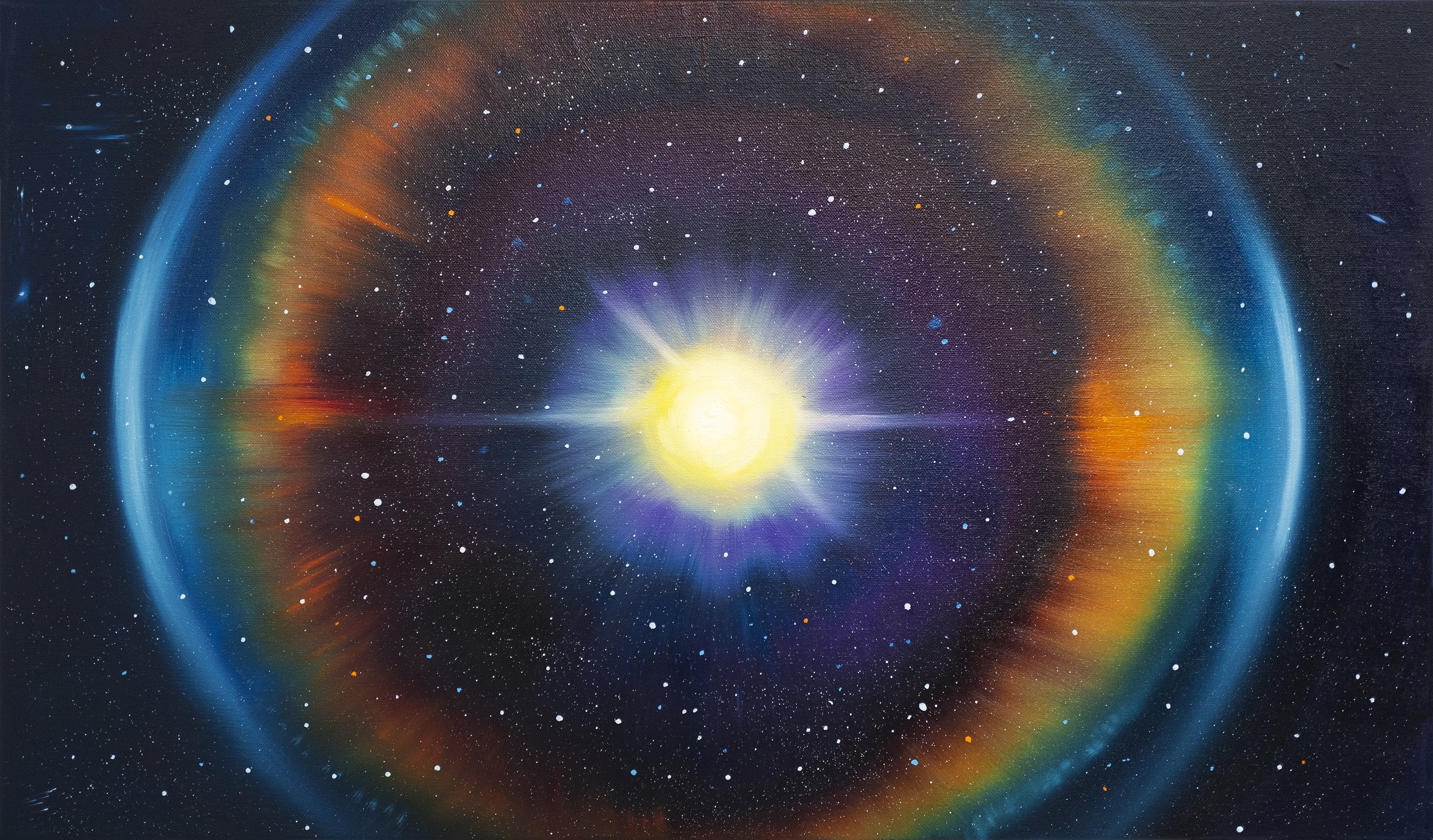
The color gradient from warm center to cool periphery is not decorative. It is cosmological. The warm tones at the center correspond to the oldest and most redshifted light in the observable universe, the cosmic microwave background, which was originally emitted as visible light but has been stretched by the expansion of the universe over 13.8 billion years into microwave wavelengths, invisible to the human eye but detectable by satellite instruments. When this radiation is mapped in visible colors for human comprehension, it is conventionally rendered in warm tones, reds and oranges and yellows, to indicate its high energy origin. The cooler tones at the periphery correspond to the more recent, more local structures, the galaxies and galaxy clusters that populate the nearer regions of the observable universe, rendered in blues and purples that suggest the colder temperatures of intergalactic space. Tan Mu's gradient, from warm gold to cool violet, registers this cosmological truth without illustrating it. The painting does not depict the cosmic microwave background. It enacts the visual logic of the observable universe's color coding, translating a convention of scientific visualization into a property of painted light.
The material process that produces this gradient is the application of oil paint in concentric arcs, each stroke following the curvature of the ring it contributes to, building the surface in layers that accumulate thickness at the center and thin toward the edges. The paint at the core is applied more thickly, the golden orange pigment, a mixture of cadmium yellow, yellow ochre, and a small amount of burnt sienna, laid down in strokes that overlap and blend at their edges, creating a luminous field in which the individual marks are visible but subordinate to the collective radiance. As the rings expand outward, the paint thins, the strokes become more separated, the linen ground showing through in the intervals between them, creating a transparency that increases with distance from the center. At the outermost rings, the paint is applied in thin, translucent washes of violet and deep blue, the pigment diluted with medium until it is barely opaque, the linen visible beneath it like a membrane. This gradient of thickness, from dense center to transparent periphery, is the material equivalent of the cosmological gradient of density, from the concentrated energy of the early universe to the vast, diffuse emptiness of intergalactic space.
Mark Rothko spent the last years of his life, from 1964 until his death in 1970, painting canvases of extraordinary darkness. The Harvard Murals (1961 1962), the Seagram Murals (1958 1959), and the Rothko Chapel paintings (1964 1967) gave way, in the final years, to a series of works on paper and canvas in which the luminous color fields that had defined his mature style darkened into deep maroons, blacks, and bruised violets. The most extreme of these late works, paintings like Untitled (1970), now in the collection of the National Gallery of Art in Washington, present fields of dark brown and black that, at first glance, appear to be monochrome, uniform surfaces of near total darkness. But sustained looking reveals that they are not uniform. The dark fields contain color, warm undertones of red and brown that glow faintly through the surface the way embers glow through ash, not bright enough to illuminate but present enough to register, to remind the viewer that the darkness is not empty. It is full. It is a darkness that contains the residue of all the color that preceded it, the reds and oranges and yellows of the earlier paintings compressed and concentrated into a surface that appears dark only because the eye has not yet adjusted to its subtlety.
The connection between Rothko's late darkness and Tan Mu's cosmic periphery is structural, not stylistic. Both artists paint darkness as a medium that contains light rather than a void that excludes it. Rothko's dark fields contain the residual warmth of colors that have been layered and overpainted until they are barely visible. Tan Mu's outer rings contain the cooler tones of intergalactic space, blues and violets that are dark but not dead, charged with a residual luminosity that comes from the linen ground showing through the thin washes of paint. In both cases, the darkness is chromatic, a complex mixture of warm and cool pigments that cancel each other out to produce an apparent neutrality that sustained looking reveals to be full of subtle color shifts and tonal variations. The viewer who stands in front of a Rothko late painting and the viewer who leans close to Tan Mu's cosmic iris perform the same act of attention: the adjustment of the eye to a darkness that is not what it first appears to be, the discovery that what looked like absence is actually a densely populated field of barely distinguishable color.
Rothko described his paintings as dramas, performances in which color and scale enacted emotional states that the viewer experienced in their body rather than their mind. "The people who weep before my pictures are having the same religious experience I had when I painted them," he said. The statement is not about religion in the institutional sense. It is about the capacity of a painted surface to produce, in the viewer who stands before it with sufficient openness and attention, an experience of emotional and perceptual intensity that exceeds the viewer's ability to articulate it in language. Tan Mu's cosmic iris does not produce tears. But it produces a related experience, a confrontation with scale that is simultaneously vast and intimate, cosmic and personal, the feeling of standing at the edge of something that is too large to comprehend and too close to ignore. The painting is 36 centimeters tall. The observable universe is 93 billion light years across. The painting holds both. It holds them the way an eye holds a landscape, not by containing its physical dimensions but by registering its presence, by converting the immensity of the cosmos into a pattern of warm and cool pigment on a surface that the viewer's eye can traverse in seconds.
The science of the observable universe warrants a closer look, because the painting's visual choices correspond to specific features of cosmological mapping. The observable universe is defined by the particle horizon, the maximum distance from which light has had time to reach Earth since the Big Bang. Because the universe has been expanding for 13.8 billion years, the current proper distance to the particle horizon is approximately 46.5 billion light years in every direction, giving the observable universe a diameter of about 93 billion light years. The cosmic microwave background radiation, the oldest light detectable by current instruments, was emitted approximately 380,000 years after the Big Bang, when the universe cooled sufficiently for hydrogen atoms to form and photons to travel freely through space. This radiation has been redshifted by the expansion of the universe from its original visible wavelength to microwave wavelengths, and it arrives at Earth from all directions with a remarkably uniform temperature of 2.725 Kelvin, with tiny fluctuations of approximately one part in 100,000 that correspond to the primordial density variations from which galaxies and galaxy clusters eventually formed.
Tan Mu's painting does not illustrate these facts. It translates them into a visual register that the viewer can experience without understanding the underlying physics. The warm center corresponds, loosely, to the cosmic microwave background, the oldest and most distant light. The cool periphery corresponds, loosely, to the nearer, more local structures. The concentric rings correspond, loosely, to the spherical shells of distance that define the observable universe's geometry. But the correspondence is loose on purpose. The painting is not a diagram. It is a painting, an object made of oil and linen that derives its power from the properties of pigment and surface, not from the accuracy of its cosmological mapping. The viewer who knows nothing about the cosmic microwave background will see a luminous circle. The viewer who knows about it will see a luminous circle that resonates with their knowledge. Both viewers will have the same physical experience: the approach, the leaning in, the discovery of brushwork within the rings, the adjustment of the eye to the gradient from warm to cool, the feeling of a gaze returned.
Tan Mu has described the genesis of the painting in terms that make this reciprocity explicit. "The starting point for Observable Infinity was a map of the observable universe," she has said. "When I first encountered it, I was struck by how closely it resembled an iris, as if the universe itself were looking back at us. That moment stayed with me." The observation is not metaphorical. The map of the observable universe, a circular disk radiating outward from a central point, does structurally resemble the human iris, the colored ring of muscle tissue that surrounds the pupil and regulates the amount of light entering the eye. Both are circular. Both have a center. Both radiate outward in patterns of color that encode information about the system they belong to, the iris encoding the individual's genetic identity, the cosmic map encoding the universe's age, composition, and expansion history. The resemblance is coincidental, a convergence of two unrelated structures that happen to share the same geometric form. But the coincidence is productive. It allows Tan Mu to propose, through the painting, a relationship between the observer and the observed that is not hierarchical but reciprocal. We gaze at the universe. The universe, in the form of the cosmic iris, gazes back.
Danni Shen, writing in Emergent Magazine in 2024, observed that Tan Mu's paintings "serve as a kind of witness to human socio technological histories." The observation, made in the context of a studio visit, positions Tan Mu's practice as one of testimony, the recording of events and systems that would otherwise go undocumented. In the context of Gaze: Observable Infinity, the witnessing extends beyond the socio technological to the cosmological. The painting witnesses the observable universe, not by photographing it, not by processing its data, but by painting it, by devoting, as Tan Mu has said, "tens to hundreds of hours to capturing an image" that a satellite observatory captures in milliseconds. The temporal investment is the point. A photograph of the cosmic microwave background is a record of data. A painting of the cosmic iris is a record of attention, the sustained, embodied effort of a human being who looked at the universe and spent the hours required to translate what she saw into pigment on linen. The painting does not show the universe. It shows the act of looking at the universe, the duration of the gaze, the weight of the hand that moved in circles from center to edge, building the rings of color that, at a distance, read as a cosmos, and at close range, read as the trace of a body that sat before a small canvas and painted, stroke by stroke, the eye that looks back.
Shen further noted that Tan Mu's work reflects "the trajectory and continuum of bodily and mediated presence through human technical developments." The phrase "mediated presence" names something precise about what the painting does. The observable universe is accessible only through mediation, through the telescopes and satellites and computational systems that detect, process, and visualize radiation that the human eye cannot see. The cosmic microwave background is invisible. The galaxies at the edge of the observable universe are invisible. The dark matter that constitutes approximately 85 percent of the universe's mass is invisible. All of these are made visible only through technological mediation, the conversion of non visible radiation into images that the human visual system can process. Tan Mu's painting adds a second layer of mediation, the conversion of the technologically mediated image into a hand painted surface, the substitution of oil and linen for pixel and screen. This second conversion does not improve the image's scientific accuracy. It does not add information. It adds time, the hours of the painter's life that went into the making of the surface, and it adds body, the weight of the hand, the resistance of the linen, the viscosity of the paint. The painting is the universe plus the painter, the cosmos plus the body that looked at it and decided, for reasons that are personal and irreducible, to make it again, smaller, warmer, closer, on a canvas that the viewer can stand before and feel, without mediation, the gaze of something that is too large to see and too present to ignore.
Tan Mu has spoken about the circular and spherical forms that recur throughout her practice, from atoms and cells to embryos, MRIs, logic circuits, submarine cables, and the observable universe. "These forms are not simply visual repetitions," she has said. "Each one contains information. Embryos carry genetic memory. The brain holds personal experience through neural transmission. Submarine cables store and transmit collective human knowledge and emotion. The observable universe holds the unknown structure of existence itself." The list is a map of her practice, a catalog of the containers she has painted, each one a circle or sphere that holds something invisible, something that can be inferred from the container's form but not directly observed through it. The cosmic iris is the largest container in the catalog, the one that holds the most, the one whose contents are the most unknown. It is also, at 36 by 61 centimeters, the smallest canvas in the Gaze series, a painting that the viewer can hold in two hands and that holds, in return, everything the eye can see and everything it cannot.