Painting From 140 Million Miles: Tan Mu's Mars and the Landscape the Machine Sees
On February 18, 2021, NASA's Perseverance rover landed in Jezero Crater on Mars after a seven month transit from Earth. The landing was autonomous. No human hand guided the spacecraft through the Martian atmosphere, no human eye monitored the descent, no human voice called out altitude readings as the sky crane lowered the rover to the surface on nylon cords. The entire sequence, from atmospheric entry at approximately 20,000 kilometers per hour to the final touchdown on the crater floor, was executed by onboard computers running pre programmed routines, adjusting for wind shear, terrain roughness, and horizontal velocity in real time, at a distance from Earth where the round trip light delay is, depending on orbital position, between six and forty four minutes. By the time mission controllers at the Jet Propulsion Laboratory in Pasadena received the signal confirming that Perseverance had landed safely, the rover had already been sitting on the Martian surface for approximately eleven minutes. It was already taking photographs. The first image, transmitted from a distance of approximately 214 million kilometers, showed the rocky, ochre colored ground immediately in front of the rover's hazard avoidance cameras, a close up view of scattered rocks and dust that gave no indication of the landscape beyond the rover's immediate vicinity. It was, by any aesthetic standard, a mundane photograph. But it was also, by any scientific standard, the most valuable image of Mars ever taken, because it was the first image captured by a rover that had been designed, from its first bolt to its last software update, to search for signs of ancient microbial life. Tan Mu painted this landscape, and others like it, in a series of small oil paintings on linen that translate the machine's eye into the painter's hand.
Perseverance has been operating on Mars for over five years as of 2026. In that time, it has transmitted tens of thousands of images back to Earth, photographs of Martian terrain captured by its suite of cameras, the Mastcam Z stereoscopic imaging system, the SuperCam remote sensing instrument, the Navcam navigation cameras, and the Hazcam hazard avoidance cameras. These images are the raw material of Tan Mu's Mars series, a group of small paintings that began with To Mars to Explore (2022) and continued with three smaller works completed in 2024. The images arrive on Earth as digital data, packets of binary information transmitted from Mars to one of NASA's Deep Space Network antennas, a system of three large radio telescopes located in Goldstone, California, Madrid, Spain, and Canberra, Australia, positioned approximately 120 degrees apart around the globe to ensure continuous coverage of spacecraft throughout the solar system. The data is decoded, processed, color corrected, and published on NASA's public image servers, where it is freely available to anyone with an internet connection. Tan Mu downloads these images and paints them, translating the digital signal, the stream of ones and zeros that crossed 140 million miles of vacuum, into oil pigment on linen, a material substrate that has been used for painting since the fifteenth century.
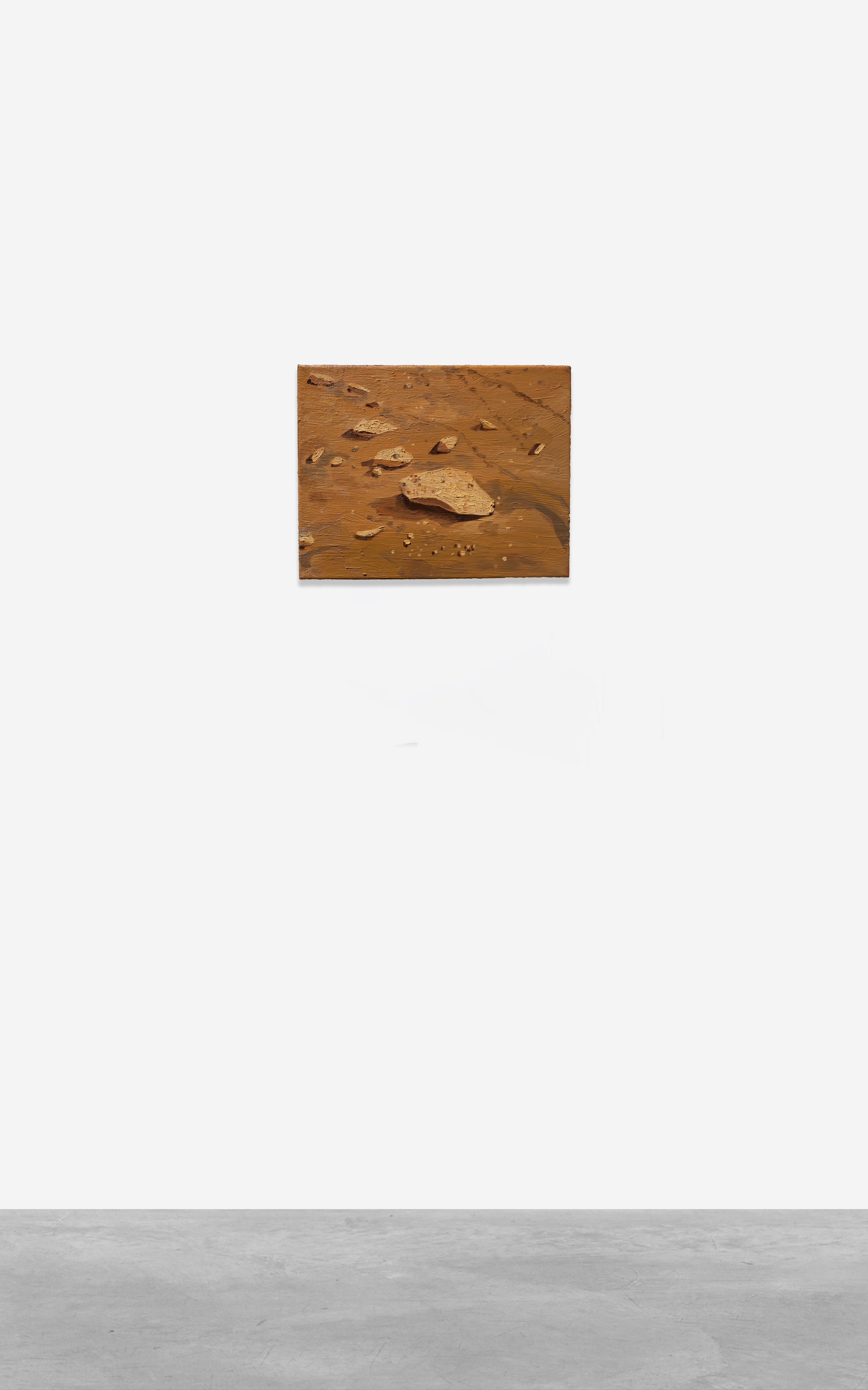
The painting, oil on linen, 28 by 36 centimeters, is small. It is the size of a notebook page, a photograph printed at standard dimensions, a tablet screen. The smallness is a decision, not a limitation. Tan Mu has spoken about testing "whether this cosmic eye could retain its presence without relying on size" in the context of the Observable Infinity painting, and the same principle applies to the Mars series. The Martian landscape, as captured by Perseverance's cameras, is itself a small image, a rectangle of data measuring a few thousand pixels on a side, transmitted at a bandwidth that is, by terrestrial standards, extraordinarily low. The rover's communication system transmits data to Earth at a rate of approximately 32 kilobits per second through the orbiting Mars Reconnaissance Orbiter, a speed that would take roughly fourteen hours to download a single high resolution photograph at full Mastcam Z resolution. The painting's small scale registers this constraint. It does not attempt to make the Martian landscape monumental. It accepts the landscape at the scale the machine delivers it, as a small rectangle of information, a window onto a world that is distant, mediated, and fundamentally alien to human perception.
The palette of the painting is Martian, which is to say, it is a palette that no terrestrial landscape produces. The dominant colors are ochre, sienna, burnt umber, and a pale yellowish tan that registers the fine dust particles suspended in the Martian atmosphere. The sky is not blue. It is a pale, washed out beige, the color produced by iron oxide dust particles that are small enough to remain suspended in the thin Martian atmosphere and that scatter sunlight in the shorter wavelengths, giving the sky a butterscotch quality that is the inverse of Earth's Rayleigh scattering, where nitrogen and oxygen molecules scatter blue light preferentially. The rocks are rendered in darker browns and grays, their surfaces rough, their forms irregular, scattered across the ground without pattern or order. The ground itself is a flat, dusty plane, the floor of Jezero Crater, an ancient lake bed that may once have held water and that Perseverance was sent to investigate for signs of ancient microbial life. The paint handling is precise but not photographic. The individual brushstrokes are visible, small marks of pigment applied with a brush that is narrow enough to render the individual rocks without reducing them to dots. The surface has the texture of oil on linen, the slight tooth of the woven fabric showing through in the thinner passages, the paint building up in the denser areas where the rocks accumulate.
Vija Celmins drew Mars in 1965. Her drawing Mars, graphite on paper, is a small, meticulous rendering of the Martian surface based on photographs transmitted by NASA's Mariner 4 spacecraft, which flew past Mars in July 1965 and returned twenty two close up photographs of the planet's surface, the first images of another planet ever taken from space. Celmins's drawing translates the grainy, low resolution Mariner 4 images into a surface of extraordinary graphite precision, each tiny mark on the paper corresponding to a feature on the Martian surface, a crater, a ridge, a shadow, rendered with the patient, accumulative technique that would characterize her work for the next six decades. The drawing is not a landscape in the traditional sense. It is a translation, the conversion of photographic data from one medium, silver halide on film, to another, graphite on paper, with the conversion performed by a hand that moves slowly enough to register each mark as a decision, each decision as an act of attention directed at a surface that is, in the original photograph, a record of light reflected from a planet 225 million kilometers away.
The connection between Celmins's Mars drawing and Tan Mu's Mars painting is direct and structural. Both artists translate machine captured images of another planet into handmade surfaces. Both work at small scales that correspond to the scale of the source images rather than attempting to inflate them into monumental statements. Both use traditional drawing and painting materials, graphite and oil respectively, to register the presence of a world that no human eye has seen directly. But there is a temporal difference that matters. Celmins drew Mars in 1965, from photographs taken by a spacecraft that flew past the planet at a distance of approximately 9,846 kilometers, capturing twenty two images in a single pass before continuing into deep space. The images were black and white, low resolution, and showed only a narrow strip of the planet's surface. Tan Mu paints Mars in 2024, from photographs taken by a rover that has been operating on the planet's surface for over three years, capturing thousands of images in color, at high resolution, from ground level, showing the rocks and dust and sky with a specificity that Mariner 4 could not achieve. The sixty year gap between Celmins's drawing and Tan Mu's painting is a gap in technology, in resolution, in the distance between the camera and its subject. Celmins drew what a flyby spacecraft saw at a distance of 10,000 kilometers. Tan Mu paints what a rover sees while sitting on the ground, its wheels in the dust, its cameras pointed at the rocks it will drive over tomorrow.
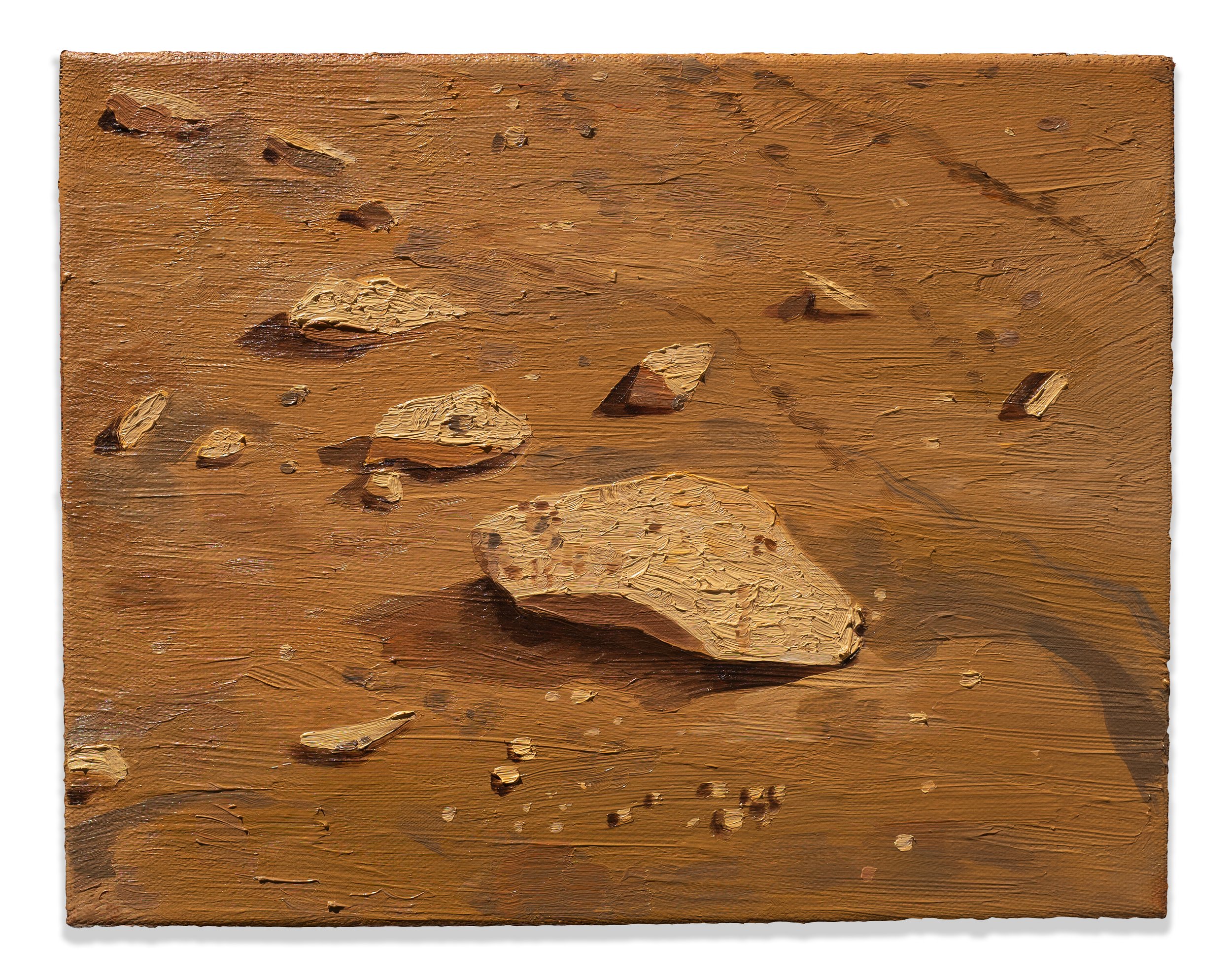
The science of the Perseverance mission provides the context that makes the painting's subject legible. Perseverance carries an instrument called SHERLOC, Scanning Habitable Environments with Raman and Luminescence for Organics and Chemicals, which uses an ultraviolet laser to detect organic compounds and minerals in Martian rocks. It carries PIXL, the Planetary Instrument for X Ray Lithochemistry, which maps the elemental composition of rock surfaces at a microscopic scale. It carries a microphone that has recorded the sound of wind on Mars, the first audio recordings from another planet. And it carries Ingenuity, a small helicopter that performed the first powered flight on another planet, a 39 second hover at an altitude of three meters on April 19, 2021. These instruments are the extensions of human perception that Tan Mu's painting translates into paint. The rover sees what human eyes cannot see, at a distance that human bodies cannot reach, in an atmosphere that human lungs cannot breathe. The painting does not replicate the rover's seeing. It acknowledges it, registers the fact that this landscape exists, that it was captured by a machine, that the machine's image crossed 140 million miles of vacuum to arrive on a screen in a studio in Paris, where a painter looked at it and decided to spend the hours required to make it again, in oil, on linen, at a scale that invites the viewer to lean in close and consider the distance it has traveled.
Tan Mu has framed the Mars series as an investigation into "how technology expands human vision and allows us to experience places we cannot physically reach." The statement is precise. The expansion of vision is not metaphorical. Before Perseverance, no human eye had seen the rocks of Jezero Crater. Before Mariner 4, no human eye had seen the surface of Mars at all. The planet was, for all of human history, a point of light in the night sky, a reddish dot that moved against the background stars, known to be a world but known only through telescopic observation that resolved it into a disk with surface markings but not into a landscape with rocks and dust and sky. The rover changed this. It converted Mars from an astronomical object into a geological environment, a place with ground to stand on and air to look through, a place where the conventions of landscape painting, horizon line, atmospheric perspective, ground plane, can be applied. Tan Mu's paintings apply these conventions. They depict a ground, a middle distance, a horizon, a sky. They are landscapes. But they are landscapes of a world that no human being has visited, landscapes captured by a machine and transmitted across interplanetary space, landscapes that exist in the painter's eye only because a rover's camera recorded them and a satellite relay system beamed them to Earth.
Li Yizhuo, in her 2022 essay "Imaginary of an Image," observed that Tan Mu's "way of looking aligns with the Chinese philosophical lineage of ge wu zhi zhi that investigates things to extend knowledge, examining and discerning objects of various scales and conditions." The principle of ge wu zhi zhi, drawn from the Confucian Great Learning, holds that careful, sustained attention to the particular reveals the universal. In the context of the Mars series, this principle operates through the act of painting itself. The rover captures an image in milliseconds, a burst of photons striking a CCD sensor, converted to digital data, transmitted across space. The painter spends hours translating that image into pigment, each hour an act of investigation, each brushstroke a decision about how to render a rock, a shadow, a patch of dust. The painting does not add scientific information to the rover's image. It adds attention, the sustained, embodied attention of a human being who looks at the machine's output long enough and carefully enough to register its presence as a fact of the world, a landscape that exists, a place where ground meets sky on a planet that is not Earth.
Li Yizhuo further noted that Tan Mu's canvases "do not aim at diagnosing the modern spectacles from a distance. They conjure up a kind of vitality and depth of their own." The observation illuminates something about the Mars paintings that a purely scientific reading would miss. The rover's photographs are data. They are records of photons, measurements of reflected sunlight, contributions to the geological and atmospheric mapping of another world. Tan Mu's paintings are not data. They are objects, physical surfaces that carry the trace of a human hand, the history of a process that began with a download and ended with a painting. The vitality that Li Yizhuo identifies is the vitality of the painted surface itself, the energy of pigment applied to linen, the resonance of warm ochre against cool beige, the weight of a small canvas that holds, in its twenty eight by thirty six centimeters, a world that is 140 million miles away and as close as the nearest screen. The painting does not photograph Mars. It paints Mars, and in painting it, brings it into the room, onto the wall, into the viewer's field of vision, at a scale that is intimate rather than monumental, personal rather than institutional, made by hand rather than captured by machine.
The question that Tan Mu poses in the series description, can these robotic explorers, in their solitary missions, experience something akin to loneliness, is not a scientific question. It is a question that only a painter would ask, a question that emerges from the act of looking at a rover's image long enough to feel, in the image's emptiness, its desolation, its silence, an echo of the human experience of being alone in a place where no other living thing exists. Perseverance has no feelings. It is a machine, a collection of instruments and actuators and computers housed in a chassis the size of a small car, powered by a radioisotope thermoelectric generator that converts the heat of decaying plutonium 238 into electricity. It does not know it is on Mars. It does not know what Mars is. It executes commands transmitted from Earth, moves its cameras, deploys its instruments, drills its core samples, and waits for the next set of instructions. But the image it sends back, the image of a barren landscape under a pale sky, with no trees, no water, no clouds, no sound, no movement except the slow creep of dust across the ground, is an image that a human viewer reads as loneliness, because the human viewer has been in empty places and knows what they feel like. The painting preserves this reading. It does not correct it. It does not explain that the rover is not lonely. It paints the landscape as the rover sees it, empty, silent, vast, and it lets the viewer feel what the viewer will feel, which is, more often than not, the particular melancholy of a world that has no one to see it except a machine that does not know it is seeing.