The First 2,000 People: Tan Mu's Share and the Moment Photography Became Personal
In June 1997, a man sat in a hospital room in Santa Cruz, California, waiting for his daughter to be born. He was a technologist, an entrepreneur, a man who had spent his career building things that moved information from one place to another. He had a digital camera, a Casio QV 10 with a resolution of 320 by 240 pixels. He had a Motorola StarTAC flip phone. And he had a laptop running a few lines of code he had written that morning, code that synchronized the camera and the phone, that grabbed the image from the camera's memory, compressed it, and pushed it through the phone's cellular connection to a server that forwarded it to a list of email addresses. When his daughter was born, he took her photograph. The image showed a newborn in her father's arms, the two of them wrapped in the fluorescent light of a hospital room, the image grainy, low resolution, barely legible by the standards that would prevail within a decade. He pressed send. The photograph reached over 2,000 people within minutes. This was the first photograph ever shared in real time from a mobile device. It predated the camera phone by four years, Instagram by thirteen years, and the daily global volume of 1.4 billion photographs shared on social media by two decades. The man's name was Philippe Kahn. The photograph was of his daughter, Sophie. And Tan Mu painted it, twenty four years later, in oil on linen, 46 by 61 centimeters, as a record of the moment when the act of sharing a photograph became, for the first time, as immediate as the act of taking one.
The painting depicts a father holding a newborn child, the two figures centered in the composition, the father's arms cradling the infant against his chest, his head bowed toward the child in a gesture of tenderness that is universal, a gesture that has been depicted in painting for as long as painting has existed. The baby is wrapped in a light cloth. The background is dark, a deep brownish black that pushes the figures forward and isolates them from any specific setting, removing the hospital room, the fluorescent lights, the medical equipment, and leaving only the two bodies, the father and the child, in a space that could be anywhere, any time, any century. The palette is warm, dominated by muted earth tones, ochres and umbers, with the lighter wrapping of the infant providing a contrast against the darker tones of the father's figure and the surrounding ground. The father's face is partially visible, his features softened by the angle of his head and the low light, his expression one of quiet absorption, the face of a person who is looking at something that has changed their life and who knows it.
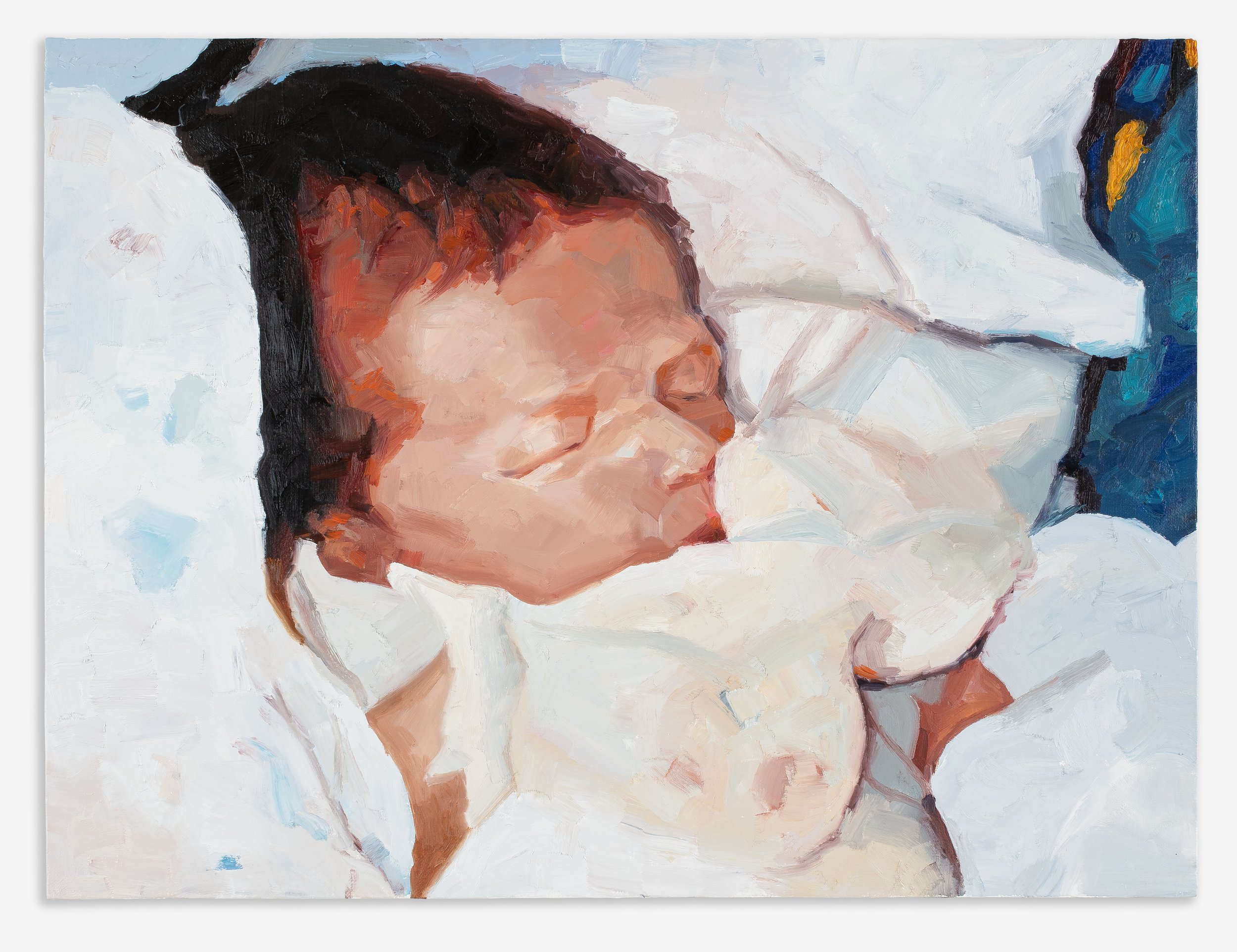
The physical qualities of the painting reward sustained attention to material fact. The oil paint is applied in thin, translucent layers that allow the linen ground to contribute a warmth to the skin tones and a luminosity to the light wrapping that a fully opaque application would not produce. In the darker areas, the figure and the background, the paint is built up more thickly, creating a depth of shadow that is chromatic rather than tonal, a darkness made from the mixture of complementary colors, browns and umbers that cancel each other out to produce a richness that simple black would not achieve. The surface has a softness that is specific to oil on linen, the slight tooth of the woven fabric modulating the brush marks and giving the image a quality of diffusion, a gentle blurring of edges that is not photographic but painterly, the result of pigment suspended in oil being drawn across a surface that resists and yields in equal measure. The brushwork is visible but not assertive. The individual strokes that build the figures and the wrapping are present enough to register as handmade but subordinate enough to register as descriptive, each mark contributing to the representation of form, skin, and cloth.
The composition of the painting, two figures centered against a dark ground, a larger figure cradling a smaller one, with the larger figure's head bowed toward the smaller, is a composition that has a history in Western painting stretching back to the earliest depictions of the Madonna and Child. The iconography of the mother holding the infant Christ, or the father holding the newborn, is one of the oldest and most persistent subjects in the history of art, a subject that appears in every culture that has a tradition of figurative painting, from the Byzantine mosaics of Ravenna to the oil paintings of the Northern Renaissance to the photographs of contemporary hospital rooms. Tan Mu's painting participates in this tradition without citing any specific precedent. The man is not a saint. The child is not a deity. The hospital room is not a stable. But the gesture is the same, the cradling arms, the bowed head, the absorption of the adult in the presence of the new life, and the painting, by placing this gesture in a dark, nonspecific space, allows the viewer to read it as a universal image of parental tenderness before reading it as a specific document of a specific technological event.
Jeff Wall reconstructed a photograph in 1993. His large scale transparency A Sudden Gust of Wind (after Hokusai), 1993, lightbox, 229 by 377 centimeters, recreates Katsushika Hokusai's woodblock print Sudden Wind at Ejiri from the series Thirty Six Views of Fuji (circa 1830 1832) as a contemporary photograph, staging the scene with actors in modern dress on a barren landscape outside Vancouver, their papers blown into the air by a gust of wind that disrupts the calm of the composition. Wall's reconstruction is not an illustration of Hokusai. It is a translation, the conversion of a nineteenth century Japanese woodblock print into a late twentieth century photographic lightbox, with the conversion preserving the essential structure of the original, the figures, the wind, the scattered papers, while replacing every material detail, the kimono with a raincoat, the woodblock with a transparency, the ink with electric light. The translation reveals something about both the original and the copy that would not be visible in either alone: the persistence of certain compositional structures across centuries and media, the capacity of a visual idea to survive the complete replacement of its material embodiment.
The connection between Wall's translation and Tan Mu's painting is structural. Both artists reconstruct a pre existing image in a different medium, preserving its essential content while transforming its material form. Wall translates a woodblock print into a photograph. Tan Mu translates a digital photograph into an oil painting. In both cases, the translation is not decorative. It is epistemological. It reveals something about the original image that the original medium concealed. Wall's lightbox reveals, through the scale and luminosity of the transparency, the compositional dynamism of Hokusai's design, a dynamism that the small, flat woodblock print could not fully express. Tan Mu's oil painting reveals, through the warmth and texture of the painted surface, the emotional content of Kahn's photograph, a content that the grainy, low resolution digital image could not fully convey. The 320 by 240 pixel photograph that Kahn took in 1997 is, by any technical standard, a poor image. It is blurry, underlit, and so low in resolution that the faces of the father and child are barely distinguishable. But the emotional content is intact. The tenderness of the gesture, the cradling arms, the bowed head, these survive the pixelation and the compression and the transmission through a cellular network to 2,000 email addresses. Tan Mu's painting takes this surviving content and gives it the material support it deserves, the oil and linen that have been the medium of parental tenderness in painting for six centuries.
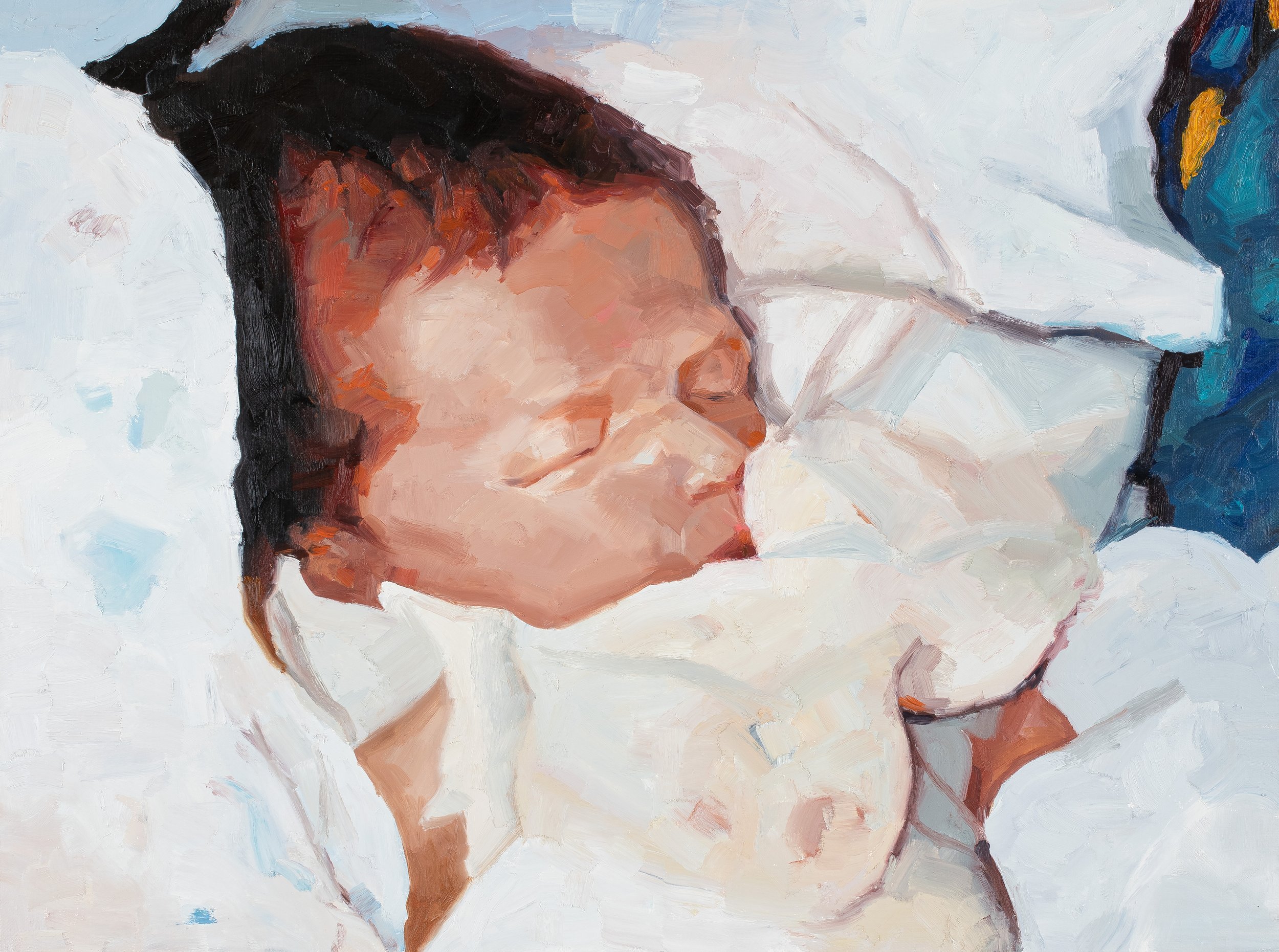
The technological history that produced Kahn's photograph is worth tracing in detail, because the painting's subject is not merely the photograph but the system that made its transmission possible. In 1997, there was no camera phone. There was no mobile internet. There was no social media platform on which a photograph could be posted and shared. The infrastructure that would eventually support the daily transmission of billions of photographs did not yet exist. What existed was a digital camera with a serial port, a flip phone with a cellular radio, and a laptop with a modem. Kahn connected these three devices with cables and wrote software that bridged their incompatible protocols, grabbing the image from the camera, compressing it to a size that could be transmitted over the cellular network, and pushing it through the phone's data connection to a server that forwarded it as an email attachment to a distribution list. The entire process was improvised. It was not a product. It was not a platform. It was a father who wanted to share a photograph of his newborn daughter and who had the technical skill to build, in a matter of hours, a system that could do it. The system he built was the prototype for every mobile photo sharing application that followed, from the first camera phones in 2000 to Instagram in 2010 to the 1.4 billion photographs shared daily on social media platforms in 2025. The painting does not depict this system. It depicts the human need that the system was built to serve, the desire of a parent to share the news of a child's birth with the people who matter to them, a desire that is as old as parenthood and that technology has made, for the first time in human history, instantly satisfiable.
Li Yizhuo, writing in January 2022, observed of Tan Mu's DAWN era paintings that "among her intricately executed work, neither the composition nor the technique of Dolly was particularly remarkable, except that unlike most others, it gazes back." The observation is precise. Share gazes back. The man's face is partially turned toward the viewer, his eyes not fully visible but his attention directed outward, toward the camera that took the original photograph, the camera that Kahn held in one hand while cradling his daughter in the other. This outward gaze is rare in Tan Mu's catalog. Her paintings typically depict objects, systems, landscapes, and structures that do not return the viewer's look. The submarine cable does not gaze. The cryostat does not gaze. The Martian landscape does not gaze. But the father in Share gazes, or almost gazes, his face turned just far enough toward the viewer to register as a presence, a consciousness, a person who is aware of being seen. This awareness is the painting's deepest subject. The photograph that Kahn took in 1997 was taken with the intention of being seen by 2,000 people. It was, from the moment of its creation, a public image, an image made to be shared, an image whose meaning depended not on what it depicted but on who received it. The painting preserves this intention. It depicts a man who knows he is being seen, who is looking at the camera that will transmit his daughter's face to a world that, in 1997, had not yet learned to expect such transmissions, a world in which the arrival of a photograph of a stranger's newborn in one's email inbox was, for the first and perhaps the last time, a genuine surprise.
Li Yizhuo further observed, in the same essay, that Kahn's Daughter, which is the alternate title for Share, "rebuilds the now unbearably low resolution image into a tender moment, with dense brushstrokes and mellow colors." The phrase "unbearably low resolution" is doing real work in this sentence. The original photograph's resolution, 320 by 240 pixels, is not merely low by contemporary standards. It is so low that the image has the quality of a memory, a recollection that is present in its emotional content but vague in its specific details, the faces soft, the edges blurred, the colors muted by the limitations of the sensor and the compression algorithm. This quality of vagueness is what the painting translates into tenderness. The dense brushstrokes that Li Yizhuo identifies are not attempts to render the image with precision. They are attempts to render it with warmth, to replace the cold, digital vagueness of the pixel grid with the warm, material vagueness of oil pigment on linen, a vagueness that is not a failure of resolution but a property of the medium, the way oil paint softens edges and blends tones in a manner that the human eye reads as intimate, as close, as handmade.
The painting hangs in the A.R.M. Holding Art Collection in the United Arab Emirates, one of the five collections that hold Tan Mu's work. It is 46 by 61 centimeters, the size of a family photograph printed at standard dimensions, the size of an image that would sit on a mantelpiece or a bedside table, the size of an object that is meant to be looked at closely, by one person at a time, in a domestic space rather than a public one. This scale is part of the painting's meaning. The photograph that Kahn took was a private image made public, a family moment transmitted to 2,000 strangers. The painting reverses this trajectory. It takes a public image, a photograph that has been reproduced and discussed and cited as a milestone in the history of digital communication, and returns it to the private register, the intimate scale, the size and warmth of an object that belongs in a home. The painting does not commemorate the technological achievement. It commemorates the human impulse behind the achievement, the desire of a father to tell the world that his daughter has been born, a desire so fundamental to human nature that it motivated the invention of a technology that would, within two decades, transform the way every human being on Earth communicates, shares, remembers, and connects.