The Ocean Is Burning: Tan Mu's Gulf of Mexico and the Tradition of Maritime Catastrophe
On July 2, 2021, a gas leak from an underwater pipeline in the Gulf of Mexico, approximately 150 meters from a platform operated by Petroleos Mexicanos, the Mexican state oil company, ignited on the ocean's surface. The resulting fire burned for over five hours, a swirling vortex of flame that rose from the dark water like an eye, orange and yellow tongues of fire spiraling around a central point where the gas, methane and associated hydrocarbons escaping from a rupture in the pipeline five meters below the surface, mixed with oxygen and combusted on contact with the atmosphere. Helicopter footage of the fire, captured by workers on the platform and shared on social media within minutes, showed the ocean itself ablaze, the water's surface rippling with reflected flame, the dark blue green of the Gulf visible at the edges of the fire, a boundary between burning and not burning that looked, from above, like the pupil of an enormous, unblinking eye. The fire was dubbed the "eye of fire" by Mexican media. It became, within hours, one of the most shared images of 2021, a visual shorthand for the environmental cost of fossil fuel extraction, a photograph that made visible, in a single frame, the collision between human industry and oceanic ecology that submarine pipelines represent. Tan Mu saw the footage. She began painting that same day. By the time the fire was declared extinguished, the painting was complete. Gulf of Mexico (2021), oil on linen, 31 by 61 centimeters, is a record of an event that lasted five hours, painted in fewer hours than the fire burned, a work that registers the speed of the catastrophe in the speed of its own making.
The decision to paint the event on the day it occurred is not incidental to the work. It is the work. Tan Mu has described her process as one of "immediacy and real time events," a methodology in which the painting is begun at the moment the artist encounters the source material and completed before the emotional and informational context of the event has had time to settle. The painting of the Gulf of Mexico fire was completed, in her account, by the time the fire was extinguished, a temporal correspondence between the event and the painting that collapses the distance between witnessing and recording. In an age when events are documented by smartphones and shared on social media within seconds, the claim that a painting can compete with the speed of digital media seems implausible. But the painting does not compete. It does something else. It registers the event at a speed that is human rather than digital, the speed of a hand moving across a canvas, loading pigment on a brush, laying down marks that approximate the shapes of flame and water, not with the precision of a camera but with the weight of a body that has chosen, in the moment, to pay attention.
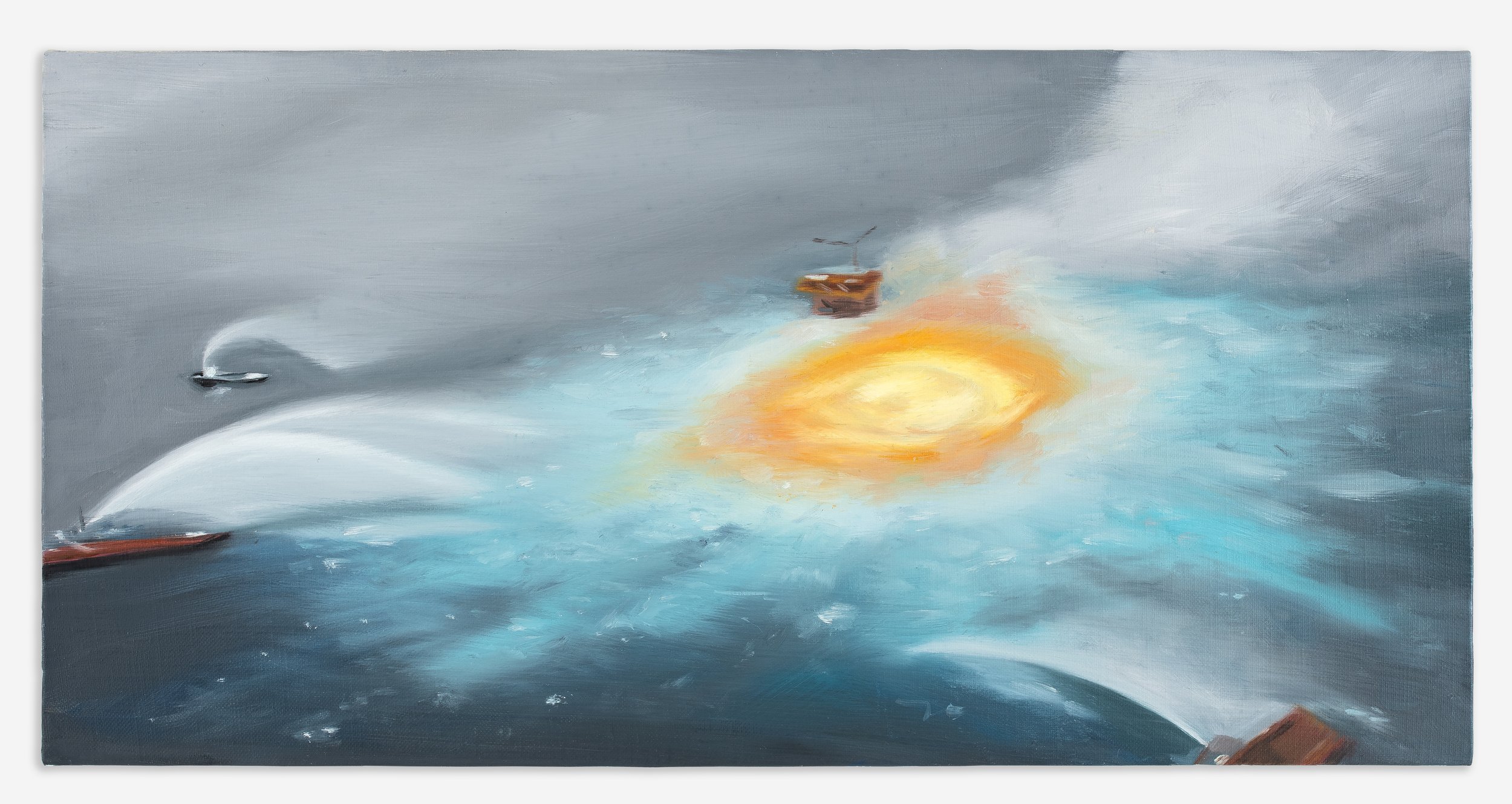
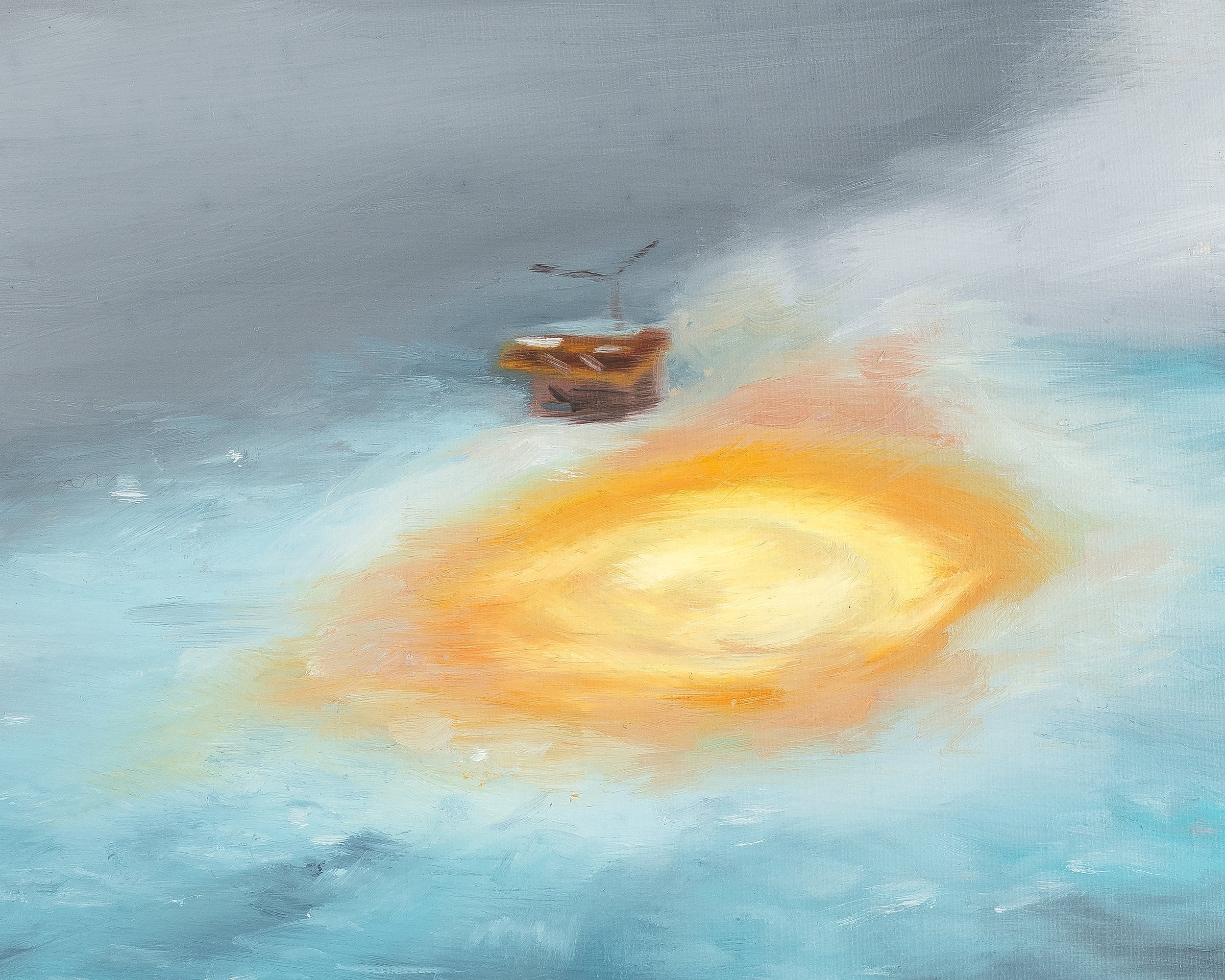
The painting, oil on linen, 31 by 61 centimeters, is horizontal in format, its width approximately twice its height, a proportion that corresponds to the panoramic view captured by the helicopter cameras that documented the fire from above. The composition places the vortex of flame slightly left of center, the bright orange and yellow of the burning gas contrasting sharply with the dark blue green of the surrounding ocean. The fire is rendered in warm tones, cadmium orange, cadmium yellow, and a red that deepens toward crimson at the base of the vortex where the gas ignites at the water's surface. The ocean is rendered in cool tones, deep viridian, Prussian blue, and a near black that registers the depth of the water beneath the surface. The horizon is visible as a faint line of lighter color above the fire, the sky at dusk or dawn, the time of day not specified but the light suggesting the low angle of a sun that is either rising or setting, casting the scene in the amber quality of golden hour. The paint handling is rapid, the marks broad, the surfaces unblended, the brushstrokes visible as individual deposits of pigment that have been laid down and left without further modification. This rapidity is not a stylistic choice in the conventional sense. It is a registration of the speed at which the painting was made, the hand moving quickly because the event was still happening, the fire still burning, the footage still streaming, the social media still sharing.
The surface texture of the canvas contributes to the painting's quality of urgency. The linen ground is visible in several areas, particularly in the darker passages of ocean, where the paint is applied thinly enough that the woven fabric contributes a warmth and a granularity to the surface that fully opaque coverage would eliminate. In the area of the fire, the paint is thicker, built up in overlapping strokes of orange and yellow that create a surface topography that catches light and casts tiny shadows, giving the flame a physical presence that goes beyond its representation on the canvas. The fire is not merely depicted. It is materially enacted, the pigment laid down with a force and a speed that mirrors the force and speed of the combustion it represents. The contrast between the thin, translucent ocean and the thick, opaque fire is the painting's material core, the point at which the medium's physical properties register the event's physical properties, the difference between a liquid that flows and a gas that burns.
J.M.W. Turner painted the ocean on fire. His late seascapes, works like Snow Storm: Steam Boat off a Harbour's Mouth (1842), Rain, Steam and Speed (1844), and The Slave Ship (1840), depict the ocean as a space of violent energy, a medium in which human vessels and human ambitions are subjected to forces that exceed the capacity of any technology to control. The Slave Ship, perhaps the most famous of these late works, depicts a vessel sailing through a sea of extraordinary color, the water rendered in deep reds, oranges, and yellows that suggest both sunset and blood, the bodies of enslaved people who have been thrown overboard visible as fragments of flesh and chain disappearing into the churning surface. The painting is not a document. No slave ship ever sailed through a sea of this color. It is an interpretation, a painting that translates the horror of the transatlantic slave trade into a visual language of color and light that communicates, through the viewer's body rather than their intellect, the scale of the atrocity it depicts. The red is not sunset. The red is blood. The churning water is not weather. The churning water is suffering. Turner's painting does not describe the slave trade. It makes the viewer feel it, in the gut, in the chest, in the involuntary recoil that a field of saturated red produces in a human nervous system that associates red with danger.
The connection between Turner's Slave Ship and Tan Mu's Gulf of Mexico is structural, not stylistic. Both paintings depict the ocean as a site of human caused catastrophe. Both use color as an instrument of emotional communication, the warm tones of fire and blood set against the cool tones of water and sky. Both are horizontal in format, the wide canvas registering the expanse of the ocean and the relative smallness of the human structures that operate on its surface. And both are, at their core, paintings about the collision between human industry and the natural world, the moment when a system designed to extract value from the ocean, slaves from Africa in Turner's case, oil from beneath the seabed in Tan Mu's, produces a consequence that the system was not designed to contain. The slave ship's crew threw enslaved people overboard to collect insurance payments. The underwater pipeline ruptured because of a failure in a system that was designed to operate, invisibly and indefinitely, five meters below the surface of the Gulf. In both cases, the ocean absorbed the consequence. In both cases, a painter made the absorption visible.
Turner's method of painting from life, of standing in storms and observing the behavior of water and light at first hand, provides a further point of connection. The famous anecdote, possibly apocryphal, of Turner having himself lashed to the mast of a ship during a storm so that he could observe the sea's behavior at close range, whether true or not, expresses a conviction that Turner held throughout his career: that painting must be grounded in direct observation, that the painter's eye must witness the event it records, that the translation from world to canvas must pass through the body of the painter rather than through a secondary source, a sketch, a memory, a report. Tan Mu did not stand on the ocean's surface while the Gulf of Mexico burned. She watched helicopter footage on a screen. The observation was mediated by a camera, a satellite, a digital display. But the speed of her response, the painting begun the same day and completed before the fire was extinguished, preserves something of Turner's conviction that painting must be grounded in the temporal reality of the event it records. The painting does not look back at the fire from a distance of weeks or months. It looks at the fire while the fire is still burning, while the footage is still streaming, while the social media is still sharing. This contemporaneity is the painting's deepest connection to Turner's method, the insistence that the painter must be present, in some form, at the event, that the painting must carry the temporal weight of the moment it depicts.
The science of the event warrants a closer look, because the painting's visual choices correspond to specific features of the gas leak that distinguish it from other forms of oceanic combustion. The fire in the Gulf of Mexico was caused by a rupture in a five inch diameter underwater pipeline carrying natural gas from a wellhead to a processing platform. The rupture, likely caused by corrosion or mechanical stress, allowed gas to escape at pressure and rise through five meters of water to the surface, where it mixed with atmospheric oxygen and ignited, possibly from a spark generated by the platform's equipment. The fire burned in a vortex pattern because of the Coriolis effect, the same force that causes hurricanes to spin, the rotation of the Earth imparting a curl to the rising column of gas that organized the flame into a spiral. The vortex shape, visible in the helicopter footage and preserved in Tan Mu's painting, is not a coincidence. It is a physical consequence of the planet's rotation acting on a column of rising gas, a macroscopic manifestation of the same force that organizes weather systems at scales of hundreds of kilometers. The painting registers this vortex as a spiral of warm color against cool, the orange and yellow of the flame curling around a central point that corresponds to the gas column's axis, the visual form of a planetary force made visible by combustion.
The event's position within the broader history of offshore oil and gas disasters gives it a context that the painting, by its rapidity and specificity, does not narrate but implies. The Deepwater Horizon explosion of April 20, 2010, which killed eleven workers and released approximately 4.9 million barrels of oil into the Gulf of Mexico over eighty seven days, was the largest marine oil spill in history and a defining event in the public's understanding of the environmental risks of offshore drilling. The Gulf of Mexico fire of 2021 was, by comparison, minor. No one was killed. The fire was extinguished in five hours. The gas leak was sealed within days. But the image of the ocean burning, the visual shock of flame rising from water, registered with a public that had, in the decade since Deepwater Horizon, become sensitized to the environmental consequences of fossil fuel extraction. The image circulated not because the event was catastrophic but because it was visible, a single frame that made legible, in the language of fire and water, the tension between energy extraction and oceanic ecology that defines the contemporary relationship between human industry and the sea.
Yiren Shen, writing for 10 Magazine in 2025, observed that Tan Mu's painting process is "typically triggered by a current event, which leads to the exploration of that event within a particular clue. This process can be understood as a retrospective journey." The observation illuminates something about the Gulf of Mexico painting that distinguishes it from Tan Mu's other works. Most of her paintings are based on research, a lengthy process of image sourcing, data gathering, and conceptual development that can take months or years. The Gulf of Mexico painting bypassed this process. It was triggered by a current event, the gas leak, and completed in the same temporal frame as the event itself. The "retrospective journey" that Shen describes, the movement from present event to historical context, happened after the painting was finished, not before. The painting is therefore not a considered reflection on the environmental consequences of offshore drilling. It is an immediate response, a registration of the visual shock that the footage produced in the painter who watched it, a translation of that shock into pigment on linen before the shock had time to metabolize into analysis.
Li Yizhuo, reviewing the DAWN exhibition at Peres Projects in 2022, singled out Gulf of Mexico as the painting in which "there is yet no sight of symbolism, of a slouching, beastly modernism as such," except for this one work, the "nightmarish scene caused by gas leak from an underwater pipeline in July 2021." The observation is precise. The DAWN exhibition contained paintings of embryos, atomic tests, splash patterns, and dolly the sheep, subjects that invite symbolic and allegorical reading, subjects that carry layers of cultural meaning that the viewer is expected to unpack. The Gulf of Mexico painting resists this unpacking. It is not symbolic. It is not allegorical. It is a painting of an ocean on fire, and the ocean is on fire because a pipeline ruptured and the gas ignited. The nightmarish quality that Li Yizhuo identifies is not a quality that the painting adds to the event. It is a quality that the event already possessed, the horror of watching the ocean burn, a horror that requires no symbolic amplification because it is, in itself, sufficient. The painting's refusal of symbolism is its strength. It does not tell the viewer what to feel about the burning ocean. It shows the burning ocean and trusts the viewer to feel whatever the viewer feels, which, for most viewers who have seen the footage, is a mixture of awe, dread, and the specific nausea of witnessing a system fail in a way that harms the environment it was built to operate within.
The painting's horizontal format, 31 by 61 centimeters, a proportion that is wider than it is tall, registers the panoramic quality of the helicopter footage that served as its source. The wide format forces the viewer's eye to travel laterally across the composition, from the dark water on the left to the fire at center to the dark water on the right, the eye tracing a path that corresponds to the camera's panning movement across the scene. This lateral movement is not the movement of contemplation, the slow, vertical traversal that a Madonna and Child or a portrait demands. It is the movement of scanning, the rapid, horizontal sweep of an eye that is looking for danger, for the edge of the fire, for the point at which the burning stops and the normal ocean resumes. The painting, by organizing the viewer's eye movement in this way, reproduces the perceptual experience of watching the footage, the scanning gaze that every viewer of the helicopter video performed unconsciously, looking for the boundary between catastrophe and safety, between the fire and the water, between the human caused disaster and the ocean that will, eventually, absorb it.