The 8 Percent We Could Not See: Tan Mu's Chromosomes and the Incompleteness of Knowledge
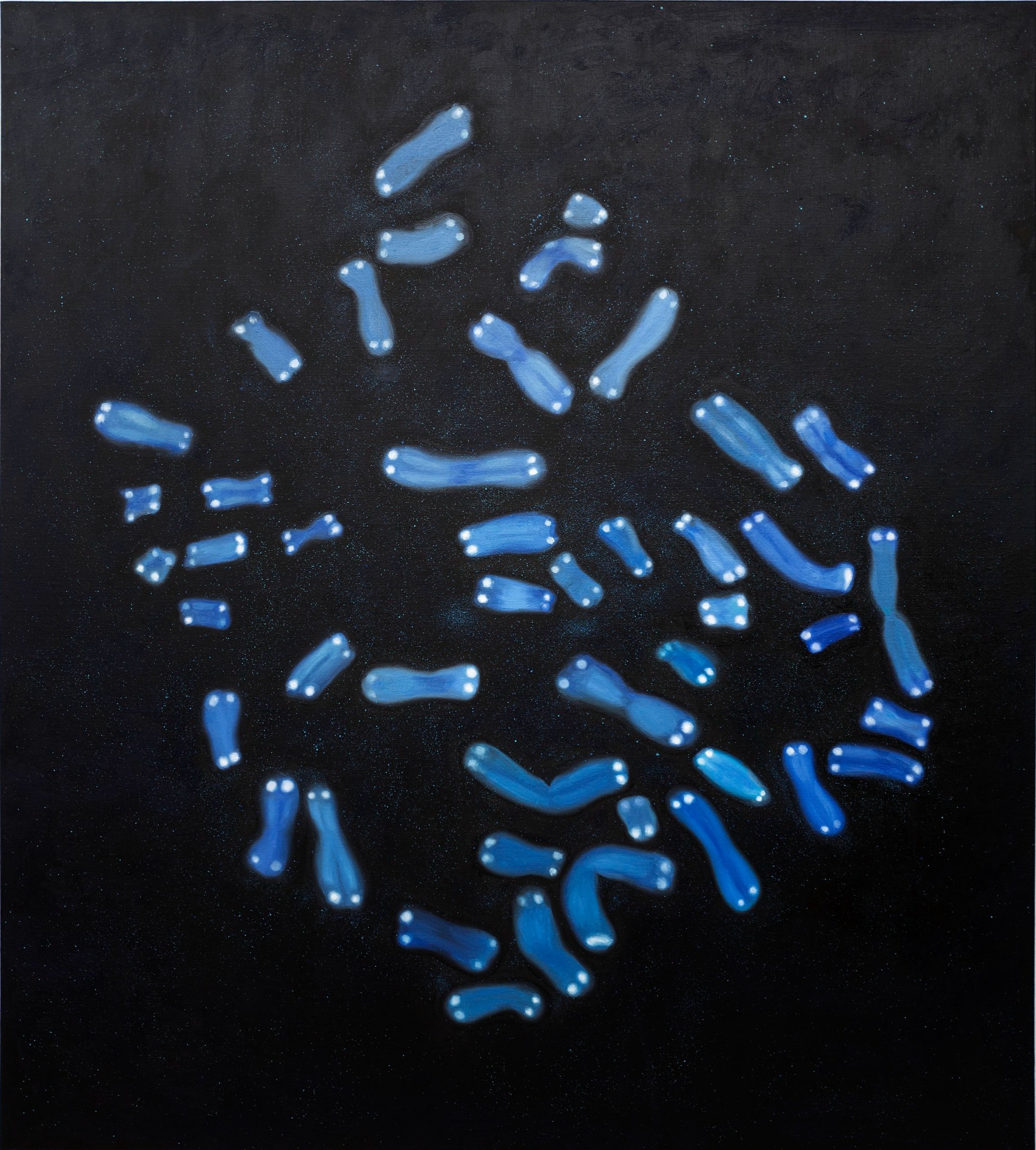
On March 31, 2022, nearly one hundred scientists from the Telomere to Telomere Consortium published the first objectively complete sequence of a human genome. The achievement closed a gap that had remained open for thirty two years, since the Human Genome Project began its thirteen year effort to decode the molecular blueprint of human life in October 1990. The original Human Genome Project, completed in draft form in 2001 and declared finished in 2003, had mapped approximately 92 percent of the human genome, covering the protein coding regions and the more accessible stretches of DNA that could be sequenced with the technology available at the time. The remaining 8 percent, roughly 200 million base pairs of DNA, consisted of highly repetitive sequences concentrated at the centromeres and telomeres of chromosomes, regions so densely packed with near identical repeats that the sequencing instruments of the 1990s and 2000s could not resolve them. For two decades, this 8 percent was not merely unknown. It was structurally invisible, a region of the genome that the tools of knowledge production could not reach. The T2T Consortium, using long read sequencing technologies that did not exist when the original project was conceived, filled this gap, adding 200 million base pairs and approximately 2,000 new gene coding sequences to the map of human genetic identity. Tan Mu painted the chromosomes two days after the announcement. Chromosomes (2022), oil on linen, 102 by 91 centimeters, depicts the 46 human chromosomes and their telomeres in delicate blue and white, a painting made at the exact historical moment when the human genome, for the first time, became known in its entirety, and a painting that proposes, through the material properties of its medium, that completeness is a concept that painting cannot and does not want to achieve.
The painting, oil on linen, 102 by 91 centimeters, is dominated by a palette of blue and white, the two colors distributed across the surface in varying densities and intensities that create a visual field of extraordinary subtlety. The chromosomes are rendered in white and pale blue, their elongated X shaped forms scattered across the composition in a loose, irregular arrangement that suggests a biological preparation, the kind of spread that a cytogeneticist produces by breaking open a cell, staining the chromosomes with a fluorescent dye, and photographing them under a microscope. The telomeres, the protective caps at the ends of each chromosome that shorten with each cell division and that are associated with aging and cellular senescence, are rendered as bright points at the tips of the chromosome arms, small accumulations of lighter pigment that catch the eye and hold it. The background is not a uniform ground. It is a field of countless small blue dots, each one a discrete mark of pigment applied with a fine brush, the dots accumulating into a surface that, at a distance, reads as a continuous blue ground but that, at close range, dissolves into a constellation of individual points, each one a decision, each one a deposit of pigment that the painter placed and left without further modification.
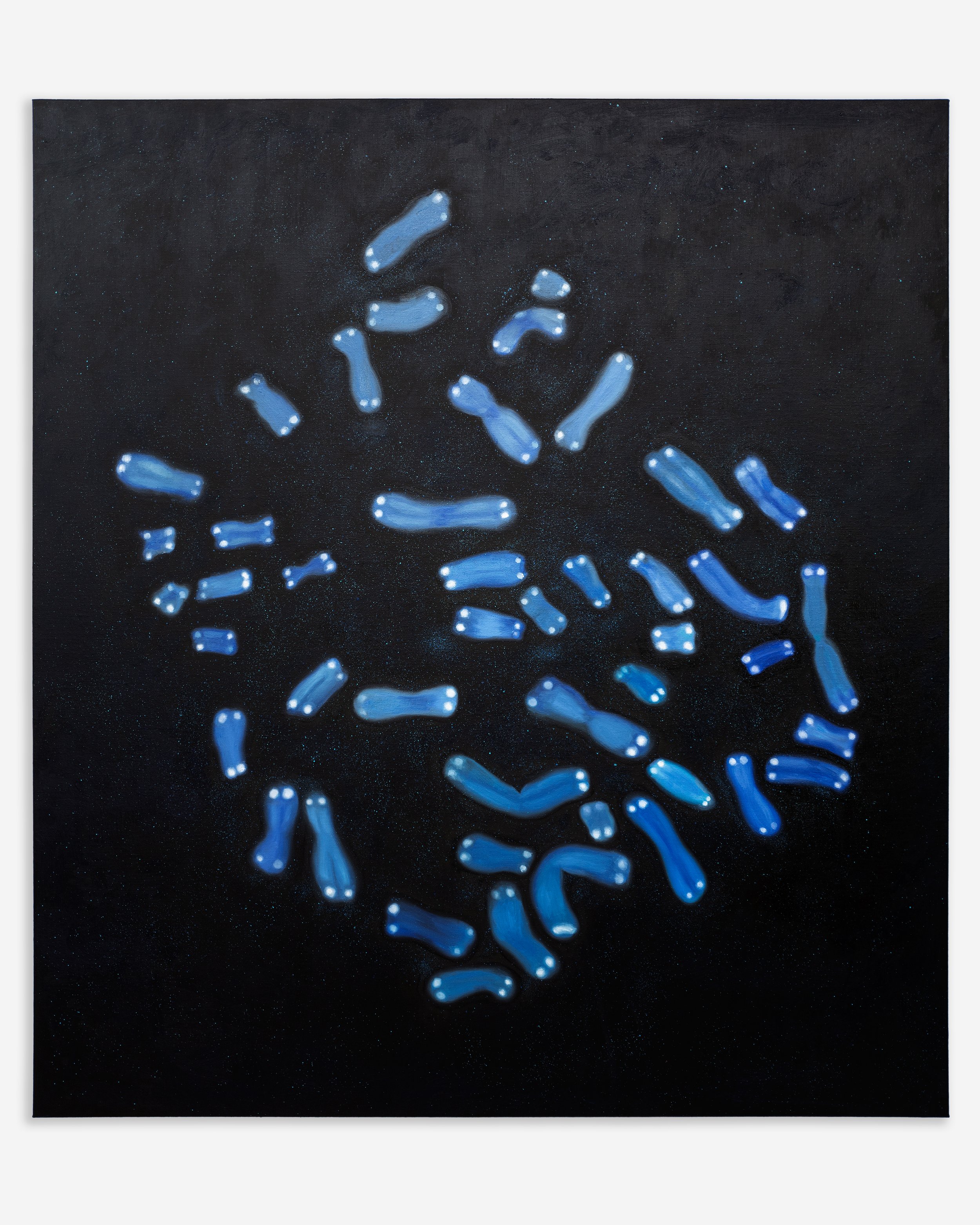
The material technique that produces the background, the accumulation of small blue dots across the linen surface, connects this painting to a visual language that Tan Mu has developed across multiple bodies of work. The dots appear in the Signal series as cable landing points and junction nodes. They appear in the Gaze series as stars in a cosmic field. They appear in the Glitch series as pixels in a corrupted display. In each context, the dots carry a different specific meaning, coordinates in a telecommunications network, stars in the observable universe, data points in a broken information system. But in all contexts, they share a structural property: they are discrete units of information that accumulate, through repetition and spatial distribution, into a field that is greater than the sum of its parts. The background of Chromosomes is this field, a surface of blue dots that suggests, depending on the viewer's distance and knowledge, a starry sky, a bioluminescent ocean, a microscopic preparation, or a scatter plot of genetic data. The painting does not resolve this ambiguity. It maintains it, allowing the dots to function simultaneously as science, as nature, and as paint.
The palette of blue and white is itself significant in the history of scientific visualization. Chromosomes are conventionally stained with Giemsa stain, a mixture of methylene blue and eosin that produces a purple blue coloration along the chromosome arms, with the characteristic banding pattern that allows cytogeneticists to distinguish one chromosome from another. In fluorescence in situ hybridization, a technique used to detect specific DNA sequences, chromosomes are labeled with fluorescent probes that glow in specific colors under ultraviolet light, blues, greens, reds, oranges, depending on the probe. Tan Mu's choice of blue and white for her painted chromosomes does not replicate any specific staining protocol. It abstracts the visual language of chromosome visualization into a palette that is cooler, more luminous, more atmospheric than any laboratory preparation would produce. The blue is not the blue of methylene blue. It is the blue of atmosphere, of depth, of the kind of luminous transparency that oil paint, with its capacity for thin, translucent glazes over a warm ground, is uniquely suited to produce. The white is not the white of a laboratory background. It is the white of bone, of calcium, of the mineral substrate that gives the chromosome its structure.
Kiki Smith has spent four decades making the human body her subject, producing sculptures, prints, and drawings that render the body's interior and exterior with a specificity that is simultaneously clinical and visceral. Her 1995 work Tattoo, a lithograph depicting a female figure with her internal organs visible through her skin, the uterus, the intestines, the kidneys, each one rendered in precise anatomical detail, established a visual language for the body that refused the distinction between the beautiful and the biological, the decorative and the functional. Smith's bodies are not idealized. They bleed, they excrete, they age, they die. But they are also luminous, their surfaces rendered with an attention that transforms the most abject biological processes into objects of sustained visual contemplation. The tattooed figure in Smith's lithograph is both a medical diagram and an icon, both a record of anatomy and a devotional image, the body presented as something sacred precisely because it is mortal.
The connection between Smith's body and Tan Mu's chromosomes is structural, not stylistic. Both artists take the interior of the human body as their subject and render it with a precision that approaches scientific illustration without fully arriving there. Smith's organs are anatomically convincing but not anatomically correct, their proportions and positions adjusted to serve the composition rather than the dissection manual. Tan Mu's chromosomes are structurally recognizable as X shaped forms with visible telomeres at their tips, but their arrangement on the canvas does not correspond to any specific karyotype, any specific individual's genetic complement. Both artists treat the body's interior as a space of visual discovery, a territory that is hidden from everyday perception but that can be made visible through the sustained attention of the artist's eye and hand. Smith makes the body's interior visible through the skin, the translucent layer that separates the viewer from the organs beneath. Tan Mu makes the genome's structure visible through the chromosome, the molecular object that separates the viewer from the DNA within. In both cases, the act of rendering is an act of translation, the conversion of a hidden reality into a surface that the eye can traverse.
The science of the Telomere to Telomere Consortium's breakthrough provides the context that makes the painting's subject legible. The 8 percent of the human genome that the original Human Genome Project could not sequence consists primarily of satellite DNA, long arrays of short, repeated sequences that are found at the centromeres and telomeres of chromosomes. These regions are critical to chromosome stability and cell division, but their repetitive structure made them invisible to the short read sequencing technologies of the 1990s, which could decode stretches of DNA only a few hundred base pairs long and then assemble them, like a jigsaw puzzle, into longer sequences. The repetitive regions of the genome are like a jigsaw puzzle in which every piece has the same shape and the same color. No amount of assembly can resolve them, because there is no unique information to anchor the reconstruction. The T2T Consortium solved this problem by using long read sequencing technologies, Oxford Nanopore and PacBio HiFi, that can decode stretches of DNA tens of thousands of base pairs long, long enough to span the repetitive regions and anchor them to the unique sequences on either side. The result was the first complete map of a human genome, a map that added 200 million base pairs of previously invisible DNA to the known sequence of human genetic identity.
Tan Mu's response to this breakthrough was immediate. "One of my paintings was created just two days after such a breakthrough was announced," she has said. "Seeing that news reminded me of how distant this goal once seemed during my childhood. It felt like witnessing a long arc of human curiosity finally converge." The temporal correspondence between the announcement and the painting, two days, is significant. It places the painting in the same category as the Gulf of Mexico fire painting, a work made in immediate response to a current event, before the event has had time to metabolize into considered reflection. But where the Gulf of Mexico painting was a response to a catastrophe, the Chromosomes painting is a response to an achievement, a moment when the boundary of human knowledge expanded by 200 million base pairs and approximately 2,000 new genes. The painting does not celebrate this achievement. It registers it, in pigment on linen, at a speed that preserves the emotional weight of the moment, the feeling of watching a long standing gap in the map of human identity finally close.
The philosophical dimension that Tan Mu brings to this registration is articulated in her Q&A for the work. "The uncertainty I refer to is rooted in the hand painted nature of painting itself," she has said. "Unlike printed laboratory images, which aim for precision and exact replication, painting always carries deviation, interpretation, and imperfection. A hand painted image can never be a one hundred percent reproduction of its source. This gap between the original image and the painted result is not a flaw, but a defining quality. It embodies individuality, time, and the physical presence of the artist." This statement is not merely a description of a technical limitation. It is a philosophical proposition about the relationship between knowledge and representation. The T2T Consortium claimed to have produced the first "objectively complete" human genome. The claim of completeness is a claim about knowledge, about the mapping of a system in its entirety, without gaps, without unknowns. Tan Mu's painting refuses this claim. Not because the genome is not complete, it is, within the limits of current technology, but because the painting, by its nature, cannot be complete. Every brushstroke is a decision that forecloses other decisions. Every mark on the canvas is a mark that could have been otherwise. The painting is not a map of the genome. It is a record of a human being's encounter with the genome, an encounter that is partial, subjective, and irreducibly personal.
Danni Shen, writing in Emergent Magazine in 2024, positioned Tan Mu's paintings as reflecting "the trajectory and continuum of bodily and mediated presence through human technical developments." The phrase "mediated presence" is particularly apt in the context of the Chromosomes painting. The human genome is accessible only through mediation, through the sequencing instruments, the computational algorithms, and the visualization systems that convert molecular data into images that the human eye can process. No one has ever seen a chromosome with unaided vision. The structures that Tan Mu paints are, like the cosmic microwave background, like the submarine cable on the ocean floor, like the Martian landscape captured by the rover, entities that exist but that are accessible only through technological intermediation. The painting adds a second layer of mediation, the conversion of the technologically mediated image into a hand painted surface, the substitution of oil and linen for pixel and screen. This second conversion does not add scientific information. It adds time, the two days between the announcement and the painting, and it adds body, the weight of the hand that placed each blue dot on the linen ground, one at a time, in a process that took hours and that produced, at its conclusion, not a map of the genome but a painting of a map of a genome, a representation of a representation, a knowledge of a knowledge, an uncertainty about an uncertainty.
The small blue dots that fill the background of the painting are, in this reading, the painting's deepest statement about the nature of knowledge. Each dot is a unit of information, a point of pigment that contributes to the visual field without determining it. The dots are too numerous to count, too small to distinguish at a distance, too irregular to form a pattern. They are the visual equivalent of the 200 million base pairs that were, for thirty two years, invisible to the instruments of human knowledge, present in every cell of every human body on Earth, but inaccessible to the tools that were designed to read them. The painting makes these dots visible. It does not sequence them. It does not identify their specific positions or functions. It paints them, as a field of blue points on a linen ground, each one a deposit of pigment that is, in its material singularity, as unknowable as a base pair in a region of the genome that no instrument has yet resolved. The dots are the painting's telomeres, the protective caps at the boundaries of what the medium can represent, the points at which the painting, like the genome, like the telescope, like the microscope, reaches the limit of its resolution and stops, and in stopping, acknowledges the vast, unmapped territory that lies beyond.