The Hands That Made the Algorithm: Tan Mu's The Binary Dream and the Hidden Labor of Computing
The IBM 704 electronic data processing machine was installed at NASA's predecessor institutions beginning in the mid 1950s. It weighed approximately 25 tons, occupied a room the size of a small apartment, and consumed enough electricity to power a neighborhood. It could execute 40,000 floating point operations per second, a speed that, at the time, was considered extraordinary, a computational velocity that enabled calculations previously impossible, trajectories for space missions, stress analyses for rocket structures, orbital mechanics for satellites that had not yet been launched. The machine was operated by human beings, mostly women, who fed it punched cards, monitored its vacuum tubes, retrieved its printed output, and debugged its programs by hand. These women were not celebrated. They were not named in the histories of computing that would later be written. They were operators, a category of labor that the narrative of technological progress has systematically rendered invisible, the human hands that made the algorithm run while the algorithm received the credit. Tan Mu's painting The Binary Dream (2024) is based on a historical photograph of one such operator, a woman seated at the console of the IBM 704, her body positioned at the intersection of human labor and machine computation, her hands touching the switches and dials that controlled a system she did not design but that could not function without her.
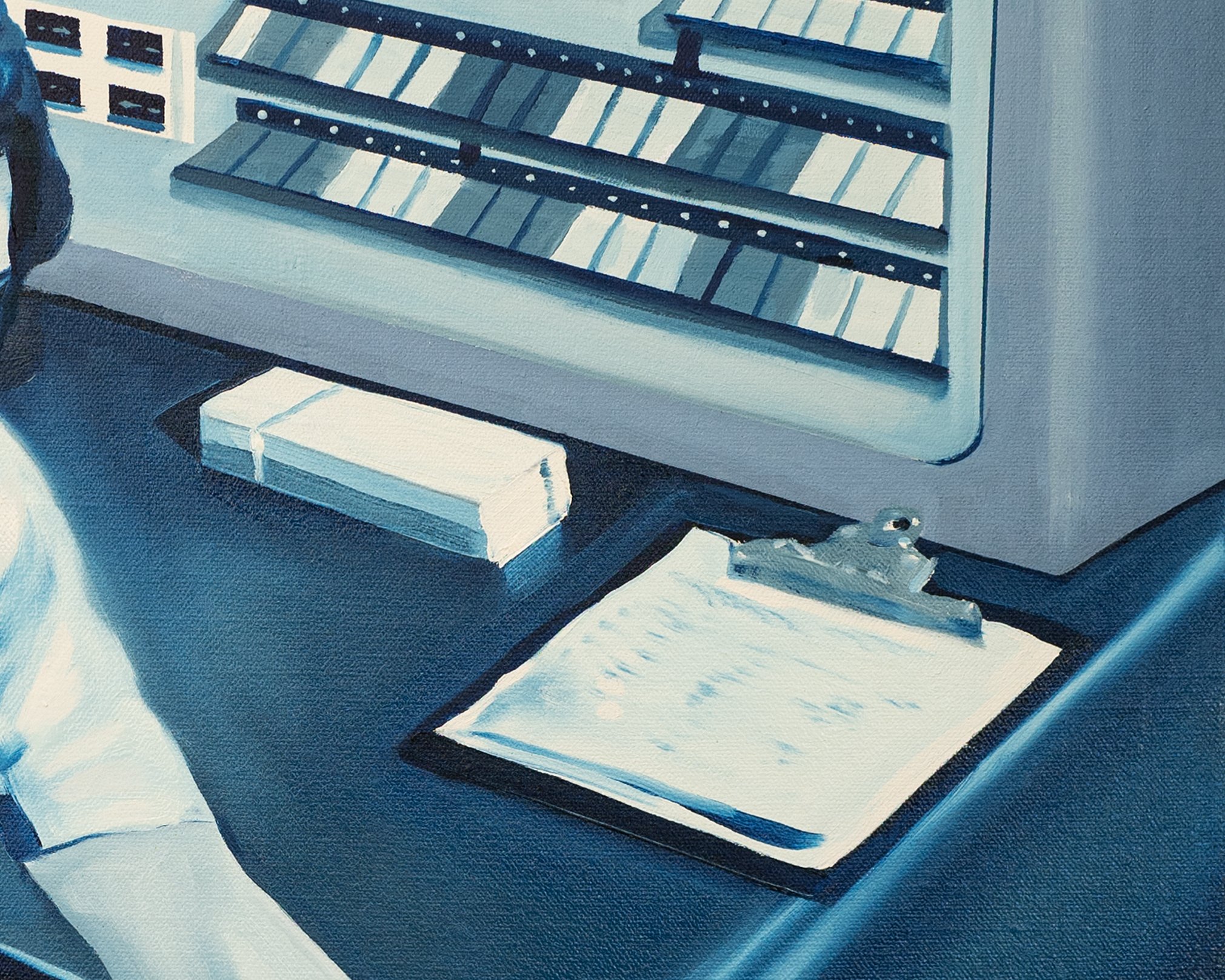
The painting, oil on linen, 76 by 46 centimeters, vertical in format, depicts two women in a room dominated by the massive cabinets of the IBM 704. The woman in the foreground is seated at a console, her body oriented toward the viewer, her hands resting on the control panel, her expression one of quiet concentration. The second woman stands behind her, partially visible, her figure emerging from the deep blue of the background. The entire image is rendered in a monochromatic blue palette, ranging from a deep, almost black navy in the shadows and the machine cabinets to a pale, luminous cerulean in the highlights on the women's faces and hands. There is no other color. The skin is blue. The machine is blue. The floor is blue. The atmosphere is blue. This total immersion in blue is not a technical limitation. It is a deliberate choice that Tan Mu has explained in terms that connect the palette to the subject: "Blue immediately evokes IBM, often referred to as Big Blue, and carries associations with rationality, order, and institutional authority. From the IBM 704 to Deep Blue, this color has become closely tied to the visual language of computing."
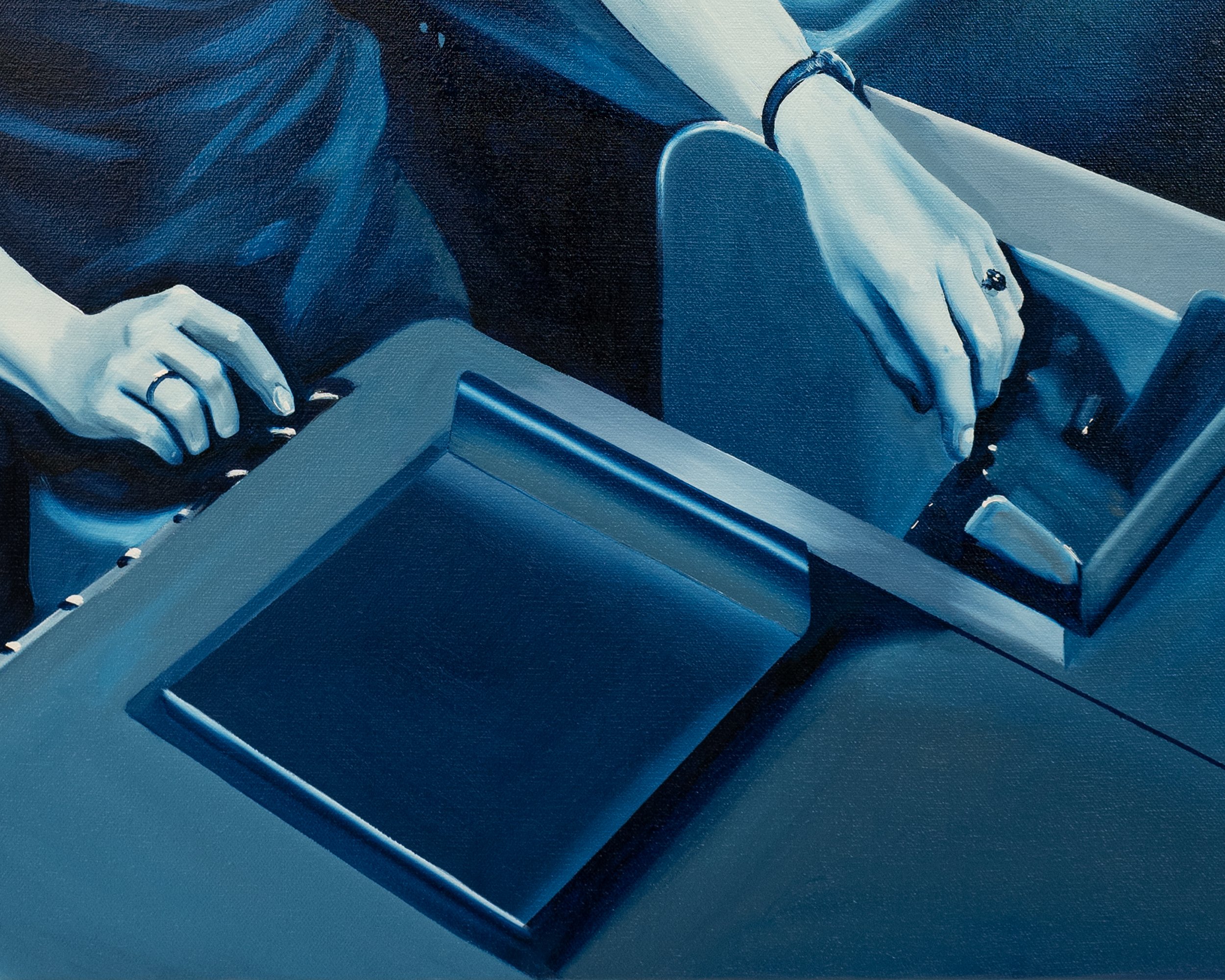
The material qualities of the monochromatic surface reward close attention. The paint is applied in thin, translucent layers that build depth through accumulation rather than opacity. The darkest areas, the machine cabinets and the deep shadows between them, are painted in multiple layers of ultramarine and Prussian blue, each layer partially visible through the one above, creating a chromatic darkness that is richer and more complex than a single application of dark blue would produce. The lightest areas, the highlights on the women's faces and the surfaces of the control panel, are painted in thin washes of cerulean and white, the linen ground contributing a warmth to the blue that prevents it from reading as cold or clinical. The surface has the texture of oil on linen, the slight tooth of the woven fabric modulating the brush marks and giving the image a softness, a diffusion that is not photographic but painterly, the result of pigment suspended in oil being drawn across a surface that resists and yields in equal measure. The brushwork is visible in the mid tones, small directional strokes that follow the contours of faces, hands, and machine surfaces, each stroke a deposit of blue pigment that contributes to the overall tonality while retaining its individual identity as a mark made by a hand.
The decision to work in a monochromatic palette is itself a form of content. Tan Mu has described the original source photograph as black and white, and she has noted that she "initially explored AI based colorization as a way of reconstructing its historical appearance. While some results were surprisingly accurate, I ultimately chose not to pursue realism." The rejection of realism in favor of monochrome is a rejection of documentary reconstruction, the attempt to restore a historical photograph to the colors it would have possessed if it had been taken with a color camera. Instead, Tan Mu substitutes a single color, blue, for the full spectrum that the photograph lost when it was rendered in black and white. The substitution does not restore the photograph. It transforms it, converting a documentary record into an atmosphere, a computational environment in which the figures and the machine exist not as they were but as they are remembered, or as they have been stored, in the archival memory of a culture that has forgotten the women who operated its first computers. The blue is the color of that forgetting, the institutional blue of IBM, the rational blue of algorithms, the cold blue of a data center, a color that has come to stand for the entire apparatus of computation, the machines, the code, the infrastructure, and the invisible labor that sustains it.
Diego Rivera painted a man controlling the universe. His mural Man, Controller of the Universe (1934), originally commissioned for the Rockefeller Center in New York and later destroyed and re painted at the Palacio de Bellas Artes in Mexico City, depicts a central figure, a worker, surrounded by the apparatus of modernity, telescopes, microscopes, machinery, astronomical instruments, and the social forces that shape human life, capitalism, communism, war, and leisure. The mural is monumental, its scale asserting the importance of the human being who stands at the center of the composition, the worker whose labor makes the machines run and whose intelligence makes the discoveries possible. Rivera's worker is male, heroic, physically powerful, his body rendered in the muscular, monumental style that Rivera developed from his study of Italian Renaissance frescoes and his commitment to Mexican revolutionary politics. The universe that the worker controls is a universe of physical forces and material systems, a universe that can be understood through science and transformed through labor.
The connection between Rivera's mural and Tan Mu's painting is structural, not stylistic. Both depict the human being at the center of a technological system, the operator whose body is positioned at the interface between human intelligence and machine computation. Both treat the human figure with a specificity that distinguishes it from the surrounding machinery, the face and hands rendered with a precision that the machines, however faithfully depicted, do not receive. And both are, at their core, paintings about the relationship between labor and knowledge, the physical work of operating a system and the intellectual work of understanding what the system produces. But where Rivera's worker is monumental, heroic, and male, Tan Mu's operators are small, quiet, and female. The 76 by 46 centimeter canvas does not assert importance through scale. It asserts it through attention, the sustained, specific attention that the painter brings to the women's faces, their hands, their postures, the details of their clothing and their concentration. The women in Tan Mu's painting do not control the universe. They operate a machine. But the machine they operate, the IBM 704, would not exist without them, and the universe it helped to explore, the cosmos of orbital mechanics and space trajectories, would have remained inaccessible without the punched cards they fed into its readers and the printed output they retrieved from its printers.
Rivera's mural was destroyed by the Rockefeller family because it included a portrait of Lenin, a political statement that the commission's patrons could not accept. The destruction of the mural is itself a parable about the relationship between art and power, the capacity of those who control institutions to erase the images that challenge their authority. Tan Mu's painting of the IBM 704 operators participates in a different but related dynamic of erasure. The women who operated early computers were not destroyed. They were forgotten. Their names do not appear in the histories of computing that celebrate the engineers who designed the machines and the programmers who wrote the software. The operators, the women who fed the cards, monitored the tubes, and retrieved the output, were classified as clerical workers, a category that the culture of technology has treated as subordinate to the categories of engineering and programming. The painting restores them to visibility, not as heroes, not as the monumental figures that Rivera's revolutionary aesthetic demands, but as women doing a job, their faces composed, their hands on the controls, their presence at the machine a fact that the historical record has failed to preserve.
The IBM 704's role in the history of computing warrants a closer look, because the painting's subject is not merely the women but the machine they operated and the computational revolution it inaugurated. The 704 was introduced in 1954 as IBM's first commercial scientific computer, a machine designed for the floating point arithmetic that space science and nuclear physics required. It was the platform on which FORTRAN, the first high level programming language, was developed by John Backus and his team at IBM in 1957, a language that made it possible for scientists to write programs in a notation that resembled mathematical equations rather than the binary machine code that earlier computers required. The 704 was also the platform on which Arthur Samuel developed his checkers playing program, one of the earliest examples of machine learning, a program that improved its own performance through experience, playing thousands of games against itself and adjusting its evaluation function based on the outcomes. These achievements, FORTRAN and machine learning, are the foundations of the digital age, the bedrock on which every subsequent development in computing, from personal computers to artificial intelligence, has been built. And they were made possible by the operators, the women who kept the 704 running, who loaded the programs, who monitored the output, who debugged the errors, whose labor was the precondition for every computation the machine performed.
Nick Koenigsknecht, writing in the BEK Forum catalog in 2025, argued that Tan Mu's paintings of technology should be understood as "self portraits, rather than depictions of external, scientific milestones." He observed that "while observing technology, are we not looking at ourselves?" The proposition applies to The Binary Dream with particular force. The painting does not depict the IBM 704 as an external object, a machine to be admired for its engineering or feared for its power. It depicts the machine as a site of human presence, a room in which two women sit and stand and work, their bodies occupying the same space as the cabinets and consoles, their hands touching the same switches and dials. The painting is, in Koenigsknecht's terms, a self portrait of the relationship between the human body and the technological system, a relationship that is intimate, physical, and ongoing, sustained by the continuous labor of operators who exist at the interface between the human and the machine. The women in the painting are not observing the machine. They are inside it, their labor the mechanism through which the machine's computational power is actualized, their attention the intelligence that the machine's circuits lack.
Koenigsknecht further proposed that humanity's relationship to its technology should be understood as a cohabitation with "bio techno siblings," technologies that "have lifecycles. They are conceived, born, maintained, and eventually replaced." The IBM 704 was conceived in the early 1950s, born when the first unit was delivered to the Lawrence Livermore National Laboratory in 1955, maintained by the operators who ran it for approximately a decade, and eventually replaced by faster, smaller, more powerful machines that rendered it obsolete. But the labor that maintained it, the human attention that loaded the cards and monitored the tubes, did not become obsolete. It transformed, moving from the console of the 704 to the terminal of the mainframe to the keyboard of the personal computer to the touchscreen of the smartphone, each transition accompanied by a further recession of the laboring body from visibility, a further abstraction of the human presence that sustains the system. The painting arrests this recession. It makes the body visible, the hands on the console, the face in the blue light, the operator at the machine whose labor, in 2024, is performed by server farms and cloud platforms and algorithms that no longer require a human hand to load a card or flip a switch. The painting remembers what the algorithm has forgotten: that computation began with a body in a room, touching a machine, making it run.
The vertical format of the canvas, 76 centimeters tall and 46 centimeters wide, corresponds to the orientation of a portrait, a format that has been used for depictions of individuals since the earliest traditions of panel painting. The women in The Binary Dream are painted in this format, their figures occupying the vertical space of the canvas from the console at the bottom to the upper cabinet of the IBM 704 at the top. The format asserts their status as individuals, as persons whose faces and hands and postures are worthy of the sustained attention that a portrait demands. This assertion is itself a political act, a refusal of the institutional classification that reduced the operators to a labor category, a clerical designation, a nameless function in the machine room. By painting them in the portrait format, Tan Mu restores the specificity that the historical record has erased, the individual faces, the particular hands, the distinct postures of women who were, in their time, essential to the functioning of a system that the culture of technology has taught us to attribute to the engineers and the programmers and the machine itself.