The Spiral at the Bottom of the Ship: Tan Mu's The Wave and the Machinery That Mirrors Nature
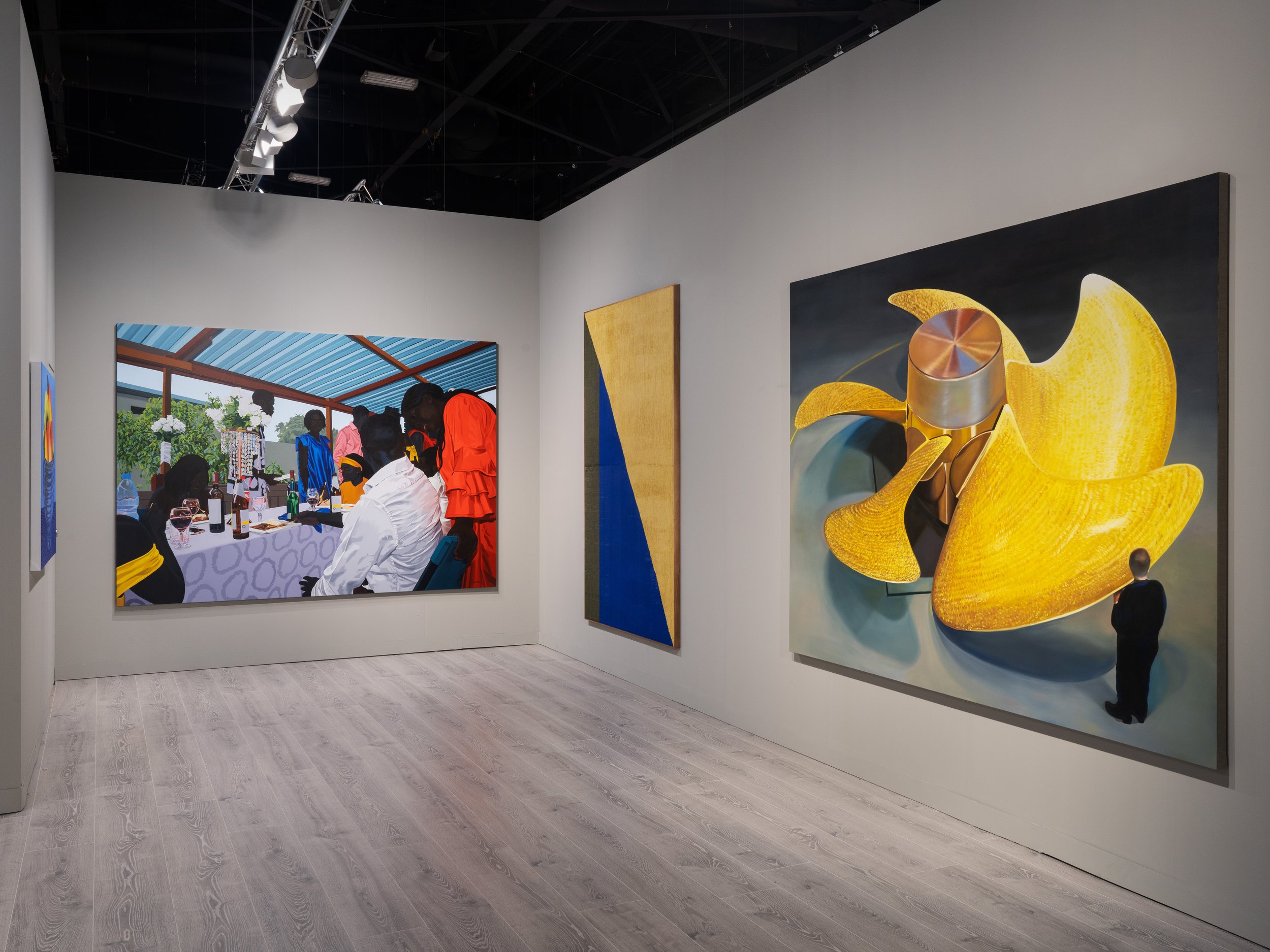
Inside the engine room of a container ship, the propeller shaft descends through the hull at an angle, passing through a series of bearings and seals before it exits the vessel below the waterline and connects to the propeller, the massive, multi bladed assembly that converts the engine's rotational energy into the thrust that moves the ship through the water. The shaft is typically between 50 and 100 meters long, depending on the vessel's size, and it rotates at between 80 and 120 revolutions per minute, a speed that is slow by the standards of automotive or aviation engines but that produces, through the propeller's diameter and blade pitch, a thrust sufficient to move a vessel of 200,000 deadweight tons through the ocean at a cruising speed of 15 to 20 knots. The propeller itself is one of the most precisely engineered components in maritime technology, its blades shaped according to hydrodynamic principles that have been refined over two centuries of naval architecture, each blade's curvature, thickness, and angle of attack calculated to maximize thrust while minimizing cavitation, the formation of vapor bubbles on the blade's surface that reduces efficiency and causes erosion. Tan Mu's painting The Wave (2023) looks up into this machinery from below, the viewer positioned beneath the shaft, gazing upward through a forest of gears, bearings, and structural supports toward the circular housing of the turbine or propeller mechanism that dominates the composition's upper register. The painting is not about the propeller's engineering. It is about the propeller's spiral, the rotational structure that connects a machine built by human hands to the natural systems, ocean currents, atmospheric circulation, biological growth patterns, that the machine was designed to move through.
The painting, oil on linen, 193 by 244 centimeters, is among the largest canvases in Tan Mu's catalog. The composition is built on a dramatic vertical perspective, the viewer looking upward through a cylindrical space defined by the machinery that surrounds the propeller shaft. The dominant colors are industrial grays, warm ochres, and deep browns, the palette of metal, grease, and rust that characterizes the interior of a working engine room. The mechanical surfaces are rendered with a specificity that distinguishes one component from another, the bolts that hold the bearing housings, the welds that join the structural plates, the grease that accumulates in the joints between rotating and stationary parts. The brushwork is visible throughout, individual strokes of pigment applied in directions that follow the contours of the mechanical surfaces, horizontal strokes on horizontal plates, curved strokes on cylindrical housings, radial strokes on the circular turbine mechanism at the top of the composition. A small figure, a worker or mechanic, is visible near the bottom of the painting, providing a human scale against which the machinery's massive dimensions become legible. The figure is dwarfed by the apparatus, a tiny vertical presence in a space dominated by horizontal and radial structures, the human body reduced to a component in a system that was built by human hands but that operates, in its daily functioning, at a scale that exceeds human physical comprehension.
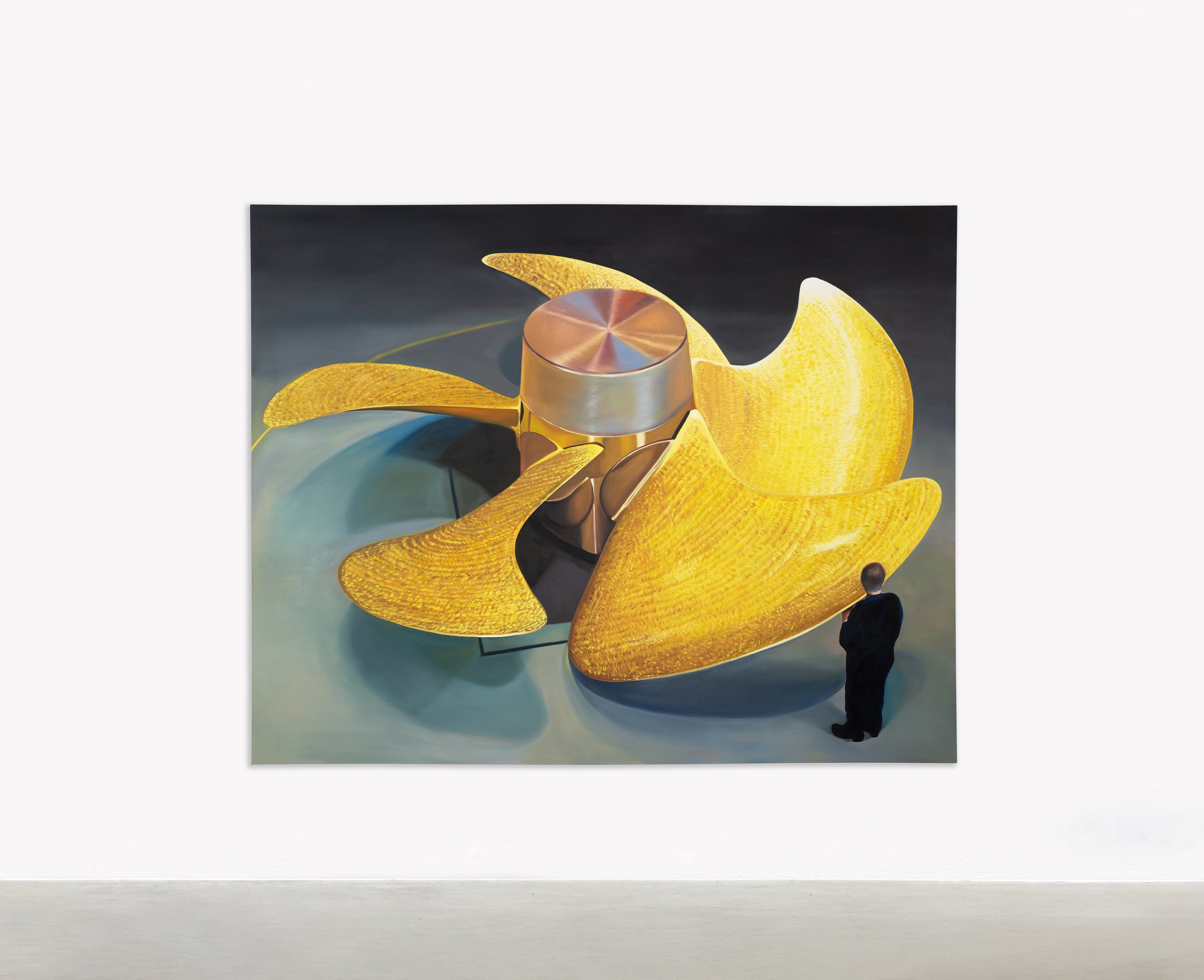
The surface texture of the painting contributes to the reading of machinery as a space that is both industrial and organic. The paint is applied in layers that build up a topographical surface, the ridges and furrows of impasto catching light and casting shadows that give the mechanical components a physical weight that a smooth, photorealistic rendering would not achieve. In the darker areas, the paint is mixed with earth tones, raw umber and burnt sienna, that register the patina of metal exposed to heat, moisture, and time. In the lighter areas, the paint includes passages of yellow ochre and Naples yellow that suggest the brass and bronze components of the bearing assemblies, metals that resist corrosion and retain their warm color even in the harsh environment of an engine room. The circular form at the top of the composition, the turbine or propeller housing, is rendered with concentric brushstrokes that follow its curvature, creating a visual rhyme with the spiral structure of the propeller blades that the housing contains. This spiral, barely visible in the painting itself but implied by the circular housing and the rotational logic of the machinery, is the painting's conceptual center, the point at which the mechanical and the natural converge.
Tan Mu has articulated this convergence in terms that connect the propeller to the broader investigation of natural and technological systems that runs through her practice. "The propeller represents a convergence of nature and machinery," she has said. "Although it is a mechanical object, its function relies on fluid dynamics, turbulence, and flow. Its motion echoes natural systems such as ocean currents, air circulation, and even biological structures like DNA. This coexistence of mechanical force and natural rhythm is what draws me to the subject. I am interested in moments where technology does not oppose nature, but mirrors it." The statement is not metaphorical. The propeller's blade shape is derived from the same mathematical principles that govern the spiral growth of shells, the branching of rivers, and the rotation of galaxies. The logarithmic spiral, a curve that appears at every scale of nature from the arrangement of seeds in a sunflower head to the arms of a spiral galaxy, is the geometric foundation of the propeller's blade pitch, the angle at which each blade meets the water and converts rotational motion into forward thrust. The propeller does not merely move through water. It participates in the same rotational logic that organizes the water itself, the Coriolis effect that drives ocean currents, the thermohaline circulation that redistributes heat across the globe, the vortex dynamics that create whirlpools and hurricanes.
This connection between the propeller's spiral and the natural systems it operates within extends across Tan Mu's catalog in a pattern that constitutes one of the most persistent structural motifs in her practice. The Torus paintings (2020, 2021) depict the self sustaining energy system found in magnetic fields and black holes, a structure defined by rotational symmetry around a central axis. The Stanford Torus (2020) depicts the rotating space habitat proposed by NASA in 1975, a ring shaped structure that generates artificial gravity through centrifugal force. The Dyson Sphere (2023) depicts the theoretical megastructure that would surround a star to capture its total energy output, a structure that is spherical rather than spiral but that shares the same fundamental logic of rotational symmetry around a central energy source. The Gaze series depicts the observable universe as a circular, radiating field, the cosmic iris that shares the spiral's outward expanding geometry. Even the Signal series, with its networks of submarine cables crossing and branching across the ocean floor, participates in this rotational logic, the cables following the curves of coastlines and the arcs of tectonic plates, their routes determined by the same geological forces that shape the ocean currents the propeller moves through.
Olafur Eliasson installed a giant artificial sun in the Turbine Hall of Tate Modern in 2003. The Weather Project consisted of a monofrequency light screen, 150 lamps behind a semi circular aluminum frame, that produced a disc of yellow light approximately 30 meters in diameter, reflected in a ceiling of mirrors that doubled the apparent size of the disc and created the illusion that the viewer was standing beneath an enormous, low hanging sun. The floor of the hall was covered in mist generated by machines that pumped a thin haze of sugar and water into the air, creating an atmospheric effect that softened the light and gave the space a quality of warmth and enclosure that was simultaneously natural and artificial, the sensation of standing in a tropical climate produced by machines that consumed sugar and electricity rather than solar radiation and atmospheric moisture. Over two million people visited the installation during its five month run, many of them lying on the floor and gazing upward at the artificial sun, their bodies reflected in the mirrors alongside the disc, their silhouettes becoming part of the composition.
The connection between Eliasson's sun and Tan Mu's propeller is structural. Both are circular forms viewed from below, radiating structures that dominate the viewer's visual field and produce a sensation of scale that exceeds the body's normal perceptual range. Both use the upward gaze as a compositional strategy, positioning the viewer beneath the dominant form and forcing them to crane their neck and expand their visual field to take in the entirety of the structure. Both create a relationship between the human body and a mechanism that is simultaneously intimate and overwhelming, the viewer standing or lying beneath a system that was built by human hands but that operates at a scale and in a register that the human body cannot directly experience. Eliasson's sun is warm, golden, and enveloping. Tan Mu's propeller is dark, mechanical, and industrial. But both produce the same perceptual effect: the confrontation of the body with a circular structure that is too large to see in a single glance and too compelling to look away from.
Eliasson's installation is, at its core, a work about the artificial production of natural phenomena, the creation of a sun, a mist, a warmth, by technological means that are visible to the viewer who knows where to look but that are designed to be invisible to the viewer who is immersed in the experience. The mist is sugar and water. The light is monofrequency lamps. The warmth is not solar radiation but the thermal output of electrical fixtures. The installation makes no secret of its artificiality. The machinery that generates the mist is visible at the edges of the hall. The lamps are visible behind the screen. But the experience of standing beneath the sun, feeling the warmth, seeing the mist, gazing at the disc, is an experience that the body processes as natural, as a genuine encounter with a tropical atmosphere, because the body's perceptual systems respond to light and heat and moisture regardless of their source. Tan Mu's propeller painting operates on an analogous principle. The machinery is clearly mechanical, clearly industrial, clearly the product of human engineering. But the spiral that the machinery produces, the rotational flow of water around the propeller blades, is a spiral that nature also produces, in whirlpools, in galaxies, in the growth patterns of shells and horns. The painting does not disguise the machine as nature. It reveals the nature within the machine, the fluid dynamic principles that the propeller shares with the ocean it moves through.
Saul Appelbaum, writing about the Signal series in November 2025, introduced the concept of "arbitration," the process of mediating between input and output, of making sense of a signal as it passes through multiple forms. Appelbaum argued that Tan Mu's paintings "transform data cables into gestural constellations that oscillate between calculation and intuition," and that what matters is "the human effort to make sense of a signal as it passes through multiple notations, forms, materials, processes, and consciousnesses." The concept of arbitration applies to The Wave with particular force. The propeller is an arbitrator, a mechanism that mediates between the engine's rotational energy and the ocean's resistance, converting one form of energy into another through a process that is simultaneously mechanical and natural, engineered and organic. The propeller does not simply push against the water. It negotiates with it, each blade's angle and curvature calculated to produce the maximum thrust with the minimum turbulence, the same optimization principle that governs the growth of a nautilus shell or the branching of a river delta. The painting registers this arbitration in its brushwork, the concentric strokes that follow the circular housing, the radial marks that suggest the propeller's rotation, the accumulation of pigment that gives the machinery a weight and a presence that is both industrial and organic.
Appelbaum's conclusion, that "the arbitrary gesture is never meaningless, it generates new systems of relation, where noise becomes form and connection becomes composition," finds its visual equivalent in the propeller's action on the water. The propeller generates turbulence, a form of hydrodynamic noise, the chaotic, unpredictable motion of water molecules that results from the interaction between the blade's pressure surface and the surrounding flow. This turbulence is not waste. It is the mechanism by which the propeller transfers energy to the water, the medium through which the engine's power becomes the ship's motion. The turbulence is noise that becomes form, chaotic motion that organizes itself, at a larger scale, into the wake pattern that extends behind the vessel, a pattern of waves and currents that is visible from the air, a signature of the ship's passage through the water that persists for hours after the vessel has moved on. Tan Mu's painting captures the machinery at the moment before this transformation, the propeller shaft stationary or nearly so, the engine room quiet, the machinery at rest. But the circular housing at the top of the composition implies the rotation to come, the spiral that will generate the turbulence that will become the wake that will become the wave, a chain of energy transformations that begins with a mechanical input, the engine, and ends with a natural output, the ocean's surface disturbed by the passage of a vessel that was built by human hands and that moves through a medium that has been in motion since before the first human eye opened onto it.
The great-grandfather who sailed between China and Korea during the Republican era did not travel by container ship. He traveled by sailing vessel or early steamer, vessels whose propellers were smaller, whose engines were weaker, and whose relationship to the ocean was more direct, the hull's motion determined as much by wind and current as by mechanical thrust. But the principle was the same: a rotating mechanism converting energy into motion, a human body on a vessel moving through water, a trade route connecting two shores. Tan Mu's painting of the propeller is, in this biographical reading, a portrait of the technology that replaced the great-grandfather's technology, the machine that made his sailing vessel obsolete while continuing his work, the movement of goods and people and culture across the ocean that three generations of her family have known as both a workplace and a home. The spiral at the bottom of the ship is the same spiral that the ocean itself produces, in currents, in whirlpools, in the growth patterns of the organisms that attach themselves to the hull and the propeller blades and make the ship, over time, a part of the marine ecosystem it was built to navigate. The painting does not separate the machine from the ocean. It places them in the same frame, the same composition, the same rotational logic, and it trusts the viewer to see what the painter sees: that the propeller and the wave are not opposites but siblings, two expressions of a single physical principle, the spiral, that organizes matter and energy at every scale from the molecular to the cosmic.