Fifteen Million Years in the Palm of Your Hand: Tan Mu's Moldavite and the Object That Remembers
Fifteen million years ago, a body of extraterrestrial origin, an asteroid or a comet, struck the Earth at a location in what is now the southern German state of Bavaria. The impact released energy estimated at approximately 10 to the 24th joules, equivalent to several hundred thousand megatons of TNT, sufficient to excavate a crater 24 kilometers in diameter, the structure known today as the Nördlinger Ries. The heat generated by the impact fused the terrestrial rock at the point of contact, melting sandstone, clay, and limestone into a molten glass that was ejected from the crater by the force of the blast and carried, by the ballistic trajectory of the ejecta curtain, across a strewn field that extends from the crater in a roughly elliptical pattern covering portions of the Czech Republic, southern Germany, and Austria. As the molten glass traveled through the atmosphere, it cooled and solidified into fragments of natural glass, tektites, whose shapes record the aerodynamic forces that shaped them during their brief, violent flight. These fragments, ranging in size from a few millimeters to several centimeters, landed in the strewn field and were buried, over millions of years, by sediment, by the slow accumulation of organic matter, by the advance and retreat of glaciers, by the entire apparatus of geological time that operates at a pace so slow that no human life is long enough to perceive it as motion. The fragments are green. They are translucent. They are called moldavite, from the German name for the Vltava River, the Moldau, whose banks in the Czech Republic yield the largest and most numerous specimens. Tan Mu holds one of these fragments in her personal collection. She painted it in 2020, oil on linen, 36 by 28 centimeters, a canvas small enough to hold in one hand, a painting of an object that is small enough to hold in the other, a painting of a stone that remembers, in its molecular structure, the moment when the Earth and the cosmos collided.
The painting, oil on linen, 36 by 28 centimeters, depicts a single moldavite specimen against a dark ground. The stone is centered in the composition, its irregular, organic form rendered in shades of green that range from a deep olive at the edges to a bright, almost luminous emerald at the center, where the stone's translucency allows light to pass through and illuminate the interior. The surface of the stone is covered in a pattern of fine, flowing textures that resemble fingerprints, or the ripples on the surface of a pool of water that has been disturbed by a falling object, or the lines on the surface of a glass that has been shaped by the breath of the blower. These textures are not decorative. They are the record of the stone's formation, the aerodynamic signature of molten glass cooling and solidifying as it traveled through the atmosphere at speeds exceeding the speed of sound, its surface shaped by the friction of air and the internal stresses of rapid cooling. The background is dark, a deep brownish black that pushes the green stone forward and isolates it from any sense of place or setting. The darkness is not uniform. It contains undertones of warm brown and deep blue, a chromatic complexity that gives the ground a quality of depth, a sense that the space behind the stone is not empty but dense, a darkness that contains matter rather than the absence of matter.
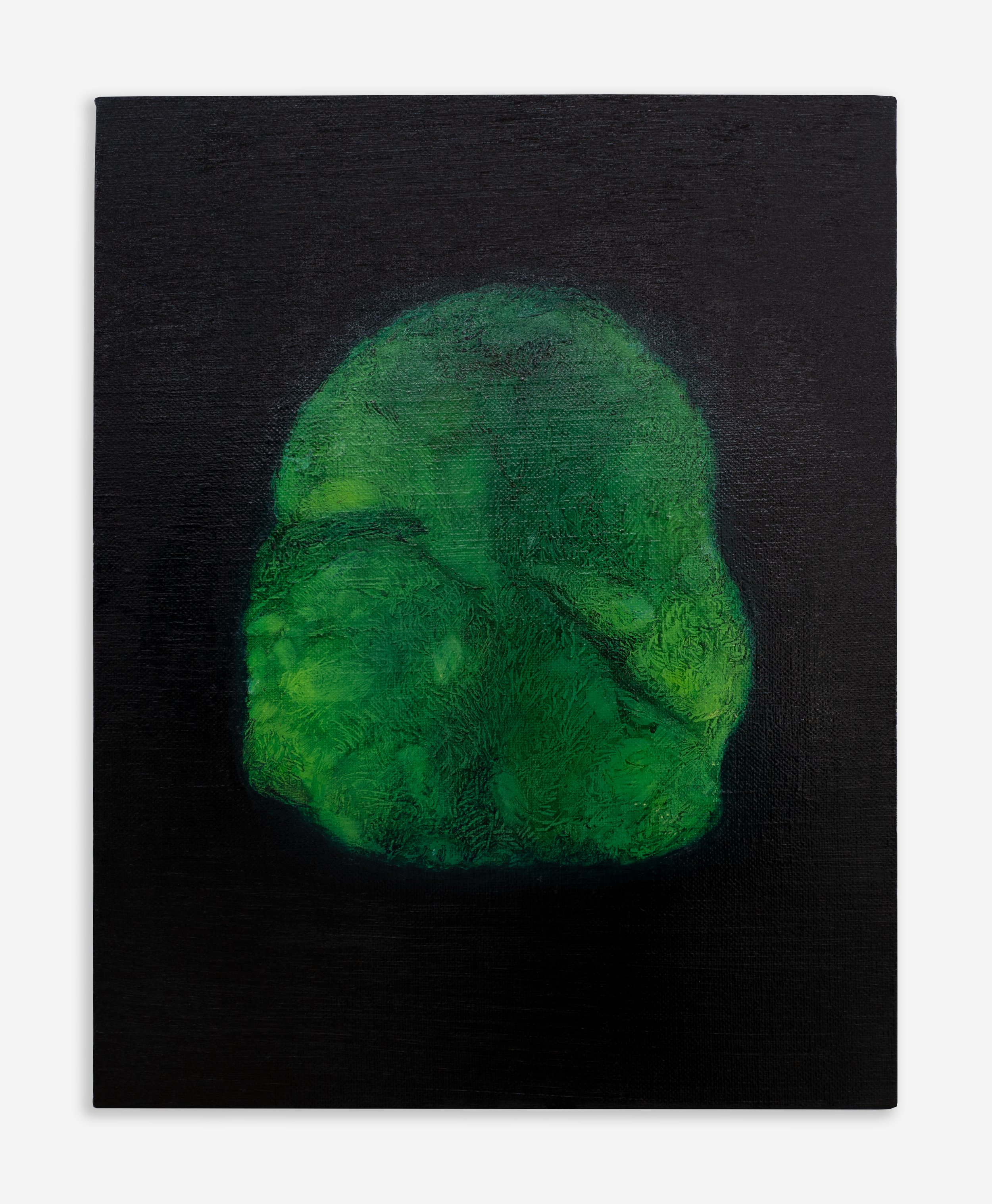
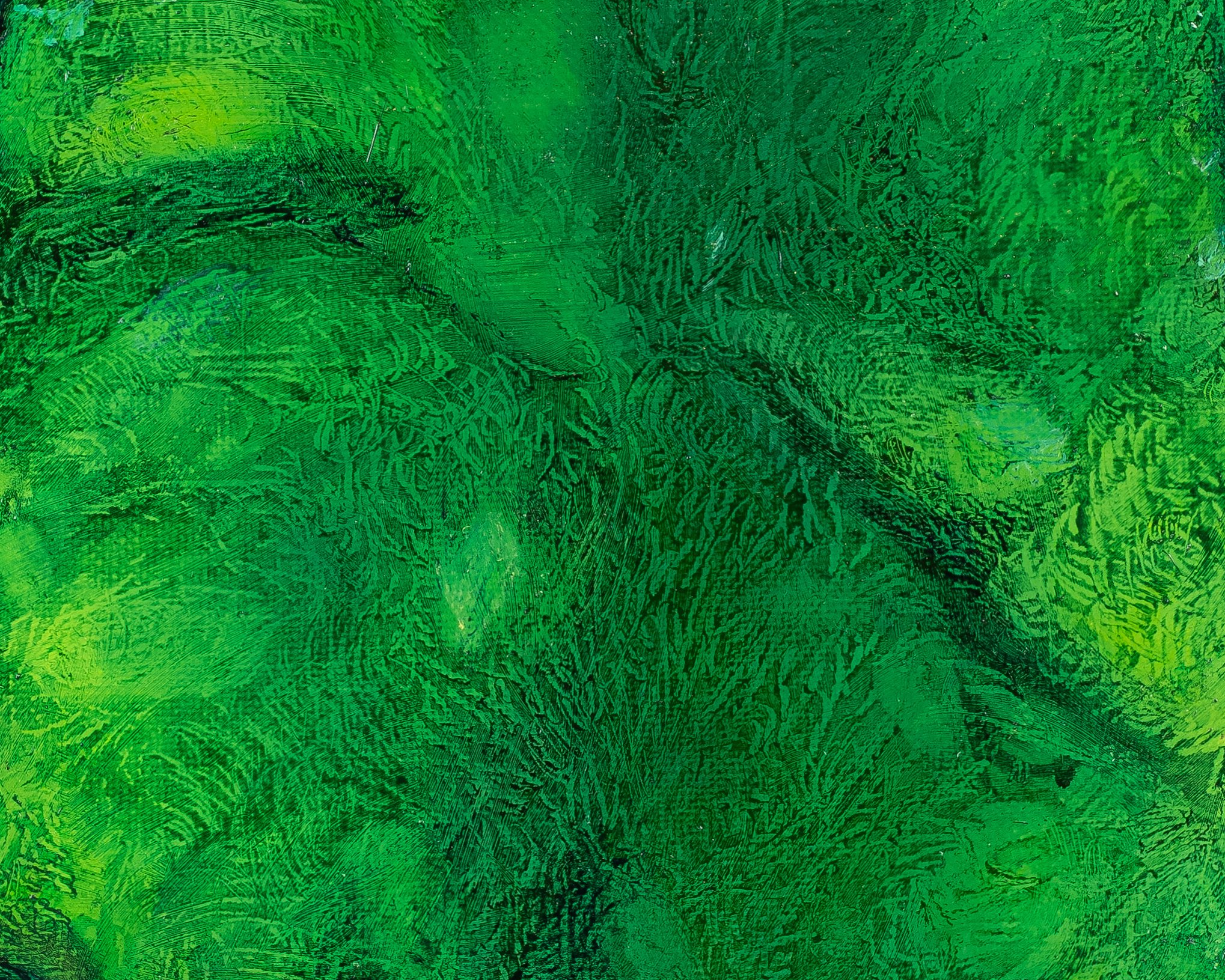
The material qualities of the painting reward close attention to the specific properties of oil on linen as a medium for rendering translucency. The green of the stone is built up in multiple thin layers of pigment, each layer partially transparent, the layers accumulating to produce a luminosity that is specific to oil painting, a quality of inner light that no opaque medium, acrylic, gouache, tempera, can achieve with the same depth. The linen ground contributes to this luminosity, its warm tone showing through the thinnest passages of green and giving the stone a warmth that pure green pigment would not possess. In the areas of greatest translucency, at the center of the stone where the light passes through, the paint is applied in a single thin wash, the linen visible beneath it, the green barely tinting the ground rather than covering it. In the areas of greatest density, at the edges of the stone where the glass is thickest, the paint is applied in multiple layers, each one adding opacity and depth, the cumulative effect producing a darkness at the margins that contrasts with the brightness at the center. The surface texture of the stone, the fingerprint-like patterns, is rendered in fine lines of darker green over the lighter ground of the stone's body, each line a deposit of pigment that follows the flow of the texture across the surface, the brush moving in curves and spirals that mimic the aerodynamic shaping of the molten glass.
The philosophical question that the painting raises is not about the stone's beauty, which is considerable, but about the stone's time, which is incomprehensible. The moldavite specimen that Tan Mu painted is approximately fifteen million years old. Its formation predates the evolution of every species of mammal currently alive on Earth. It predates the formation of the Mediterranean Sea in its current configuration, the Messinian salinity crisis of approximately 5.96 million years ago having refilled a basin that had been dry for hundreds of thousands of years. It predates the emergence of the genus Homo by approximately fourteen million years. It predates the last common ancestor of humans and chimpanzees by approximately seven million years. The stone was already ancient when the first hominids stood upright on the African savanna. It was already buried when the first stone tools were chipped from flint. It was already green when the first cave paintings were daubed on the walls of Lascaux and Chauvet. To hold this stone in one's hand is to hold an object that has existed, continuously, through the entire span of human evolution, from the earliest bipedal apes to the contemporary species that builds particle accelerators and paints pictures of stones.
Tan Mu has described the experience of holding the stone in terms that register this temporal vertigo. "Holding it made me reflect on how it has endured through vast geological and cosmic processes, placing human history, technological progress, and social conflict into a much smaller perspective. This contrast in scale strongly affected me, and I wanted to translate that feeling into the painting." The phrase "much smaller perspective" is doing the philosophical work. Human history, the span of recorded civilization, is approximately five thousand years old. The stone is fifteen million years old. The ratio is three thousand to one. If the stone's existence were compressed into a single day, the entire span of human civilization, from the first Sumerian tablets to the present, would occupy approximately thirty seconds. The painting does not illustrate this ratio. It does not provide a timeline or a scale bar. It presents the stone as an object, green, translucent, textured, luminous, and it trusts the viewer to bring to the encounter whatever knowledge of deep time the viewer possesses, the knowledge that the stone is old beyond comprehension, that it remembers a world in which no human being had yet existed, that it carries in its molecular structure the evidence of a collision between the Earth and the cosmos that occurred in a time so remote that the geological and biological records of the period are fragmentary and contested.
Vija Celmins drew the night sky. Her work Night Sky 3 (2001), graphite on paper, is a small, meticulous rendering of a field of stars, each point of light drawn with the patient, accumulative technique that Celmins has refined over five decades of sustained attention to surfaces that are vast, complex, and resistant to representation. The night sky, like the moldavite stone, is an object of deep time. The light that reaches the viewer's eye from the nearest star, Proxima Centauri, left its surface 4.24 years ago. The light from the most distant stars visible to the naked eye left their surfaces thousands of years ago. The light from the most distant galaxies detectable by telescope left their surfaces billions of years ago, in an epoch when the universe was a fraction of its current age. Celmins's drawing does not depict this temporal depth. It depicts the surface of the sky as it appears to the human eye at a single moment, a field of points rendered in graphite on paper, each point drawn individually, each point a deposit of pencil lead that corresponds to a star whose light has traveled, in some cases, longer than the moldavite has existed.
The connection between Celmins's night sky and Tan Mu's moldavite is structural, not stylistic. Both artists take objects of deep time and render them at intimate scales, small drawings and small paintings that the viewer can hold at arm's length and examine with the same sustained attention that the artist brought to the act of making. Both artists use traditional materials, graphite and oil, to register the presence of objects that are accessible only through indirect means, the telescope in Celmins's case, the geological record in Tan Mu's. And both artists produce, through the patient accumulation of small marks, surfaces that are simultaneously precise and mysterious, surfaces that record the artist's encounter with an object whose full significance exceeds the artist's capacity to comprehend it. Celmins does not understand the night sky. Tan Mu does not understand the moldavite. But both artists look, long enough and carefully enough, to produce a surface that carries the trace of the looking, the hours spent drawing stars or painting green glass, hours that are, in the span of deep time, less than an eyeblink, but that are, in the span of a human life, a significant investment of attention and care.
Nick Koenigsknecht, writing in the BEK Forum catalog in 2025, proposed that Tan Mu's paintings of technology should be understood as "self portraits, rather than depictions of external, scientific milestones." The proposition, while articulated in the context of technological subjects, extends to the moldavite painting with particular clarity. The stone is not an external object that Tan Mu observed from a distance. It is an object from her personal collection, a stone she holds in her hand, a material presence in her daily life. The painting is, in this sense, a portrait of a relationship, the relationship between a human being and an object that predates human existence by millions of years, a relationship that is intimate, physical, and profoundly asymmetric, the human life spanning decades and the stone spanning millions of centuries. The painting does not depict this asymmetry. It depicts the stone, green, translucent, textured, luminous, and it lets the viewer feel the asymmetry in the gap between the painting's small scale and the stone's vast age, the thirty six centimeters of linen that contain fifteen million years of cosmic and geological history.
Koenigsknecht's further observation, that "maybe it is time to recontextualize our presence on earth as a cohabitation with bio techno siblings" who "have lifecycles. They are conceived, born, maintained, and eventually replaced," applies to the moldavite with a force that Koenigsknecht may not have intended. The moldavite is not a bio techno sibling. It is a cosmic sibling, a fragment of the collision between the Earth and the cosmos that predates all biological and technological systems on the planet. It was not conceived by human hands. It was not born in a factory. It will not be maintained or replaced. It exists, in its molecular permanence, as a record of a physical event that occurred fifteen million years ago and that will persist, unchanged, for millions of years to come, long after every human technology has rusted and every human civilization has been buried by the geological processes that buried the moldavite itself. The painting registers this permanence in the luminosity of the green, a color that has not faded in fifteen million years and that will not fade in fifteen million more, the color of glass that was molten when the Mediterranean did not yet exist, the color of an object that remembers what no human being can remember, the moment when the sky fell and the earth melted and the cosmos left its fingerprint on a fragment of the world.
The painting hangs in the collection of Antimony, the same year, 2020, that Tan Mu painted Antimony, a painting of another mineral from her personal collection, a metallic element that has been known since antiquity and that was used, in its sulfide form, as eye makeup in ancient Egypt and as a component of pewter and type metal in the medieval period. The pairing of Moldavite and Antimony in the same year of production is not coincidental. Both are paintings of minerals, small, intimate canvases that render geological and chemical objects with the same sustained attention that Tan Mu brings to her larger, more conceptually ambitious subjects. Both are paintings of objects that exist at the intersection of the natural and the human, materials that the Earth produced and that human beings have collected, valued, and, in the case of moldavite, painted. The small scale of both canvases, thirty six by twenty eight centimeters, is itself a statement about the relationship between the object and the painting, the stone and the surface that contains it, a relationship that is not monumental but domestic, not institutional but personal, not a painting that hangs in a museum and commands a room but a painting that sits on a shelf or leans against a wall and invites the viewer to come close, to lean in, to look at the green and the dark and the fingerprint textures and to feel, in the closeness of the looking, the weight of fifteen million years compressed into a canvas that is smaller than a sheet of typing paper.