The Room Where the Internet Began: Tan Mu's DEC's PDP-10 and the Continuity of Human Life
In 1966, the Digital Equipment Corporation shipped the first unit of the PDP 10, a mainframe computer that would become, over the following decade, one of the most influential machines in the history of computing. The PDP 10 was not the fastest computer of its era. It was not the largest. It was not the most expensive. It was, however, the first widely used time sharing system, a machine that allowed multiple users to interact with a single computer simultaneously, each user experiencing the illusion that the entire machine was dedicated to their individual task. This illusion, the experience of a computer that responds to you as if you are its only operator, is the foundational experience of interactive computing, the perceptual template that every subsequent development in personal computing, from the desktop to the laptop to the smartphone, has reproduced and refined. The PDP 10 was also a core platform of ARPANET, the Advanced Research Projects Agency Network, the military funded system that connected computers at four universities in 1969 and that would, over the following two decades, evolve into the internet. The protocols that govern the movement of data across the internet today, TCP IP, the Transmission Control Protocol and the Internet Protocol, were developed on PDP 10 systems running at Bolt Beranek and Newman, the engineering firm that built the first ARPANET routers. The machine that Tan Mu painted in 2021, oil on linen, 31 by 61 centimeters, is the room where this began, the physical space in which the conceptual foundations of the global network were laid by human operators sitting at consoles that had no screens, no graphics, no mouse, no windows, no icons, nothing that a contemporary user would recognize as a computer interface.
The painting, oil on linen, 31 by 61 centimeters, horizontal in format, depicts a room filled with the cabinets and peripherals of the PDP 10 system, with human figures visible at the consoles, their bodies positioned at the interface between the human operator and the machine's computational core. The palette is monochromatic, rendered in black and white, a decision that Tan Mu has explained as connected to the archival origins of the source material. The original photographs from which the painting derives were black and white, documentation of the PDP 10 in its operational environment, and the monochrome palette preserves the temporal quality of the archival image, the sense that this room exists in the past, that the people in it are no longer there, that the machine has been decommissioned and the room repurposed. The paint handling is precise but not photographic. The individual brushstrokes are visible, small marks of pigment that articulate the surfaces of the cabinets, the consoles, the cables, the clothing of the operators, each mark a deposit of gray or white or black that contributes to the representation of a specific material, a specific texture, a specific light condition. The surface has the quality of oil on linen, the slight tooth of the woven fabric modulating the brush marks and giving the image a softness, a diffusion that is not photographic but painterly.
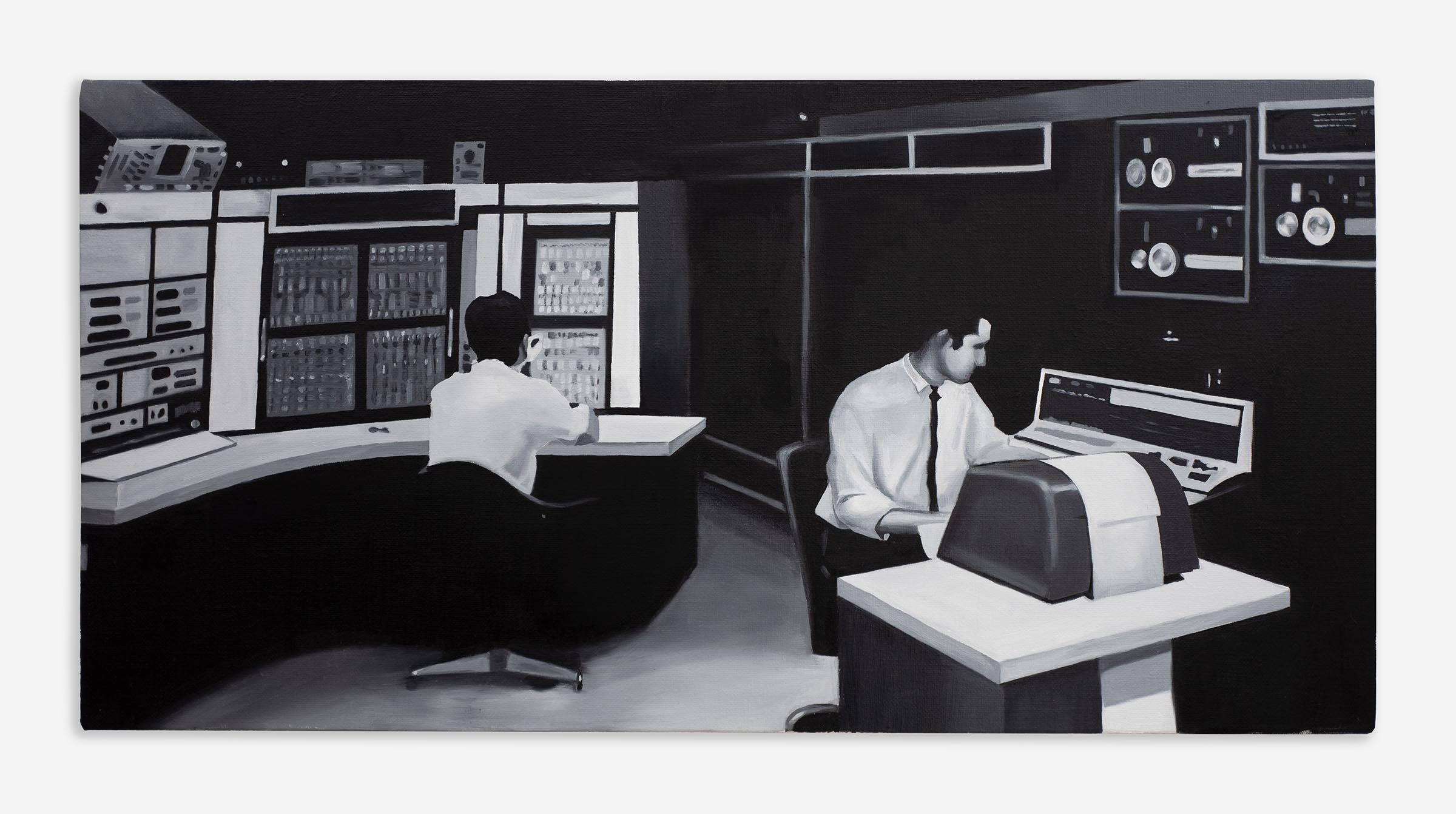
The horizontal format of the canvas, its width approximately twice its height, registers the panoramic quality of the room, the expanse of cabinets and consoles that fill the physical space. The composition places the machinery in the center and upper portions of the canvas, the cabinets rising from the floor to a height that exceeds the human figures, their mass and weight dominating the room. The figures are positioned at the lower edges of the composition, their bodies reduced to small vertical presences against the horizontal sweep of the machine room. This asymmetry between the human scale and the machine scale is the painting's visual thesis: the human beings who built and operated the system are smaller than the system they built, their bodies occupying a fraction of the room's volume, their presence at the console the point at which human intelligence enters the machine and the machine's computational power exits into the world. The figures' clothing, as Tan Mu has noted, is strikingly contemporary. "The figures in the painting wear clothes that still feel familiar today, and the desks and chairs are not fundamentally different from those we use now. This contrast highlights a tension between rapid technological evolution and the continuity of human life."
The observation about clothing and furniture is not incidental. It is the painting's deepest insight into the relationship between technological change and human permanence. The PDP 10 is obsolete. It was superseded by the VAX series in the late 1970s, by minicomputers and microcomputers in the 1980s, by personal computers and workstations in the 1990s, by laptops and smartphones in the 2000s. The machine that Tan Mu painted no longer exists in any operational capacity. Its components have been decommissioned, scrapped, or preserved in museum collections. The protocols it helped develop, TCP IP, have been updated, extended, and superseded by newer protocols that the PDP 10's architects could not have imagined. But the people in the painting are still recognizable. Their clothing, their postures, their gestures at the console, the way they lean toward the machine and extend their hands toward the switches and dials, all of these are behaviors that a contemporary office worker would perform at a keyboard or a touchscreen. The technology has changed beyond recognition. The human body has not. The painting registers this permanence not as a statement but as a fact, a visual observation that the viewer absorbs without needing to articulate it, the recognition that the person in the 1960s photograph looks, in their clothing and their posture and their engagement with the machine, exactly like a person in 2021.
Tacita Dean installed a work in the Turbine Hall of Tate Modern in 2011. FILM was a silent, 11 minute projection onto a white screen that occupied the full height of the hall, 13 meters, the image composed of multiple layered exposures made on 35mm film stock, a technique that combined multiple images on a single strip of celluloid through repeated passes through the camera. The resulting projection was a palimpsest, a surface in which multiple images of the Turbine Hall's architecture, its windows, its steel structure, its light, were superimposed on each other, each exposure partially visible through the others, creating a visual field that was simultaneously dense and transparent, a record of multiple moments compressed into a single frame. Dean's work was, at its core, a meditation on the survival of a medium, film, in an era when digital technology was rendering it obsolete. The 35mm film stock that Dean used was manufactured by Kodak, which filed for bankruptcy in January 2012, three months after the installation opened. The medium that Dean celebrated was dying as she celebrated it, its obsolescence the condition of its beauty, its fragility the source of its emotional power.
The connection between Dean's FILM and Tan Mu's PDP 10 painting is structural. Both works document a technology at the moment of its obsolescence, preserving a medium or a machine that the contemporary world has already replaced. Dean's film stock is the PDP 10 of analog photography, a technology that was once the universal standard and that has been displaced by a digital alternative that is faster, cheaper, and more versatile. Tan Mu's PDP 10 is the film stock of computing, a machine that was once the universal platform for interactive computing and that has been displaced by alternatives that are faster, smaller, and more powerful by factors of billions. Both artists approach the obsolete technology not with nostalgia, the sentimental longing for a lost past, but with attention, the sustained, specific attention that the artist brings to a surface or a machine that is about to disappear, the recognition that the act of looking, carefully and at length, is itself a form of preservation, a way of holding the technology in the visual field for a few more moments before it dissolves into the archive.
The PDP 10's role in the development of the internet warrants a closer look, because the painting's subject is not merely the machine but the system of human collaboration that the machine enabled. The PDP 10's time sharing capability allowed multiple users to work on a single machine simultaneously, each user's terminal connected to the central processor through a multiplexer that allocated computing time in small slices, giving each user the experience of uninterrupted access to the machine. This capability was the conceptual foundation of networked computing, the idea that a computer could serve multiple users across multiple locations, each user interacting with the machine as if it were their own. ARPANET extended this idea across distance, connecting PDP 10 systems at universities and research institutions across the United States, allowing users at one site to log in to a machine at another site, to transfer files, to send messages, to run programs on remote hardware. The protocols that governed these interactions, the Network Control Protocol of the original ARPANET, later superseded by TCP IP, were the technical foundation of the internet, the rules that determine how data is packaged, addressed, transmitted, and received across a network of interconnected machines.
The PDP 10's connection to artificial intelligence history gives the painting a further layer of significance. The machine was the platform on which MACSYMA, one of the first large scale symbolic mathematics systems, was developed at MIT in the late 1960s. It was the platform on which SHRDLU, Terry Winograd's natural language understanding program, demonstrated in 1971 that a computer could parse and respond to English language instructions about a virtual world of blocks. It was the platform on which the early development of the Lisp programming language, the language most closely associated with artificial intelligence research for three decades, was refined and distributed. These achievements, MACSYMA, SHRDLU, Lisp, are the ancestors of every contemporary AI system, from the large language models that process natural language to the image generators that produce visual content from text prompts. The PDP 10 did not produce artificial intelligence. It produced the conditions under which artificial intelligence could be imagined, tested, and refined by human researchers sitting at the same consoles that Tan Mu's painting depicts, their hands on the same switches, their eyes on the same printed output, their minds engaged in the same fundamental question that drives AI research today: can a machine think?
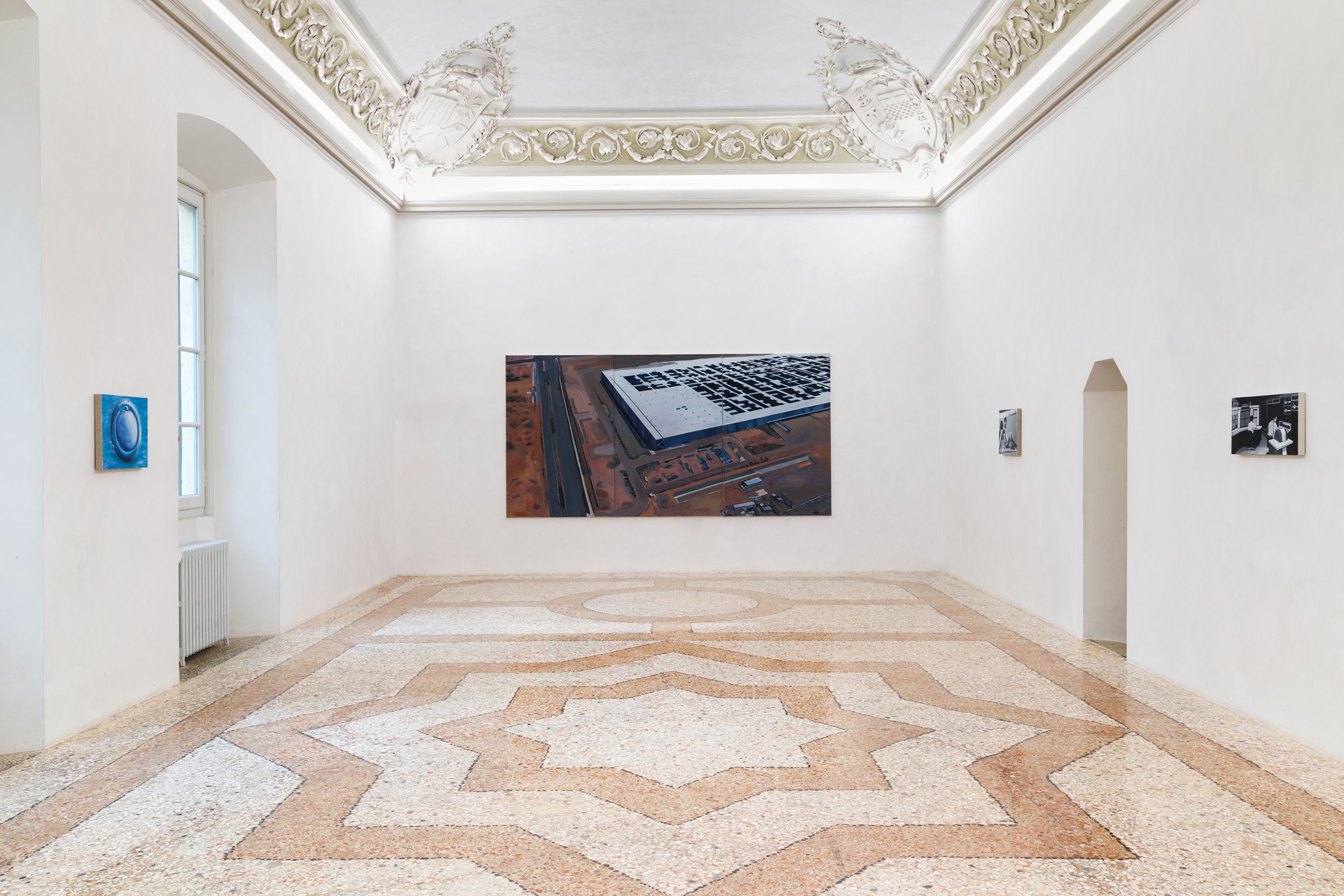
The exhibition context that gives the painting its most specific meaning is its placement, at the Signal exhibition at Peres Projects in Milan in 2022, alongside No Signal (2019), Tan Mu's painting of television static, the visual representation of a broadcast signal that has been lost. Tan Mu has described this pairing as creating "a dialogue between two moments in the history of technology. One traces the emergence of computing and information networks, while the other reflects uncertainty and interruption in an era of technological acceleration." The PDP 10 painting depicts the origin, the room where the network began, the machine that connected the first nodes. The No Signal painting depicts the consequence, the moment when the network fails, the screen that displays only noise because the signal has been interrupted. The two paintings, hung together, form a complete circuit, from the system's birth to its breakdown, from the promise of connection to the reality of disconnection, from the optimism of the ARPANET engineers who believed that a network of computers could transform human communication to the anxiety of the contemporary user who watches a departure board flicker between data and static.
Li Yizhuo, writing in January 2022, observed that Tan Mu's work "disengages from the common thesis in works on science, technology, and media society, such as nostalgia for a derelict utopian vision, withdrawal from or reconciliation with the fragmented experiences, or speculation on an undefined endgame." The observation names something precise about the PDP 10 painting's refusal of sentimentality. The painting does not mourn the PDP 10. It does not celebrate it. It does not speculate about what the world would be like if the PDP 10 had never existed, or if its time sharing architecture had been developed differently, or if ARPANET had been funded by a different agency. It presents the machine as it was, in a room, with operators, in a moment that is past but that is not gone, because the painting preserves it, in pigment on linen, at a scale that invites the viewer to come close and look at the operators' faces, their hands, their clothing, their engagement with the machine, and to recognize in these details the continuity that Tan Mu has identified as the painting's central insight: that technology changes beyond recognition while human life remains, in its fundamental rhythms and gestures and postures, the same.
Li Yizhuo further observed, in the same essay, that Tan Mu's canvases "do not aim at diagnosing the modern spectacles from a distance. They conjure up a kind of vitality and depth of their own." The PDP 10 painting conjures this vitality through the specific quality of the monochromatic palette, the black and white that places the scene in the past while the painterly brushwork places it in the present, the tension between archival distance and handmade intimacy producing a surface that vibrates with a temporal ambiguity, the sense that this room exists simultaneously in 1966 and in 2021, that the operators who lean toward the consoles are leaning toward them now, in this moment, as the viewer stands before the painting and watches them reach for switches that have not existed for fifty years. This temporal ambiguity is the painting's deepest achievement. It does not document the PDP 10. It does not commemorate the PDP 10. It makes the PDP 10 present, in the room, on the wall, in the viewer's field of vision, a machine that built the internet and a room full of people who built the machine, their clothes still familiar, their gestures still recognizable, their hands still reaching for the switches that opened the door to the world we live in now.