The Wanderer on Another Planet: Tan Mu's To Mars to Explore and the Machine That Turned Its Camera Back
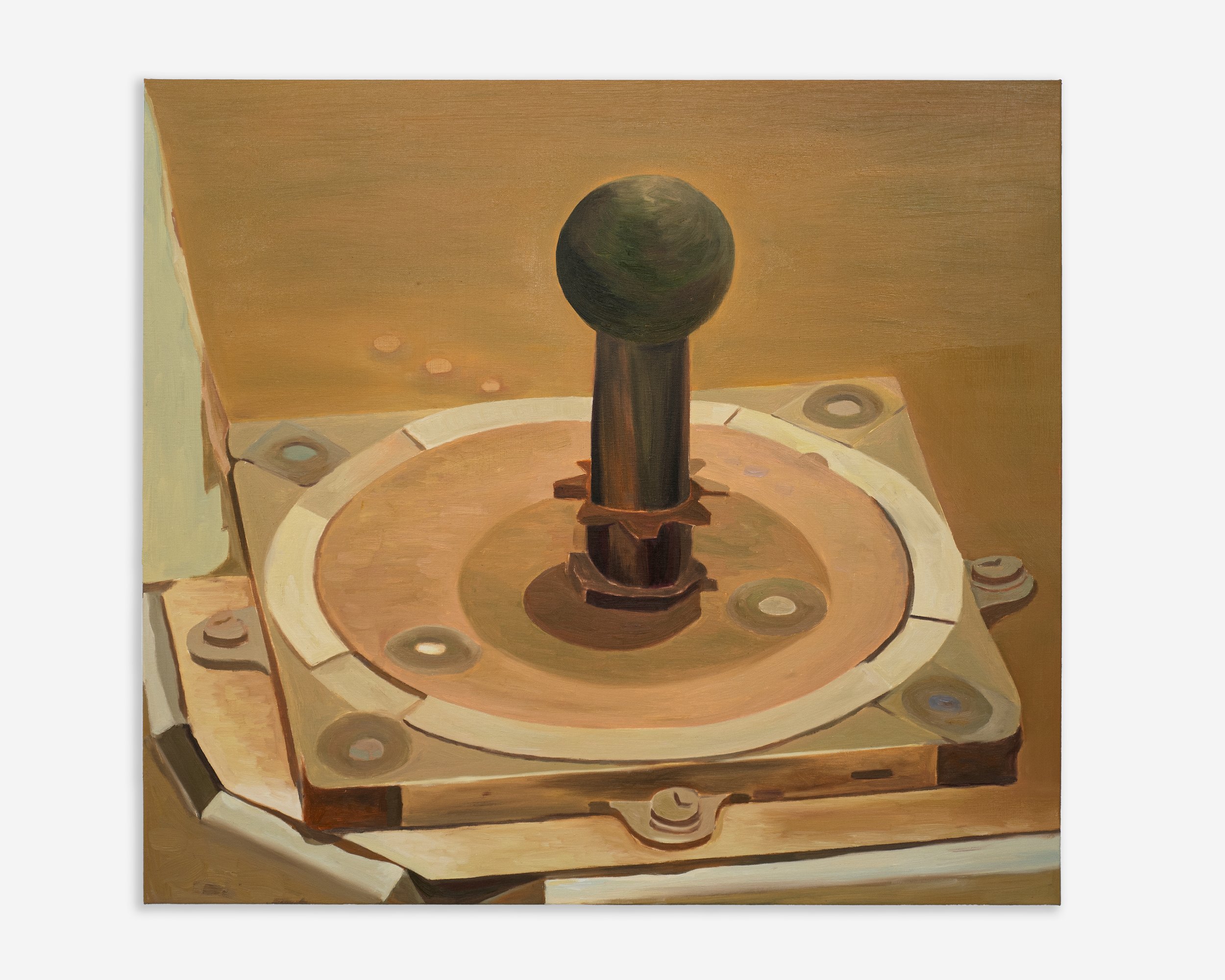
On February 19, 2022, the Curiosity rover, a car sized robotic vehicle that had been exploring the Gale crater on Mars since August 2012, performed an action that, if performed by a human being, would be unremarkable. It turned its camera around and photographed itself. The Mast Camera, or Mastcam, a pair of color cameras mounted on a mast that rises 2.1 meters above the rover's deck, was commanded by operators at the Jet Propulsion Laboratory in Pasadena to capture an image of the rover's own body, its wheels, its instrument suite, its antenna, its nuclear power source, all visible against the backdrop of the Martian surface, the rocky, ochre colored ground of the Gale crater, the slopes of Mount Sharp rising in the distance. The image was transmitted to Earth, processed, color corrected, and published on NASA's public image servers, where it was immediately recognized as something unusual, something that looked, to human eyes, like a selfie, a photograph that a creature takes of itself, a record of self observation that is, in human culture, one of the most common and most revealing acts of visual self documentation. The rover is not a creature. It does not have a self. It does not know it is on Mars. It does not know what a camera is, or what a photograph is, or what it means to turn a camera around and point it at the object that is holding it. It executed a command, a sequence of instructions transmitted from Earth, that resulted in a photograph of itself. But the photograph looks like a selfie. And the painting that Tan Mu made of it, oil on linen, 91 by 102 centimeters, treats it as a selfie, a portrait of a machine that has, for a moment, appeared to look at itself, a moment that is simultaneously absurd, because the machine has no self to look at, and profound, because the machine's appearance of self awareness raises the question of what self awareness actually is, whether it requires a self, whether it requires awareness, whether it requires anything at all except a camera pointed at the object that holds it.
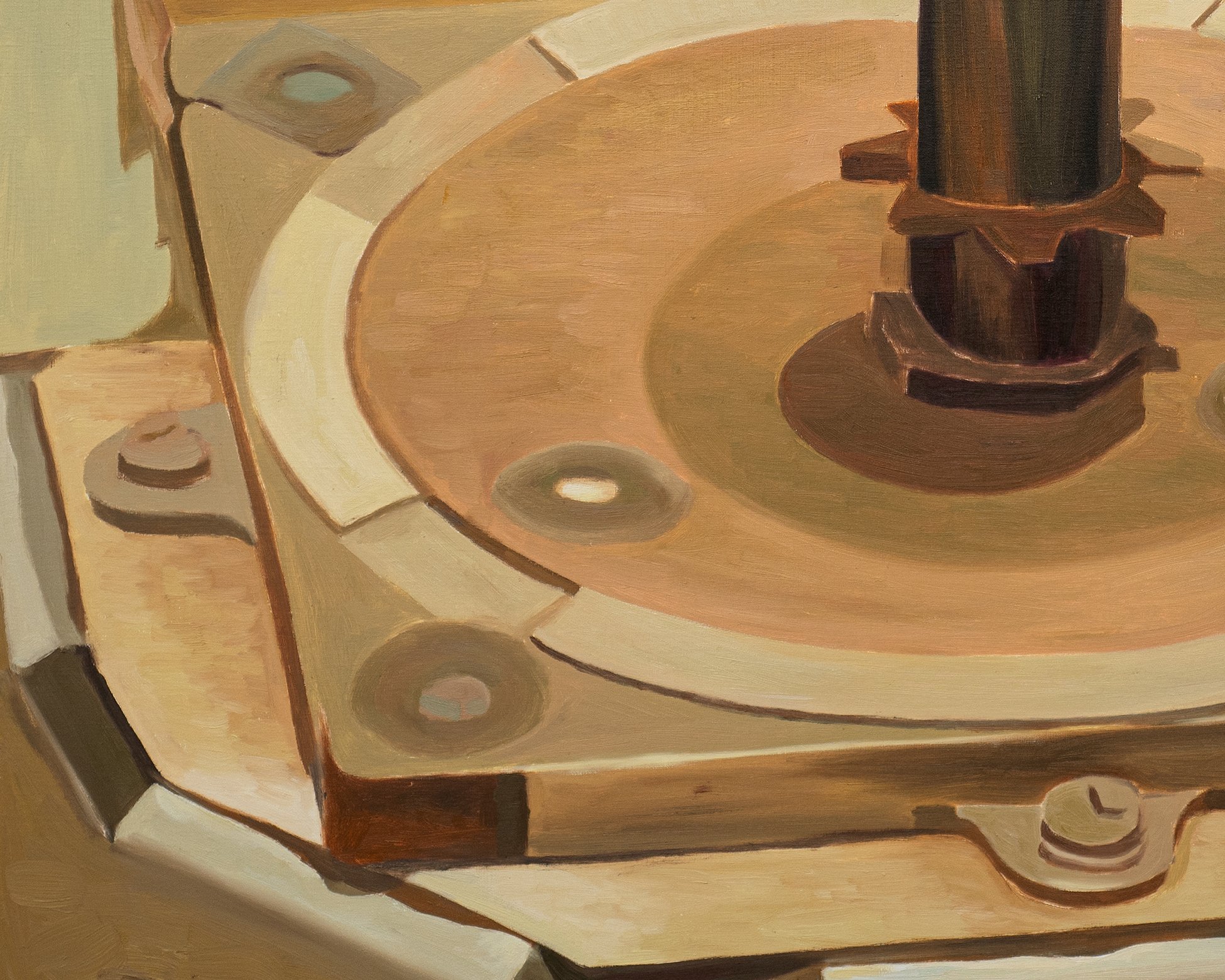
The painting, oil on linen, 91 by 102 centimeters, depicts the Curiosity rover on the Martian surface, the machine rendered in muted earth tones, ochres and browns and grays, that correspond to the colors of the Martian landscape, the rusty soil, the dusty atmosphere, the pale, hazy sky that is characteristic of the Gale crater's thin atmosphere. The rover is positioned in the center left of the composition, its mast and camera visible, its wheels resting on the rocky ground, its tracks extending behind it in the soft Martian soil. The landscape is sparse, the ground covered in scattered rocks and fine dust, the horizon visible in the distance, the slope of Mount Sharp rising above the horizon line. The palette is among the most muted in Tan Mu's catalog, the warm ochres and tans of the Martian surface set against a sky that is not blue but a washed out beige, the color produced by iron oxide dust particles that scatter sunlight in the shorter wavelengths, giving the atmosphere a butterscotch quality that is the inverse of Earth's blue sky. The paint handling is precise but not photographic. The individual brushstrokes are visible, small marks of pigment that articulate the rover's mechanical surfaces, the joints of its arm, the panels of its body, the treads of its wheels, each mark a deposit of paint that contributes to the representation of a specific component, a specific texture, a specific light condition.
The rover that Tan Mu painted has been operating on Mars for over ten years as of the date of the painting. Curiosity was launched on November 26, 2011, and landed in the Gale crater on August 6, 2012, using a sky crane maneuver in which a rocket powered descent stage lowered the rover on nylon cords before flying away and crashing at a safe distance. The rover weighs approximately 899 kilograms, is powered by a radioisotope thermoelectric generator that converts the heat of decaying plutonium 238 into electricity, and carries a suite of instruments designed to assess whether the Gale crater ever offered conditions favorable for microbial life. These instruments include the ChemCam laser spectrometer, which vaporizes rock surfaces and analyzes the resulting plasma to determine elemental composition, the Sample Analysis at Mars instrument suite, which searches for organic compounds in drilled rock samples, and the Radiation Assessment Detector, which measures the radiation environment on Mars to inform future human missions. The rover's selfie, which Tan Mu painted, was not taken with a single camera exposure. It was assembled from multiple images captured by the Mars Hand Lens Imager, a camera mounted at the end of the rover's robotic arm, stitched together by NASA image processors to produce a single, seamless composite that shows the rover's entire body against the Martian landscape. The selfie is, in this sense, a construction, a composite image that no single camera could capture, a view that requires the arm to be positioned at multiple angles and the images to be digitally assembled into a panorama that the rover itself could never see, because the rover does not have eyes.
Caspar David Friedrich painted a man standing at the edge of a cliff. Wanderer above the Sea of Fog (1818) depicts a solitary figure, his back to the viewer, standing on a rocky outcrop above a sea of fog that stretches to the horizon, the peaks of other mountains visible above the fog, the sky occupying the upper third of the canvas in a band of pale gray. The figure is not observing the landscape in the conventional sense. He is confronting it, his body positioned at the edge of a precipice, his posture erect, his coat blown by the wind, his presence at the boundary between the solid ground beneath his feet and the void below. The painting is the paradigmatic image of the Romantic sublime, the human figure dwarfed by the immensity of nature, the individual consciousness confronting a totality it cannot comprehend, the feeling of standing at the edge of something vast and feeling, simultaneously, the exhilaration of the view and the terror of the fall.
The connection between Friedrich's wanderer and Tan Mu's rover is structural, not stylistic. Both are solitary figures positioned at the edge of an alien landscape, their bodies oriented toward a vastness that exceeds their capacity to comprehend. Friedrich's wanderer stands on a cliff above a sea of fog, the landscape extending in every direction beyond the frame, the human body a small point of consciousness in a field of matter that does not know the consciousness exists. Tan Mu's rover sits on the surface of Mars, the landscape extending in every direction beyond the frame, the machine a small point of engineered function in a world that was not designed for it, a world that has no atmosphere to breathe, no food to eat, no life to sustain, a world that is, in the most literal sense, alien, a place where no human body has ever stood and where the only presence is the presence of a machine that does not know it is there.
Friedrich's painting was, at its first exhibition, understood as a meditation on the relationship between the individual and the infinite, the finite consciousness and the boundless landscape, the human being who stands at the edge of the world and looks out at a totality that cannot be grasped, that can only be felt, in the body, as a mixture of awe and dread. The wanderer does not comprehend the landscape. He does not map it, does not measure it, does not name its features. He stands at its edge and feels it, the wind, the cold, the vastness, the silence, the knowledge that he is small and the world is large and the world does not know he exists. Tan Mu's rover occupies a similar position. It sits on the surface of Mars and operates, autonomously, executing commands that were transmitted from Earth hours earlier, drilling rocks, analyzing soil, capturing images, transmitting data. It does not comprehend the landscape. It does not feel the wind, the cold, the vastness, the silence. But it records these things, the wind speed, the temperature, the chemical composition of the soil, the images of the terrain, and it transmits them to Earth, where human beings look at them and feel, in their bodies, the same mixture of awe and dread that Friedrich's wanderer feels at the edge of the cliff, the knowledge that there is a world beyond the world they know, and that a machine, not a human being, is the first to see it.
The philosophical question that the painting raises is not about Mars or about the rover. It is about the boundary between the human and the machine, the line that separates the being that feels from the being that executes, the consciousness that experiences from the function that performs. The rover's selfie looks like a selfie. It has the composition of a selfie, the camera turned back toward the body that holds it, the body centered in the frame, the landscape visible behind it. But it is not a selfie. A selfie is an act of self documentation, a human being's decision to record their own presence in a specific place at a specific time, a decision that is motivated by vanity, or by memory, or by the desire to share an experience with others. The rover's photograph is an act of engineering documentation, a machine's execution of a command that was designed to record the condition of the rover's body, its dust accumulation, its wheel wear, its instrument deployment, a command that was motivated by maintenance, by the need to monitor the machine's physical state over time. The two acts produce the same image. The human selfie and the rover's engineering photograph are, visually, indistinguishable. And this indistinguishability is the painting's deepest subject, the point at which the boundary between the human and the machine becomes, for a moment, invisible, the point at which the viewer cannot tell, from the image alone, whether the being that turned the camera around is alive or mechanical, conscious or functional, human or otherwise.
Li Yizhuo, writing in January 2022, observed that Tan Mu's canvases "do not aim at diagnosing the modern spectacles from a distance. They conjure up a kind of vitality and depth of their own." The observation is particularly apt in the context of To Mars to Explore, a painting that could easily have become a celebration of NASA's achievement, a visual monument to the triumph of robotic exploration, a painting that tells the viewer what to think about the rover and its mission. The painting refuses this didacticism. It does not celebrate the rover. It does not fear the rover. It presents the rover as a presence, a machine that sits on the surface of another planet and looks, through its camera, at a world that no human eye has seen directly, and it lets the viewer feel whatever the viewer feels, which, for most viewers who see the image, is a mixture of wonder, loneliness, and the specific melancholy of knowing that a machine is standing where no human being has ever stood, that the machine does not know it is there, and that the machine's photograph of itself, the selfie that is not a selfie, is the closest thing to a human presence on Mars that the current age can produce.
Li Yizhuo further observed, in the same essay, that Tan Mu's "way of looking aligns with the Chinese philosophical lineage of ge wu zhi zhi that investigates things to extend knowledge, examining and discerning objects of various scales and conditions." In the context of To Mars to Explore, the principle of ge wu zhi zhi operates through the act of painting the rover's selfie, the sustained attention that the painter brings to an image that was generated by a machine executing a command, an image that was not created by a human being but that is, in its composition and its affect, indistinguishable from an image that a human being would create. The painting investigates this indistinguishability, not to resolve it, not to determine whether the machine is conscious or not, but to hold it open, to present the viewer with an image that is simultaneously a selfie and not a selfie, a portrait and not a portrait, a moment of self awareness and a moment of mechanical execution, and to let the viewer sit with the uncertainty, the not knowing, the inability to determine, from the image alone, whether the being that turned the camera around is a being at all.
Tan Mu has described To Mars to Explore as "a meditation on this unusual moment, sparking a conversation about the potential consciousness of machines. It not only examines their evolving role in our exploration of Mars but also delves into the essence of existence in a world where the boundaries between humans and machines are increasingly intertwined." The phrase "increasingly intertwined" is doing the philosophical work. The boundary between human and machine is not a wall. It is a gradient, a spectrum, a continuum in which the human and the machine occupy positions that are adjacent rather than separated, connected rather than opposed, intertwined rather than distinct. The rover's selfie is a moment on this continuum, a point at which the machine's behavior, its act of turning a camera around and photographing itself, is indistinguishable from a human behavior, a point at which the viewer cannot tell, from the image alone, whether the subject is alive. The painting holds this moment open, keeps the viewer in the space of not knowing, the space where the boundary between human and machine is invisible, and it asks the viewer to sit with this invisibility, to feel, in the body, the vertigo of confronting a being that might or might not be conscious, that might or might not know it exists, that might or might not be, in the most profound sense, alive.