The Card That Taught Machines to Read: Tan Mu's Punched Card and the First Translation from Human to Machine
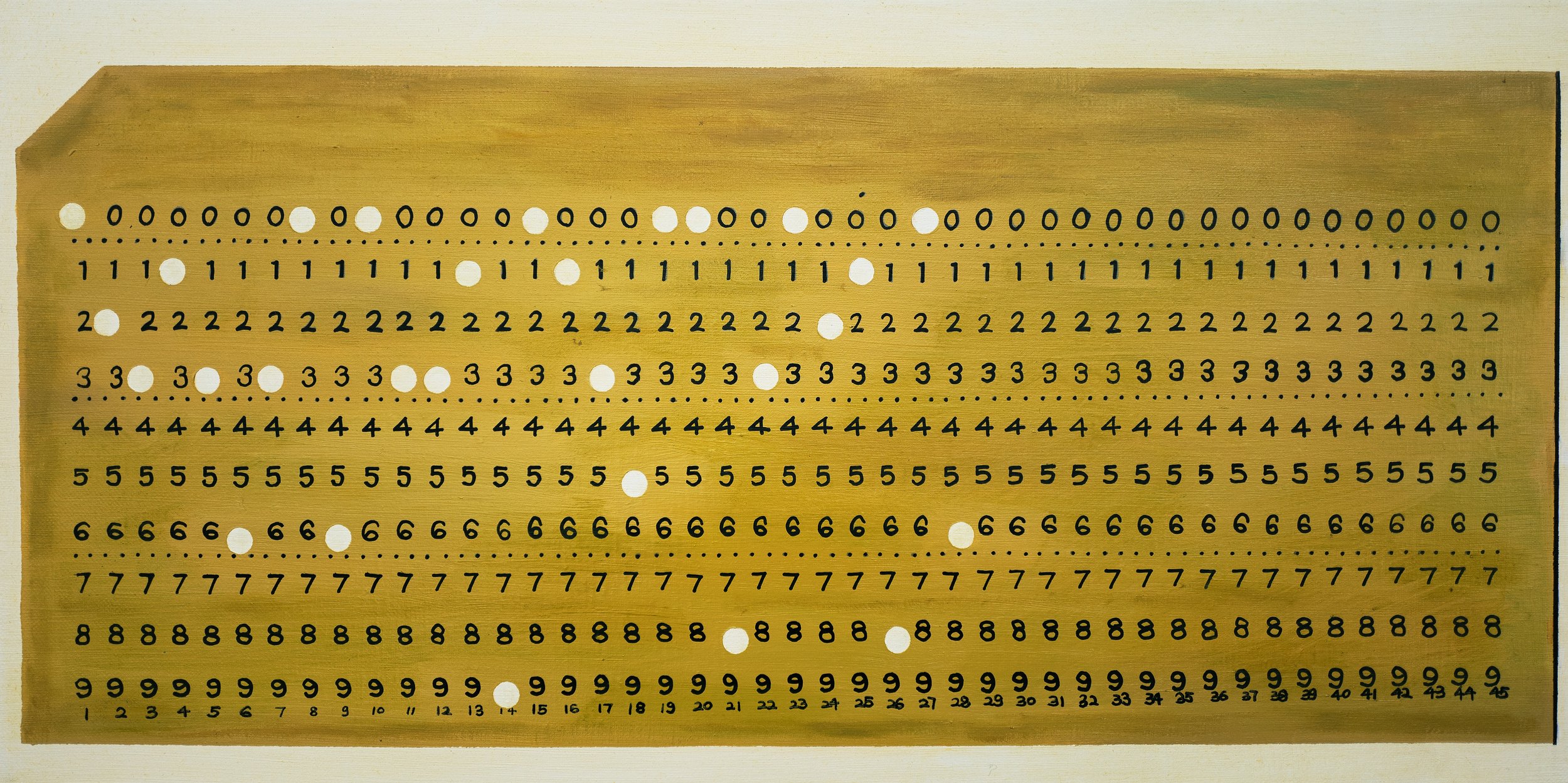
A card made of stiff paper, approximately 18.7 centimeters wide and 8.3 centimeters tall, with 80 columns and 12 rows of rectangular positions, each position corresponding to a hole that can be punched or left intact. When a hole is punched, the card reader's spring loaded pins pass through it and make electrical contact, registering a binary one. When a position is left intact, the pins are blocked, registering a binary zero. The pattern of holes encodes information, a letter, a number, an instruction, a datum, in a form that a machine can read but that a human being can also read, if they know the code, by holding the card up to the light and looking through the holes. This is the punched card, the IBM 80 column format that Herman Hollerith designed in the 1890s for the United States Census and that IBM standardized in the 1920s, the format that would become the dominant medium for data input and program storage in computing for the next six decades, from the tabulating machines of the early twentieth century through the mainframe computers of the 1960s and 1970s to the minicomputers and early microcomputers of the 1980s, a medium that was not fully retired until 2012, when the last punched card voting machines in the United States were decommissioned. The punched card is, by any historical standard, the first instance of human intention being physically encoded for machine interpretation, the first translation from the language of human thought to the language of mechanical action, the first bridge between the physical world of hands and paper and the digital world of electrical signals and binary logic. Tan Mu painted it in 2022, oil and acrylic medium on linen, 30 by 61 centimeters, as a portrait of the object that taught machines to read.
The painting, oil and acrylic medium on linen, 30 by 61 centimeters, horizontal in format, depicts a punched card rendered with visible holes in a grid pattern, the rectangular positions of the 80 column format arranged in rows and columns across the surface of the linen. The card is depicted with warm, vintage tones, the stiff paper rendered in ochre and tan, the holes appearing as dark rectangles against the lighter ground, each hole a window through which the viewer can see the darkness of the background, the absence of paper registering as the presence of information, the punched position encoding a datum in a format that is simultaneously human readable and machine readable. The palette is muted, the ochres and tans of aged paper set against a darker ground that gives the card a quality of preciousness, the warmth of a material that has been handled and stored and preserved, an object that carries, in its grid of holes, the history of a century of computation. The paint handling is precise but not mechanical. The individual rectangular positions are rendered with visible brushstrokes, each hole a deposit of dark pigment that is too small to be read as a brushstroke at normal viewing distance but that, at close range, reveals the hand that made it, the painter's body moving across the linen surface, punching holes in pigment rather than in paper.
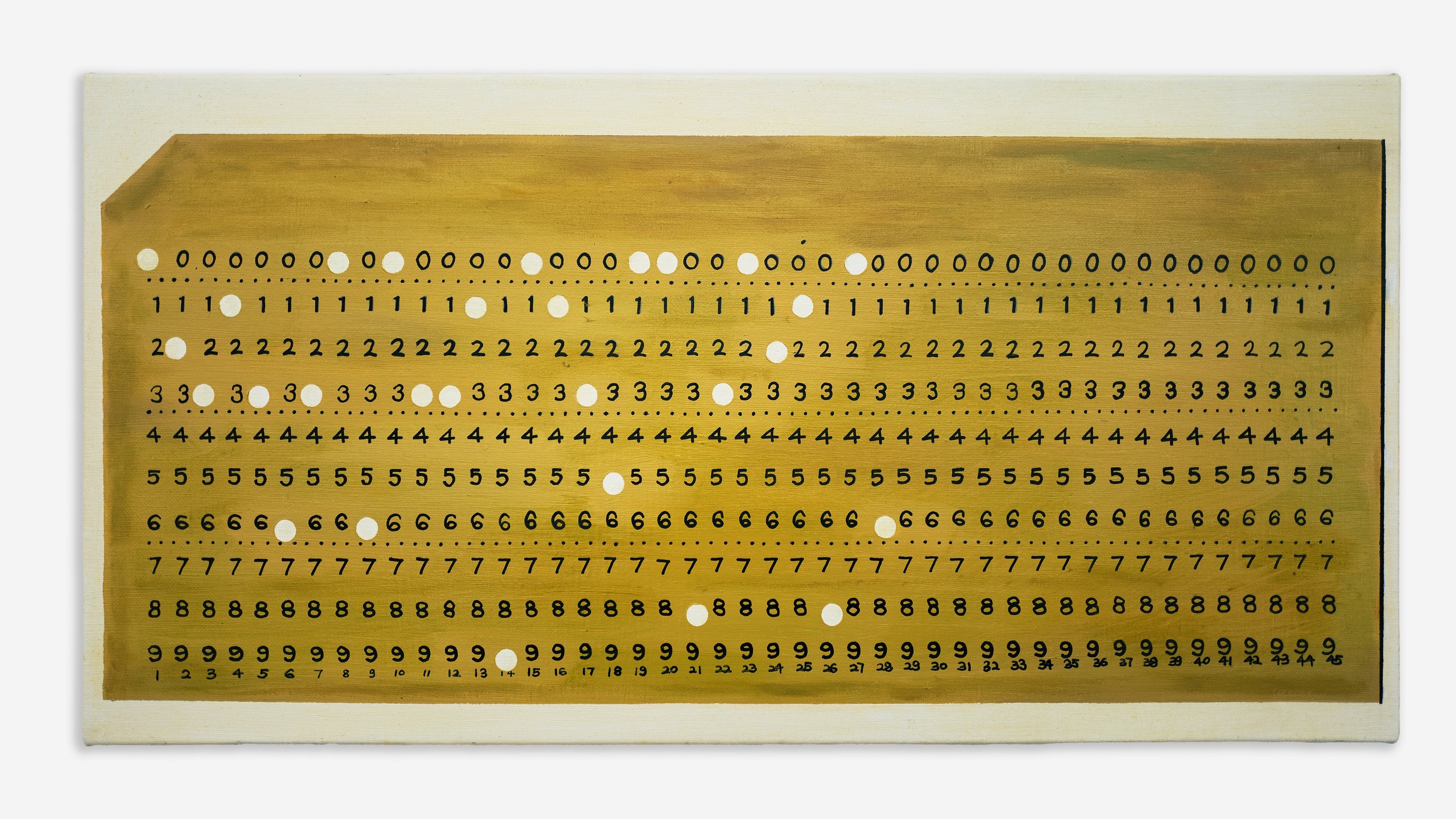
The material technique that produces the painting is the application of acrylic as a base and oil as a top layer, a combination that creates a surface in which the two media coexist without fully merging, the acrylic visible as a ghost beneath the oil in the thinner passages, the oil sitting on top of the acrylic in the thicker passages. The acrylic, which dries faster, is used for the underlying grid, the rows and columns of rectangular positions that define the card's structure. The oil, which dries more slowly, is used for the holes, the dark rectangles that represent the punched positions, and for the card's surface, the ochre and tan of the aged paper. This layering is the material equivalent of the punched card's own structure, the grid of positions that exists as a physical substrate, the pattern of holes that encodes the information on top of it, the two layers, structure and data, substrate and signal, coexisting on the same surface without merging, each one legible in its own register, each one dependent on the other for its meaning.
William Turner painted a ship being towed to its final berth. The Fighting Temeraire tugged to her last Berth to be broken up, 1838 (1839), oil on canvas, 90.7 by 121.6 centimeters, depicts the ninety eight gun warship HMS Temeraire, a veteran of the Battle of Trafalgar, being towed up the Thames by a small, dark steam tug, the ship's masts and rigging still standing but its sails furled, its days of wind powered glory over, its hull being delivered to the shipbreakers who will dismantle it and sell its timbers for scrap. The painting is, at its core, a painting about obsolescence, the moment when a technology that was once the pinnacle of human achievement is superseded by a newer, more efficient alternative and is retired from service, not because it has failed but because it has been surpassed. Turner's Temeraire is not sinking. It is not damaged. It is not broken. It is obsolete, a wooden warship in an age of steam, a sailing vessel in an age of mechanical propulsion, a technology that was once the most powerful instrument of naval warfare in the world and that is now, in 1838, being towed to the scrapyard by a vessel that is smaller, uglier, and more powerful than it will ever be.
The connection between Turner's Temeraire and Tan Mu's punched card is structural. Both are paintings of obsolete technologies, objects that were once the most advanced instruments of their respective domains and that have been superseded by newer, more efficient alternatives. Turner's Temeraire was superseded by the steamship. Tan Mu's punched card was superseded by the magnetic tape, the magnetic disk, the semiconductor memory, the flash drive, each successive medium faster, smaller, and more capacious than the one it replaced. Both paintings treat the obsolete technology not with nostalgia, the sentimental longing for a lost past, but with attention, the sustained, specific attention that the painter brings to an object that is about to disappear, the recognition that the act of painting, the patient accumulation of pigment on canvas or linen, is itself a form of preservation, a way of holding the technology in the visual field for a few more years, a few more decades, before it dissolves into the archive and is forgotten.
Turner's painting is famous for the quality of its light, the golden glow of the setting sun that illuminates the Temeraire's hull and reflects in the water, the sky above rendered in bands of color that range from a warm gold at the horizon through oranges and reds to a deep blue at the zenith, the entire composition dominated by the contrast between the warm light of the sunset and the cool darkness of the approaching night. This light is not merely atmospheric. It is elegiac, the warm glow of a day that is ending, a technology that is dying, an era that is closing. The Temeraire is painted in the light of its own sunset, its hull illuminated by a sun that will not rise on it again, its masts and rigging silhouetted against a sky that is already darkening. Turner understood that the painting of an obsolete technology requires a specific emotional register, not the cold, clinical precision of a technical drawing but the warm, atmospheric glow of a elegy, a visual farewell to a thing that was once powerful and is now, in its final hours, beautiful.
Tan Mu's punched card painting shares this elegiac quality, though it achieves it through different means. Where Turner uses light, the golden sunset that bathes the Temeraire in warmth, Tan Mu uses material, the warm ochres and tans of aged paper, the vintage tones that give the card a quality of preciousness, the warmth of a material that has been handled and stored and preserved for decades, a material that carries, in its grid of holes, the memory of a century of computation. The holes in the card are not holes. They are windows, openings through which the viewer can see the darkness of the background, the void that surrounds the card, the nothing that the punched positions represent, the absence of paper that encodes the presence of information. The card is a surface of absences, a field of holes that are legible to a machine but that are, to the human eye, a pattern of dark rectangles against a warm ground, a visual rhythm that the eye can follow but that the mind cannot read without the code, the specific correspondence between column position and data value that the IBM format defined.
The punched card's role in the history of computing deserves a closer look, because the painting's subject is not merely the card but the system of human labor that the card enabled. Before the punched card, data processing was performed entirely by human beings, clerks who read handwritten records, performed calculations on paper, and entered results into ledgers by hand. The punched card mechanized this process, converting the handwritten record into a pattern of holes that a machine could read, sorting the cards into categories, counting the cards in each category, and producing printed totals that a clerk could read and record. The 1890 United States Census, the first to use Hollerith's punched card tabulating machines, was completed in one year, compared to the eight years required for the 1880 census, which had been processed entirely by hand. The speed increase was not merely quantitative. It was qualitative, a transformation of the relationship between human labor and data processing that would, over the following century, culminate in the fully automated, fully digital systems that process billions of transactions per day without any human intervention at all.
The IBM 12 row, 80 column format that Tan Mu's painting depicts was adopted in 1928 and remained the industry standard for over fifty years. Each card could encode 80 characters, one per column, each character represented by a combination of punched positions in the 12 rows. The format was so successful, so widely adopted, that it became synonymous with computing itself, the phrase "do not fold, spindle, or mutilate," printed on every card as a warning to operators, entering the American idiom as a metaphor for the dehumanizing rigidity of bureaucratic systems. The card was physical. It could be held, stacked, shuffled, sorted, dropped, lost, bent, torn, and destroyed. It was a tangible object in a world that was rapidly becoming intangible, a piece of paper that contained digital information, a bridge between the physical world of hands and the digital world of electrons. The painting preserves this bridge, the card rendered in oil and acrylic on linen, a physical object that depicts a physical object that encoded digital information, a threefold translation from electrons to holes to pigment, each layer adding a material weight that the previous layer lacked.
Saul Appelbaum, writing about Tan Mu's Signal series in November 2025, introduced the concept of "arbitration," the process of mediating between input and output, of making sense of a signal as it passes through multiple forms. Appelbaum argued that Tan Mu's paintings "transform data cables into gestural constellations that oscillate between calculation and intuition," and that what matters is "the human effort to make sense of a signal as it passes through multiple notations, forms, materials, processes, and consciousnesses." The concept of arbitration applies to the punched card with particular force. The punched card is an arbitrator, a medium that mediates between human intention and machine execution, converting the language of human thought, a number, a name, a command, into the language of mechanical action, a pattern of holes that a reader can interpret and a machine can execute. The card does not think. It does not compute. It translates, the same act of mediation that the submarine cable performs when it converts electrical signals into pulses of light, the same act of translation that the protocol performs when it converts a commerce verb into a system call.
Appelbaum's further observation, that "the arbitrary gesture is never meaningless, it generates new systems of relation, where noise becomes form and connection becomes composition," finds its historical equivalent in the punched card's career. The card was, for decades, the most ubiquitous object in computing, a stiff sheet of paper that was handled by millions of operators, fed into millions of readers, sorted by millions of machines, and filed in millions of cabinets around the world. It was so common, so ordinary, so unremarkable that no one looked at it twice. And yet this unremarkable object was the physical substrate of every computation that was performed in the first six decades of the computer age, the medium through which every program was entered, every datum was stored, every result was produced. The card was noise, the background hum of a technology that was so pervasive that it became invisible. It became form, the painted grid of holes on Tan Mu's linen, the visual record of a technology that was once everywhere and is now nowhere, a surface that holds the memory of an era in which the bridge between the human and the machine was made of stiff paper and rectangular holes.