The First Click: Tan Mu’s OXO and the Birth of Interaction
In 1952, a graduate student at the University of Cambridge named Alexander Shafto Douglas sat before the Electronic Delay Storage Automatic Calculator, one of the first stored program computers ever built, and programmed a game of tic tac toe. The machine had no screen in any modern sense. Its display was a cathode ray tube, a bank of illuminated dots arranged in a grid. You turned a rotary dial to position a cursor, pressed a button to register your move, and waited while the machine calculated its response. The entire interaction consisted of a human intention transmitted through a dial, a computational process hidden inside vacuum tubes and mercury delay lines, and a visual result rendered as a pattern of green phosphorescent points. There was no keyboard, no mouse, no graphical interface. There was only the grid, the cursor, and the question of whether the machine would understand what you wanted.
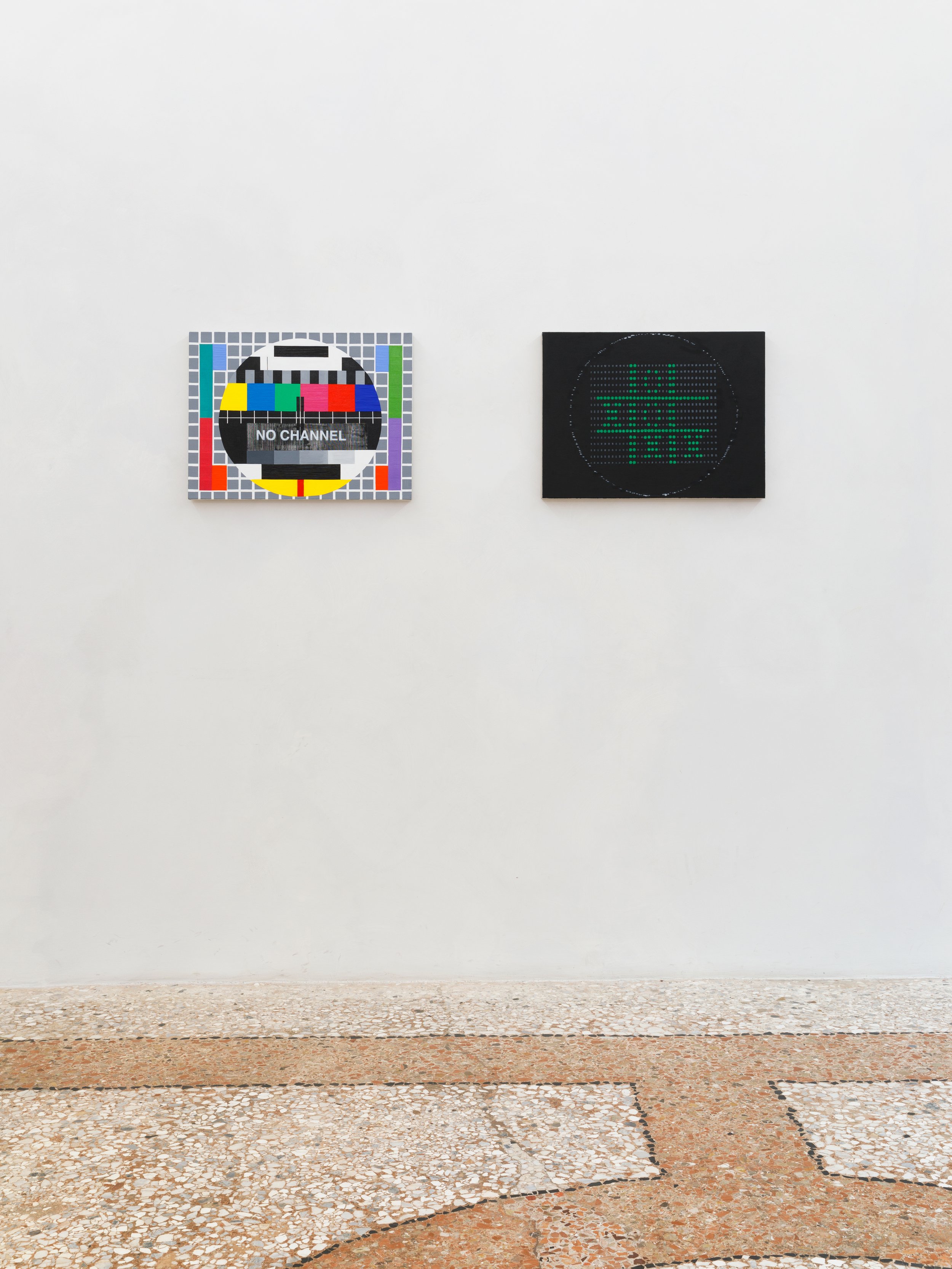
Nearly seventy years later, Tan Mu painted this moment. Her OXO (2021), oil on linen, 46 by 61 centimeters, translates the ghostly green grid of a cathode ray tube display into the physical vocabulary of painting. The canvas holds a dark ground, nearly black, against which a pattern of luminous points traces the familiar three by three matrix of a tic tac toe board. Some squares contain the mark of a move, others remain empty. The composition is deliberately minimal, almost severe, yet the surface vibrates with the kind of optical activity that only oil paint can produce: tiny variations in tone, texture, and edge that no digital reproduction can fully capture. The painting does not illustrate a historical artifact. It performs a translation, converting the logic of early human computer interaction into the durational, haptic medium of oil on linen.
The painting measures 46 by 61 centimeters, a modest scale that positions itself at roughly the dimensions of a laptop screen or a sheet of tabloid paper. At arm's length, the viewer's field of vision encompasses the entire canvas comfortably, the same spatial relationship one has with a monitor. This is not accidental. The scale registers the intimate, domestic quality of screen based interaction, the way a display sits within the personal sphere of the body rather than commanding a room from a wall. Oil on linen, the medium is emphatic in its materiality where the original CRT display was ephemeral, its phosphor dots fading the moment power was cut, the painting insists on permanence, on the physical residue of pigment bound in oil.
The dark ground absorbs light the way a switched off monitor absorbs the room around it. Against this darkness, the illuminated grid points function as the painting's primary structural element. Each point is a discrete mark, built up with enough paint to register a slight relief against the surface. Run a fingertip across the canvas and you would feel the topography of the grid, the raised nodes where light once emanated from phosphor coated glass. Tan Mu has described these marks as symbols of cursor position, the points where user input entered the system. In paint, they become something more: deposits of attention, each one placed by hand through a process that is, by definition, the opposite of computational. The machine calculated in microseconds. The painter deliberates.
The color palette is restricted to a narrow register of greens, blacks, and muted warm tones. The greens recall the specific phosphor used in early CRT monitors, P1 phosphor, which emitted the characteristic green glow that defined the visual language of computing for decades. This is not the bright, saturated green of a modern interface. It is the tired, slightly yellowish green of decay, the color of a screen left on too long, its phosphor slowly losing energy. The warmth that enters the palette in certain passages suggests the heat generated by the machine itself, the vacuum tubes and wiring that made EDSAC occupy an entire room at Cambridge. Technology in 1952 was not sleek. It was heavy, hot, and loud. The painting preserves this materiality.
In 1974, Nam June Paik installed TV Buddha, a work in which a small statue of the Buddha faces a closed circuit television camera that captures and displays the statue's own image in real time. The figure gazes at its own televised reflection, caught in a loop of self observation. The piece is often read as a meditation on narcissism, on the feedback loop between image and identity, on the way television collapses the distance between subject and spectator. But there is a more mechanical reading available. Paik's closed circuit system establishes a precise circuit: input (the statue), process (the camera and broadcast signal), output (the screen). The system has no memory, no computation, no decision making. It merely transmits. The Buddha does not interact with the screen. It receives its own image, unchanged, in perpetuity.
Tan Mu's OXO depicts a fundamentally different relationship between human and screen. Douglas's game required the user to act, to turn the dial and press the button, and then to wait for the machine's response. The screen was not a mirror. It was an interlocutor. The illuminated grid changed depending on what the user did and what the machine calculated in return. Where Paik's system was a closed loop, Douglas's was an open exchange, limited in scope but genuinely bidirectional. The user offered a position. The machine offered a counterposition. The user responded. This simple structure, alternating turns between a human agent and a computational process, is the architecture of every digital interaction that followed: every click, every tap, every voice command, every query typed into a search field.
Paik understood the television as a sculptural object, something to be stacked, magnetized, deformed, and reconfigured. His intervention was physical: bending the screen, exposing the cathode ray, disrupting the broadcast signal. Tan Mu's intervention is temporal. She does not bend the screen or break the signal. She slows it down. By rendering the CRT display in oil paint, she converts a real time interaction, something that happened in seconds and was forgotten, into a durational object that required weeks or months of studio labor. The painting preserves what Paik's work critiques: the image as stable, contemplative, available for sustained attention. Where Paik distrusted the screen's apparent neutrality, Tan Mu extracts from it a form of visual knowledge that the original technology, designed for speed and efficiency, never intended to provide.
Both artists understand that the screen is never merely functional. Paik's TV Buddha reveals the screen as a site of philosophical encounter, a surface on which questions of presence, identity, and mediation play out. Tan Mu's OXO reveals the screen as a site of historical encounter, a surface on which the first transaction between human intention and machine logic was recorded. The difference is one of emphasis. Paik asks what the screen does to us. Tan Mu asks what the screen once was, and what that origin tells us about everything that followed.
The Electronic Delay Storage Automatic Calculator became operational in 1949 at the University of Cambridge Mathematical Laboratory, under the direction of Maurice Wilkes. It was not the first stored program computer, that distinction belongs to the Manchester Baby, which ran its first program in 1948, but it was among the first to be available for regular use by researchers outside its design team. EDSAC used mercury delay lines for memory, ultrasonic pulses traveling through tubes of liquid mercury to store and retrieve data. Its instruction set was minimal. Its input came from paper tape. Its output went to a cathode ray tube or a teleprinter. The machine occupied a large room, consumed significant power, and required constant maintenance.
Into this environment, Douglas introduced something unprecedented: a program written not for calculation but for interaction. OXO was not designed to solve a mathematical problem or process data. It was designed to play a game with a human being. The user turned a rotary dial to select a position on the three by three grid, pressed a button to confirm the move, and the machine calculated its response, displaying the updated game state on the CRT. The machine played optimally, using a minimax algorithm that could not be beaten, only drawn against. The experience was, by any contemporary standard, excruciatingly slow. But it established a structure that would prove more consequential than almost any computational advance that followed: the feedback loop between a human and a machine mediated by a visual display.
This is the moment Tan Mu's painting holds. Not the moment of computation, which is invisible, but the moment of contact, when a pattern of light on a glass screen first communicated a machine's response to a human's choice. The grid of dots on the CRT was, in 1952, the most intimate visual interface between a person and a computer that had ever existed. It was the ancestor of every screen that now mediates daily life: the phone in a pocket, the monitor on a desk, the dashboard of a car, the display on a refrigerator door. All of them descend from this grid, this rotary dial, this button press, this pattern of green light on dark glass.
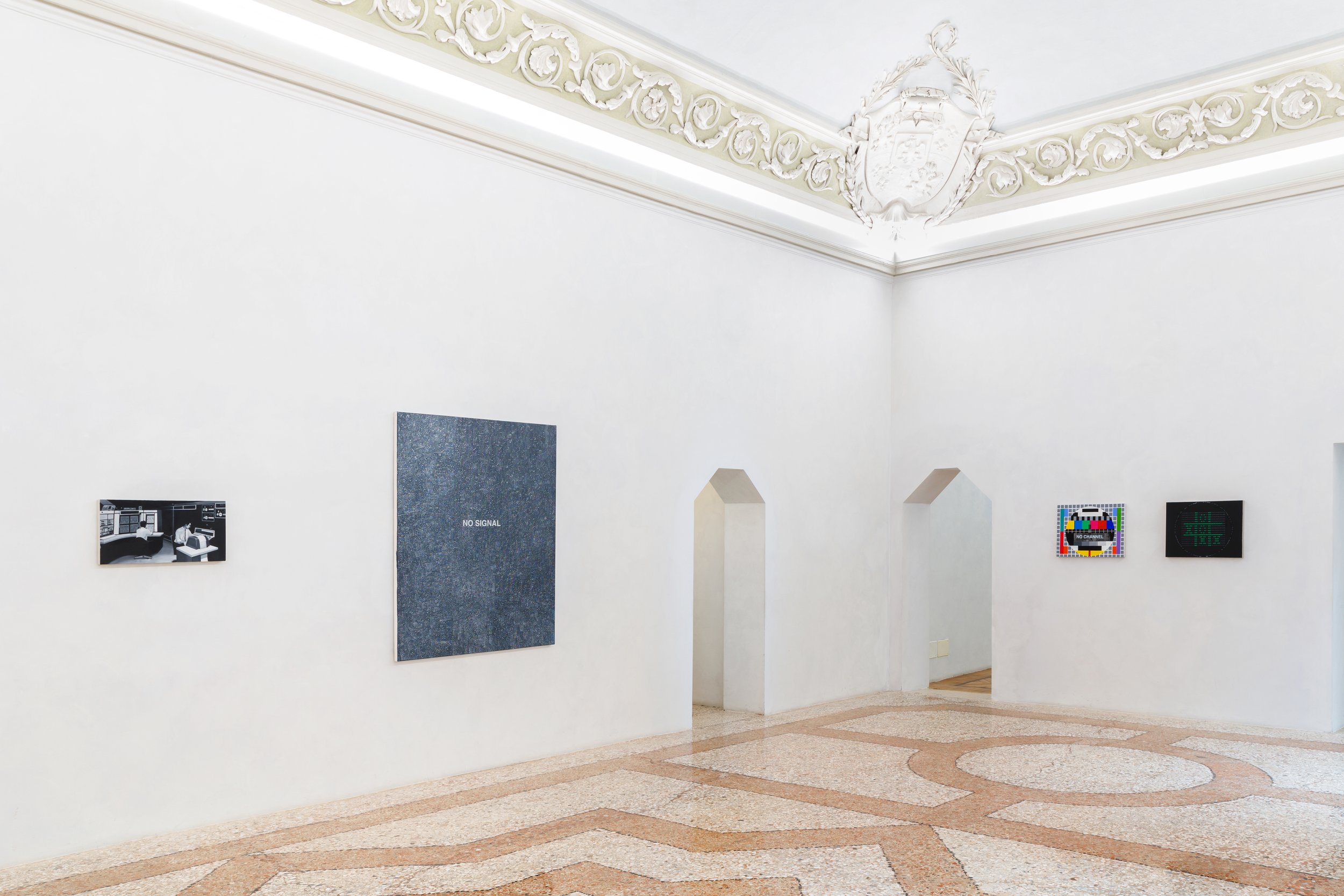
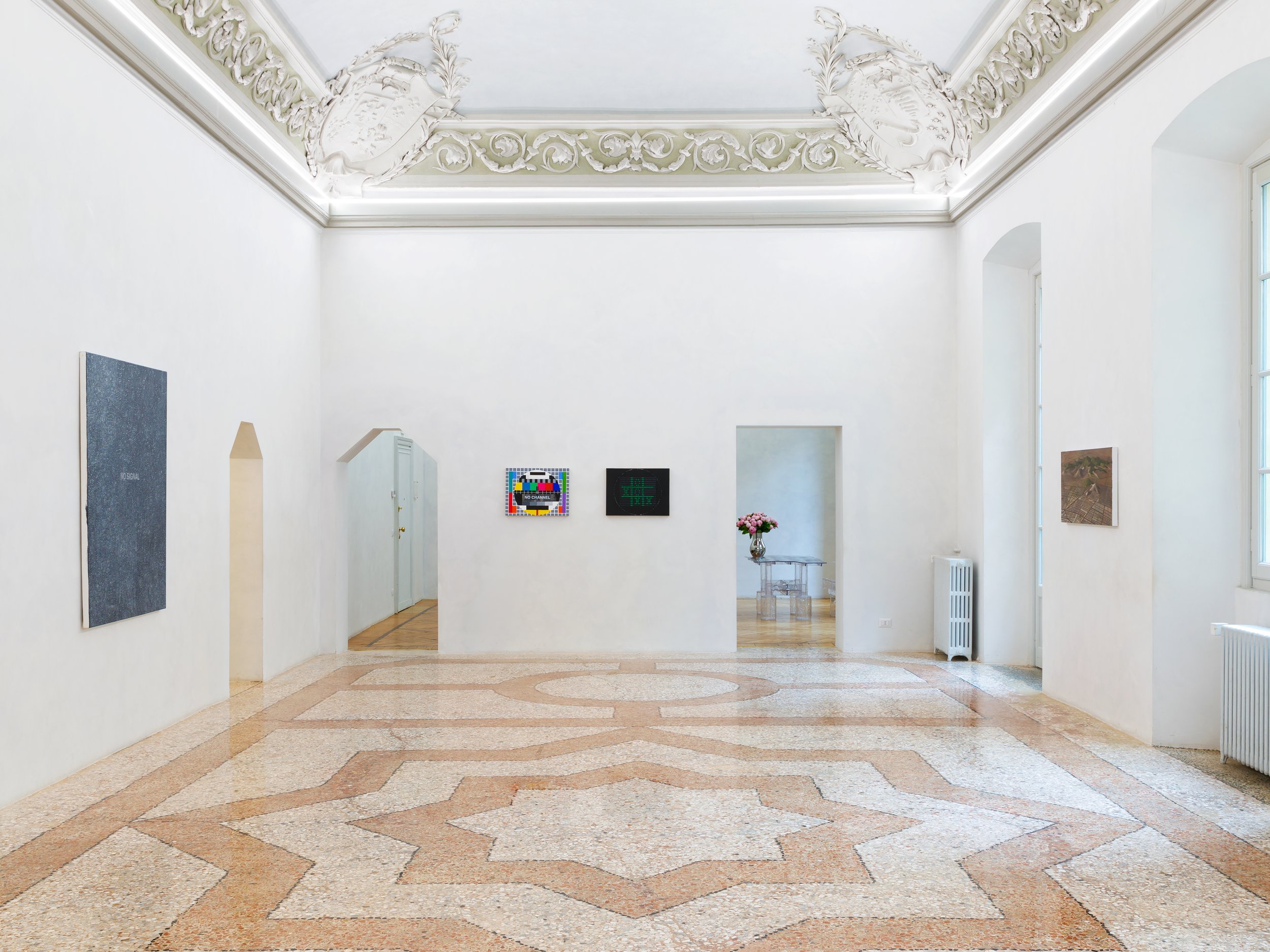
In the SIGNAL exhibition at Peres Projects in Milan (2022), OXO was shown alongside NO CHANNEL (2019), a painting of a television test pattern. Both works share a square inflected format with a circular central element, and both engage the visual language of functional interfaces. Tan Mu has described the pairing as a tension between interaction and interruption: one work depicting the moment when communication between human and machine began, the other depicting the moment when the signal failed, when the screen returned to its calibration state, waiting for a connection that might never arrive. Together, they bracket the entire lifecycle of a technological system, from inception to obsolescence, from the first click to the last static frame.
In 1968, the Hungarian French artist Vera Molnár began her series Interruptions, in which she used a computer to generate variations on a grid of straight lines. Some lines were systematically removed according to an algorithm, producing compositions in which the grid's regularity was disrupted by absence. The works are among the earliest examples of algorithmic art, produced using a plotter connected to a computer at the University of Paris. Molnár did not draw the lines herself. She wrote the program that drew them. The hand was displaced, not eliminated but rerouted through a chain of instructions that the machine executed.
Molnár's project and Tan Mu's OXO share a structural concern: what happens when a human system of order, the grid, the algorithm, the rule set, meets a computational process that operates according to its own logic? In Molnár's Interruptions, the answer is productive disruption. The algorithm introduces irregularity into the grid, creating compositions that feel both systematic and organic. In Tan Mu's OXO, the answer is a game. The grid is not disrupted by the algorithm; it is activated by it. Each square becomes a site of strategic decision, a space where human choice and machine calculation converge in a pattern of occupied and empty cells.
The difference between these two engagements with the programmatic grid illuminates something about Tan Mu's position within the history of art and computation. Molnár approached the computer as a tool for generating visual form, extending the traditions of concrete art and constructivism into the digital domain. Her interest was in the aesthetic possibilities of algorithmic processes: what a machine could draw that a human hand could not, or would not. Tan Mu approaches the computer as a historical and cultural artifact. She does not use the machine to generate the painting. She paints the machine, or more precisely, she paints the moment when the machine first became something a human being could talk to. The grid in OXO is not a compositional device. It is a record of contact.
Yet both artists understand the grid as something more than a formal structure. For Molnár, the grid is the baseline of order against which computational deviation becomes visible. For Tan Mu, the grid is the baseline of interaction against which the entire subsequent history of human computer relations becomes traceable. In both cases, the grid functions as a kind of notation: a system for recording information that is not itself the information but makes the information available. The difference is that Molnár's notation records the behavior of an algorithm, while Tan Mu's notation records the behavior of a user, a machine, and the brief, luminous exchange that passed between them.
Tan Mu has spoken about her attraction to what she calls functional aesthetics, the visual language produced by systems designed not for beauty but for purpose. Early computing interfaces like OXO were built under severe constraints: limited processing power, minimal display resolution, no consideration for visual design in any artistic sense. Yet these constraints produced a distinctive visual vocabulary, the grid, the cursor, the dot, the pixel, that has become one of the defining aesthetic languages of the modern world. The green phosphor glow of the CRT, the blocky resolution of early displays, the austere geometry of a game board rendered in light: these were engineering solutions that became cultural symbols.
The painter Nick Koenigsknecht, writing in the BEK Forum catalog about Tan Mu's broader practice, asks whether her technological subjects function as depictions of external milestones or as self portraits. His answer is the latter. When we observe technology, he argues, we are looking at ourselves. The infrastructure we build, the machines we design, the screens we face: these are projections of human need, human ambition, and human limitation rendered in silicon, glass, and copper. A painting of OXO is not a painting of a machine. It is a painting of the moment when a human being first saw their own intention reflected back to them through a computational process, the moment when the screen became a surface for self recognition.
This reframing is essential to understanding what Tan Mu's painting does that the historical artifact alone cannot. The EDSAC is a museum piece. OXO exists as a historical footnote in computing literature, a program that ran for a few years on a machine that was decommissioned in 1958. The rotary dial is gone. The CRT is gone. The mercury delay lines are gone. What remains is the structure: the feedback loop, the visual display, the alternation between human and machine agency. Tan Mu's painting preserves this structure in a medium that is itself a form of memory, oil on linen, one of the oldest information storage technologies available to human civilization. The painting stores what the machine could not: the feeling of that first exchange, the weight of a moment that would reshape the relationship between humans and their tools for the next century.
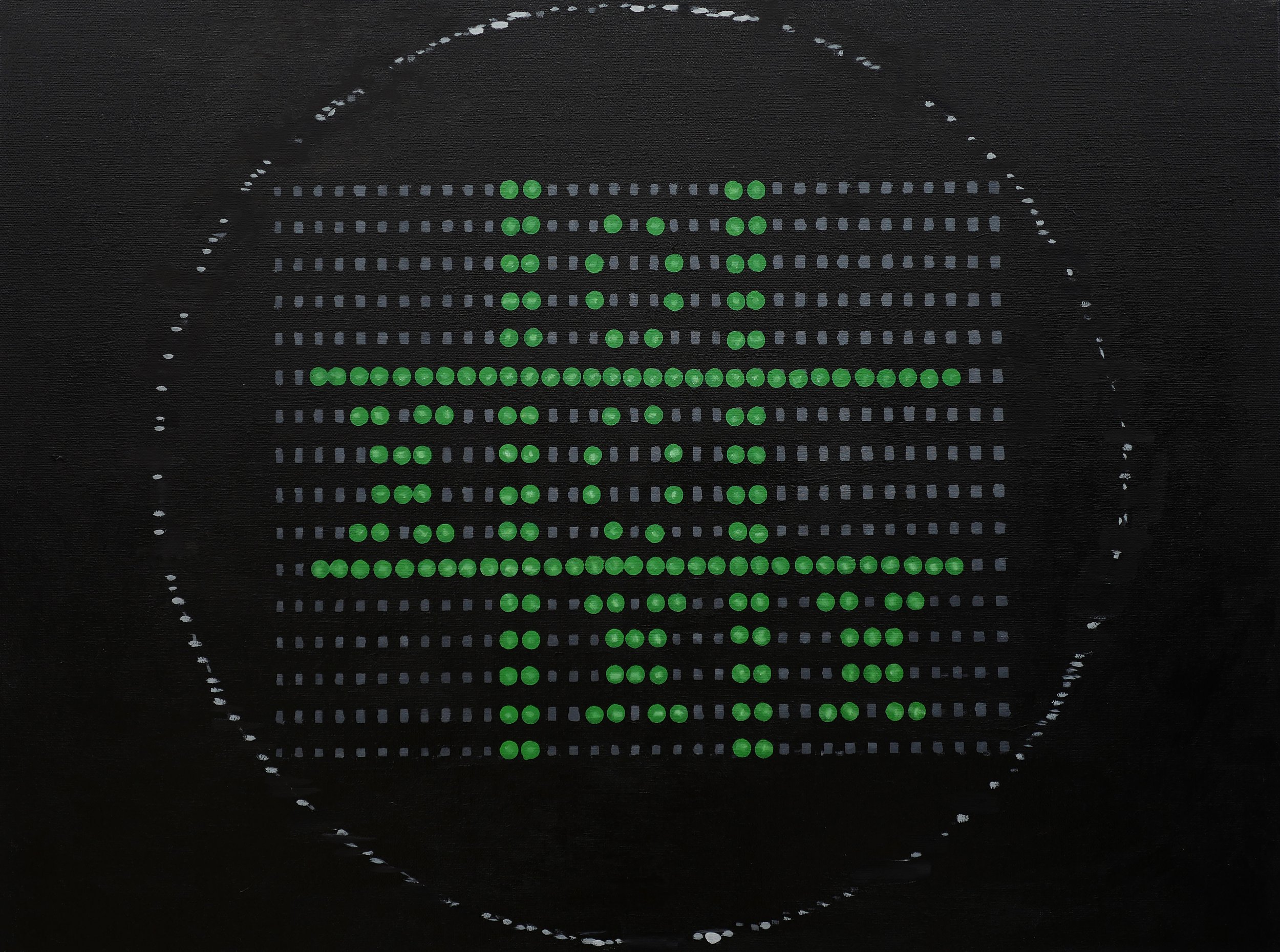
The grid of green points on Tan Mu's canvas does not glow. It absorbs. Where the original CRT emitted light from a phosphor coated surface, the painting receives light from the room and returns it altered by the texture and color of oil paint. This reversal, from emission to absorption, from screen to surface, from signal to substance, is the fundamental operation of Tan Mu's practice. She takes systems designed for speed, transparency, and ephemerality and translates them into a medium defined by slowness, opacity, and endurance. The result is not nostalgia. It is a form of critical preservation, an insistence that the origins of our technological present deserve the kind of sustained, material attention that only painting can provide.
Seventy years after Douglas sat before the EDSAC and turned a rotary dial, the gesture has been multiplied billions of times over. Every tap on a phone screen, every click of a mouse, every voice command spoken to a device descends from that single transaction: a human intention entering a machine through a physical interface, a computational process converting the input into a response, a visual display rendering the result as a pattern of light. The simplicity of OXO, a game of tic tac toe on a screen of green dots, belies the enormity of what it inaugurated. Tan Mu's painting holds that simplicity without reducing it, letting the viewer sit with a grid of points on a dark ground long enough to feel the weight of what those points once meant: the first time a human being looked at a screen and saw the machine looking back.