The Moment Before Speech: Tan Mu's LOADING... and the Phenomenology of a Waiting Image
Before a text can be sent, before a voice note can be heard, before a photograph can be forwarded to someone in another country, there is an image that appears for a fraction of a second and then disappears. The eye catches it, then the interface advances, and daily life proceeds. Most users treat this as technical filler, a cosmetic screen that masks an internal process. Tan Mu's LOADING... (2019) refuses that classification. It proposes that this pre verbal instant is one of the most emotionally charged images in modern life, not because of what it depicts but because of where it sits in the chain of human connection. It is the image that appears right before a voice crosses an ocean.
The artist states the subject with direct precision. The painting takes WeChat's opening screen as its focus, specifically the transition from NASA's Blue Marble Earth image to imagery produced by China's Fengyun 4A satellite. In her Q and A, she describes watching this change from within her own transnational life. She left home for Beijing in 2006 and moved to the United States in 2011. Family connection increasingly depended on communication platforms. In that context, the loading screen stopped being neutral decoration. It became an emotional technology. A user opens an app to call home, and before any voice is heard, the interface stages a model of planetary perspective. The painting is anchored there, in the short interval between expectation and contact.
The shift from NASA's Blue Marble to the Fengyun 4A image in 2017 was not merely a technical update. It was a quiet assertion of technological sovereignty, a moment when a Chinese app replaced a globally recognized American image with one of its own making. The Blue Marble, taken by Apollo 17 in 1972, had become a symbol of global unity, a view of Earth that transcended borders. Its replacement by a Chinese satellite image marked a change in the visual language of power, a shift in the focal point from Africa to China. This transition happened at a time when China was rapidly expanding its presence in space, launching its own navigation systems, space stations, and lunar missions. The loading screen became a subtle battleground for narrative control, a daily reminder of the country's growing technological prowess. Tan Mu captures this moment of transition, not as a political statement but as a lived experience, a change in the visual fabric of daily life that reflected broader geopolitical shifts. The painting holds this tension, the two Earth images facing each other in a symmetric composition that allows the viewer to feel the weight of the change.
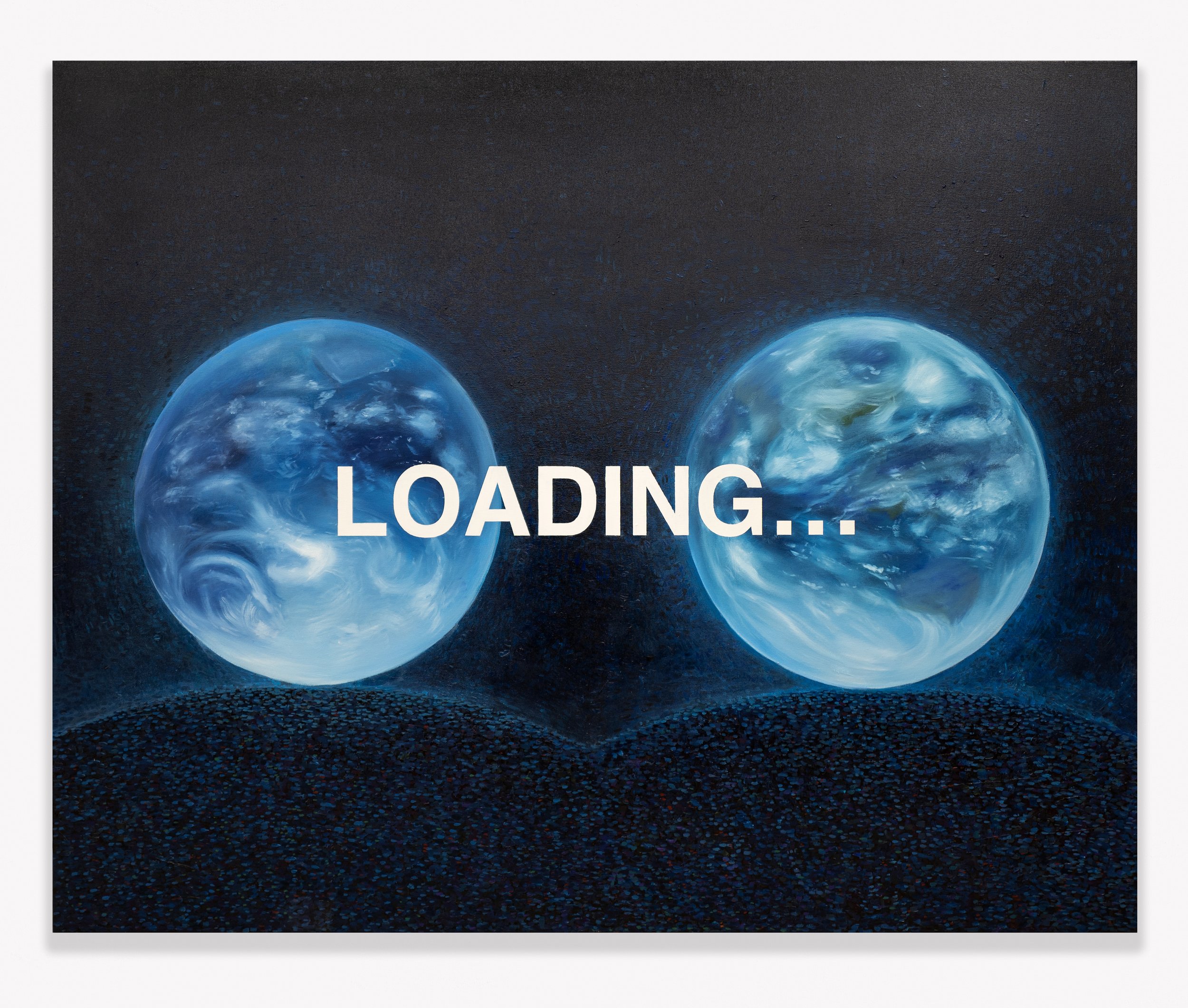
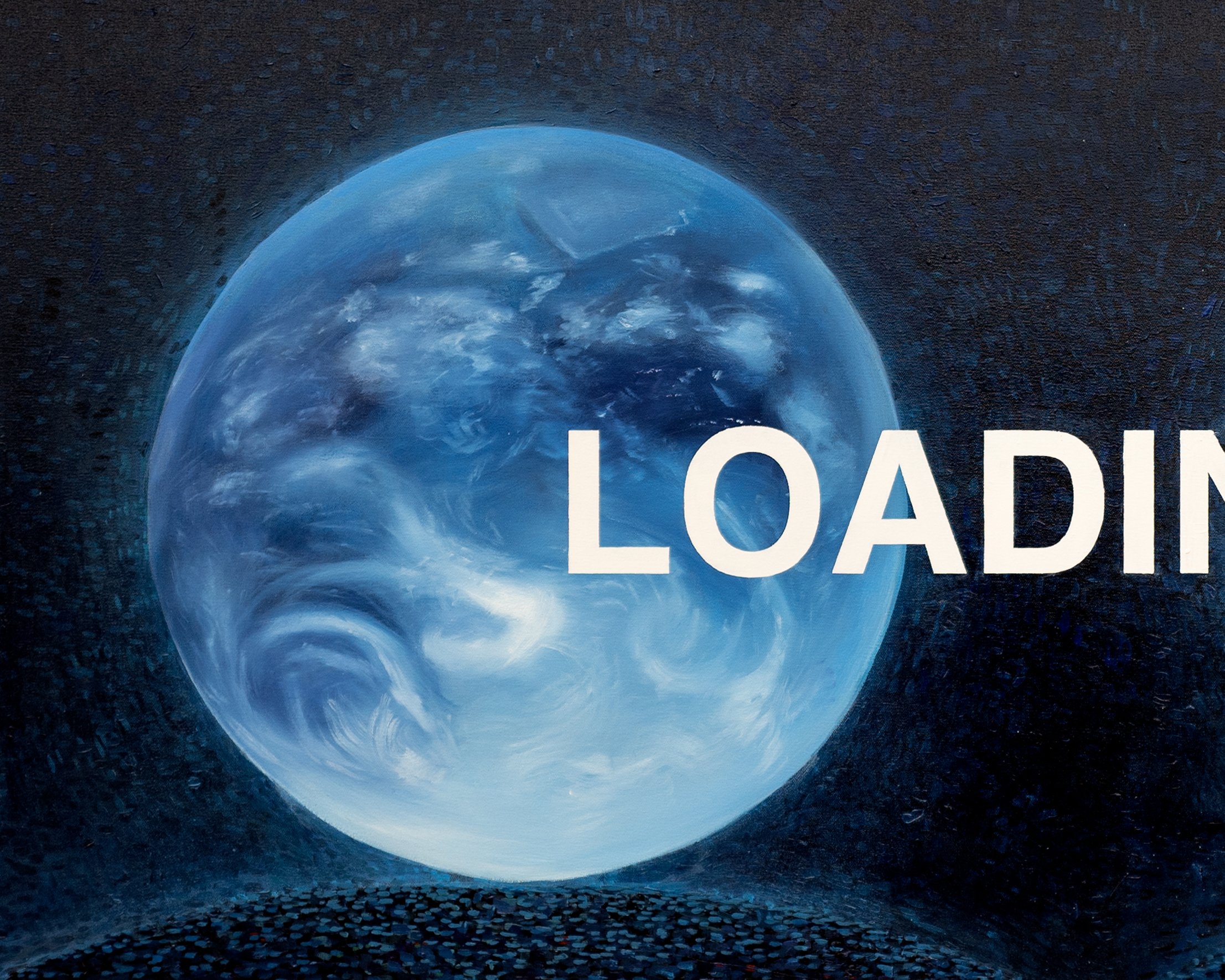
LOADING... is oil on canvas, 122 x 152 cm (48 x 60 in). The scale matters. This is not pocket scale like the phone that generated the source image. It is large enough that a body stands in front of it as in front of a landscape painting. That enlargement does conceptual labor. A startup screen designed to be glanced at for less than one second becomes an object requiring sustained looking. The painting converts a software pause into physical duration. What was engineered to vanish quickly is now set at a size where it can no longer hide in function.
The composition is built around a bilateral tension between two Earth images, with a field of layered marks that initially reads as smooth atmosphere and then breaks into particulate structure at closer distance. Tan Mu describes this field as constructed from countless dots. This is a key material move. The dots are paint events, but they behave like data metaphors without becoming illustration. From far away, the painting presents planetary unity. From near distance, that unity resolves into accumulation, repetition, and interruption. The interface promise of frictionless immediacy is replaced by a surface that records labor and latency.
Color also refuses neutrality. The chromatic balance is restrained, with cool spatial tones around the Earth forms and warmer pressure in transitional zones, so the eye moves between image clarity and atmospheric uncertainty. The edges do not simply separate figure from ground. They pulse between registration and blur. This is where the painting differs from its digital source. The source image is compressed and backlit. The painted version is layered and absorptive. Light is not emitted from behind the screen. It is held in pigment thickness, in matte and semi gloss passages, in a deliberately uneven skin that keeps reminding the viewer that this global image sits on a finite support.
In her own account, the loading screen is a moment of waiting, suspension, and quiet anticipation. The painting translates that anticipation into optical pacing. The eye expects immediate legibility and instead encounters strata. It expects quick utility and receives visual friction. Even the regularity of the dot field becomes a temporal device, because repetition in paint never fully repeats. Each unit carries micro variation in pressure, viscosity, and edge behavior. The result is a paradox central to Tan Mu's method: she uses one of the slowest mediums to study one of the fastest visual regimes. Oil here is not nostalgic. It is analytic.
Sigmar Polke's Bunnies (1966) is an unavoidable precedent for understanding Tan Mu's procedure in LOADING.... Polke took a Playboy photograph and repainted it through raster dots, converting print reproduction logic into a painted event. The image remained recognizable, yet its authority shifted. It no longer functioned as seamless mass media image. It became an object about mediation itself, about how pictures arrive already processed by technical systems. Tan Mu performs a related conversion: she takes a platform image optimized for speed and transparency, then repaints it so that its mediations become visible rather than hidden.
Polke's use of the Benday dot, a technique borrowed from commercial printing, was a way of critiquing the mass media landscape of postwar Germany. He used the dot to expose the mechanics of image production, to show how reality is constructed through reproduction. Tan Mu's use of the dot is similarly critical, but her target is not print media but digital interfaces. The dots in LOADING... are not just a stylistic choice; they are a reference to the pixel, the basic unit of the digital image. By rendering these pixels in oil, Tan Mu slows down the image, forcing the viewer to see the construction of the digital world in the same way Polke forced viewers to see the construction of the print world. Both artists use the dot to create a distance between the viewer and the image, a distance that allows for critical reflection.
The connection between Polke and Tan Mu is also one of humor and irony. Polke's work is often playful, using the absurdity of the source material to critique the seriousness of the media. Tan Mu's work is more solemn, but it shares Polke's interest in the hidden logic of images. The loading screen is a mundane object, something we see thousands of times without thinking. By painting it, Tan Mu elevates it to the status of art, just as Polke elevated the comic strip and the advertising image. Both artists find the extraordinary in the ordinary, the profound in the trivial. They show us that the images we ignore are often the ones that shape our world the most.
The structural kinship is specific. In both cases, dot based organization is not decorative style. It is a critical mechanism. Polke's rasterized fields expose the machinery of photographic circulation in postwar consumer culture. Tan Mu's layered particulate field exposes the machinery of platform circulation in the age of mobile interfaces and transnational communication. Both painters choose an image many viewers believe they already know. Both then refuse passive repetition. They place the image inside paint so that its mediations and formats can be inspected at human speed. Polke's operation was tied to print reproduction and West German visual economy. Tan Mu's operation is tied to app infrastructure, satellite imagery, and the intimate experience of using technology to maintain closeness with people far away.
There is another important difference that clarifies Tan Mu's contribution. Polke often introduced irony through image choice and unstable scale effects. LOADING... carries less irony and more affective pressure. The source image is connected to daily communication with family across continents. Its stakes are practical and emotional at once. This is why Tan Mu's translation feels less like detournement and more like forensic attention. She does not mock the interface. She examines it with care. The painting says that what looks like a neutral technical prelude is in fact a scene where memory and intimacy are quietly carried.
The science and media context of LOADING... is explicit in the artist's own words. WeChat's startup screen originally used NASA's Blue Marble photograph, a globally circulated image with deep post Apollo visual history. In 2017, Tencent replaced it with imagery from China's Fengyun 4A satellite. Tan Mu identifies this replacement as a subtle but meaningful shift in how the world is seen from within a daily tool. The difference is not only technical. It is perceptual. Which horizon appears. Which focal point sits at the center. How millions of users unconsciously register planetary shape every time they open an app to call someone they love.
Splash screens function as micro rituals. They appear in moments when users have committed an action but cannot yet receive output. This waiting interval is often treated as dead time. Tan Mu's painting refuses that assumption. She shows dead time as charged perceptual time. During loading, a platform can orient a user toward expectation, toward the emotional register of who they are about to contact and how far away that person might be. By extracting this micro ritual and magnifying it in paint, she makes visible what interface design usually keeps imperceptible.
Her Q and A frames this within biography without collapsing into autobiography. She describes moving from Shandong to Beijing, then to the United States, and relying first on expensive data plans and Skype, later on WeChat as communication infrastructure matured from text to voice to video. This timeline matters because it ties visual transition to lived emotional transition. The shift from Blue Marble to Fengyun image is not an abstract anecdote in the painting. It intersects with how distance is managed in daily life. The platform both reduces distance and reminds users that distance persists. Tan Mu names this tension directly: communication systems carry connection, absence, pauses, and longing at the same time.
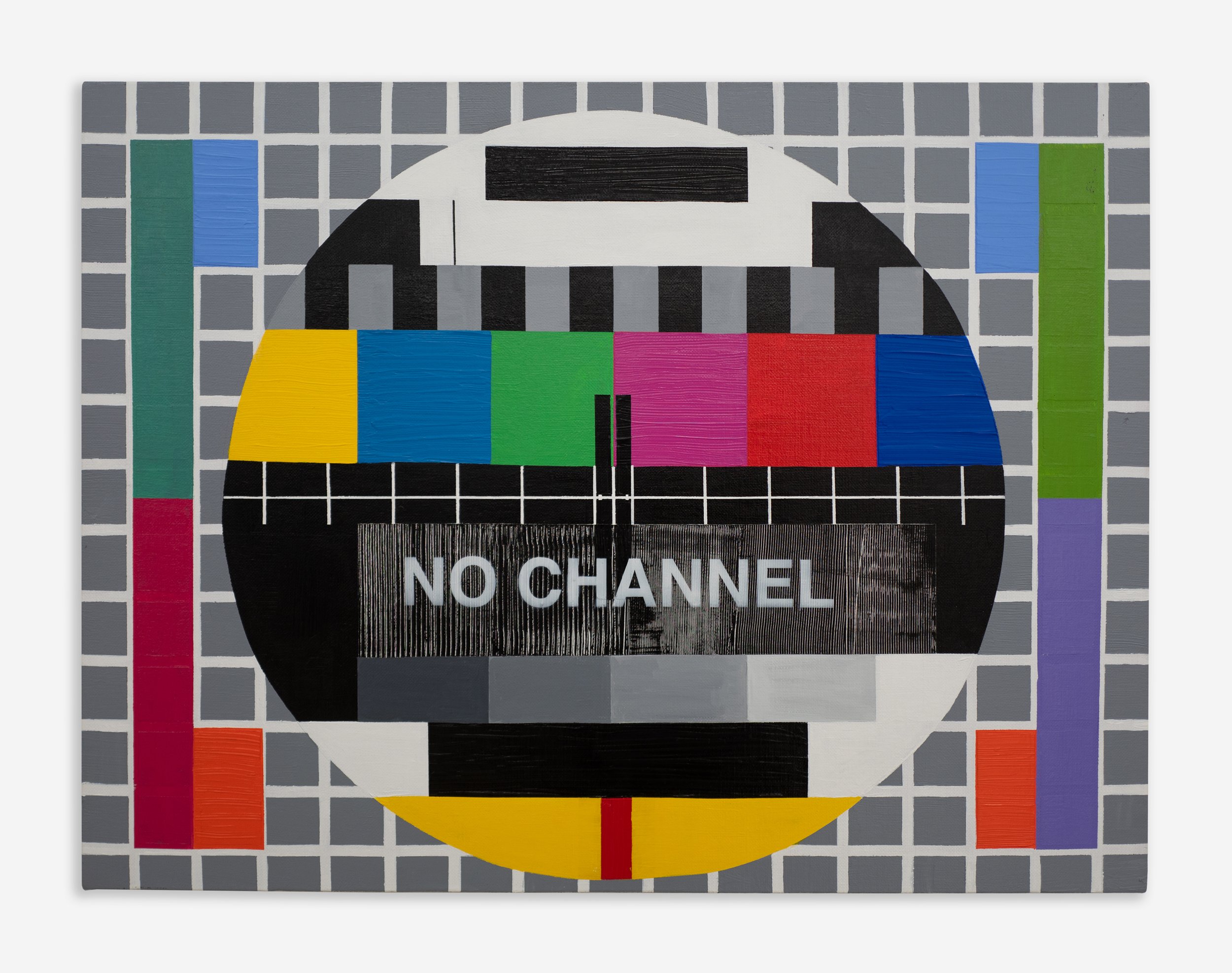
The painting also anticipates later series. In discussing LOADING..., Tan Mu links it to NO SIGNAL, Off, and Eruption, then to later submarine cable works. This continuity is crucial for reading the piece in the arc of her practice. LOADING... is not an isolated early experiment. It is an origin node for a larger investigation into infrastructures that operate below ordinary perception. Here the infrastructure is software interface and satellite imaging. Later it becomes ocean floor cable topologies. In both cases, she studies systems that organize intimacy while appearing technically neutral. The subject remains consistent: how structures of transmission shape structures of feeling.
Hiroshi Sugimoto's Seascapes (1980 onward) offers a second, distinct frame for LOADING.... Sugimoto repeatedly photographs sea and sky divided by a horizon line, producing images that are geographically specific yet formally austere, almost pre linguistic. His method compresses geographic variation into a persistent optical proposition: human history changes, but this relation between water, light, and horizon endures. Tan Mu's painting performs a different operation with comparable rigor. She takes a globally circulating Earth image and reveals that what appears automatic is in fact a historically layered perceptual event. Sugimoto pursues continuity through repetition. Tan Mu pursues the specific texture of change through a single interface transition.
The relevance is not resemblance in motif alone. It lies in how both artists treat mediation as part of perception, not a secondary issue. Sugimoto's long exposure durations convert wave movement and atmospheric change into calm tonal structures that feel timeless while being technically produced. Tan Mu converts a fleeting digital render into layered pigment so that technological mediation becomes palpable. In both practices, the viewer confronts an image that seems simple at first encounter and then opens into questions of apparatus, duration, and attention. Sugimoto asks what remains across civilizations when looking at sea and horizon. Tan Mu asks what happens to memory when the image that precedes a call to someone you miss keeps changing without your conscious notice.
Nick Koenigsknecht's 2025 curatorial essay offers a useful phrase for this move when he writes that observing technology can become a form of self portraiture. LOADING... confirms that claim. The painting is not about a machine from outside. It is about a perceptual system inside which contemporary subjects already live. The startup image is internalized through repetition, becoming part of memory architecture. By repainting it, Tan Mu returns that internalized image to exterior space where it can be felt and reflected upon. This is not a rejection of technology. It is an insistence that technological images carry emotional weight whether or not we notice them.
The comparison with Sugimoto clarifies another dimension of Tan Mu's method, namely scale reversal as a phenomenological gesture. Sugimoto often produces large photographs that hold viewers in front of a horizon they cannot physically enter, yet the motif itself is geologic and planetary. Tan Mu starts with a planetary motif already miniaturized by phone hardware and software routines, then expands it back to human wall scale. This reversal is the argument. The world image has been folded into routine so completely that it feels like furniture. Painting restores its wonder and its strangeness. What looks instantly legible on a screen becomes layered and resistant on canvas. The result is a shift from consumption to encounter.
Many paintings in modern and contemporary art address events, objects, or myths already recognized as historically significant. LOADING... chooses a different target. It paints the preface to communication, the almost unnoticed visual interval that occurs before content, before speech, before exchange. That choice is ambitious because prefatory images are so deeply internalized that they barely register as images at all. They appear too briefly to trigger scrutiny, yet they accompany some of the most emotionally important acts in daily life. Tan Mu's decision to fix this interval in oil on canvas reassigns value. She treats startup time as memory time.
Seen this way, the work does more than document WeChat's image change. It proposes a method for painting under interface conditions. Instead of asking only what images depict, it asks what images do at the level of habitual use. Instead of reading interfaces as neutral conduits, it reads them as surfaces that carry traces of memory and longing. Instead of opposing human intimacy and technological mediation, it studies their entanglement with care and precision. The painting's intelligence lies in that refusal of simplification. Its emotional force lies in the artist's lived knowledge that communication can be both immediate and fragile in the same breath.
There is also a curatorial dimension. A gallery wall is one of the few places where platform imagery can be encountered without notifications, without incoming messages, without the compulsion to respond. In that setting, viewers can register how many layers of perception and memory are folded into an image they may have seen thousands of times without noticing. The painting becomes a quiet counter interface. It does not accelerate interaction. It suspends it. It asks what kind of attention is required to feel the weight of the systems that now hold our kinship, our language, and our distance.
By turning one second of loading into a sustained field of attention, Tan Mu demonstrates that contemporary painting can still perform one of its oldest tasks with unusual force: taking what passes too quickly to be understood, and giving it enough duration to become thinkable. In LOADING..., the first image is no longer a prelude. It is the event. The pause itself becomes a site of memory, feeling, and patient looking.