The Constellation That Was Already There: Tan Mu’s Signal: Submarine Networks 02 and the Data Routes Beneath the East China Sea
On January 15, 2022, the Hunga Tonga-Hunga Ha'apai volcano erupted beneath the Pacific Ocean with a force roughly equivalent to 10 million tons of TNT. The blast generated a tsunami that crossed the Pacific and knocked out the single submarine cable connecting Tonga to the rest of the world. For five weeks, 100,000 people were unable to send emails, make phone calls, or access the internet. Tonga disappeared from the network. Not from satellites, not from wireless infrastructure, but from the physical glass threads that had been laid across the ocean floor decades earlier and that everyone had forgotten were there. Tan Mu, who had been diving in Tonga before the eruption and who understood the region's cable geography intimately, watched the news coverage and saw something different from what most viewers saw. She saw the absence of a line. The cable had been severed, and the silence that followed was not the silence of disconnection but the silence of infrastructure made visible by its failure. She began painting the cables that same day. Signal: Submarine Networks 02, completed in 2025, depicts one of the densest concentrations of those lines on earth, the corridor connecting East Asia to Southeast Asia, where Japan, South Korea, China, Hong Kong, Singapore, and the Philippines are linked by systems so heavily trafficked that any disruption propagates instantly across global markets, financial exchanges, and personal communications. The painting does not show the eruption. It shows what the eruption revealed: the lines that hold the world together, drawn so finely they could be mistaken for a diagram, a score, or a child's drawing of stars.
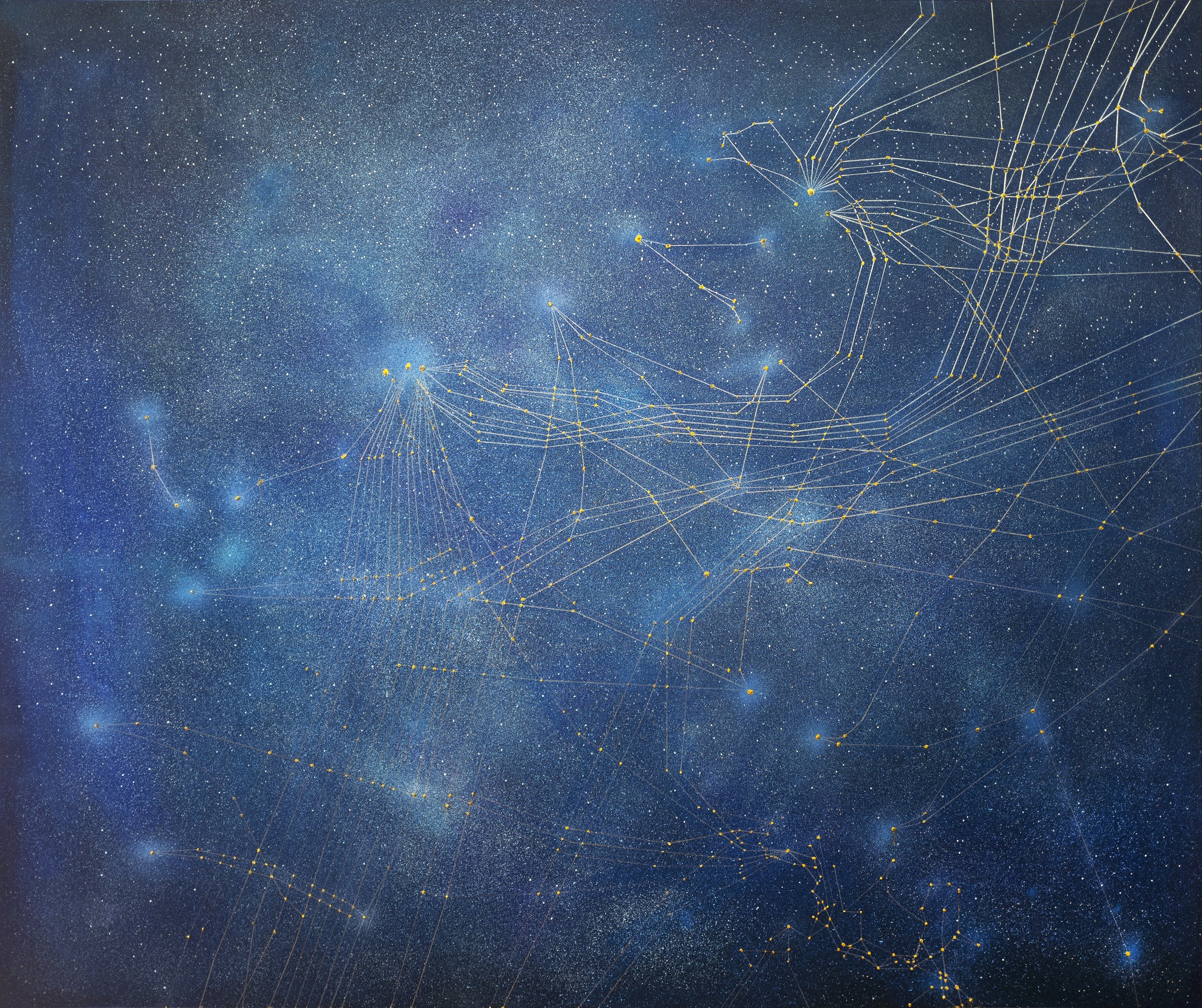
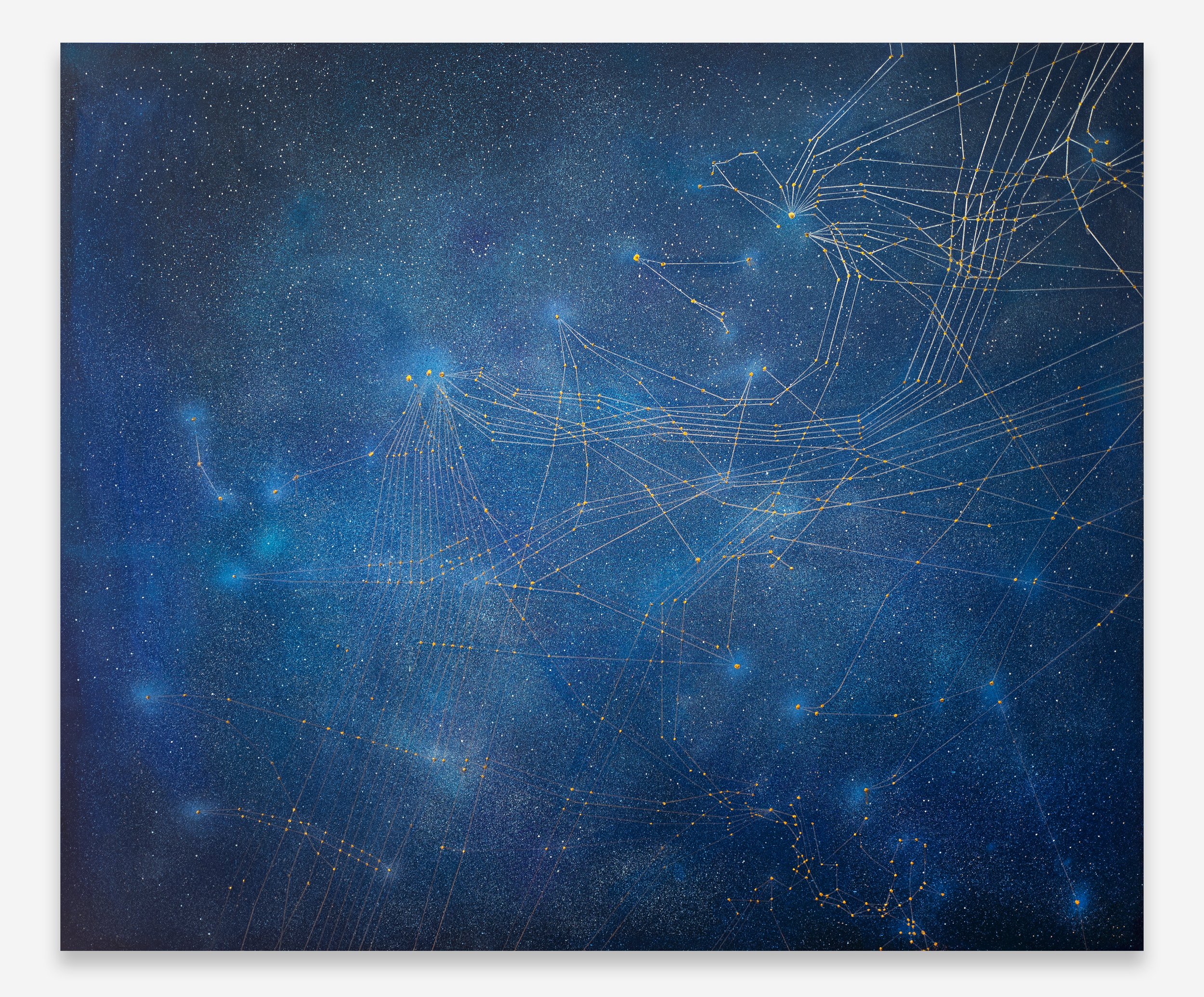
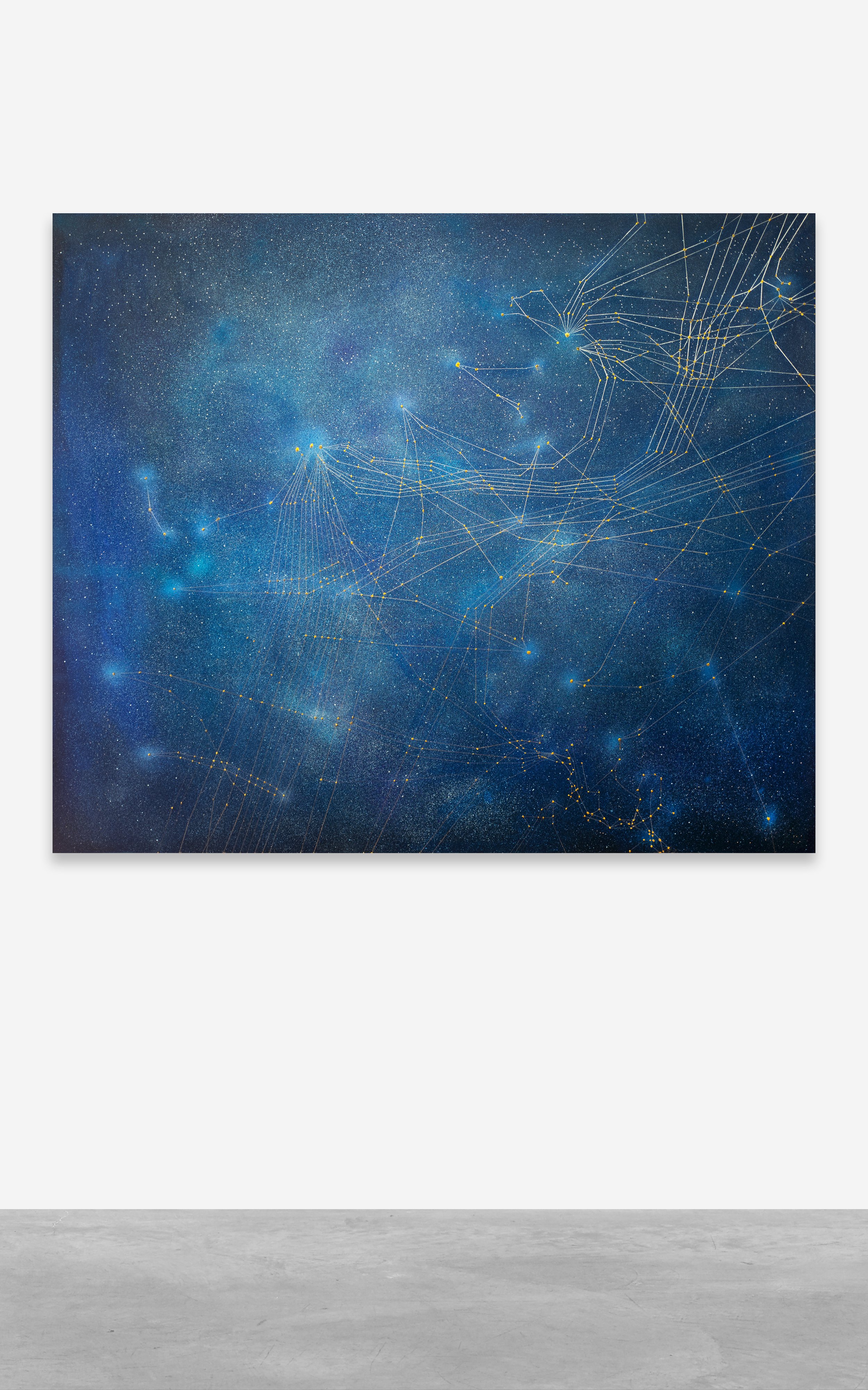
At 152.5 by 183 centimeters, Signal 02 is one of the largest paintings in the Signal series. The canvas holds a field of dark, almost black ground, against which a network of pale lines and dots distributes itself across the entire surface. From a distance, the effect is closer to a star chart than to any conventional landscape painting. There is no horizon, no horizon line, no sense of a viewing position above or within the world. Instead, the lines seem to float in a void that could be either the ocean floor or deep space, and the ambiguity is deliberate. Up close, the lines resolve into distinct trajectories, some thicker, some thinner, some terminating in dots that cluster at landing points corresponding to real cable stations on real coastlines. The dots are not uniform. Some are larger, some smaller, and their distribution follows a logic that is simultaneously geographic and economic, since cable landing stations tend to be placed where population centers, existing port infrastructure, and regulatory frameworks converge. Oil and acrylic on linen, the work combines Tan Mu's characteristic precision in the final layer with an underpainting that introduces warmth into what might otherwise read as purely diagrammatic. The acrylic layer, applied in the initial stages, allows for rapid build-up of tone, while the oil layer, applied afterward, introduces the fine lines and dots that function as the painting's primary visual vocabulary. The result is a surface that oscillates between the warm flesh tones of the underlayer and the cool silver and white of the final surface, so that at different viewing distances the same painting can seem either intimate or expansive, warm or cold, organic or mechanical.
In 1974, Gordon Matta-Clark took a chainsaw to a condemned house at 322 Humphrey Street in Englewood, New Jersey, and cut it in half. The resulting work, Splitting (1974), exposed the interior structure of the building, its wall studs and floor joists and plumbing runs and electrical conduit, to daylight. The cut was precise: a single vertical plane dividing the house into two halves, with one half tilted slightly on its foundation so that a sliver of light entered the gap from top to bottom. What had been invisible for decades, the skeleton that held the domestic space together, became the subject. Matta-Clark was not interested in demolition. He was interested in revelation: what happens when you open up the skin of a structure and force the viewer to see the systems that make habitation possible. The plumbing, the wiring, the framing, none of it was designed to be seen. All of it was designed to be forgotten after the drywall went up. Splitting made forgetting impossible. The house became an anatomy lesson, and the lesson was that every domestic comfort depended on infrastructure that had been deliberately hidden from view.
Tan Mu's Signal 02 operates in a parallel register, though the infrastructure she reveals is not architectural but planetary. The submarine cable networks that the painting maps were designed, like Matta-Clark's wall studs, to be invisible. No one sending an email from Shanghai to Singapore thinks about the glass fiber carrying that message across the floor of the South China Sea, just as no one sitting in a living room thinks about the copper wiring behind the plaster. Tan Mu has described the Signal series as an ongoing investigation into the networks that carry human connection across space, and the structural kinship with Matta-Clark is precise: both artists insist on the visibility of what has been deliberately concealed, both treat infrastructure not as background but as subject, and both understand that the revelation of hidden systems changes the viewer's relationship to the spaces those systems serve. Where Matta-Clark used a chainsaw to open a house, Tan Mu uses oil paint to open an ocean. The cables in Signal 02 are rendered with a reverence that transforms engineering diagrams into something closer to anatomical drawing, with the understanding that what is being depicted is not technology but the connective tissue of contemporary life, the planetary equivalent of the wiring behind the wall.
Tan Mu's own Q&A, recorded on the tanmustudio.com archive page for this work, describes the cables as functioning like the veins of the planet, circulating energy and information through a living body. She draws an explicit parallel between internal systems like neurons and synapses and external systems like submarine cables and data centers, arguing that together they form a larger anatomy that connects individuals across space and time. This analogy is not incidental. It is the philosophical core of the entire Signal project, and Signal 02 embodies it with particular clarity because the East Asia to Southeast Asia corridor is one of the most heavily trafficked cable routes on earth, carrying not just personal communications but the financial transactions of entire economies, the operational data of multinational corporations, and the emotional traffic of millions of families separated by geography. When Tan Mu paints this corridor, she is painting a region of the planet's nervous system, and the scale of the painting, 152.5 by 183 centimeters, allows the viewer to stand before it as they might stand before a map in a cartographic library, tracing routes with their eyes and feeling the weight of the distances they represent. The lines in the painting do not indicate distance in the way that a map scale indicates distance. They indicate capacity, redundancy, and the concentration of strategic investment in specific corridors. A cable that carries 100 terabits per second is not visually distinguished from a cable that carries 10 terabits per second in the painting. What is distinguished is the geometry of the network, the places where lines converge, the junctions where multiple systems meet, and the landing points where the underwater infrastructure surfaces and connects to the terrestrial internet exchange points that serve entire nations.
The cable systems Tan Mu depicts in Signal 02 are not hypothetical. APCN-2, the Asia Pacific Cable Network 2, is a real system connecting Japan, South Korea, China, Taiwan, the Philippines, Singapore, and Malaysia with a design capacity in the terabit range. SeaMeWe-3, the Southeast Asia-Middle East-Western Europe cable, extends the route further west, connecting Southeast Asia to India, the Persian Gulf, the Red Sea, and the Mediterranean. SJC, the Southeast Asia Japan Cable, connects Singapore, Thailand, Vietnam, Hong Kong, China, Japan, and the Philippines. Together, these systems form the primary nervous system of the Asian economy, and their maintenance requires constant monitoring by ships equipped with sonar and grapple hooks, deployed to repair damage from anchors, fishing nets, underwater landslides, and the occasional shark bite. Sharks bite fiber-optic cables because the electromagnetic field around a carrying cable mimics the electromagnetic field produced by the bioelectric signals of injured fish. The predators investigate, bite, and sometimes damage the cables, requiring repairs that cost millions of dollars and take weeks to complete. Tan Mu has dived in these waters. She has swum through the underwater world where these cables run. In her Q&A, she describes the experience of neutral buoyancy at 10 meters below the surface, where marine life begins to resemble stars drifting through space. The parallel between the ocean floor and the star field is not poetic license. It is phenomenological: the conditions are similar, and the mind, suspended in a medium it was not designed to inhabit, makes the same kinds of pattern recognition it makes in other alien environments. The painting translates that experience into a surface that functions simultaneously as map and as star chart, as infrastructure diagram and as cosmic map.
In 1953, Robert Rauschenberg took an existing drawing by Willem de Kooning, a large and elaborate composition in pencil and crayon, and erased it. The result, Erased de Kooning Drawing, took months of careful work, as Rauschenberg applied dampened fingers and bread erasers to the surface of the drawing, gradually removing layer after layer of marks until only the ghosts of de Kooning's lines remained, visible but illegible, present but no longer readable as drawing. The work was not a destruction. It was a transformation, the conversion of one kind of meaning into another kind. What remained was the support, the paper, and the trace of the process of erasure, which Rauschenberg exhibited framed and mounted as a work in its own right, complete with smudges, pressure marks, and the residue of graphite that the eraser had pushed into the paper's grain rather than removed. The gesture was read variously as an act of homage, an act of aggression, and an act of philosophical investigation into what constitutes a drawing and who has the authority to unmake one. What is certain is that the work did not destroy the drawing. It transformed the drawing's objecthood, moving it from the category of image to the category of artifact, from something intended to be read to something intended to be experienced as an object carrying the residue of its own history.
Tan Mu's Signal 02 operates in a comparable register, though in the opposite direction. Where Rauschenberg subtracted information to reveal what remained, Tan Mu adds information to make the invisible visible. The cable infrastructure that Signal 02 depicts is not secret, but it is unknown in the way that infrastructure often is: present in every communication, invisible in every moment of use, so thoroughly integrated into the experience of the internet that it has become transparent, like water to a fish. The painting insists on the presence of what has become invisible, and in doing so, it performs an act of recovery that parallels Rauschenberg's act of erasure. The cables are still there in the world. They have not been removed. What has changed is their legibility. Nick Koenigsknecht, in his essay for the BEK Forum catalog (2025), describes Tan Mu's paintings of cables as assembling into a hagiography of an almost obsolete technology, noting that the cables are not only infrastructure but relic, glowing with the aura of what once physically tethered us together. This observation is precise: the painting treats the cables with the kind of reverence that hagiography reserves for saints, not because the cables are sacred but because they have become the condition of possibility for everything the contemporary world considers sacred, including the flow of information, the movement of capital, and the maintenance of intimacy across distance. The reverence is earned not by the technology but by what the technology carries. In Koenigsknecht's formulation, the cables have become relics because they are being replaced, not by something better but by something that will make them obsolete, as the undersea cable network that took decades to construct is beginning to be supplemented and eventually supplanted by satellite constellations that orbit at lower altitudes and promise to make the cable infrastructure redundant. The painting is thus both a document and an elegy, a record of what exists and a mourning for what will cease to exist in its current form.
Tan Mu grew up by the sea in Shandong province. Her mother was a professional windsurfer, part of China's first national team in the 1980s, and Tan Mu spent her childhood sailing and observing the movement of wind and water, learning to read the conditions of a medium that does not hold still. Her grandfather was a marine engineer who worked on port design and land reclamation, and through him she was exposed to marine maps, technical drawings, and engineering plans that revealed the ocean not only as a natural force but as a complex, constructed environment shaped by human systems. These biographical facts are not incidental to an understanding of Signal 02. They are constitutive of it. The painting is an extension of the same attention that her family taught her to direct toward the sea: the understanding that the surface conceals structure, that the movement of water is not random but follows patterns determined by depth, temperature, coastline, and the rotation of the earth, and that these patterns can be mapped, studied, and rendered legible without being mastered. The cables in Signal 02 are like the patterns of wind and water: they follow routes determined by physics, economics, and geopolitics, and they can be mapped, painted, and made legible, but they cannot be fully controlled, only maintained, repaired, and extended. The painting is a record of the world's attention to these routes, the accumulated investment of capital, labor, and engineering that has produced the network that now connects nearly everything to everything else, silently, invisibly, continuously, carrying the data of daily life as the sea carries the heat of the tropics toward the poles.
Signal 02 depicts the cables as they exist in the present moment, but the present moment in cable infrastructure is always already historical. The systems Tan Mu paints were designed in the 1990s and early 2000s, and their capacity has been extended repeatedly through technical upgrades that replace the terminal equipment at each end without replacing the cable itself. The glass fiber core, laid on the ocean floor, has a design life of roughly 25 years, but many cables have been in service for longer, maintained by a global fleet of cable ships that spend their entire operational lives traveling from repair site to repair site, welding new sections of cable to damaged sections, replacing repeaters that have failed, and reburying cables that have been exposed by underwater landslides. The painting captures a specific moment in this ongoing process: the moment when the East Asia to Southeast Asia corridor is fully operational, fully loaded, and fully mapped, before the satellite constellations have advanced to the point where they begin to absorb the traffic that currently runs through the glass. In that sense, the painting is less a depiction of infrastructure than a portrait of a specific state of infrastructure, a record of what has been built and what it looks like when it is running exactly as designed. The dots and lines, rendered with the precision of a chart but the warmth of a painting, carry within them the knowledge of everything that has gone into building them: the ships, the submersibles, the engineers, the financiers, the diplomats who negotiated landing rights, the fishermen who unknowingly anchor on cable routes and drag their nets across the glass, the sharks who bite because the electromagnetic field feels like food. All of this is present in the painting, not as illustration but as implication, as the weight that the lines carry when you understand what they represent.
The final register of the painting is the one Tan Mu identifies most directly in her own words: the parallel between submarine cables and the human nervous system. In her Q&A, she describes cables as functioning like meridian lines in traditional medicine, circulating energy and information through a living body, and she connects this to her earlier work on the brain and memory. The internal systems of neurons and synapses transmit thought and emotion within the body. The external systems of cables and data centers extend that process outward into the world. Together, they form a larger anatomy that connects individuals across space and time, and the Signal series visualizes this extended anatomy, reminding us that connection is both biological and technological, that the body and the network are not separate systems but different scales of the same system. In Signal 02, this argument takes on specific geographic weight because the East Asia to Southeast Asia corridor is one of the most densely connected zones on earth, home to hundreds of millions of people whose daily lives depend on the continuous, uninterrupted flow of data through the cables depicted in the painting. The dots in the painting are not abstract nodes. They are the landing points where the data enters and exits the ocean, where the glass meets the metal meets the air meets the human beings who receive the signal, decode it, and act on it in whatever way the content of the signal demands. The painting is about the physical reality of a system that most people experience only as abstraction, as the invisible substrate of daily life, and in making that substrate visible, it performs an act of recovered attention that is also, in a specific sense, an act of mourning for what has been forgotten, or what was never known in the first place.