The Heat That Stayed: Tan Mu’s Touch and the Handprint Across Millennia
The human hand at rest radiates heat at roughly 33 degrees Celsius. An infrared camera pointed at a hand held against a dark surface records that heat as a gradient of color, the warmest areas appearing in bright yellows and oranges, the cooler zones in blues and purples, and the space between the hand and the surface, where the heat dissipates into air, as a diminishing halo of red that fades toward the edge where the thermal field yields to ambient temperature. The image produced by such a camera is not a photograph of a hand. It is a photograph of the heat that a hand generates, a record of thermal radiation rather than reflected light, a map of energy leaving a body and entering the surrounding environment. The hand in the image is not a hand. It is the trace a hand leaves in the infrared spectrum, the thermal signature of a body that was present and is now absent or that is still present but no longer touching the surface where its heat was recorded. This is the image that Tan Mu chose to paint in 2022, during the second year of the pandemic, when the temperature of another person's skin had become something most people could not feel, and the question of what a hand leaves behind when it touches a surface had acquired a weight that it had not carried before.
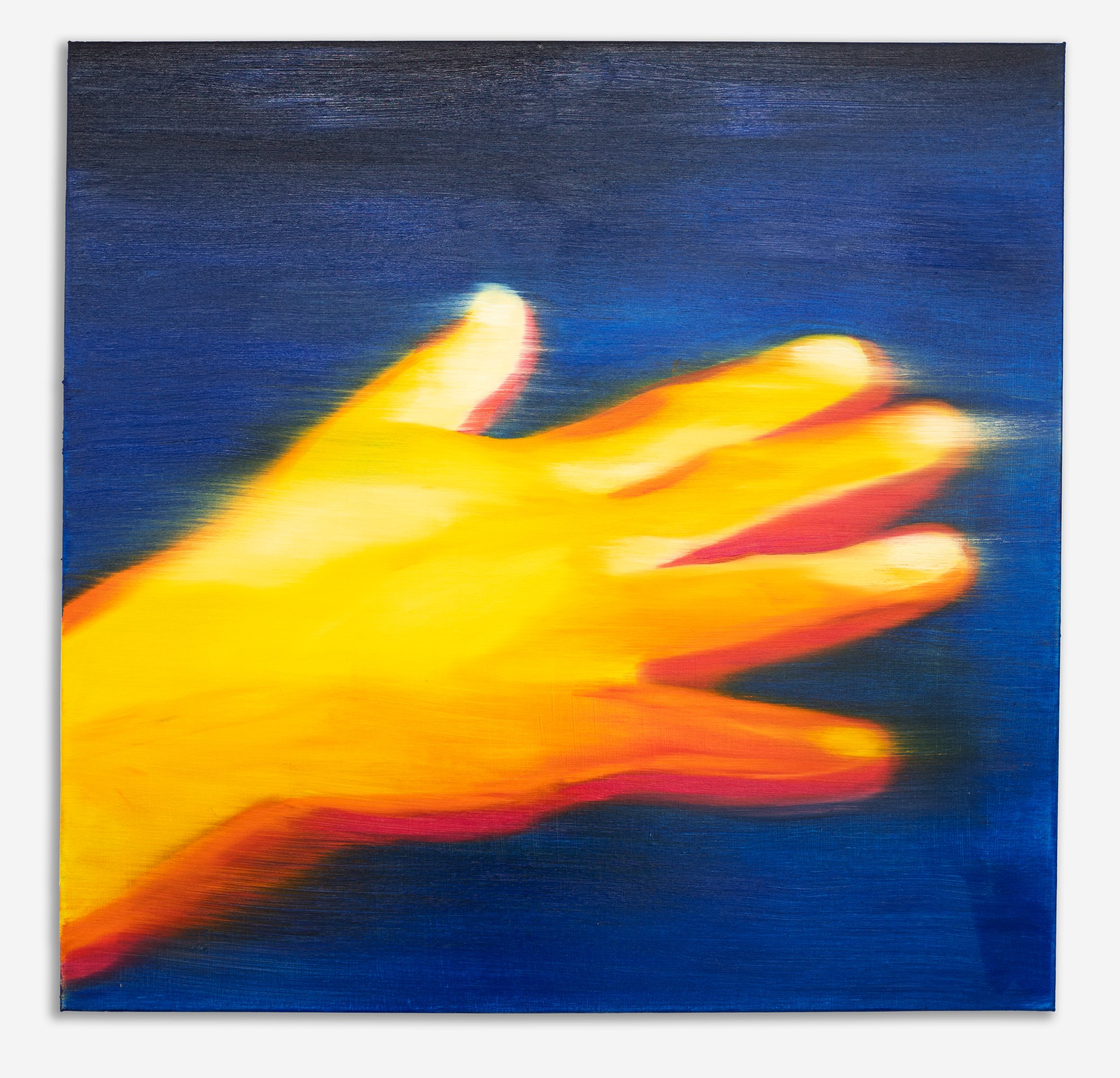
Touch is a square painting, 76 by 76 centimeters, oil on linen, and its format is deliberate. The square canvas eliminates the directional bias of the rectangular format, removing the implication of landscape or portrait and placing the viewer in front of an image that has no preferred orientation, an image that faces the viewer the way a hand faces the viewer when it is pressed against a surface, palm outward, fingers spread. The composition centers on a single hand rendered in the palette of thermal imaging: warm yellows and oranges at the palm and fingertips, where the blood vessels are closest to the surface and the skin temperature is highest, transitioning through reds to deep blues at the edges where the thermal field dissipates into the background. The background itself is a near-uniform deep blue, the color that a thermal camera assigns to surfaces at ambient temperature, the color of a surface that has not been touched, the color of the absence that the hand's presence interrupts. The edges of the hand are soft, blurred, indistinct, not because the painting lacks precision but because the thermal signature of a hand is inherently imprecise, the heat radiating outward from the skin in a gradient that has no sharp boundary, the way a voice carries in a room, diminishing with distance but without a wall where it simply stops. The blur is the painting's most important formal decision. It tells the viewer that this is not a hand being seen but a hand's heat being recorded, not an object being observed but an energy field being measured, not touch being depicted but touch being remembered in the only medium that can hold it, which is the medium of temperature, the medium of warmth, the medium of the body's involuntary confession that it was there.
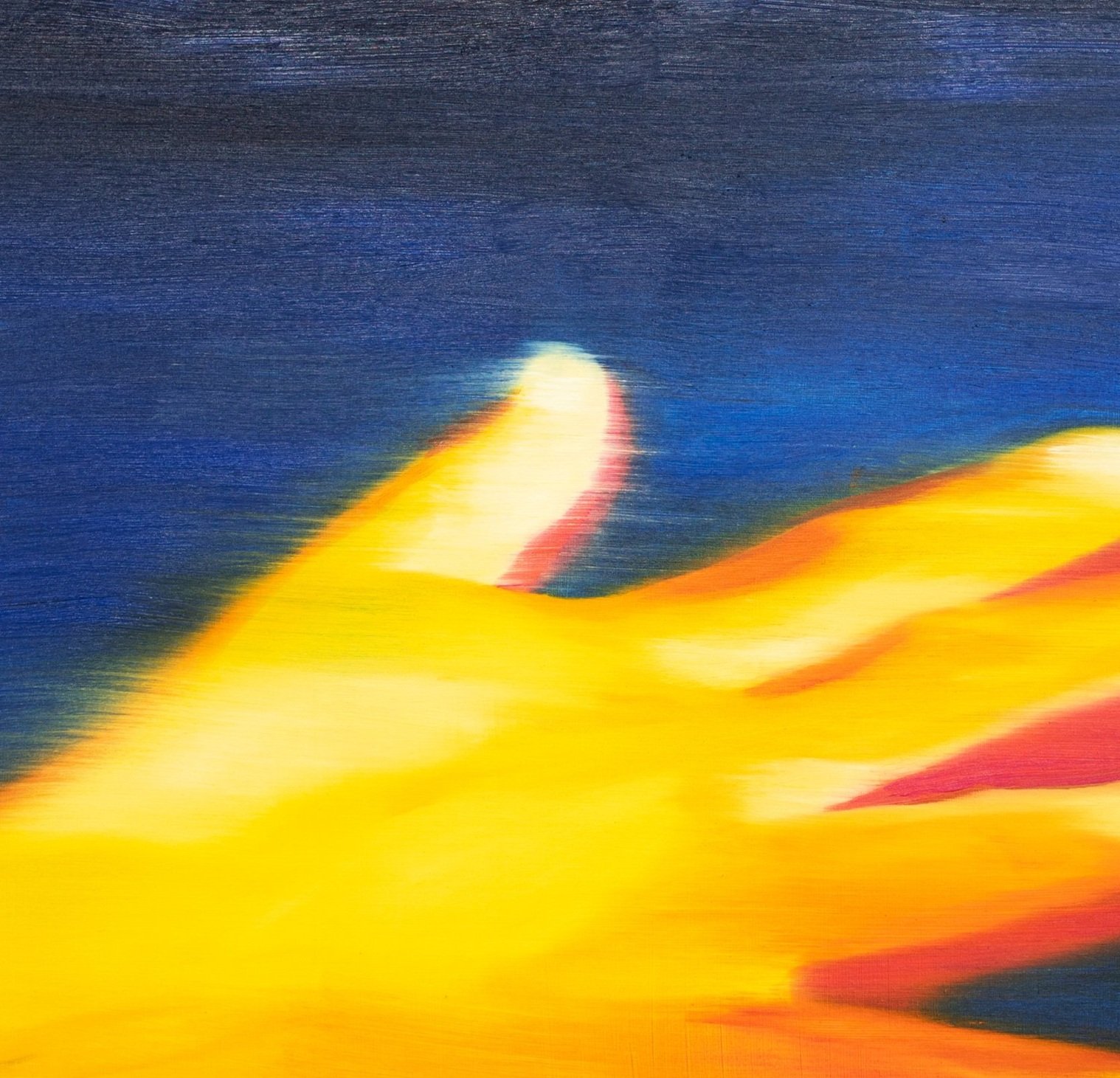
The paint handling reinforces the thermal logic. In the center of the palm, where the heat is most intense, the oil is applied in thin, smooth layers that produce a surface almost without texture, the way a thermal camera renders the hottest zones as the most legible, the most resolved, the most legible and the most present. Toward the edges of the hand and in the background, the paint becomes more granular, the brushwork more visible, the surface more resistant to the eye's desire for resolution, the way a thermal image degrades at its periphery where the temperature gradient flattens and the sensor's precision drops. The contrast between the smooth center and the rougher edges is not an aesthetic choice. It is a translation of the physics of thermal radiation into the physics of oil paint, where thin layers produce gloss and thick layers produce matte, where the smooth and the textured correspond to the clear and the unclear, the present and the receding, the touch that was and the touch that is fading. The linen substrate is visible in the background areas, its weave creating a grid of tiny interruptions that paradoxically recall the pixel grid of a digital thermal image, the way the camera resolves the continuous gradient of temperature into discrete measurements, each one a point of data in a field of data, each one a record of a specific temperature at a specific location at a specific time, the way a handprint in a cave is a record of a specific hand at a specific moment, pressing pigment against stone, leaving a trace that says: I was here, I was warm, I touched this surface and this surface remembers.
In the canyon of the Pinturas River in Patagonia, Argentina, there is a cave known as Cueva de las Manos, the Cave of Hands. The cave takes its name from the hundreds of handprints that cover its walls, stenciled in mineral pigments between approximately 7300 BCE and 700 CE by the ancestors of the Tehuelche people who inhabited the region for millennia before European contact. The handprints were made by placing a hand against the rock surface and blowing pigment over it through a hollow tube, probably a bone, creating a negative image in which the hand's silhouette appears as an absence of color against a field of sprayed pigment. The technique is simple, the materials are elemental, and the result is direct: a record of a specific hand, at a specific moment, pressing against a specific surface, leaving a trace that has survived for nine thousand years. The hands vary in size, indicating that both adults and children participated. Some are left hands, some are right, and their distribution across the cave walls suggests that the act of making the handprint was itself the event, not the decoration of the cave but the performance of presence, the assertion that a specific person with a specific hand was in this specific place at this specific time and wanted the stone to remember.
The connection to Tan Mu's Touch is not incidental. Tan Mu cites the Cueva de las Manos directly as a source for the painting, and the reference is not decorative or scholarly. It is structural. The handprints in the cave and the thermographic hand in the painting are the same gesture separated by nine thousand years: a hand pressing against a surface, leaving a record of its presence, and then withdrawing, leaving the surface to hold the trace. The cave hand leaves a negative image, the absence of pigment where the hand blocked the spray. The thermographic hand leaves a thermal image, the presence of heat where the hand radiated against the background. Both are records of touch. Both are records of a body that was warm and present and then withdrew. The difference is the medium. The cave hand uses mineral pigment and stone. The thermographic hand uses infrared radiation and digital processing. The impulse is the same: to leave a trace of presence, to make the surface remember the hand, to convert the ephemeral act of touching into a durable record that can outlast the body that made it. Tan Mu has described the handprints as "among the earliest traces of human presence" and as preserving "a moment of touch across thousands of years," and she identifies them as representing "a timeless human impulse to connect, to assert presence, and to be remembered." The thermographic image belongs to the same impulse, but it executes it with a technology that makes the touch visible by translating it into data, by converting warmth into color, by making the body's heat legible as information rather than as pigment.
A thermographic camera does not see the way the eye sees. The eye detects reflected light, photons bouncing off surfaces and entering the retina through the lens, where they are converted into electrochemical signals that the brain assembles into an image of the world. A thermographic camera detects emitted radiation, the infrared photons that every object with a temperature above absolute zero radiates continuously, the electromagnetic signature of molecular motion, the heat that every body generates and that propagates outward from the skin in waves that the eye cannot perceive but that the camera can translate into a visible spectrum. The translation is not neutral. It assigns specific colors to specific temperature ranges, usually mapping the warmest temperatures to white or yellow and the coolest to dark blue or black, producing an image in which the body appears as a heat source surrounded by a cooler environment, a field of warmth in a field of cold, a figure that is not a figure but a concentration of energy that the camera renders as a figure because that is how the human visual system prefers to organize information, as a thing against a ground, a presence against an absence, a hand against a wall. Tan Mu describes this process directly: "I chose a thermographic image because it translates bodily warmth into color through a technological lens. Each hue corresponds to a specific temperature, transforming a tactile sensation into visual information." The translation is the point. The thermographic camera does not capture touch. It captures the thermal residue of touch, the heat that the hand leaves on a surface when the hand has been removed, the warmth that persists for a few seconds after contact and then dissipates, the trace that says: something warm was here, and now it is gone, but the camera recorded the moment when the warmth was still present, and the recording is what remains.
Andreas Gursky's photograph 99 Cent, taken in 1999 and printed at a scale of approximately 2 by 3.5 meters, depicts the interior of a 99 Cents Only store in Los Angeles, its shelves packed with brightly colored products arranged in dense horizontal rows that fill the entire image from edge to edge. The photograph is a document of consumer abundance, a field of merchandise so dense and so uniformly organized that the individual products lose their identity and become units of color and pattern, a visual texture that Gursky amplifies through digital manipulation, extending shelves and duplicating rows to produce a density that exceeds what any actual store could achieve. The result is an image in which the human body is almost entirely absent, replaced by the products that bodies consume, the shelves that bodies stock, the aisles that bodies walk, the entire apparatus of commercial exchange rendered as a landscape in which the human figure has been edited out or reduced to a trace, a reflection in a glass surface, a presence that is inferred rather than seen. The work has been interpreted as a commentary on globalization, on the homogenization of consumer culture, on the reduction of human desire to a grid of identically priced objects. But it is also a work about the translation of warmth into data, of presence into pattern, of the living body into the system of exchange that surrounds it and gradually replaces it, so that the store becomes a body and the body becomes a customer and the customer becomes a data point in a transaction log that records what was purchased and when and for how much, but not who touched the product before placing it in the cart, not whose hand reached for the shelf and whose warmth briefly animated the plastic packaging before it was carried away and consumed and discarded and replaced by another unit in the same slot on the same shelf in the same row in the same store.
Gursky's image and Tan Mu's painting share a concern with what happens to the body when it is translated into information. In 99 Cent, the body disappears into the commercial system. In Touch, the body is present only as its thermal signature, only as the data that the infrared camera extracted from its surface, only as the color gradient that represents degrees of heat rather than degrees of presence. Danni Shen, in her 2024 studio visit with Tan Mu, observed that the paintings "serve as a kind of witness to human socio-technological histories," and Touch is a painting that witnesses the specific socio-technological history of a pandemic in which the body was reduced to a temperature reading at the entrance to every building, a number on a screen that determined whether the person carrying that body was allowed to enter or was turned away, a data point that replaced the handshake, the embrace, the casual touch that passes between people who are close enough to feel each other's warmth. Tan Mu has described this condition explicitly: "Touch was replaced by screens, and warmth was reduced to data." The thermographic hand is the image of that reduction. It is the hand as it appears when touch has been replaced by measurement, when presence has been replaced by data, when the warmth that one body radiates toward another is captured by a camera and displayed on a screen instead of being felt against the skin. The painting holds both registers at once: the warmth of the hand and the coldness of the technology that renders it visible, the ancient impulse to leave a trace and the modern apparatus that translates that trace into information, the handprint in the cave and the infrared image in the clinic, separated by nine thousand years of technology but united by the same gesture, the same surface, the same desire to be remembered.
The pandemic locked people in their homes and replaced their contact with screens, and the screens showed them data, and the data included their own temperatures, taken at the door, recorded at the desk, displayed on a monitor that glowed in the darkened lobby of every building that still admitted visitors during the months when the city was closed. The temperature was a proxy for danger. A body above 37.5 degrees Celsius was a body that might be carrying the virus, a body that might infect other bodies, a body that needed to be identified and separated from the bodies around it. The infrared camera that recorded the temperature was the same technology that produced the thermographic image that Tan Mu painted, and the painting holds both meanings simultaneously: the warmth of the hand as a sign of life and connection, and the warmth of the hand as a data point in a system of surveillance, a measurement that could be used to grant access or deny it, to allow a body into a space or to turn it away. The same image, the same gradient of color, the same translation of heat into visible information, could mean "I am alive and I am here" or it could mean "this body is a potential source of infection and must be monitored." The painting does not choose between these meanings. It holds them both, the way a handprint in a cave holds both the desire to connect and the fact of being alone, pressing a hand against stone in the dark, leaving pigment on rock, and then withdrawing, leaving the surface to hold what the hand gave it, which was nothing but warmth and pressure and the shape of five fingers spread against a wall that would remember them for nine thousand years after the hand that made them had turned to dust.