The Grid That Ate the Field: Tan Mu's Solar Farm and the Harvest of Light
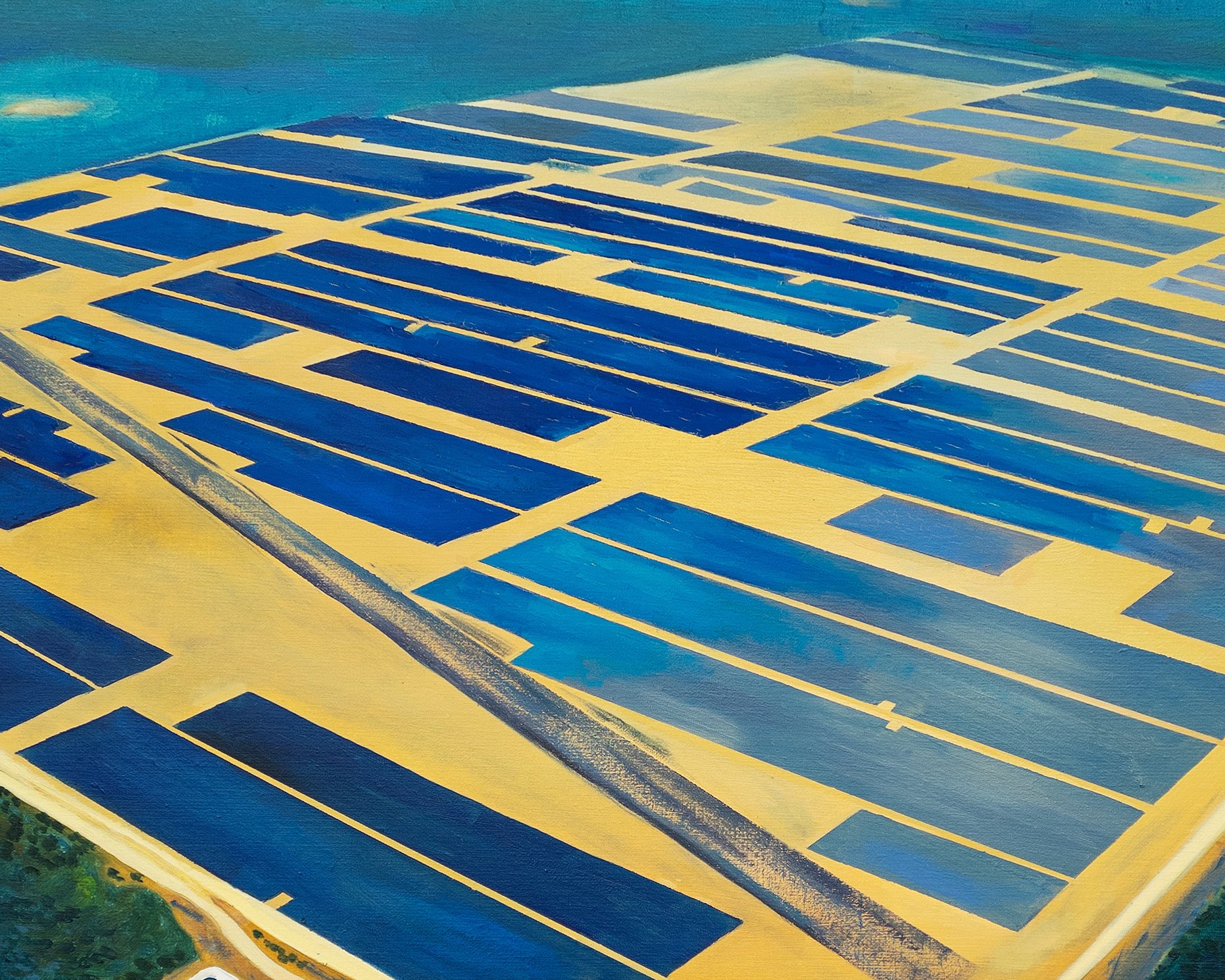
Close up, the surface of Solar Farm (2022) reads like a problem in paint handling. The panels that occupy the central register of this square canvas are rendered in a blue so dark it hovers between navy and black, their internal subdivisions traced in thin lines of pale grey that catch the light like the seams between photovoltaic cells. The surrounding land, visible at the composition's edges, is a muted green-gold, the color of grass bleached by late summer heat or by the desaturation that satellite imaging imposes on color. Where the panels meet the earth, the boundary is not a single clean edge but a zone of transition, the dark blue bleeding into the green in strokes that refuse to resolve into a sharp line. The linen weave shows through in several passages, particularly where the paint thins over the fields between panel rows. Up close, these fields are not flat. They carry the texture of the brush, the slight ridges where one stroke has been laid over another, and the subtle variation in hue that distinguishes a panel catching direct light from one angled away. At six inches from the canvas, the painting is about paint: about the difficulty of translating the regular geometry of an industrial surface into the irregular material of oil on woven linen, and about the way that difficulty becomes the subject of the work.
Pull back and the painting shifts. The square format, 76 by 76 centimeters, oil on linen, frames an aerial view of a solar farm: rows of photovoltaic panels arranged in a grid across what was once agricultural land. The panels occupy the center of the composition in an orderly, rectilinear formation, their uniformity broken only by the slight offset of row upon row receding toward the picture plane. The land around them, visible at the margins, carries the irregular shapes of fields, access roads, and tree lines. The contrast is immediate and structural. Inside the grid, the landscape has been converted into a surface that harvests energy. Outside the grid, the landscape remains what it was: soil, grass, the slow accretion of organic time. The painting holds both regimes in the same frame and asks what happens when one replaces the other.
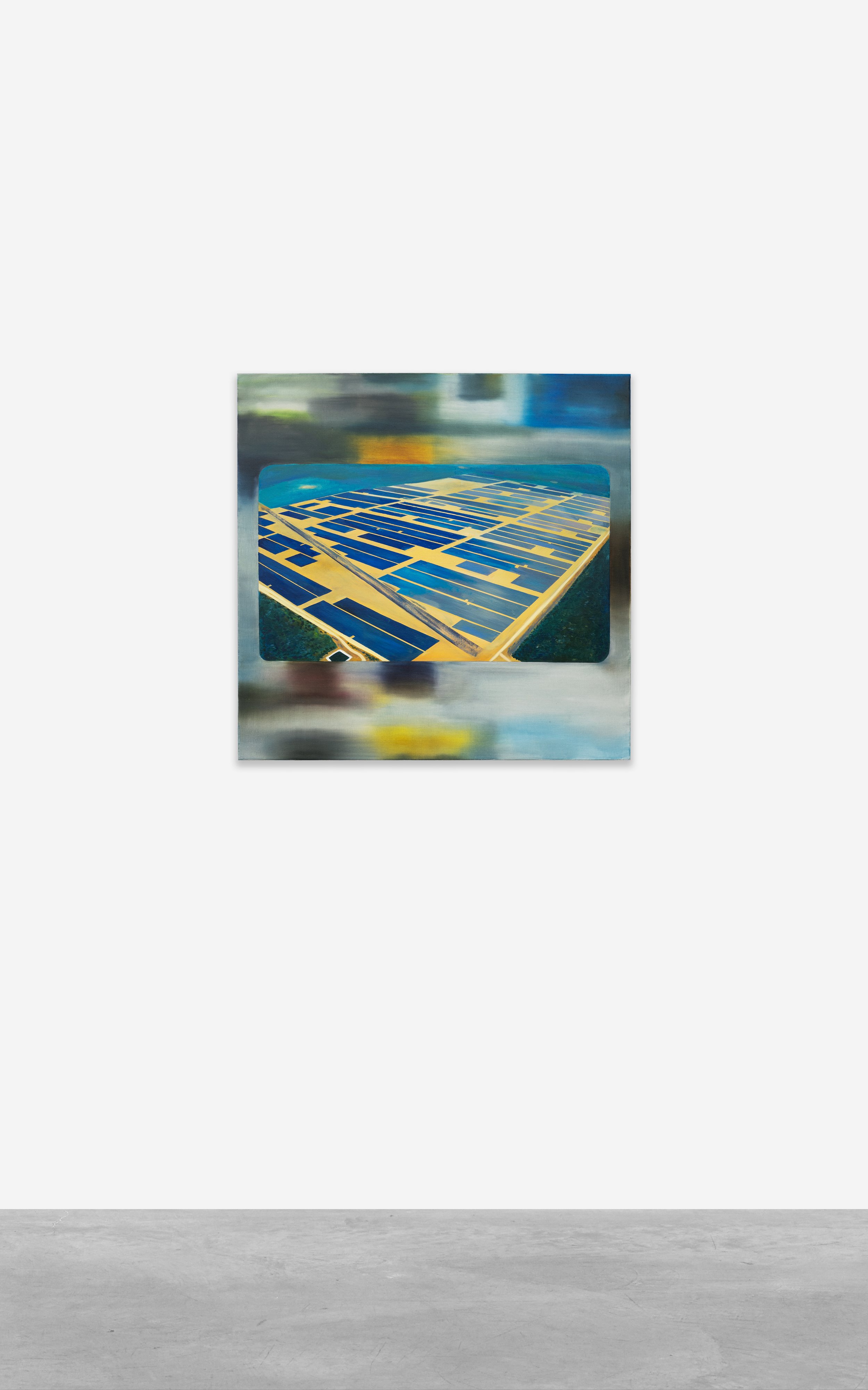
The background of the painting, visible as a soft blur behind the solar farm and bleeding into its edges, is not a conventional landscape feature. It is, as Tan Mu describes it, a screenshot from her phone, incorporated into the composition alongside blurred visuals from her photo gallery. This is a decisive formal choice. The source image for the painting is not a print, not a satellite photograph taken from a professional archive, not a view from an airplane window held in memory and transcribed later. It is a screen. The phone's camera captured the solar farm from above, and that captured image, already compressed and already framed by the device's aspect ratio, became the basis for the painting. The blur at the edges of the composition, the degraded resolution of imagery pulled from a photo gallery, these are artifacts of the digital capture and storage process, not of the landscape itself. By painting these artifacts rather than erasing them, Tan Mu insists that the experience of seeing the solar farm was already mediated by the screen before it became mediated by the brush. The phone came first. The painting came second. And the order matters.
Tan Mu's own description of the work foregrounds this mediation. "Today," she writes, "people consume news on politics, environmental issues, and technological progress with a swipe, engaging with the world remotely. This shift in information consumption is mirrored in the painting: the solar farm appears as an archived image, while blurred visuals from my photo gallery dissolve into the background, symbolizing the overwhelming digital landscape and my reflection on technology's role in shaping perception." The key phrase is "engaging with the world remotely." The solar farm in the painting is not a farm you can walk to. It is a farm you have already seen through a screen, a farm that exists for most viewers only as an image, archived and scrollable, indistinguishable from the other images that fill a phone's photo gallery. The painting does not restore the farm to some pre-digital immediacy. It paints the farm in its mediated state, with the blur and the compression and the residual artifacts of the screen intact, because that mediation is part of what the painting is about.
Robert Smithson's Spiral Jetty (1970) occupies a stretch of the Great Salt Lake's Rozel Point, a coil of black basalt rocks and earth extending 1,500 feet into the red water. Smithson chose the site for its industrial desolation: abandoned oil rigs, rusted machinery, the residue of a brief extraction boom that left the shoreline scarred and discolored. The jetty's spiral form is derived from the site's own geology, the salt crystals that grow in crystalline spirals along the shore, and from the entropic processes that Smithson identified as the engine of all landscape: erosion, dissolution, the tendency of organized systems toward disorder. The work was constructed in April 1970 by a crew operating heavy machinery. It emerged from the lake's water and disappeared back into it within a few years, submerged by rising lake levels, only to reappear decades later when the water receded. Its visibility has always depended on conditions outside the artist's control: the salt content of the water, the depth of the lake, the rate of evaporation. The jetty is a work of art whose medium is entropy itself.
The structural parallel to Solar Farm is the relationship between geometric order and the landscape that receives it. Smithson imposed a spiral on the lake shore. Tan Mu imposes a grid on the Florida terrain. Both interventions are geometric: one circular, one rectilinear. Both use industrial materials: Smithson's basalt rocks and mud, Tan Mu's photovoltaic panels and aluminum frames. Both replace what was there, a section of lake shore, a stretch of agricultural field, with a designed form that follows a logic external to the site. And both acknowledge that the intervention is subject to forces that exceed it. The spiral jetty erodes under salt water and re-emerges when the lake level drops. The solar farm absorbs sunlight and converts it to electricity, but the panels degrade under ultraviolet exposure, their efficiency declining by a fraction of a percent each year, their surfaces accumulating dust and pollen that must be washed off or allowed to reduce output. Neither the jetty nor the farm is permanent. Both are temporary installations that transform a landscape while they last and leave their mark on it after they are gone. The difference is that Smithson's work was conceived as art from the beginning, while the solar farm was conceived as infrastructure. Tan Mu's painting asks whether that distinction still holds.
The aerial perspective of Solar Farm is inseparable from its subject. A solar farm seen from ground level is a wall of panels, dark and reflective, blocking the view of whatever lies beyond. From above, the farm becomes a pattern. The individual panels lose their specificity and merge into rows, and the rows merge into a grid, and the grid becomes a single mark on the landscape, legible as a unit of infrastructure rather than as an assemblage of individual objects. This is how satellite imagery renders the earth: not as a place where people walk and live, but as a surface organized by patterns. Roads are lines. Fields are polygons. Solar farms are dark rectangles. The aerial view transforms the farm from an industrial installation into a visual sign, and it is this transformation that the painting enacts. Tan Mu has described how she encounters these farms in Florida, "whether driving on highways or flying near airports," where "vast fields of panels stretching across the landscape" become visible from the air. The elevated viewpoint is not an artistic choice imposed on the subject. It is the viewpoint from which solar farms are most intelligible, the viewpoint that makes them recognizable as what they are. The grid only reads as a grid from above.
Tan Mu's description of solar panels as "symbols of capital, infrastructure, and humanity's intervention in nature" locates the work at the intersection of economics and landscape. She continues: "Their presence marks a significant transition in how land is used. Historically, land was cultivated primarily for food production. Today, large areas are repurposed to host solar panels that harvest energy instead." The shift from agriculture to energy production is not a metaphor. It is a material transformation of the ground itself. The same soil that once grew crops now supports aluminum frames and silicon wafers. The same sunlight that once drove photosynthesis now drives the photovoltaic effect. The painting compresses this shift into a single frame: the grid inside, the fields outside, and the screen blur that overlays both as a reminder that most encounters with this landscape are already digital, already compressed, already scrolled past.
The painting's color palette enforces this compression. The dark blue-black of the panels reads as an absence, a gap in the landscape's color register. The green-gold of the surrounding fields, muted and desaturated, reads as a memory of color, as though the landscape had already been processed through a camera that reduces its chromatic range. The blur at the edges, the remnants of a phone's photo gallery, reads as digital residue, the visual equivalent of background noise in a data stream. Together, these three registers, the industrial grid, the agricultural margin, and the digital overlay, compose a landscape that is no longer simply physical. It is a landscape that has already been seen, captured, compressed, and stored before the painter ever begins to work. The painting's subject is not the solar farm alone. It is the solar farm as it appears through the screen that has already mediated it.
Andreas Gursky's Rhein II (1999) is a photograph of the Rhine near Dusseldorf, reduced to a narrow band of green grass, grey water, and pale sky, running in horizontal stripes across a wide horizontal frame. The image appears to be a straightforward depiction of the river, but it is not. Gursky removed a factory building, a pedestrian walkway, and other signs of human presence from the original photograph using digital manipulation. The river in the final print is a cleaned-up version of the real river, an idealized landscape that never existed in the form shown. The manipulation is invisible in the print. The water flows, the grass grows, the sky stretches. Only the documentation of Gursky's process reveals that the image is a construction. The river is the subject, but the real subject is the act of removing what does not fit the composition. Gursky's Rhine is a landscape that has been edited into coherence, a natural scene improved by the elimination of its most natural features: the human buildings and paths that line every real river in the industrial Rhineland.
Tan Mu's Solar Farm performs the inverse operation. Rather than removing the digital artifacts from her source image, she paints them in. Rather than cleaning up the landscape into an idealized version of itself, she preserves the blur and the compression and the gallery residue that attest to the image's passage through a phone. Where Gursky subtracts the factory to produce a more convincing river, Tan Mu adds the screenshot to produce a more honest solar farm. The factory was really there, and the screenshot was really there, and the decision to paint one rather than subtract the other is a decision about what the viewer is allowed to see. Gursky's photograph presents a landscape that pretends to be unmediated. Tan Mu's painting presents a landscape that declares its mediation as part of its content. The blur at the edges of Solar Farm is the equivalent of leaving the factory in the frame: it is the element that refuses to let the viewer forget that what they are looking at has already passed through an apparatus before it reached the canvas.
Nick Koenigsknecht, writing in the BEK Forum catalog (2025), observes that Tan Mu's paintings "function more as self-portraits, rather than depictions of external, scientific milestones." He frames the work as a record of the artist's own looking: "While observing technology, are we not looking at ourselves?" This reading sharpens when applied to Solar Farm. The painting does not depict a solar farm as a neutral landscape feature. It depicts a solar farm as Tan Mu encountered it: through a screen, on a phone, while scrolling through a gallery of images that accumulate without hierarchy or narrative. The screenshot and the photo gallery blur are traces of the artist's own viewing apparatus, and by painting them into the composition, she makes the apparatus visible. The painting becomes a portrait not of the solar farm but of the act of seeing the solar farm, an act that is now always already mediated by the device through which the image was captured. The self-portrait Koenigsknecht identifies is not a portrait of the artist's face. It is a portrait of the artist's screen.
The painting's second life in Tan Mu's practice connects it to Memory (2019), an earlier work that also features solar panels on the rooftop of a data center. The connection is not incidental. In Memory, the solar panels serve as the roof of a building that stores data, and the painting's subject is the relationship between data storage and personal memory, between the external archive and the internal one that the artist feared she had lost after a diving accident. In Solar Farm, the panels have left the rooftop and colonized the ground. They have moved from the periphery of the data center, where they supply the electricity that powers the servers, to the center of the landscape itself, where they replace the fields that once grew crops. The trajectory from rooftop to field is the trajectory from infrastructure that supports something else to infrastructure that becomes the thing itself. The solar panels are no longer serving a data center. They are the landscape. And the landscape, seen through a phone screen, is already data.
The grid of photovoltaic panels that fills the center of the painting is rendered with a precision that contradicts the blur at the edges. The panels are individual rectangles, dark and reflective, arranged in neat rows that recede toward the horizon. Each panel is painted with enough differentiation to register as a separate unit, catching light at slightly different angles, but not so much differentiation that it reads as a portrait of a specific panel. They are units in a system, like cells in a spreadsheet or pixels in an image. This is how the aerial view renders infrastructure: not as individual objects with character and wear, but as units in a pattern, distinguishable from their neighbors only by their position in the grid. The painting's precision in the center and its blur at the edges reproduce the experience of looking at a satellite image on a phone. The center of the screen is sharp. The edges are cropped, compressed, or covered by the user interface. The phone frame is not a neutral window. It is a device that selects, crops, and degrades. By painting this degradation rather than correcting it, Tan Mu makes the frame part of the picture.
Smithson described Spiral Jetty as a work that exists in a state of "continuous present," always being built and always eroding, always visible and always submerged. Solar farms exist in a similar condition. They are built to last twenty-five to thirty years, after which the panels are decommissioned, the frames are disassembled, and the land may or may not be returned to agriculture. In the interim, they produce electricity. They convert light into current, and the current flows into the grid, and the grid distributes it to cities and data centers and phone screens, where it powers the devices that capture images of solar farms and store them in photo galleries. The loop is closed. The sunlight that the panels harvest becomes the electricity that powers the phone that captures the image that becomes the painting that depicts the panels harvesting the sunlight. Solar Farm is not outside this loop. It is inside it. The painting is made with oil paint on linen, materials that predate the photovoltaic cell by centuries, but its source image is a screenshot taken on a device charged by electricity that may have passed through panels like the ones it depicts. The painting does not transcend its subject. It is caught in the same circuit.
The fields that surround the solar farm in the painting are not empty. They carry the green-gold of grass, the muted tones of land that has been cleared and leveled but not yet entirely surrendered to the grid. In the upper portion of the composition, where the panels give way to open terrain, the brushwork loosens. The strokes become broader, the paint thinner, the color less saturated. This is where the screenshot blur begins to dissolve the image, where the photo gallery residue overlays the landscape with the soft focus of compressed data. The transition from the sharp grid to the blurred margin is not a gradual fade. It is a break in the image's resolution, the line where the phone's camera gave up its precision and the compression algorithm took over. Painting this transition, rather than smoothing it out, is Tan Mu's most radical decision in the work. She could have painted the entire landscape in uniform focus, giving the viewer a seamless aerial view. Instead, she painted the seam. She painted the place where the image fails, where the data runs thin, where the screen gives way to its own limitations. The blurred background is not a stylistic flourish. It is a record of the medium's failure to capture what the eye can see, and it is painted with the same care as the panels in the foreground.
What remains after the fields have been gridded and the screen has been painted is a landscape that belongs to two systems at once. It is a physical place where sunlight hits silicon and generates current, and it is a digital image where a phone captured a view and stored it in a gallery of other images, most of which have nothing to do with solar farms or agriculture or energy policy. The painting occupies both systems without resolving the tension between them. The grid that ate the field is also the grid that makes the field visible to anyone with a satellite mapping app and a few seconds to scroll. The screen that blurs the edges is also the screen that preserves the center in high resolution. The painting does not choose between the farm and the phone. It holds them together and lets the contradiction stand. A field that grows electricity is still a field. A landscape that only exists as a screenshot is still a landscape. The harvest has changed, but the sunlight is the same.