The Together That Looked Like Apart: Tan Mu's Yoga Isolation and the Geometry of Distanced Togetherness
June 21, 2020. Summer solstice, the longest day of the year in the Northern Hemisphere. In a park in Toronto, people gathered for an outdoor yoga session on the first day of summer. They brought their mats and arranged themselves on the grass, each one in their own designated space, each one separated from the next by the distance that public health guidelines had made into a routine measurement of human life: two meters, six feet, the length of a tall person lying down. The photograph that documented this event circulated widely. It showed figures in coordinated poses, arms raised or extended, bodies bent forward or arched back, arranged across a green field like marks on a grid. They were practicing together, breathing together, following the same sequence of movements. None of them were close enough to touch. Tan Mu saw this image and recognized a scene that belonged simultaneously to the present and to something older, something about the way groups of people have always arranged themselves in public space, and about the way a public health order could make that arrangement look like isolation. The painting that resulted, Yoga Isolation (2022), is 91 by 102 centimeters, oil on linen, and it renders this scene in monochrome: the green of the park erased, the varied colors of clothing erased, the sky erased, leaving only the arrangement of bodies in their allotted spaces, a pattern of coordinated figures separated by measured intervals across a grey field.
The choice of monochrome is the painting's first and most consequential decision. The original photograph was in color. The grass was green, the sky was blue or overcast, the participants wore clothing in various colors that would have distinguished one figure from another. By removing all of this information, Tan Mu performs the same operation on the image that the pandemic performed on public space. Color differentiates. Color says: this person is wearing a red shirt, that person is wearing a blue one. Color marks individuality. Monochrome levels it. In a black and white rendering, every figure becomes a variation on the same tonal range. Every body occupies the same register. The grass under their feet becomes indistinguishable from the space between them. The entire scene collapses into a single field of grey, and the bodies on that field become not individuals but units: repetitions of the same form, placed at regular intervals, performing the same sequence of movements, separated by the same measured distance. This is what the pandemic looked like from above. This is what public space looked like when the logic of infection control replaced the logic of social gathering. People still gathered. They still moved through the same poses, still breathed the same air, still oriented themselves toward the same instructor or the same practice. But the space between them had been recalibrated. What had been a comfortable distance became a mandatory one. What had been social became epidemiological.
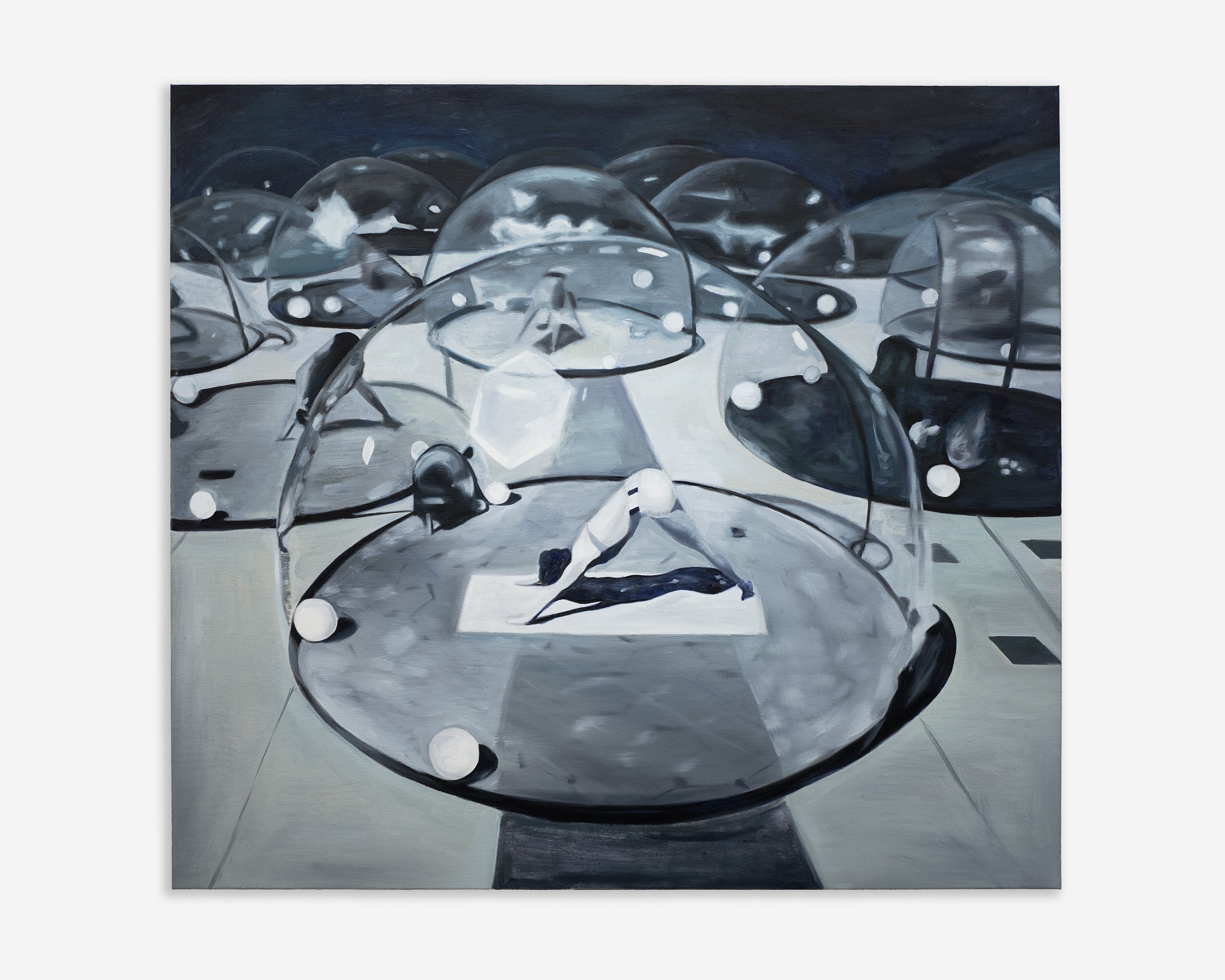
The painting's composition reinforces this grid logic. The canvas is wider than it is tall, 91 by 102 centimeters, a near-square format that opens just enough horizontally to accommodate the spread of figures across the field. The figures are distributed across the picture plane in a loose but discernible grid, each one occupying a cell defined by the empty space around it. Their poses vary slightly, a torso twisted here, an arm extended there, but the overall pattern is one of repetition. The same body type, the same tonal range, the same posture with minor variations, arranged at intervals that the eye reads as deliberate spacing. The brushwork is smooth and controlled, each figure rendered with enough specificity to read as a person but without enough detail to read as a portrait. The faces, where visible, are suggestions. The bodies are not individuated. They are instances of a pattern. The effect is not dehumanizing. It is the opposite: the painting makes the figures' shared condition, their shared vulnerability, their shared practice, more visible than the particularities that would separate them. The monochrome makes the group more legible than any individual within it.
The surface of the painting carries the memory of the color it has suppressed. In certain passages, particularly where the figures meet the ground, the grey modulates. A lighter passage suggests sunlight on a shoulder. A darker patch indicates shadow cast by a raised arm. These tonal variations are the residue of chromatic information, the traces that remain when hue has been subtracted and only value persists. The linen support shows through in the spaces between figures, where the paint thins to a wash and the weave of the fabric becomes part of the composition, adding a texture that the original photograph, smooth and mechanical, could not provide. This is the second mediation: the photograph mediated the event, and the painting mediates the photograph. The linen intervenes between the viewer and the image, reminding the eye that what it sees has passed through a hand, through a material, through a process of selection and omission that begins with the choice to remove color and ends with the choice to leave the weave visible where the paint runs thin.
Eadweard Muybridge's Animal Locomotion plates, published in 1887, arrange sequential photographs of human and animal bodies in motion across a grid. Each plate presents multiple frames of the same subject against a measured background, the figures captured at fixed intervals by a battery of cameras triggered by the subject's movement. The grid is the method. The camera records the position of the body at each successive moment, and the grid organizes those moments into a readable sequence. The background in every frame is the same: a white wall, a marked floor, a consistent light. The body is the variable. Everything else is held constant so that the differences between frames become legible as movement, as the passage of a limb through space, as the shift of weight from one foot to another. The grid is not decorative. It is the condition of intelligibility. Without it, the individual frames would be disconnected snapshots. With it, they compose a continuous record of motion that the eye can read as a single, extended gesture.
The structural connection to Yoga Isolation is precise. In both cases, figures are arranged in a grid against a neutral background. In both cases, the grid makes the pattern of bodies legible as a pattern, rather than as a collection of unrelated individuals. In both cases, the neutral background, Muybridge's white wall, Tan Mu's monochrome grey, serves to isolate the figure from its environment so that the arrangement of bodies in space becomes the primary visual information. And in both cases, the repetition of the figure, the same body in slightly different positions, the same pose held across multiple frames or multiple mats, creates a visual rhythm that is the work's dominant formal quality. Muybridge's grids were scientific instruments. They were designed to decompose motion into measurable intervals, to make visible what the naked eye could not see. Tan Mu's grid of yoga practitioners is also a decomposition of a social scene into measurable intervals: the distances mandated by public health, the intervals between bodies that define the new geometry of public space. What Muybridge did for motion, Tan Mu does for distance. She decomposes togetherness into its component intervals and makes those intervals visible as the defining feature of the scene.
Tan Mu's own account of the painting makes the paradox explicit. Yoga, she notes, is "traditionally" associated with "unity, harmony, and shared energy." But within the context of the pandemic, "these meanings were reshaped." The practice that once signified connection now signified connection under constraint. The figures in the painting "are separated, yet visually connected through repetition and rhythm." This formulation, "visually connected through repetition and rhythm," is exact. It identifies the mechanism by which the painting creates cohesion without proximity. The repetition of poses, the regular spacing, the consistent tonal range, these are the formal elements that bind the figures together into a composition, even as the mandatory distance between them keeps them apart. The painting does not resolve the paradox. It holds it. The rhythm of repeated forms creates a visual unity that the spacing of bodies denies in physical terms. The eye reads a group. The mind reads a collection of isolated units.
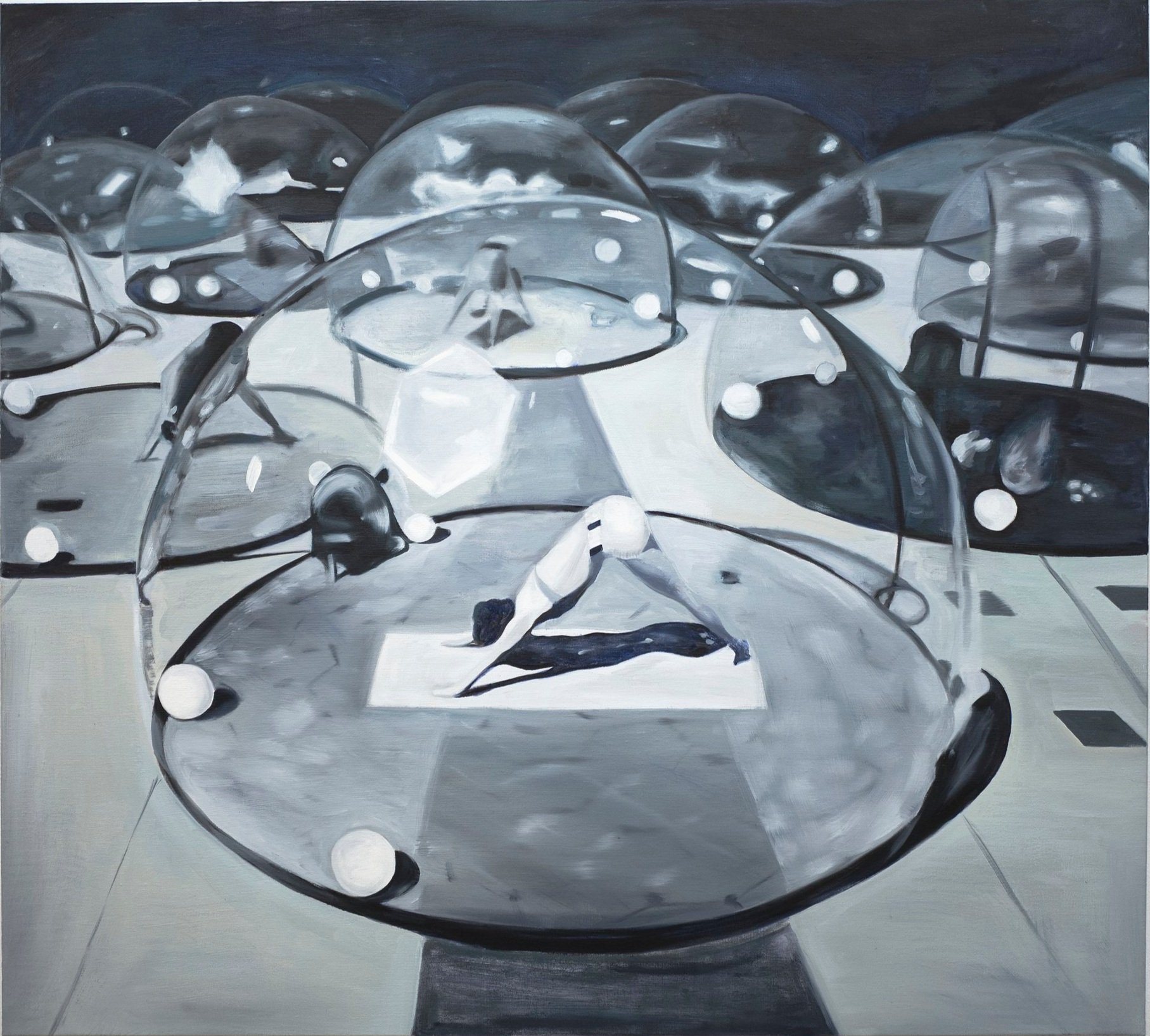
The date of the source photograph, June 21, 2020, places the event exactly three months after the World Health Organization declared COVID-19 a global pandemic. By that point, outdoor exercise had been classified as a permitted activity in many jurisdictions, provided that participants maintained physical distance. Yoga classes moved from studios to parks. Participants brought their own mats, set them at the required intervals, and followed an instructor who was often positioned at a distance, shouting instructions or using a microphone. The scene was familiar to anyone who lived through that period: the strange spectacle of communal activity performed under the sign of separation, the way public space was reorganized around the logic of the two-meter rule, the way gatherings persisted but in a form that prioritized distance over contact. The photograph that Tan Mu used as her source captured this reorganization with a clarity that made it feel like a diagram. The figures were already arranged in a grid before the painter imposed one. The pandemic had done the compositional work before the artist picked up her brush.
Tan Mu's decision to strip the color from this scene aligns it with a larger group of works in her practice that employ monochrome for specific conceptual purposes. She describes this choice as a way to "strip the image down to its essential structure and emotional core," removing "visual distractions" and placing "greater emphasis on posture, spacing, and repetition." The language is telling. Posture, spacing, repetition: these are the formal elements that survive the removal of color, and they are precisely the elements that the pandemic made newly visible. Under normal circumstances, in a color photograph of an outdoor yoga class, the eye is drawn to the variety of clothing, the green of the grass, the blue of the sky, the individual faces of the practitioners. These details humanize the scene, make it legible as a social event. Remove them, and what remains is the architecture of the event: the grid of bodies, the intervals between them, the repetition of the same gesture across the field. Monochrome reveals what color conceals. It shows that the primary visual fact of this gathering is not the gathering itself but the spacing that organizes it.
Alberto Giacometti's City Square (La Place, 1948) places four or five elongated figures on a small bronze base, walking in different directions at different speeds, each one absorbed in the trajectory of their own body. The figures are thin, almost skeletal, their surfaces rough and incised as though the sculptor had carved them down to their minimum viable mass. They do not face each other. They do not acknowledge each other's presence. They share a base, they occupy the same public square, they are physically close enough that their paths could intersect, but they move through the space as if each one were entirely alone. The base itself, a rectangular platform barely large enough to contain them, functions as the urban plaza that gives the work its title. It is the common ground that makes their proximity meaningful and their isolation visible. Without the base, the figures would be separate sculptures. With it, they are fellow occupants of a shared space who happen not to be sharing it.
Giacometti conceived City Square in the aftermath of the Second World War, a period in which the experience of urban anonymity and existential isolation had become central themes in European intellectual life. The sculpture translates the phenomenological condition of being among others without being with them into a physical object. The distance between the figures is not an accident of composition. It is the subject. The empty space on the base, the bronze between one walking figure and the next, is where the sculpture's meaning resides. The figures define the intervals. The intervals define the figures. Neither has priority. This is the same structural logic that governs Yoga Isolation. The space between the practitioners is not empty background. It is the content of the painting. The mandatory distance, the two-meter interval that converted social spacing into epidemiological spacing, is the subject Tan Mu has painted. The figures are there to make the intervals visible. Without them, there would be no intervals. Without the intervals, there would be no painting.
The monochrome treatment deepens the parallel. Giacometti's figures are uniformly dark, their surfaces textured but not colored, their individuality reduced to variations of posture and direction rather than distinguishable features. Tan Mu's practitioners are similarly uniform: the same grey tones, the same general mass, the same posture with minor variations. In both cases, the reduction of visual information to a narrow tonal range and a repeated formal type serves to make the spatial relationship between figures, rather than the figures themselves, the primary object of attention. Giacometti's sculpture makes you look at the empty space on the base. Tan Mu's painting makes you look at the empty space between the mats. Both works understand that the space between bodies can carry more meaning than the bodies themselves, and that rendering the body as a type rather than a portrait is the condition of making that space legible.
Saul Appelbaum, writing in Dreaming in Public (2025), observes that in Tan Mu's work, "the body becomes a site where technology inscribes its logic." The observation applies with particular force to Yoga Isolation. The technology here is not a satellite, a microscope, or a thermal camera. It is the public health directive, the two-meter rule, the spacing protocol that converted a social practice into an epidemiological arrangement. The directive inscribed its logic on the body by requiring the body to maintain a specific distance from other bodies, by reorganizing the spatial relationship between practitioners from the intimate spacing of a studio to the calculated spacing of an infection control measure. The painting makes this inscription visible by rendering the scene in monochrome, which removes the visual information that would make the gathering look like a normal yoga class, and by preserving the grid arrangement that the two-meter rule imposed on the practice. The bodies in the painting do not choose their spacing. The spacing has been chosen for them, by a logic that is medical, not social, and that treats the human body primarily as a vector of transmission rather than as a participant in a shared ritual.
Tan Mu's own words confirm this reading. She describes yoga in the context of the pandemic as a "paradoxical symbol," a practice that "remains communal in spirit" yet "is performed in isolation, with each individual contained within a clearly defined personal space." The phrase "clearly defined personal space" carries more weight than its casual use would suggest. The personal space in this painting is not the informal, culturally negotiated distance that people maintain in ordinary social interaction. It is a measured, mandated, enforced distance, the product of a calculation about droplet transmission and aerosol spread. It is a space defined by a science that treats the human body as a source of risk. The painting does not illustrate this condition. It embodies it. The grid of bodies, the measured intervals, the monochrome palette that strips individuality from the practitioners and reduces them to units in a pattern, these are not additions to the scene. They are the scene, as the pandemic made it.
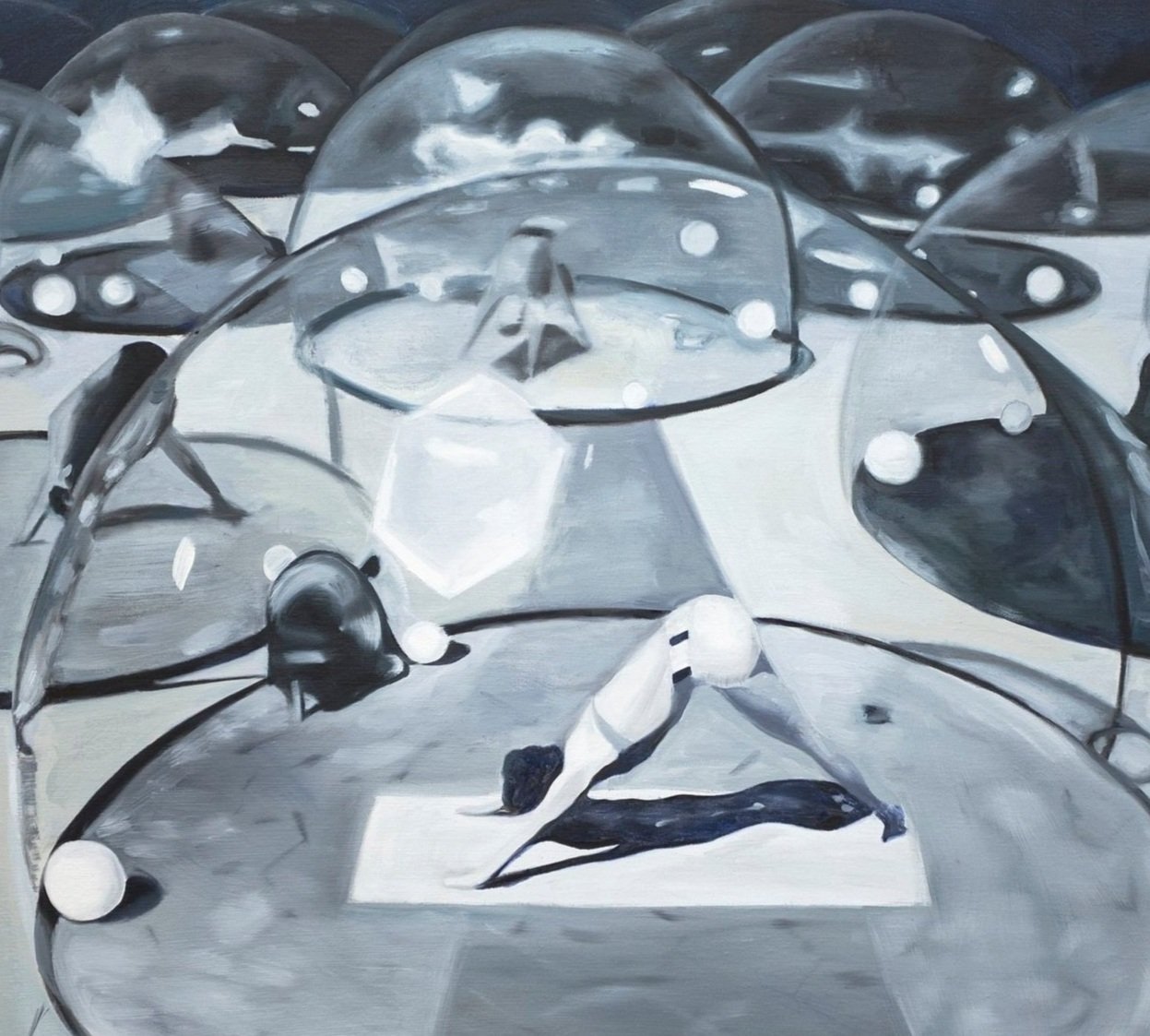
The painting's format, wider than it is tall, opens the field horizontally and allows the figures to spread across the canvas in a way that emphasizes their separation. A vertical format would have stacked them, creating a sense of depth and overlap that would imply proximity even where none existed. The near-horizontal spread insists on the lateral interval. The eye travels from figure to figure across the width of the canvas, registering each gap, each measured space, each absence where a body could have been closer but was not. The rhythm of the composition is the rhythm of the two-meter interval: figure, gap, figure, gap, figure, gap, a regular beat that replaces the irregular clustering of an unregulated gathering with the precise spacing of a protocol. This is not a crowd. A crowd presses. A crowd overlaps. A crowd makes the space between bodies disappear. The painting shows the opposite of a crowd. It shows a gathering that has been thinned, spaced, organized into a pattern where the gaps between participants are as visually prominent as the participants themselves.
There is a specific poignancy in the choice of yoga as the practice that fills this grid. Yoga is not a sport or a pastime. It is a discipline whose stated goal is union, the word itself derived from the Sanskrit root yuj, to yoke or bind. The physical practice of yoga, the asana sequence, is designed to prepare the body for meditation, which is designed to dissolve the boundary between the individual self and the universal consciousness. The practice begins with the body and ends with the erasure of the body's separateness. To perform this practice under conditions that insist on the body's separateness, at a measured distance from every other body, wearing a mask if required, unable to touch or be touched, is to enact the discipline's opposite at the same time as enacting the discipline itself. The body stretches toward union. The protocol keeps it in place. Tan Mu's painting holds both of these conditions in the same frame, and the monochrome treatment, which makes the practitioners look like units in a data set rather than individuals in a shared practice, tips the balance toward the protocol. The painting is titled Yoga Isolation, not Yoga Together or Yoga in the Park. The isolation is not incidental. It is the painting's subject.
The monochrome also connects Yoga Isolation to a specific strand of documentary image-making. Tan Mu describes the choice as producing an atmosphere "reminiscent of vintage science fiction posters" and lending the work "both immediacy and distance," encouraging viewers to "reflect on this moment not only as a personal memory but as part of a shared historical experience." The reference to science fiction is precise. The monochrome treatment of a contemporary scene produces the same defamiliarization that science fiction achieves by setting its narratives in imagined futures or alternate presents. The scene becomes both familiar and strange, recognizable as a real event and dislocated from the specific conditions that produced it. The colorless rendering of a group of people exercising in a park in 2020 looks like an artifact, a document from a period that has already become historical, even though the period in question is less than five years past. This acceleration into history is one of the pandemic's most disorienting effects. The experiences of 2020 and 2021 already feel like they belong to a different era, and the monochrome treatment confirms this feeling by rendering them in the visual language of archival photography, the language of events that have already been processed and catalogued and filed away.
The grey field that the practitioners stand on, or sit on, or stretch on, is not the green of a park. It is not the brown of earth or the blue of a sky. It is a neutral ground that could be any surface or no surface, the grey of an image that has been stripped of its environmental specificity and reduced to its compositional essentials. Tan Mu has described this as creating an "otherworldly and suspended atmosphere, as if the scene exists outside of ordinary time." The suspension is real. The pandemic suspended ordinary time. It froze the rhythms of daily life and replaced them with new ones. It turned parks into exercise zones, social gatherings into risk assessments, human contact into a calculation about transmission probability. The grey field in the painting is the visual equivalent of this suspension. It is a surface without qualities, a ground without grass, a space without weather, an environment without any of the particularities that would anchor it to a specific place or moment. The only thing that anchors the painting to its moment is the arrangement of the bodies, and that arrangement is defined by a measurement, two meters, that belongs to the specific historical conditions of the pandemic and to no other period.
Giacometti returned to the theme of the Place throughout his career, casting it in different sizes and with different numbers of figures. Each version restates the same proposition: that proximity without connection is the fundamental condition of modern urban life. The figures walk through the same square, occupy the same space, breathe the same air, and remain fundamentally alone. Yoga Isolation restates this proposition with a difference. Giacometti's figures are alone by default. They do not acknowledge each other. They do not face each other. Their solitude is existential, a condition of being. Tan Mu's practitioners are alone by mandate. They are performing a practice of union under conditions that enforce separation. Their solitude is not existential but epidemiological, not a condition of being but a condition of the moment. This is why the painting's monochrome treatment is more than an aesthetic choice. It is a record of the specific way that the pandemic collapsed the distinction between existential isolation and enforced separation. When you are standing two meters from another person in a park, performing the same movements, breathing the same air, you are both alone and together, and the monochrome, which makes every figure look like every other figure, makes this doubleness visible. The practitioners are individuals who have been reduced by the painting's palette to instances of a type. They are a group that has been reduced by the pandemic's protocols to a collection of units. The painting holds both readings at once, and the tension between them, between the person and the pattern, between the practice and the protocol, between yoga and isolation, is the space where the work operates.