The Light That Made the Shadow: Tan Mu's Projection: Light and Shadow and the Self That Projection Invents
A single figure stands in a blue-toned environment. Light falls on the figure from more than one direction, which should not be possible in a room with a single light source, and the result is a proliferation of shadows. One shadow is solid, dark, and sharply defined. A second is translucent, its edges dissolving into the blue ground. A third is faint, barely more than a suggestion of a silhouette, present enough to register as a shadow but too diffuse to carry the weight of a physical body. The figure that casts these shadows is rendered with enough specificity to read as a person, but not enough to read as a portrait. It is a body in light, a body that produces shadows in the way that bodies in the path of light always produce shadows, except that here there are three shadows where there should be one, and the light that generates them is not the light of a window or a candle or the sun but the blue wash of a video projection, the kind of light that emanates from a screen, that flattens and saturates, that turns the room it illuminates into a stage set for a technology that has not yet been identified.
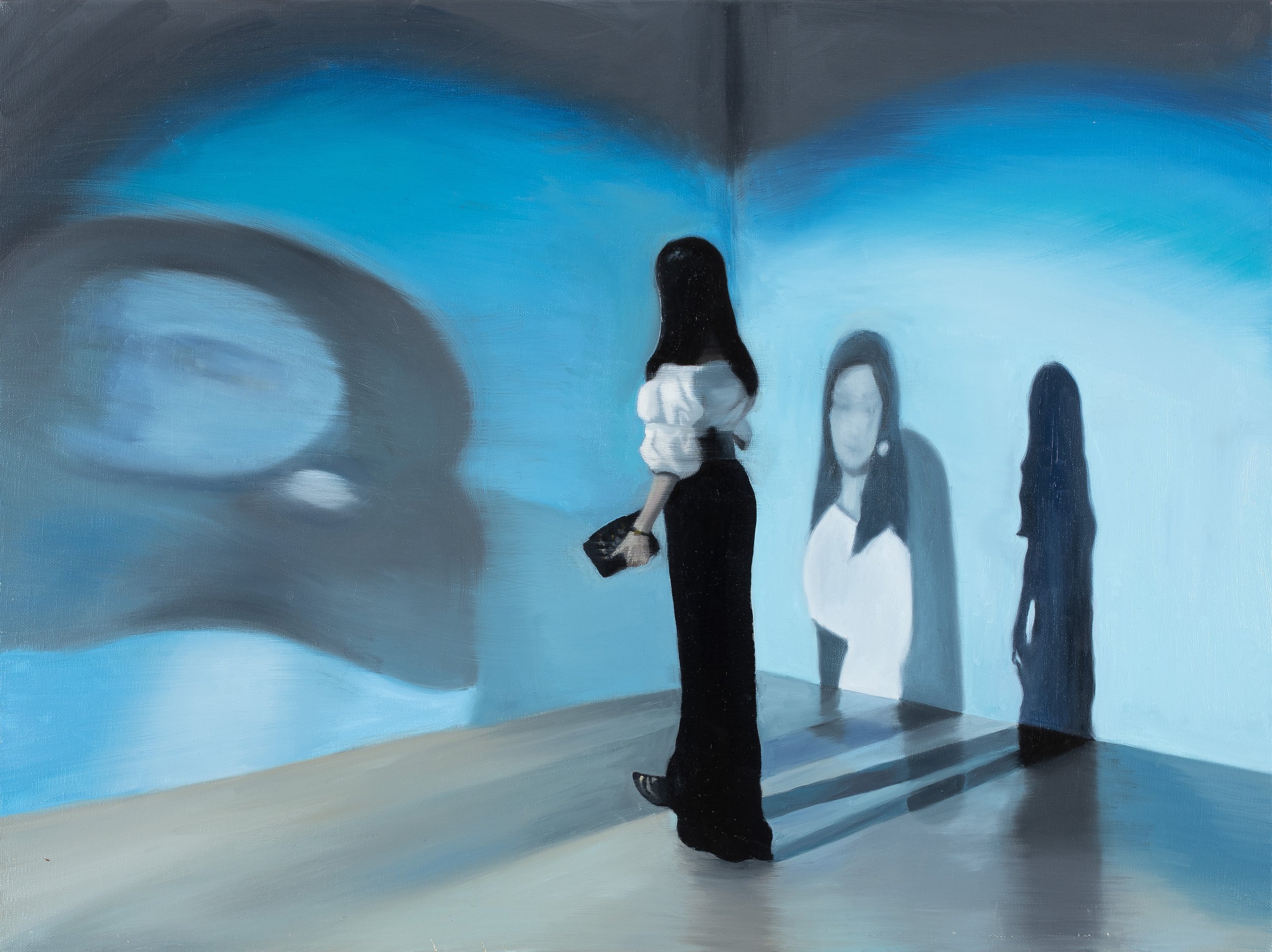
This is Projection: Light and Shadow (2021), oil on linen, 46 by 61 centimeters, and the scene it depicts is deliberately unstable. The blue tone that dominates the canvas is the color of projected light, the cool, slightly electric blue of a monitor or a projector beam, and it fills the composition with an ambient glow that seems to come from no single source. The figure stands at the center of this glow, and the three shadows fall away from the body at different angles, as though three separate projectors were aimed at the figure from three different positions in the room. The effect is not surreal in the manner of Magritte, where impossible configurations are presented with deadpan clarity. It is technological. The multiple shadows are not a violation of physics but a consequence of a particular technology, video projection, that generates its own light and can be directed from multiple angles simultaneously. The painting does not depict an impossible scene. It depicts a scene that a specific technology makes real, and it asks what happens to the self when the light that illuminates it comes from a screen.
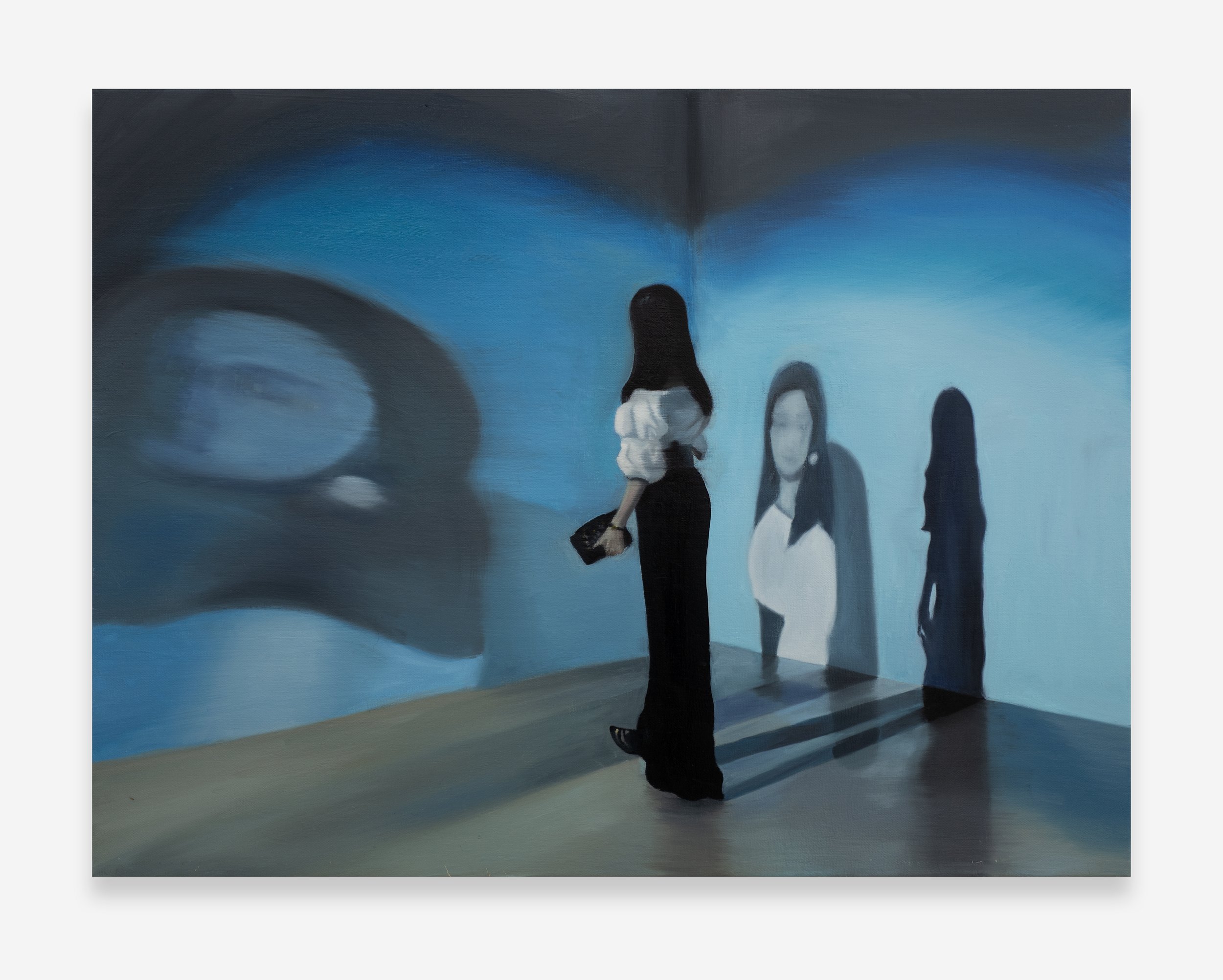
The surface of the painting rewards close attention. The blue that dominates the composition is not a single flat tone. It modulates across the canvas, darker where the shadows fall, lighter where the projected light strikes the figure and the surrounding space. The transitions between these zones are handled with a softness that mimics the behavior of projected light, which does not produce the hard edges of direct sunlight but instead creates gradients, pools of brightness that bleed into pools of shadow. The oil paint is applied in thin layers, allowing the linen weave to register in the lighter passages, where the ground of the canvas shows through as a warm undertone beneath the cool blue. This warmth is important. It is the material reminder that the blue wash, which reads as projected, artificial, and technological, is painted over a surface that is physical, handmade, and warm in color. The warm linen visible at the margins of the composition is the ground that the technology has not yet covered. The shadows themselves are rendered in three distinct registers of density. The solid shadow is nearly black, its edge crisp where it meets the blue ground. The translucent shadow is a medium grey-blue, its edge feathered. The faint shadow is the palest blue, almost indistinguishable from the background. These three registers correspond to three degrees of presence, three modes of being a body in a field of projected light. The painting treats them as equivalent in kind if not in intensity. Each shadow is a version of the same figure, and each version is real in the sense that it is really there on the canvas, really a mark made by the painter's hand in response to a real phenomenon, the multiple shadows cast by a body illuminated by multiple light sources.
Tan Mu's own description of the work locates it at the intersection of technology and identity. The figure, she writes, is "surrounded by projected shadows, fragmented into multiple layers, much like our contemporary identities." The key word is "fragmented." The shadows do not merely accompany the figure. They fragment it. They take a single, integrated body and disperse it across multiple registers of presence. The solid shadow is the most physical, the closest to the body's actual form. The translucent shadow is more ambiguous, neither fully present nor fully absent. The faint shadow is a trace, a residue, the outline of a body that has almost dissolved into the light that projected it. Together, the three shadows constitute what the artist calls "the layered nature of modern identity in the age of digital reproduction." This is not a metaphor that the painting illustrates. It is a condition that the painting enacts. The figure on the canvas is fragmented by the light that falls on it. The viewer sees the fragmentation as a fact of the composition. The body and its shadows occupy the same space, the same blue field, and the shadows are as much a part of the visual experience as the body itself.
Rembrandt van Rijn's Return of the Prodigal Son (c. 1668) is a painting about light as revelation. The composition is dominated by a single, powerful light source that illuminates the figures gathered in the foreground while leaving the architectural space behind them in deep shadow. The light falls on the kneeling son, on the father's face and hands, on the faces of the onlookers who lean in from the edges of the composition. It does not fall on the son's elder brother, who stands apart in the shadows, or on the figures in the background, who are barely visible in the murk of the interior. The light in Rembrandt's painting is not naturalistic. It does not come from a window or a candle that we can see. It comes from above and to the left, concentrated on the central figures with an intensity that no single candle could produce. It is a compositional light, a light that has been arranged to reveal what the painter wants revealed and to conceal what he wants concealed. The shadows in Rembrandt's painting are not secondary to the light. They are its complement. Without the deep shadow that surrounds the illuminated figures, the light would have no force. The shadow gives the light its drama, its moral weight, its capacity to single out one figure from a crowd and say: this one matters, look at this one.
The structural connection to Projection: Light and Shadow lies in the relationship between light and shadow as a medium of meaning. In Rembrandt, the light reveals. It picks out the prodigal son and his father from the surrounding darkness and makes their encounter the center of the painting's emotional and spiritual gravity. The shadow conceals. It pushes the elder brother and the bystanders to the margins of attention, not by erasing them but by reducing their visibility. The hierarchy of meaning in the painting is a hierarchy of illumination. What is lit matters most. What is shadowed matters less. Tan Mu's painting inverts this hierarchy. In Projection: Light and Shadow, the shadows are not secondary. They are the subject. The light that falls on the figure is not a single, revelatory source that illuminates one truth. It is multiple, technological, and diffuse. It comes from projectors, from screens, from the apparatus of digital reproduction. And the shadows it casts are not unified. They are multiple, competing, layered. The painting does not use light to reveal a single, central truth about the figure. It uses multiple lights to fracture the figure into several versions of itself, each one equally real and equally partial. Where Rembrandt's light creates a hierarchy of meaning, illuminated body over shadowed background, Tan Mu's projected light creates a democracy of shadows, each one a legitimate version of the same self, none of them complete.
The source of the blue light in Tan Mu's painting is video projection, a technology that produces light through electronic means rather than combustion or reflection. A video projector sends an image through a lens and onto a surface. The image is composed of pixels, each one a discrete point of colored light. When the projector illuminates a body, the light wraps around it, and where the body blocks the light, a shadow falls. With one projector, there is one shadow. With two projectors aimed from different angles, there are two shadows, each one cast by a different light source, each one corresponding to a different position in the room. With three or more, the shadows multiply, overlapping and separating according to the geometry of the room and the placement of the projectors. This is the physical reality that Projection: Light and Shadow depicts. The three shadows are not a painterly invention. They are the consequence of placing a body in a room with multiple projected light sources, and the painting renders each shadow with a different degree of opacity, as though each projector were casting a shadow of a different weight, a different density of presence.
The significance of this configuration extends beyond the physics of light and shadow. Video projection is not a neutral technology. It is a technology of reproduction, of copying, of multiplying an image across surfaces. When a video projector illuminates a body, it does not simply make the body visible. It records it, transmits it, and reproduces it in real time. The projected light carries information. It is not the warm, analog light of a candle or the directional light of the sun. It is digital light, composed of pixels, refreshed at a rate of sixty frames per second or more, and it brings with it the entire apparatus of digital mediation: the screen, the camera, the network, the platform. The figure in Tan Mu's painting is not standing in candlelight. It is standing in the light of a technology that can capture its image, transmit it, store it, and reproduce it. The multiple shadows are the visual manifestation of this capacity. They are what identity looks like when it has been projected, captured, transmitted, and reproduced by multiple channels simultaneously.
Tan Mu's Q&A for the work makes this explicit. She describes the piece as emerging from "a period of personal uncertainty surrounding memory and identity," during which she became aware of how "in the digital era, human existence can become fragmented, fluid, and constantly redefined through technological mediation." The three shadows are the visual form of this fragmentation. Each shadow is a version of the self that the technology has produced: the self on social media, the self captured by surveillance, the self constructed from data. None of these versions fully defines the person. None of them is complete. But each of them is real, in the sense that each of them exists, has been produced by a real technology, and has real consequences for the person whose body cast the shadow. The painting does not present this fragmentation as a tragedy or a crisis. It presents it as a condition. The figure stands in the blue light. The shadows fall. The figure does not resist the projection or reach toward a single, unified self. It exists within the field of multiple illumination, and the multiple shadows are as much a part of its presence as its physical body.
Bill Viola's The Reflecting Pool (1977-79) is a single-channel video that lasts approximately twelve minutes. A man approaches a pool in a forest. He stands at the edge, lifts his arms, and prepares to dive. Then he freezes. The image of the man, suspended mid-motion, hovers above the surface of the pool while the pool itself continues to ripple and reflect the surrounding trees. The man's reflection does not dive. It remains static, floating above the water, while the water moves beneath it. At the end of the video, the man disappears from the frame entirely, leaving only the pool, its surface disturbed by ripples that have no visible cause. The work is a meditation on time, stillness, and the relationship between the body and its image. The man is there and not there. His reflection is present but not moving. The water reflects the trees and the sky but not the man who stands above it, or it reflects him in a way that freezes his image while the world around him continues in real time. The technology of video, which can record and manipulate time, has split the man from his reflection, creating a disjunction between the body and its image that only video can produce.
The structural parallel to Projection: Light and Shadow is the disjunction between the physical body and its mediated image. Viola's video separates the man from his reflection by freezing one and allowing the other to continue in real time. Tan Mu's painting separates the figure from its shadow by multiplying the shadow into three distinct registers, each one cast by a different light source, each one a different degree of presence. In both cases, the technology of mediation, video in Viola, video projection in Tan Mu, creates a gap between the body and its image that did not exist before the technology was introduced. The reflection in Viola's pool is not a natural reflection. It is a video reflection, produced by the technology that can pause time and hold a figure still while the world around it moves. The shadows in Tan Mu's painting are not natural shadows. They are projected shadows, produced by a technology that can multiply a body's image across multiple surfaces simultaneously. In both cases, the mediated image is not a copy of the body. It is a version of the body, produced by the technology that mediates it, and it has properties, stillness in Viola, multiplicity in Tan Mu, that the physical body does not possess.
Yiren Shen, in conversation with Tan Mu for 10 Magazine (2025), observes that the artist's practice "distills everything into the controlled space of a painting," a space that is "a purer state, like being in the ocean, free from excessive sensory distractions." The observation is precise and it applies with particular force to Projection: Light and Shadow. The painting takes a scene of technological mediation, a body in a room with multiple projectors casting multiple shadows, and distills it into the controlled space of oil on linen. The projectors are not depicted. The screens are not shown. The cables, the lenses, the power sources, the entire apparatus that produces the projected light, are absent from the composition. What remains is the effect: the blue light, the three shadows, the figure standing in the field of multiplied illumination. The painting strips the technology down to its visual consequences. It does not show the projectors. It shows what the projectors do to a body. And by removing the machines from the frame, it makes the effect of mediation feel like a condition of the body itself, rather than an effect of the equipment that surrounds it. The figure does not appear to be standing in a room with projectors. It appears to be standing in a room where the light naturally multiplies, where shadows naturally diverge into multiple registers, where the self naturally fragments into several versions. This is the painting's most radical move. It naturalizes what is technological. It makes the fragmentation of identity by digital projection look like a natural property of being illuminated.
The blue tone of the painting reinforces this naturalization. Blue is the color of projected light, but it is also the color of twilight, of deep water, of the atmosphere at the horizon. In Rembrandt's Return of the Prodigal Son, the light is warm, golden, the color of indoor firelight. It is the color of human habitation, of domestic interiors, of the candlelit rooms where people have always gathered. Tan Mu's blue is the color of the opposite condition. It is the color of the screen, the monitor, the projector, the interface. It is not a color that occurs in nature. It is a color that is produced by technology and imposed on the visual field. And yet, within the painting, it feels natural. The figure stands in it as though it were air. The shadows fall in it as though it were sunlight. The painting makes the light of digital projection feel like the light of the world, and this feeling is the point. The technology has become so pervasive, so ambient, so much a part of the visual environment, that its light has acquired the quality of a natural phenomenon. The blue wash that covers the canvas is not an intrusion of technology into a natural scene. It is the scene itself. The figure does not stand in a natural environment that has been invaded by projected light. It stands in an environment that has always been blue, always been projected, always been mediated.
The three shadows, then, are not anomalies. They are what identity looks like in a space where the light comes from screens. The solid shadow is the self that the body produces in the physical world, the self that stands in the room and casts a shadow on the floor. The translucent shadow is the self that appears on the screen, the digital self, the mediated self, the self that is visible to others but that cannot be touched or held. The faint shadow is the self that lingers after the body has left the room, the data self, the residual trace that persists in the network after the physical body has moved on. These three shadows are not three different people. They are three versions of the same person, produced by three different modes of illumination, existing simultaneously in the same space. The painting does not judge them. It does not mourn the loss of a unified self or celebrate the proliferation of digital identities. It presents the condition as it is: a figure standing in projected light, casting multiple shadows, each one a legitimate version of the body that produced it, none of them complete, all of them present.
The linen ground visible at the margins of the composition is the material fact that anchors the technological condition to the physical world. The weave of the linen, the warm undertone that shows through where the paint thins, is the reminder that this image was made by hand, in oil paint, on a woven fabric, using materials and techniques that predate video projection by centuries. The painting is not a projection. It is a painting of a projection. It is a physical object that depicts a technological condition, and the tension between the physical object and the technological subject is the tension that drives the work. The blue light on the canvas was mixed by hand. The shadows were applied with a brush. The linen was stretched over bars and prepared with gesso. Every pixel of the original video image has been translated into brushstrokes, and every brushstroke is a physical mark on a physical surface. The painting takes the most disembodied form of light, the projected light of a video image, and remakes it in the most embodied medium available. The body that casts the shadows and the hand that paints them are the same organ. The self that fragments under digital projection and the self that reassembles it in oil paint occupy the same palm.