The Weight of the Curve: Tan Mu's Horizons 06 and the Gaze That Unfinished the World
On October 4, 1957, the Soviet Union placed a 58-centimeter polished sphere into low Earth orbit, and for the first time in the history of the species, a human-made object looked down on the planet from above. Sputnik carried no camera. But eighteen months later, in April 1959, NASA's Explorer 6 transmitted the first photograph of Earth from orbit: a grainy composite of light and shadow in which the curved edge of the planet was barely distinguishable from the solar flare bleeding across the frame. The image was almost unrecognizable as a world. It looked like a smudged thumbprint on a window. But the curve was there. The horizon was not a line on that photograph. It was an arc, and the arc meant that the world was finite, that it ended, that it could be seen whole, that the entire system of weather and ocean and city and forest was a bounded thing floating in a darkness that offered nothing back. Every orbital photograph taken since, from John Glenn's handheld 35mm shots aboard Friendship 7 in 1962 to the International Space Station's live-streamed 4K video in 2025, has been an elaboration of that first smudged arc. The curve changed everything. It made the horizon into a shape.
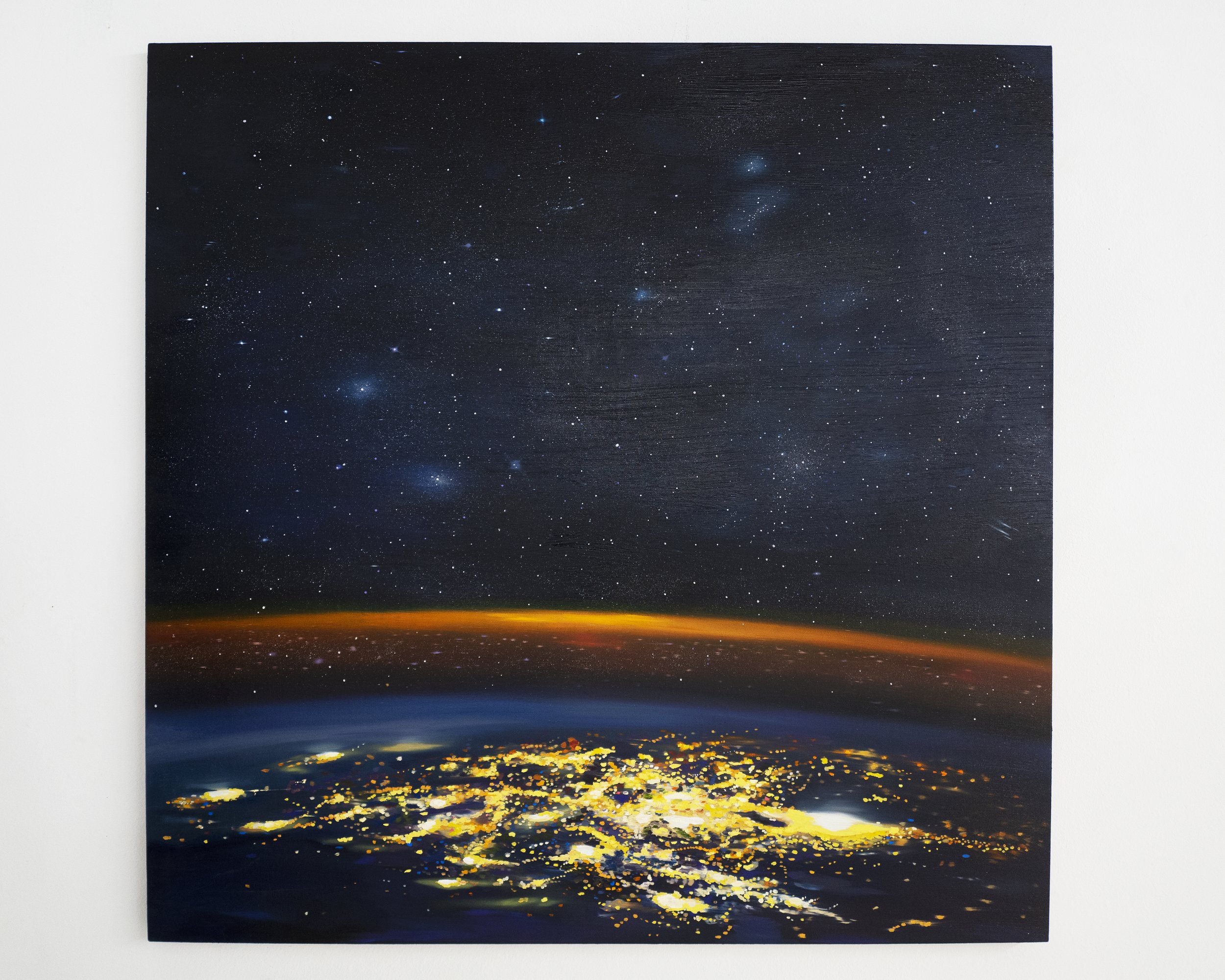
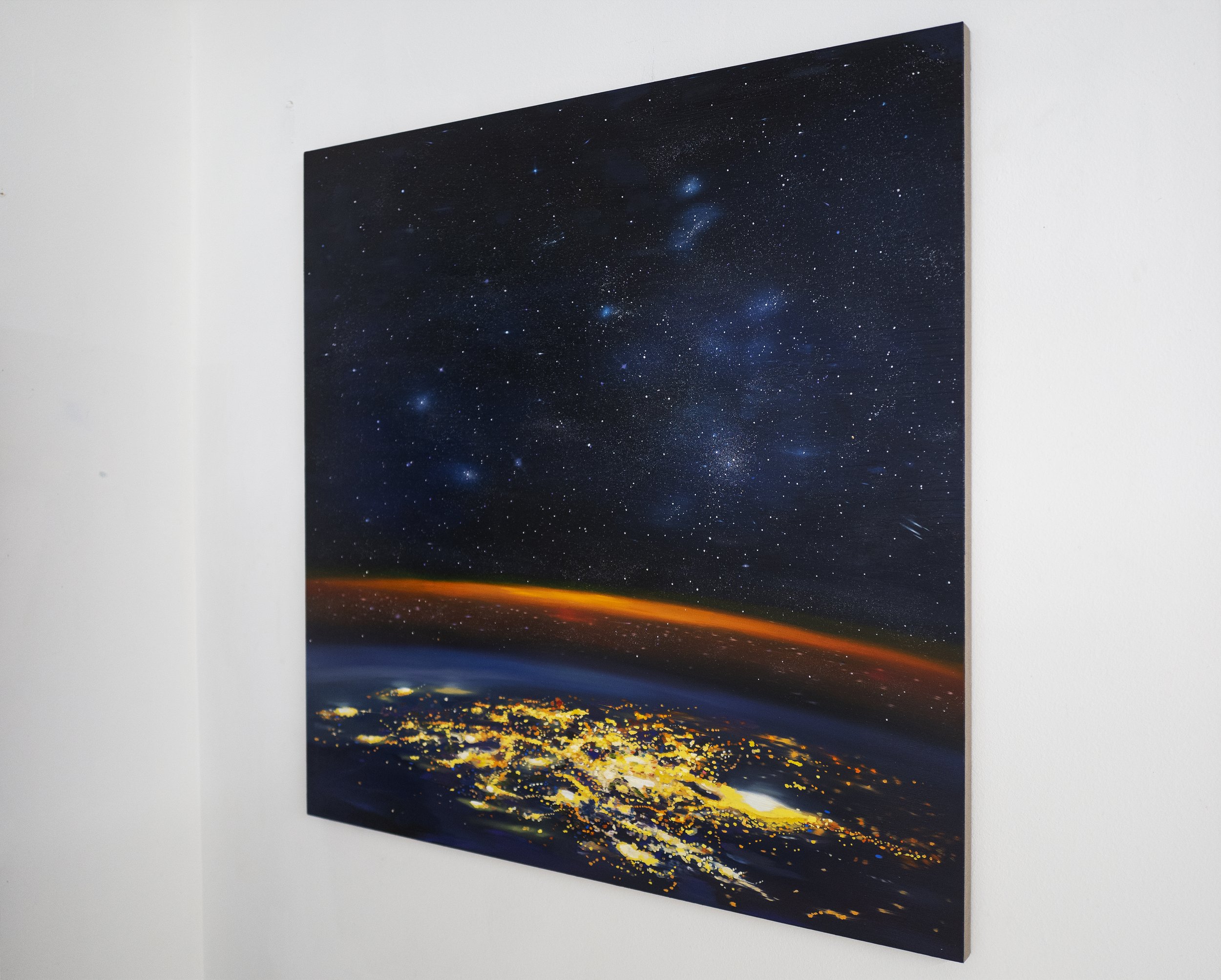
Tan Mu's Horizons 06 (2024) is a painting about this shape. Oil on linen, 122 x 122 cm, it is the only square painting in the Horizons series, and the square format is not incidental. Where the other Horizons works use landscape or portrait orientation to emphasize the lateral sweep of atmosphere or the vertical compression of the visible spectrum, Horizons 06 uses the square to hold the curve still. The painting depicts Earth from the perspective of the International Space Station: a horizontal band of atmosphere dividing the canvas into two unequal zones, the luminous surface below and the absolute dark of space above. The horizon line is not straight. It curves. The curvature is subtle, compressed by the square format into a slight downward bow at the canvas edges that reveals itself slowly, the way the curvature of the Earth reveals itself to an astronaut only after minutes of sustained looking. This is not a painting of the horizon. It is a painting of the knowledge that the horizon is curved. It is a painting of the shift from flat to round, from infinite to finite, from the line that walks away from you to the arc that returns.
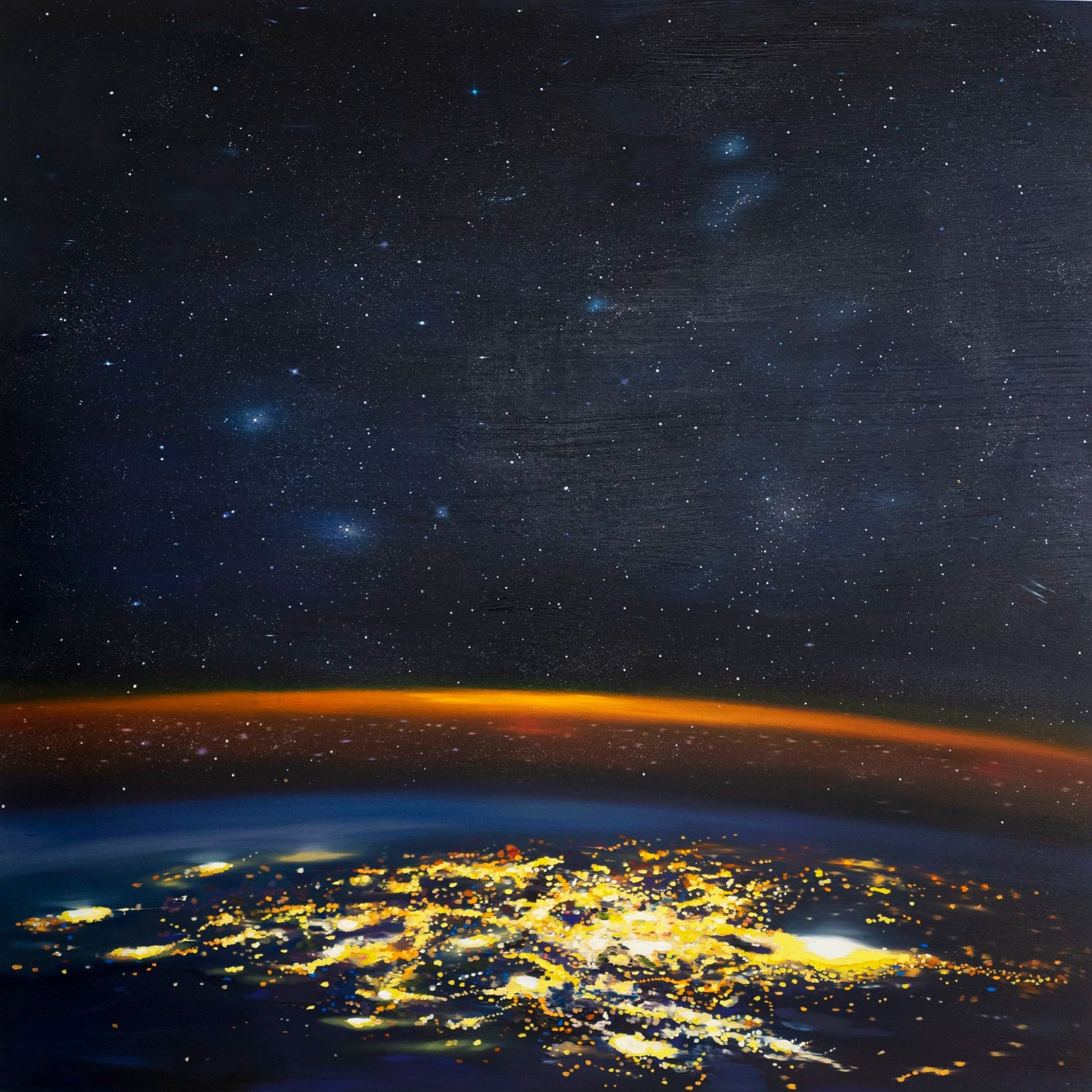
The surface of Horizons 06 rewards sustained attention at multiple distances. From three meters, the painting resolves into three broad zones: a dense lower field of amber and burnt sienna, where city lights cluster along what appears to be a coastal region; a luminous central band of cerulean and pale titanium white, where the atmosphere glows with the thin fluorescence of nitrogen scattering; and an upper field of raw umber fading into lamp black, the color of space at orbital altitude, where no air remains to scatter light. At this distance, the city lights read as a continuous textile of gold and orange, a fabric of habitation that spreads across the lower third of the canvas without resolving into individual points. Step closer, to arm's length, and the textile dissolves into individual marks. Each light is a discrete daub of paint, some thick enough to hold a raised edge, others scraped thin enough that the linen grain shows through. The variation in mark-making is deliberate: some lights are crisp and opaque, the landing lights of major airports and the sodium glow of industrial corridors; others are diffuse and semi-transparent, the residential sprawl of suburbs where light pools rather than points. The thickest marks cluster along the coastline, where population density is highest and where the sea reflects enough ambient illumination to double the visible glow. Move closer still and the atmosphere reveals itself as a series of translucent glazes, each one a separate pass of thinned oil that catches the weave of the linen differently, producing a subtle vertical striation that mimics the stratification of the actual atmosphere: troposphere, stratosphere, mesosphere, each a slightly different shade of blue, each a slightly different opacity, building toward the thin shell of the thermosphere where the blue gives way to black.
The linen itself plays a role that a smoother support would not. At close range, the horizontal threads of the linen are visible through the thinner glazes of the atmospheric band, creating a grid of faint lines that echo the latitude markers on a satellite map. This is not an accident of material but a decision of method. Tan Mu works on unprimed or lightly sized linen for precisely this reason: the weave provides a structural ground that reads simultaneously as the surface of a painting and as a coordinate system. In the Horizons series, this double reading is essential. The painting is not a window onto a view. It is a surface that remembers it is a surface, even as it offers the most expansive view available to human perception. The linen threads keep the painting honest. They prevent the illusion from completing itself. They say: this is also a piece of fabric with paint on it, and the fact that paint on fabric can produce the curvature of the Earth is the genuine marvel, not the simulated vista.
The square format of Horizons 06 distinguishes it from every other painting in the series. Horizons 01 through 05 all use landscape-oriented formats (122 x 76 cm, 41 x 51 cm, 46 x 61 cm, 41 x 51 cm, 46 x 61 cm), which naturally accommodate the lateral sweep of the atmosphere. The square refuses this accommodation. It forces the curvature to declare itself within a bounded field where the eye cannot glide along the horizon to the edges of the canvas. The horizon in Horizons 06 does not extend beyond the frame. It curves within it, and the curve is visible because the format is square. In a landscape format, the curvature would be so slight as to be nearly imperceptible. The square compresses the arc, making the curvature a fact of composition rather than a mathematical inference. This is a painting that knows what format it needs and chose the one that makes its argument visible.
Frederic Edwin Church's Heart of the Andes (1859) is a painting that, at first glance, could not be more different from Horizons 06. Church's canvas is nearly five feet high and ten feet wide, a landscape of staggering breadth that compresses tropical jungle, snow-capped peaks, placid lake, and distant village into a single perspectival system. The painting was exhibited in a darkened room, with gas jets illuminating the canvas and curtains framing it like a window. Viewers paid admission to stand before it and feel as though they were looking at the actual Andes. But Church's painting, for all its apparent expansiveness, is constructed around a single vanishing point that draws the eye inward toward a bright pass between two mountain ridges. The composition is a funnel. The breadth is an invitation to depth. The painting uses horizontal space to create the illusion of infinite recession, but the recession is always toward a single point, and the point is always out of reach. The horizon in Heart of the Andes is not a curve. It is a line that retreats as you approach it, the way horizons always do in single-point perspective. Church's painting is the apotheosis of the flat horizon, the line that can never be reached because it is always ahead.
Tan Mu's Horizons 06 operates on the opposite principle. The horizon here is not ahead. It is beneath. The viewer does not look toward it across a landscape. The viewer looks down at it from above. The curvature is not an inference drawn from perspectival recession. It is a visible fact inscribed on the surface. Where Church uses breadth to create depth, Tan Mu uses compression to reveal curvature. The square format does not funnel the eye toward a vanishing point. It holds the eye in a state of sustained attention to the surface, where the slight bow of the horizon line becomes the most important mark on the canvas. The painting does not invite the viewer into a landscape. It suspends the viewer above one. The shift from Church's horizontal expanse to Tan Mu's orbital square is the shift from the horizon as a promise of distant arrival to the horizon as proof that the world is finite. Church's horizon says: keep walking and you will reach the mountains. Tan Mu's horizon says: you have already arrived at the edge, and the edge curves back on itself.
The subject of Horizons 06, as Tan Mu states on her artwork page, is the International Space Station's perspective on Earth, where "the satellite perspective reflects my understanding of technology as an extension of the body and an external form of memory." The ISS orbits at approximately 408 kilometers above the surface. At that altitude, the Earth's curvature is clearly visible to the naked eye. Astronauts consistently report that seeing the curve, and the thinness of the atmosphere that surrounds it, fundamentally altered their understanding of the planet's fragility. The "overview effect," as it was named by Frank White in 1987, describes the cognitive shift that occurs when a human being sees Earth from orbit: the immediate recognition that the planet is a single system, that national borders are invisible from that vantage, and that the atmosphere is not an infinite resource but a shell so thin it can be represented on a globe by the gloss on the varnish. The city lights that cluster along the coastline in Horizons 06 are not decorative elements. They are data. From the ISS, the primary visible evidence of human presence at night is not buildings or roads or people. It is light. The light is the signature of civilization at orbital altitude, the way a heat signature is the signature of life at microscopic scale. Tan Mu's dots of amber and orange are not abstractions. They are representations of what an astronaut actually sees when looking down at a populated coastline from four hundred kilometers up.
The connection between city lights and neural networks that Tan Mu draws in her Q&A is not metaphorical. "They form intricate patterns that resemble neural networks or biological systems, suggesting that human activity mirrors natural structures." The visual similarity is not coincidental. The dendritic branching of city lights along coastlines and river deltas follows the same minimum-energy growth patterns as the branching of neurons in the cerebral cortex. Both systems optimize for connectivity across a surface. Both favor pathways along existing routes. Both produce networks that are neither wholly random nor wholly regular. The resemblance between a satellite image of city lights at night and a fluorescence micrograph of a brain slice has been noted by neuroscientists and urban planners alike. Tan Mu's contribution is not the observation itself, which has been made before, but the decision to paint both systems using the same formal vocabulary: small luminous marks distributed across a dark ground, connected by thin lines of light, clustering at nodes of high density. In Horizons 06, the city lights and the neural network share the same visual grammar because they share the same organizational logic. The painting does not argue by analogy. It argues by resemblance, and the resemblance is structural, not decorative.
Hiroshi Sugimoto's Seascapes series, which he began in 1980 and has continued for more than four decades, consists of black-and-white photographs of ocean horizons taken with long exposures from coastal vantage points around the world. Each photograph in the series is divided by the horizon line into two equal halves: sea below, sky above. The format is always the same. The location changes, but the composition is identical. The horizon is always centered, always level, always razor-thin. The sea and sky are rendered in tones of gray that vary from near-white to near-black, depending on the time of day and weather conditions at the moment of exposure. Sugimoto has described the series as an investigation of the most ancient visual experience shared by all human beings: the division of the world into water and air, below and above, matter and void. Before there was art, before there was architecture, before there was language, there was the horizon line. Sugimoto's photographs return to this primordial division with a monk's discipline, stripping away everything except the fact of the line.
Tan Mu's Horizons 06 begins where Sugimoto's series ends. Sugimoto's horizons are always flat because they are always photographed from the surface of the planet. The curvature of the Earth is not visible from sea level. It requires altitude. Sugimoto's discipline, his insistence on the same composition from the same vantage, is a discipline of the flat horizon, the horizon as it has appeared to every human being who has ever stood on a beach and looked out at the water. Tan Mu's painting shares Sugimoto's formal clarity, the division of the canvas into zones of atmosphere and darkness, but it refuses the flatness of the line. The horizon in Horizons 06 curves, and the curvature is the painting's argument. Where Sugimoto's horizons confirm the ancient division of the world into sea and sky, Tan Mu's horizon reveals that the division is an illusion produced by proximity. Stand on the beach, and the horizon is flat. Rise four hundred kilometers, and it curves. The line was never a line. It was always an arc, and the flatness was always an artifact of the viewer's position, not a property of the world. Sugimoto's series preserves the horizon as our ancestors knew it. Tan Mu's painting shows what our ancestors could not see: that the line is the local appearance of a curve, and the curve is the truth.
Tan Mu's biographical connection to this subject is direct. Her maternal grandfather was a meteorologist who worked at a weather station, and through him she learned to read weather patterns, to understand atmospheric movement, and to observe the Earth from an analytical distance. At Alfred University, she lived near the Stull Observatory, one of the oldest private observatories in the United States, with six telescopes housed in domes and a fiber-fed spectrograph for analyzing stellar light. She attended weekly observation sessions. "The first time I saw the moon through a telescope was a profound moment for me," she has said. "It fundamentally shifted my perception of scale and distance, and it altered how I understood humanity's position within the universe." The Horizons series emerged from this biographical formation. It is not a series about outer space in the abstract. It is a series about the experience of seeing the world from an altitude that changes the shape of its most basic visual feature: the horizon line itself. The telescope did not give Tan Mu a view of the moon. It gave her a view of the Earth, by placing her in a position from which the Earth's curvature became visible. The telescope and the satellite are instruments of the same displacement: they move the eye far enough from the surface that the flat horizon reveals itself as an arc.
The atmospheric glow in Horizons 06 is not an aesthetic choice. It is a physical fact rendered in paint. At orbital altitude, the atmosphere does not appear as a thin blue line the way it is drawn in children's diagrams. It appears as a luminous band, brightest at the limb of the Earth, where the light passes through the greatest volume of air, and fading inward toward the surface. This limb brightening is the same phenomenon that produces the brilliant orange rim of a sunset, but seen from above, it wraps the entire planet in a continuous shell of light. Tan Mu renders this shell in successive glazes of cerulean, pale titanium white, and a thin wash of cadmium yellow where the atmosphere meets the surface. The transition from atmosphere to space is not a clean boundary. It is a gradient that occupies the central third of the canvas, a band of luminosity that holds the viewer's eye in suspension between the warmth of the inhabited surface below and the absolute cold of the void above. The glow is the painting's most seductive passage, and it is also its most honest: it tells the viewer that the atmosphere is thin. The entire band of light, all that stands between the living surface and the dead vacuum, is compressed into a few pixels of paint. From the ISS, astronauts report that they can block the entire atmosphere with their thumb. Tan Mu's glazes achieve a similar compression. The atmosphere in Horizons 06 is beautiful, and it is impossibly thin, and both of these facts are true at the same time.
Saul Appelbaum, writing about the Signal series in his 2025 essay "Dreaming in Public," describes Tan Mu's practice as one of "arbitration": deciding, judging, mediating between input and output, between the raw data of scientific observation and the subjective experience of encountering it as visual art. The concept of arbitration is useful for Horizons 06 as well. The painting arbitrates between two kinds of vision: the flat horizon of terrestrial experience and the curved horizon of orbital perspective. It holds both in a single image. A viewer standing before the painting sees the horizon curve, but the curve is subtle enough that it could be an artifact of the canvas shape or a slight irregularity in the paint application. The curvature reveals itself gradually, the way it reveals itself to an astronaut: not in a single glance, but through sustained looking, through the slow accumulation of evidence that the line at the center of the canvas is not straight. The painting makes the viewer perform the same cognitive shift that the overview effect produces. First you see a horizon. Then you see a curve. Then you understand that the curve was always there, and that the flatness was the illusion.
The square format intensifies this shift because it removes the lateral extension that a landscape format would provide. In a landscape format, the eye has room to travel along the horizon, to test it for curvature by scanning, to confirm that it is (or is not) straight by comparing its trajectory across the canvas. The square denies this scanning motion. The eye enters the painting and immediately encounters the horizon line, which bisects the square horizontally, and the only way to determine whether the line curves is to look at it carefully, to hold the two edges of the canvas in peripheral vision simultaneously and notice that the center of the horizon sits slightly higher than its endpoints. This is an act of measurement, not of impression. The painting makes the viewer measure. It makes the viewer into an instrument of observation, performing the same act of sustained looking that an astronaut performs when confirming the curvature of the Earth from orbit. The square format is not a neutral choice. It is the format that makes curvature legible by eliminating the distraction of lateral sweep.
Tan Mu has described the satellite perspective as "a way of seeing that surpasses the horizon, offering a shared, planetary view of Earth." The word "surpasses" is precise. The satellite does not deny the horizon. It does not eliminate it. It surpasses it by moving to a position from which the horizon can be seen as what it is: not the edge of the world, but the edge of the atmosphere, curved because the planet beneath it is round. The "panoramic gaze" that she identifies as central to the series is not the gaze of mastery that a military satellite implies, the God's-eye view that reduces human lives to coordinates. It is the gaze of recognition. It is the moment when the eye, placed at sufficient altitude, recognizes that the flat line it has always taken for granted is a local approximation of a global truth. The recognition does not diminish the local. It contextualizes it. The beach sunset is not less beautiful because the horizon curves. It is more beautiful because the curve means the sunset is happening on a sphere, and the sphere is the only place in the observed universe where sunsets happen at all.
The city lights along the coastline in Horizons 06 do not represent individual cities. They represent the luminous signature of a species that builds along coastlines because coastlines are where fresh water meets navigable water, where trade routes converge, where the resources of land and sea are accessible simultaneously. The lights cluster along the edge of the continent and thin out inland, following the same dendritic pattern that a neural network follows along the surface of the brain. This is not because cities are like brains, though the visual resemblance is striking. It is because both systems obey the same optimization principles: minimize energy expenditure per unit of connectivity, favor pathways along existing routes, and cluster at nodes where multiple pathways intersect. The lights are not a metaphor for neurons. They are a parallel instantiation of the same network logic, expressed in a different medium and operating at a different scale. The painting's argument is not that cities look like brains. The painting's argument is that the same mathematical principles that govern the growth of neural networks also govern the growth of urban ones, and that the orbital perspective, which makes both networks visible at once, is the perspective from which this structural homology becomes legible.
The transition from atmosphere to space in the upper third of Horizons 06 is rendered in a gradient so smooth that it almost vanishes. The cerulean lightens to a thin wash, the wash fades to a glaze, and the glaze dissolves into the raw linen, which reads as the black of space. This is the point where the painting's material honesty converges with its cosmic subject. The black of space is not painted black. It is unpainted linen. The void beyond the atmosphere is represented by the absence of paint, the substrate showing through, the raw fabric that has been waiting beneath the image all along. This is not a casual decision. It is a structural one. The atmosphere, the thin shell of gas that makes life possible, is rendered in the most labor-intensive part of the painting: layer after layer of translucent glaze, each one requiring drying time before the next can be applied. The void, the killing vacuum of space, is rendered by doing nothing. The painting enacts its own argument. What protects life takes work. What destroys it takes nothing at all. The atmosphere is the product of sustained labor. The void is the default. And the glazes, for all their luminous beauty, are thin enough that a thumb could cover them. The painting is not a landscape. It is a cross-section. And the cross-section shows that the margin between life and void is thinner than any viewer wants to believe.
Horizons 06 is the painting in the series where the argument of the panoramic gaze reaches its most compressed form. The other Horizons paintings spread the atmosphere across a wider canvas, giving the viewer room to wander along the coast, to follow the lights from city to city, to sink into the color field. Horizons 06 refuses this comfort. It presents the view in its most essential configuration: surface, atmosphere, void, held in a square that admits no lateral drift and offers no narrative distraction. The square says: look at this. Look at the curve. Look at the thinness. Look at the lights and understand what they are. The painting does not tell you what to feel about the thinness or the curvature. It presents the conditions of visibility that make the curvature and the thinness legible, and it leaves the recognition to the viewer. The satellite perspective, as Tan Mu describes it, is a perspective that "fosters collective awareness and redefines landscape art." The word "collective" is the key. The panoramic gaze is not a personal vision. It is a shared one. Any astronaut who has seen the curve has seen the same curve. The curvature of the Earth is not a matter of interpretation. It is a fact, and the fact is that the atmosphere is thin, the lights are dense along the coastlines, and the void begins where the paint ends. What the viewer does with this information is not the painting's concern. The painting's concern is making the information visible. The rest, as with the first photograph of Earth from orbit in 1959, is a matter of what the species decides to do with the knowledge that its world is curved, finite, and glowing against an absolute dark.