The Portrait That Was Never Mine: Tan Mu's Turf and the Memory That Came From Outside
The photograph appeared in sports news. A young man, a professional soccer player in the 1980s, captured in the posture of his profession, seated on the field or standing in the locker room or mid-stride on the pitch, the image composed by a sports photographer who had no idea that decades later it would become the source material for a painting made by the player's daughter, who was not yet born when the photograph was taken. Tan Mu never saw her father play. She never watched him on the field, never heard the crowd, never sat in the stands and watched the man in the photograph run. The image arrived in her life as an external fact, a piece of public documentation that documented a version of her father that existed before she existed, a version that circulated through sports media, was printed in newspapers, and was seen by strangers who knew more about his athletic career than his own daughter ever would. Turf (2021) is a painting made from a photograph that the painter never witnessed being taken, of a person she never saw in the act depicted, in a time before she was born. It is a portrait of someone known through an image, and it is a painting that asks what it means to inherit a memory that was never yours to begin with.
The painting is small, 41 by 51 centimeters, oil on linen, roughly the size of a photograph or a page from a family album. This is not an accident. The format matches the source. The image that Tan Mu worked from was a photograph, and the painting's dimensions approximate the scale at which photographs are held, looked at, and passed from hand to hand. The monochrome palette, blacks, whites, and a narrow band of greys between them, further aligns the painting with the photographic source. There is no color in Turf. The field is not green. The uniform is not the specific color of any team. The sky, if it appears, is not blue. The entire image has been stripped of the chromatic information that would locate it in a specific time and place and returned to the tonal register of the black-and-white photograph, the medium through which it originally existed. This is a deliberate choice. Tan Mu describes the monochrome as removing "the image from a specific moment in time and placing it into a more reflective, suspended space," echoing "the language of archival photography and historical documentation, reinforcing the idea that this is a moment retrieved rather than remembered." The painting does not recreate the experience of watching her father play. It recreates the experience of looking at a photograph of him playing, and it insists on the difference between those two acts.
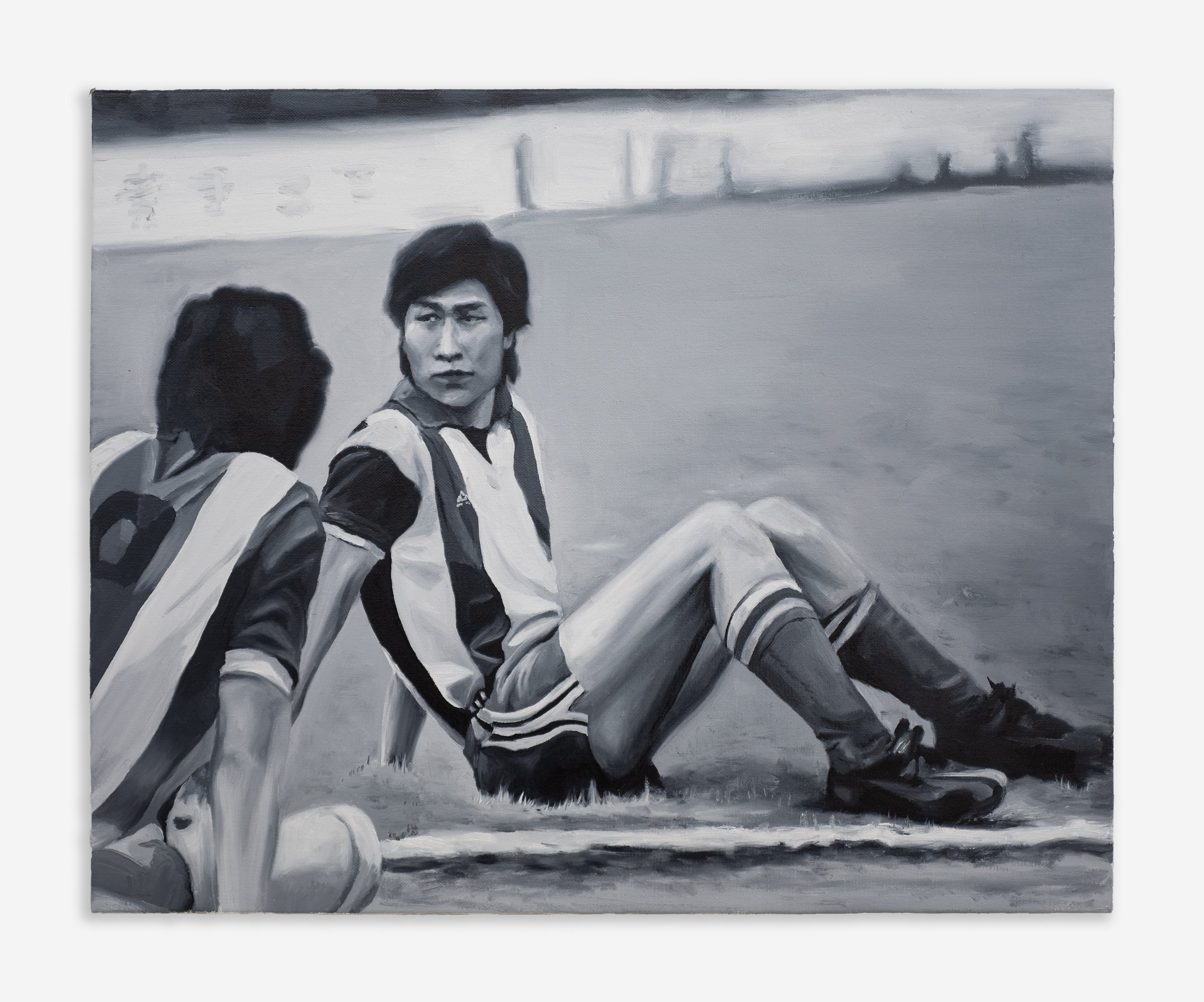
The surface of the painting is smooth and controlled, consistent with Tan Mu's practice of translating photographic sources into oil paint with a fidelity that preserves the tonal structure of the original image while introducing the materiality of the painted surface. The brushwork is tight and precise in the figure, where the contours of the body and the folds of the uniform need to read clearly, and looser in the background, where the field and the sky merge into a field of grey that suggests the grain of a photograph rather than the texture of grass or sky. The linen weave is visible in the lighter passages, where the paint thins to a wash and the fabric's texture becomes part of the image's surface. This is the trace of the painting's physical making, the point where the hand that applied the paint becomes visible through the surface of the image. The figure sits or stands, the posture is composed, the body is held in the specific stillness of an athlete at rest, not in motion but not at ease either, maintaining the tension of someone who is between actions, who has just finished one exertion and is about to begin another. This is not a candid moment. It is a composed one. The photograph that is the painting's source was taken by a professional photographer who chose the angle, the framing, and the moment. The painting inherits this composition. It does not correct it, improve it, or add to it. It translates it into paint, and in the translation, it preserves the photograph's point of view: a view from outside, from the stands, from the press box, from the position of a spectator who is watching, not participating.
Gerhard Richter's Onkel Rudi (1965) is a painting of a family photograph. Richter's uncle, Rudi, stands in the uniform of the Luftwaffe, smiling, one hand on his hip, the other holding his cap, his body angled toward the camera in the easy posture of a young man who does not yet know what the uniform he is wearing will come to signify. The photograph was taken before the war, before Rudi was drafted into the German military, before he was killed in action. Richter painted it in 1965, twenty years after the war ended, in the same grey monochrome that he applied to all of his early photo-paintings. The grey is not a filter. It is a position. It declares the painting's distance from its subject, the impossibility of accessing the past through the image with any color that would restore it to lived experience. The photograph shows a young man in uniform, smiling, full of life. The painting shows the same young man in the same uniform, smiling the same smile, but drained of the warmth that color would provide. The grey makes him a document. It makes him evidence. It transforms the photograph from a family keepsake into a historical artifact, and it asks the viewer to consider what it means to look at a smiling face that belongs to someone who is already dead, someone whose death the photograph does not yet know about.
The structural parallel to Turf is the distance between the painter and the image. Richter painted his uncle from a photograph he had seen many times, a photograph that belonged to his family, a photograph of a person he had known, however briefly, in life. Tan Mu painted her father from a photograph that she had never seen being taken, a photograph that belonged to the public record before it belonged to the family, a photograph of a person she had never known in the version depicted. Both painters use monochrome to mark the distance between themselves and the image. Both painters translate a photograph into oil paint, a process that slows down the act of looking, that forces the painter to spend hours with an image that might otherwise be glanced at and put away. Both painters produce a work that is more than a copy of the photograph and less than a portrait from life. It is a portrait from an image, and the image is the only access the painter has to the person depicted. The grey in Richter's painting is the grey of historical distance, the distance between 1965 and the 1930s, the distance between the painter's present and the uncle's past. The grey in Tan Mu's painting is the grey of temporal and experiential distance, the distance between a daughter who was not yet born and a father she never saw play. In both cases, the monochrome does not drain the image of emotion. It makes the emotion legible as a specific kind of emotion: not grief, not nostalgia, but the recognition that the past is irretrievable, that the photograph is a record of something that no longer exists, and that painting it is a way of holding the record without pretending that the record can be reversed.
Tan Mu describes the source photograph as functioning "as a kind of inherited memory rather than a lived one." The distinction is precise. A lived memory is something you experience directly. You were there. You saw it. The image in your mind corresponds to an event that happened to you. An inherited memory is something you receive from outside: from a story, from a photograph, from a document, from a piece of evidence that attests to an event that happened before you were born or that happened in a place where you were not present. The photograph of Tan Mu's father in his soccer uniform is an inherited memory. It documents a moment in his professional career, a career that ended, as Tan Mu notes, "upon the artist's birth." The decision to retire from professional soccer was made in connection with her arrival. His career and her life are linked by a choice that he made and that she inherited. The photograph records his career. The painting records her reception of it. The career is his. The reception is hers. The painting sits at the point where the two intersect.
The soccer field in the painting, the turf of the title, is both a literal location and a structural element. It is the ground on which the figure stands or sits, the green surface that has been reduced by the monochrome palette to a field of grey, and it is the stage on which the drama of inheritance and choice plays out. Tan Mu describes the field as "a stage where lineage, choice, and trajectory intersect." The language of the stage is deliberate. A stage is a place where actions are performed, where roles are assumed and discarded, where the performer is both themselves and the character they play. The soccer field is the father's stage. It is where he performed as a professional athlete, where his image was captured by a sports photographer and circulated through media, where his body was displayed for public consumption as a player rather than as a person. When he retired from that stage, he exchanged one role for another, athlete for father, and the exchange coincided with the birth of the person who would eventually paint his image from that stage, not from the stands, not from the field, but from the position of someone who was never there, looking at a photograph taken by someone she has never met, of a version of her father she never knew.
The field's reduction to grey in the painting is not a denial of its material reality. Grass is green, and soccer fields in the 1980s were green. The grey is an admission that the field as the painter knows it is not a physical place she can walk on but a tonal value in a photograph she can look at. The painting does not restore the grass to green because the painter has no access to the color of that grass. She was not there. The photograph does not record the color, and memory, inherited or lived, does not supply what the photograph omits. The grey is the color of the distance between the daughter and the field, between the present and the past, between the person who is looking and the person who was looked at. It is the color of a moment that has been transmitted through a medium that strips it of chromatic information, and it is the color that the painting faithfully preserves because to add color would be to add knowledge that the source does not contain.
Thomas Eakins's Max Schmitt in a Single Scull (1871) depicts the artist's friend and rowing partner, Max Schmitt, seated in a shell on the Schuylkill River, his oars resting at his side, his body turned slightly toward the viewer, the water stretching behind him in a long, reflective expanse. Schmitt was a real person, a fellow rower, and Eakins painted him from direct observation and from his own experience of the river and the sport. The painting is both a portrait and a sporting scene. It identifies Schmitt by name in the inscription on the boat, and it places him in the specific context of competitive rowing on a specific river at a specific time of year. Eakins himself appears in the painting as the rower in the distant shell, pulling away from the viewer. The painting is personal. It is about friendship and about the sport that the two men shared, and it makes this personal connection visible through the inscription and the self-portrait in the background.
The connection to Turf is the figure of the athlete as both a personal subject and a public document. Eakins painted his friend in a moment of athletic repose, just as Tan Mu painted her father in a moment of athletic repose. Both paintings show the athlete between actions, not in the full exertion of the sport but in the stillness that frames it, the pause before or after the event. Both paintings locate the athlete in the specific landscape of their sport: the river for Eakins, the field for Tan Mu. Both paintings use the conventions of their respective media, the detailed realism of academic oil painting for Eakins, the monochrome photo-painting for Tan Mu, to document a real person in a real place at a real time. And both paintings make the personal nature of the subject visible through specific details: Eakins through the inscription of Schmitt's name on the boat and the self-portrait in the background, Tan Mu through the choice to paint an image that comes from family history rather than from the news cycle or the scientific archive. The difference is that Eakins was there. He was on the river. He knew Schmitt, he rowed with Schmitt, and he painted Schmitt from the direct experience of sharing the sport. Tan Mu was not there. She never saw her father play. She never stood on the field or sat in the stands. She knows her father's athletic career only through the photograph, through the public record, through inherited memory. The painting does not pretend otherwise. It does not restore the color of the grass or the warmth of the day. It renders the image in the grey of the photograph, the grey of the archive, the grey of the distance between the painter and the moment she paints.
Li Yizhuo, writing in Constellations (BEK Forum, 2025), observes that in Tan Mu's practice, "technology serves as a mirror of the human condition" and that the paintings "function more as self-portraits than as depictions of external events." The observation applies to Turf with particular force. The painting depicts the artist's father, but it is not a portrait of him in the conventional sense. It is a portrait of the artist's relationship to an image of him. The father in the painting is not the father as Tan Mu knew him in daily life. He is the father as he appeared in a photograph taken by a stranger, in a context, professional sports, that she never witnessed. The painting is a self-portrait in Li Yizhuo's sense because it reveals more about the person who made it than about the person it depicts. It reveals that Tan Mu's relationship to her father's past is mediated by images, that she knows his professional career through the same channels that any member of the public would have known it, and that the act of painting this image is an act of claiming it, of pulling a public document into the private space of family memory and reconstituting it as a painted object that belongs to her.
The title, Turf, names the ground. Not the figure, not the sport, not the player, not the father. The turf. The ground on which the game is played, the surface that the athlete's feet press against, the substrate that gives the sport its physical reality. A turf field is a prepared surface, planted, maintained, cut to a regulation height, marked with lines that define the boundaries of play. It is an artificial landscape designed for a specific purpose, the same way a stage is designed for performance, a canvas is prepared for painting, or a photograph is composed by a camera. The turf in Tan Mu's painting has been reduced to a grey field, its green stripped away by the monochrome, its texture rendered in the smooth tonal gradations of oil paint over linen. But the title insists on its presence. The painting is named after the ground, not the figure. The ground is what the figure stands on. It is what connects the player to the physical reality of the sport. It is also what connects the painter to the physical reality of the image, the linen that lies beneath the oil, the surface that receives the brushstroke, the ground that gives the painting its material existence. The turf is the father's ground and the painter's ground at the same time. The field where he played. The linen where she painted. The same word, the same surface, two meanings that the painting holds together without resolving.
Tan Mu's own account of the work connects it explicitly to her broader practice. "Just as satellites, data centers, or containers carry information across space," she writes, "this photograph carried a piece of my family history across time." The comparison is not decorative. It places Turf within the same system of inquiry that governs her paintings of submarine cables, data centers, and satellite networks. The photograph of her father is a technology of transmission. It carried a piece of information, his image, his posture, his presence on the field, across a distance of decades, from the 1980s to the moment when she found it and decided to paint it. The technology of photography, like the technology of the submarine cable or the satellite, transmits information across a distance that the human body cannot traverse on its own. The photograph does not bring the past into the present. It brings a record of the past into the present. The painting does not restore the past. It renders the record in a medium that takes time, that requires the hand, that insists on the physical presence of the painter in a way that the photograph does not. When Tan Mu spent hours painting the grey field of her father's turf, she was not re-creating his past. She was spending time with his image, time that he did not spend with her, time that the photograph made possible and the painting made tangible.
The coincidence that frames the painting, that her father retired from professional soccer upon her birth, gives the work a structural weight that a straightforward family portrait would not carry. The career ended so that the child could begin. The public stage was vacated so that the private life could commence. The photograph that documents the career is the last evidence of the version of the father that existed before the version that the daughter would know. It is not a family photograph in the usual sense. It is a photograph that entered the family from outside, through sports media, through the public circulation of images that documents professional athletes, through the channels that exist specifically to make private bodies public. The painting takes this public image and reclaims it for the private sphere. It takes a photograph that was made for strangers and makes it into an object for the family. It takes a document of a career and makes it into a document of a relationship, the relationship between a daughter and a version of her father she can only know through pictures. The turf, the painted ground, the grey field on which the figure sits or stands, is the surface where the two meet. Not on the field where he played. Not in the stands where the spectators watched. On the linen where she paints, where the inherited memory and the hand that received it finally occupy the same plane.