The Command That Stood Still: Tan Mu's Play and the Screen That Told Us What to Do
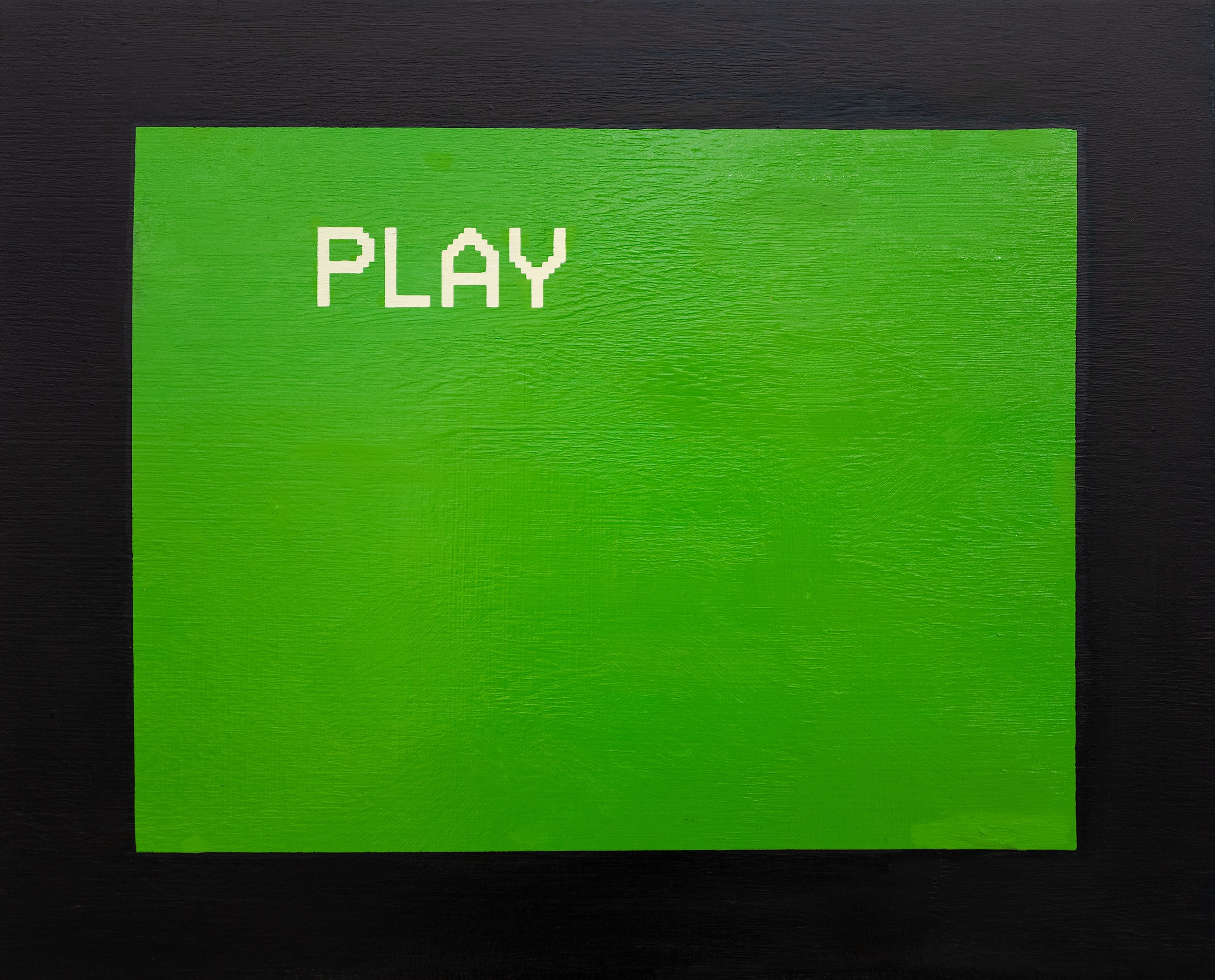
The word "PLAY" appears in the center of a black screen. It is set in a sans-serif typeface, white or near-white against the dark surround, with a small triangular arrow to its left, the universal symbol for playback on a videotape recorder. The screen is green, the specific green of a cathode ray tube in the seconds after the tape is inserted and before the content begins, a green that anyone who grew up in the era of VHS will recognize instantly as the color of anticipation, the color of the machine waiting, the color of the medium readying itself to deliver whatever the viewer has queued. The green is not uniform. It carries the faint horizontal lines of a CRT scan, the raster pattern that distinguishes a television screen from a painted surface, the texture that says: this is electronic, this is generated, this came from a machine. And yet the green is paint. It is oil on linen, applied in horizontal strokes that mimic the scan lines they depict, built up over a black ground that shows through at the edges, creating the illusion of a screen that is simultaneously a surface and a window, an object and an interface, a thing you can touch and a thing that commands you to watch.
Play (2022) is 41 by 51 centimeters, oil on linen, roughly the proportions of a small monitor or a page from a manual of instructions. The format matches its subject. This is not a painting about a landscape or a portrait of a person. It is a painting about an interface, and the size of the canvas corresponds to the size of the screen that delivers the interface to the viewer. The black border that frames the green field mimics the bezel of a television set, the plastic housing that separates the screen from the room, the frame that turns a glowing rectangle into an appliance. Inside this frame, the green field fills the entire picture plane, and the word "PLAY" floats in its center, preceded by the arrow, commanding attention and action. The word is not describing something. It is instructing someone. It is a command issued by a machine to a human, and the human is expected to obey, not by pressing the button again, but by watching, by settling into the chair, by allowing the content to begin and the hours to pass in the glow of the screen.
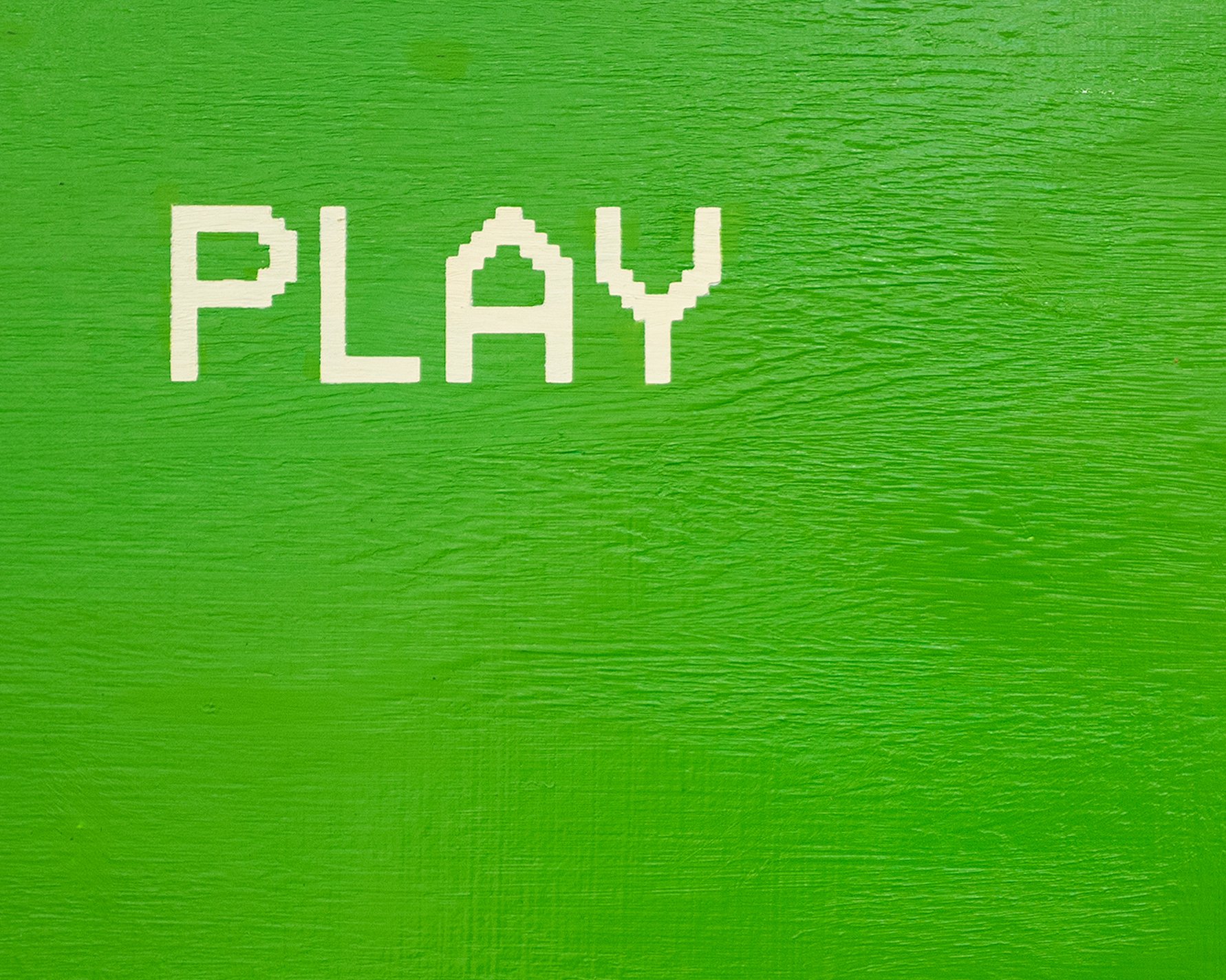
The paint handling is specific and deliberate. Tan Mu describes beginning with a black base layer, allowing it to dry fully, and then applying layers of green oil paint over it. The green pigment was applied thickly, creating what she calls "a dense, tactile surface." The horizontal brush movements form "ripple-like stripes that mimic scan lines and the refresh behavior of CRT screens." This is not a painting that imitates the appearance of a screen from a distance. It is a painting that reconstructs the screen's material behavior at the level of the brushstroke. Each stroke of green paint is a scan line, each layer of paint a refresh cycle, each pass of the brush an approximation of the electron beam that drew the image on the phosphor coating of a cathode ray tube. The word "PLAY" was added last, as "the final visual anchor," painted over the green field in a lighter tone that reads as white against the surrounding darkness. The black border is the black ground showing through, the original layer of the painting that was never covered by green, serving as the bezel that turns the painted surface into a screen-shaped object. The linen weave is not visible in the finished work. The surface is dense, the paint is thick, and the horizontal strokes are the texture that a viewer sees when standing close, the texture that resolves into scan lines when viewed from a few feet back and into a smooth screen when viewed from across the room.
Ed Ruscha's OOF (1962) is a painting of a single word, three letters, rendered in large, blocky type against a dark ground. The word is an onomatopoeia, the sound of a punch, a collision, an impact, and it is also a word that refuses to become an image. You can read it, you can say it, you can hear the sound it describes, but you cannot look at it the way you look at a landscape or a face. The word is the image. There is nothing behind it, no representational content that the word labels or describes. It is what it is: three letters in yellow against a dark blue-black background, floating in a space that is neither a wall nor a canvas nor a billboard but something that Ruscha leaves deliberately ambiguous, a non-space that could be any surface where a word might appear, a sign, a screen, a page, a painting. The word "OOF" is funny and violent at the same time, a comic book sound effect stripped of its comic book context and placed in the austere format of a mid-century abstract painting, where it sits, doing nothing except being itself, being a word that is also a sound that is also a painting.
The structural connection to Play is the word as both command and image. Ruscha's "OOF" is a sound that has been turned into a visual object. Tan Mu's "PLAY" is a command that has been turned into a visual object. Both paintings take a word from the vocabulary of popular media, "OOF" from comic books, "PLAY" from the VCR interface, and place it in the center of a composition where the word becomes the only content. Both paintings frame the word within a colored ground that mimics the surface on which the word originally appeared: the comic book panel for Ruscha, the television screen for Tan Mu. Both paintings freeze the word in a moment that denies its function. "OOF" is the sound of an impact that never lands. "PLAY" is the command to begin something that never begins. The painting holds the word in a state of permanent readiness, the arrow pointing right, the finger on the button, the moment just before the tape starts rolling, extended indefinitely across the surface of a canvas that will never play anything. The irony that Tan Mu identifies in the work, "a motionless frame branded with the command to play," is the same irony that animates Ruscha's word paintings: the word that does what it says it cannot do, the image that shows what it cannot perform.
Tan Mu's Q&A for the work locates its origin in a specific visual memory. "That image carries a strong visual memory for me," she writes, "particularly the green screen that signaled the beginning of recorded content." The green screen is not an abstraction. It is a specific technological artifact, the color that a cathode ray tube displayed when no video signal was present but the machine was active, waiting, ready to receive the data that would fill the screen with images. It was the color of the medium in a state of readiness, the color of the apparatus between states, the color of not-yet-playing. For anyone who grew up in the era of VHS tapes, this green is a Proustian trigger. It summons not a specific program but the condition of watching, the state of sitting in front of a screen and waiting for the content to begin, the anticipation that preceded every viewing experience. The painting does not depict a program. It depicts the interval between inserting the tape and pressing play, the moment when the machine has acknowledged the cassette but the content has not yet started. This interval, which lasted a few seconds in actual experience, becomes permanent in the painting. The machine will never play. The content will never begin. The viewer will sit in front of the green screen forever, waiting for something that the painting, by its nature as a still object, cannot deliver.
The word "PLAY" in Tan Mu's description operates on multiple registers. "It is a technical instruction," she notes, "but it is also a symbol of entertainment, consumption, and information delivery." This doubleness is the painting's subject. "PLAY" tells the viewer to press a button on a remote control. It also tells the viewer to play, to engage in leisure, to consume what the screen provides, to spend time in front of the television rather than doing anything else. The command is both functional and ideological. It tells you what to do with the machine, and it tells you what to do with your evening. Neil Postman's Amusing Ourselves to Death (1985), which Tan Mu cites as a direct influence, argues that television has transformed public discourse into entertainment, that the format of the medium, its reliance on visual imagery, its preference for brevity and spectacle over sustained argument, has reshaped how a culture thinks, speaks, and governs itself. The word "PLAY" on the screen is the most honest statement the medium ever makes. It does not say "inform," "educate," "discuss," or "deliberate." It says "play." It tells you what it is for. It tells you what it wants you to do. And the painting, by isolating this word and freezing it on a canvas that cannot play anything, makes the command visible as a command, stripping away the content that would normally follow it and leaving only the instruction, the imperative, the structure that organizes the viewer's time, attention, and desire.
Nam June Paik's TV Buddha (1974) places a seated Buddha sculpture in front of a closed-circuit television camera. The camera feeds its image to a monitor that faces the Buddha, so that the Buddha is watching a live video image of itself. The sculpture, an ancient religious figure associated with meditation, enlightenment, and the transcendence of worldly attachments, is locked into a feedback loop with a technology of modern entertainment, the television, a device associated with distraction, consumption, and the endless circulation of images. The Buddha watches itself watching itself, and the loop closes. There is no outside to the circuit. The image on the monitor is not a broadcast. It is not a program. It is the Buddha's own image, reflected back at him in real time, a self-portrait generated by a machine that does not distinguish between a religious icon and any other object placed in front of its lens.
The structural connection to Play is the screen as a closed system of command and response. Paik's Buddha is instructed by the circuit: watch this. Tan Mu's viewer is instructed by the interface: play this. Both commands are issued by the same apparatus, the television, which in Paik's work has been turned into a mirror and in Tan Mu's work has been turned into a painting. The screen in Paik reflects the viewer's image back to the viewer. The screen in Tan Mu reflects the viewer's expectation back to the viewer. In both cases, the screen produces a closed circuit. The Buddha watches itself. The viewer watches the word that commands the viewer to watch. The circuit of watching and being commanded to watch is the circuit that Play makes visible by removing the content that would normally fill the screen and leaving only the command. Paik removes the broadcast and replaces it with the viewer's own image. Tan Mu removes the content and replaces it with the interface. Both artists show what the screen looks like when it is not delivering the entertainment it was built to deliver. Paik shows it reflecting. Tan Mu shows it waiting. And in both cases, the result is more revealing than any program the screen could show, because the circuit itself, the command structure that organizes the viewing experience, has been made visible as a structure.
Tan Mu describes the shift from the television era to the present as a shift in the platform, not in the structure. "During the television era," she writes, "daily leisure and shared cultural experience were largely shaped by TV programming. Today, that role has been taken over by social media platforms and online content." The screen has changed. The command has not. The word "PLAY" that appeared on the VCR interface in the 1980s and 1990s has been replaced by the play button on every streaming service, every video player, every social media app that delivers moving images to a handheld screen. The format is the same. The triangular arrow still points right. The command still says: watch this. The difference is that the command now appears on a device that is always on, always connected, always ready to deliver content, and the green screen of anticipation has been replaced by an infinite scroll of content that never requires the viewer to wait. There is no pause between the insertion of the tape and the beginning of the program because there is no tape and there is no program. There is only the stream, which plays continuously and can be paused at any point, which means that the moment of waiting, the green screen, the interval between the machine's readiness and the content's arrival, has been eliminated from the experience of watching. Play preserves this interval. It paints the moment that has been engineered out of existence, the pause before the play, the silence before the stream, the green screen that said: the machine is ready, are you?
Saul Appelbaum, writing in Dreaming in Public (2025), argues that Tan Mu's paintings "function more as self-portraits, rather than depictions of external, scientific milestones." The observation applies with particular clarity to Play. The painting does not depict a VCR interface. It depicts the artist's memory of a VCR interface, the specific green and the specific arrow and the specific word that she remembers from her own experience of inserting a tape and waiting for the content to begin. The memory is not only hers. It is shared by anyone who grew up in the era of VHS, and it is precisely this shared quality that makes the painting a self-portrait of a generation rather than an individual. The green screen is a collective memory, a visual experience that was repeated in living rooms around the world every time someone pressed play on a VCR. By painting this memory, Tan Mu is not documenting a technology. She is documenting the experience of a technology, the way it felt to sit in front of a screen and wait for the green to resolve into image, the way the anticipation was part of the experience, the way the command structure of the medium was visible because the medium was not yet seamless enough to hide it. The painting is a self-portrait because it portrays the viewer's position in front of the screen, the position of the person who is about to watch, who has been told to play, and who has not yet begun to do what the screen has instructed.
The black border that frames the green field is the material boundary between the screen and the world. In a real television set, this border is the plastic bezel, the housing that encloses the cathode ray tube and separates the glowing rectangle from the room. In the painting, the black border is the underpainting, the first layer of black oil paint that was allowed to dry before the green was applied over it. It is the ground of the painting, the surface that existed before the screen was painted on top of it, just as the plastic bezel is the object that existed before the screen was manufactured inside it. The painting does not hide its material origin. It uses it. The black border is not painted over the green. It is visible because the green was painted over the black, and the black was left exposed at the edges, exactly where the bezel of a television would be. The painting is a screen painted on a ground, a surface painted on a surface, an interface painted on a canvas. The relationship between the two surfaces, the black ground and the green screen, mirrors the relationship between the bezel and the display, between the object that houses the technology and the technology itself, between the world that surrounds the screen and the world that the screen displays. The painting holds both. It is the bezel and the display, the object and the image, the thing you can touch and the thing that tells you what to do.
The horizontal strokes that mimic the scan lines of a CRT are the painting's most precise formal decision. Each stroke is a band of green paint applied across the width of the canvas, overlapping the stroke above it and the stroke below it, creating a texture that reads as a pattern of lines from a distance and as a series of individual brushstrokes up close. This texture is the material proof that the painting was made by hand, that each line of the scan pattern was laid down one at a time, in sequence, from top to bottom or bottom to top, by a painter who was recreating the visual effect of a technology that drew its images in the same way, one line at a time, from top to bottom, at a rate of thirty or sixty lines per second. The CRT and the oil painting share this fundamental structure. Both build their images from lines. Both require the viewer to stand at a certain distance to see the lines resolve into a coherent picture. Both reveal their construction to the close observer and conceal it from the distant one. The painting does not simply depict a CRT screen. It reconstructs the CRT's method of image-making in the medium of oil paint, and in doing so, it reveals that the two technologies, separated by centuries, share a deeper structural logic: the image is built from lines, the lines are applied in sequence, and the viewer assembles them into a whole. The painting does not represent the screen. It performs the screen's operation in a different material.
The word "PLAY" is the last element to be added to the composition, and it functions as what Tan Mu calls "the final visual anchor." It is the element that locks the painting into its referent. Without it, the green rectangle with horizontal lines could be an abstract painting, a color field, a study in green and black. With it, the painting is unambiguously a screen, and the screen is unambiguously a VCR interface, and the interface is unambiguously waiting for someone to press a button. The word turns the entire composition from an abstract exercise into a representational one, and it does so with a single stroke of a different color. The white or near-white of the letters against the green of the screen is the highest contrast in the painting, the point where the eye lands first and returns to last. It is the command that gives the painting its direction, and it is the command that the painting denies. The arrow points right. The word says play. The painting will never play. It holds the command in a state of permanent suspension, a permanent readiness that can never be resolved into action, because the action it commands, the playing of content on a screen, is an action that oil on linen cannot perform. The painting shows the interface. It does not perform the function. It makes the command visible by preventing it from being executed. And in that gap between the command and its execution, the painting shows what the screen normally conceals: that every act of watching begins with an instruction, that every moment of consumption is preceded by a command from the machine, and that the instruction "play" is the first thing the screen says to the person who has agreed to watch it.