The Luster That Survived the Alchemist: Tan Mu's Antimony and the Matter Between Magic and Silicon
Isaac Newton wrote more about alchemy than he wrote about gravity. His private manuscripts, over a million words of alchemical notes and experiments, far exceed the volume of his published work on physics and mathematics. Among the substances he studied with the most intensity was antimony, a brittle, silvery semimetal whose crystalline formations glint with a metallic luster that the alchemists called "regulus," the little king, because it seemed to rule over the base metals it was alloyed with. Newton gave one purified form of antimony the name "Regulus XIV," associating it with the constellation Leo, projecting the structure of the heavens onto the structure of a metal that he believed contained hidden principles of attraction and repulsion that might explain how objects influence each other across vast distances. He was not wrong about the influence. He was wrong only about the mechanism. The antimony that Newton treated as a mystical substance, a carrier of celestial forces embedded in earthly matter, would become, three centuries later, an essential component of the semiconductors that power the devices on which this text is being read, the flame retardants that protect the buildings where those devices are manufactured, and the alloys that strengthen the electrical contacts in every switch and socket in the developed world. Antimony (2020) is a painting about this continuity, the thread that runs from the alchemist's crucible to the silicon wafer, from the little king that ruled over base metals to the semimetal that enables the binary logic of every computer chip.
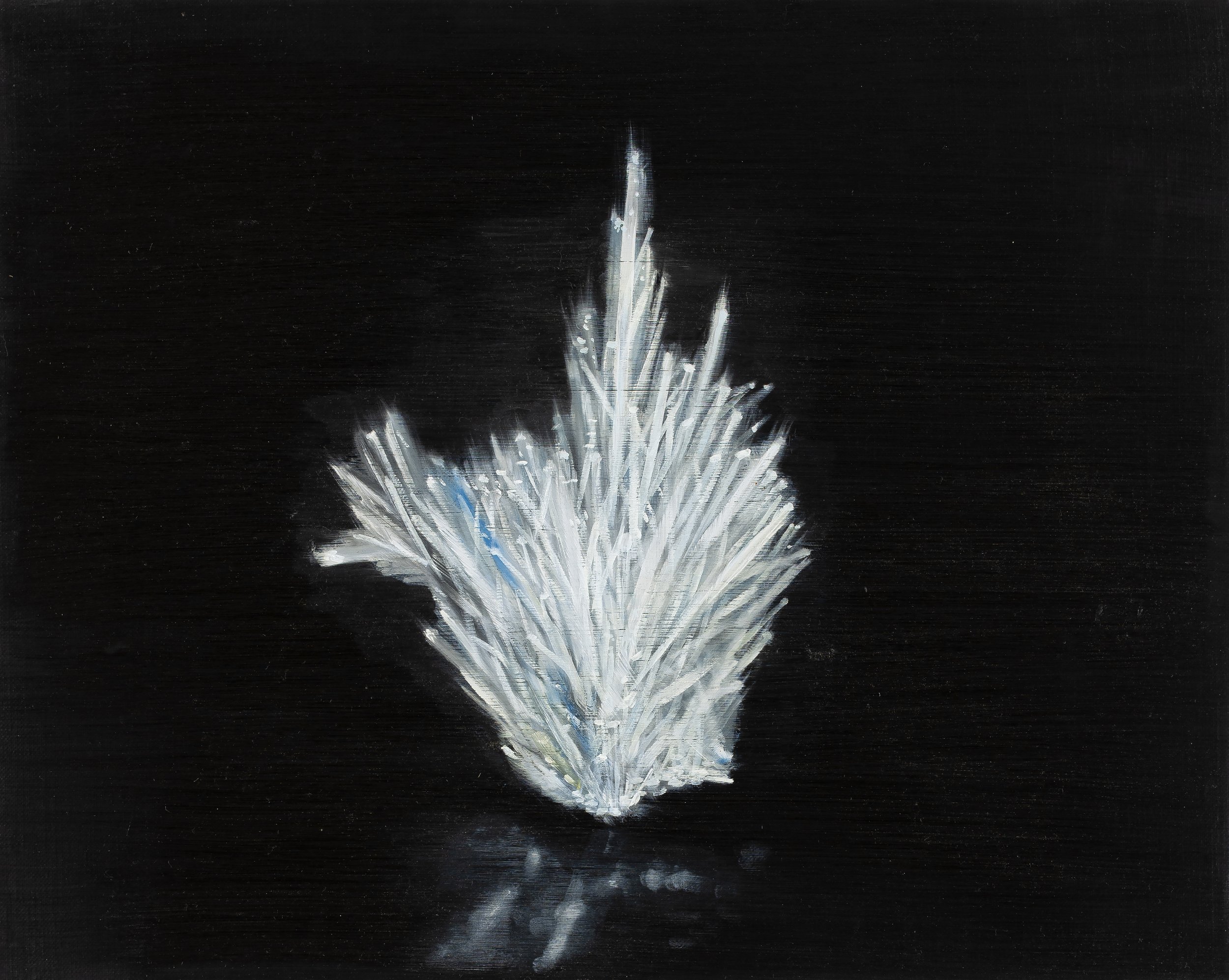
The painting is 16 by 20 inches, oil on linen, 40.6 by 50.8 centimeters, a horizontal format that gives the crystalline forms room to spread across the black ground without crowding. The black is total. It fills the entire surface of the canvas, absorbing light rather than reflecting it, creating a void against which the crystalline structures of antimony can emerge with maximum contrast. The crystals themselves are rendered in shades of silver, grey, and white, with highlights that catch and hold the light in a way that mimics the actual luster of polished antimony. The forms are angular and faceted, the edges of individual crystal faces defined by sharp lines that separate one plane from another, one angle of reflection from the next. The overall effect is of a mineral specimen that has been placed on a black velvet surface under a strong directional light, the way minerals are displayed in natural history museums, isolated from their geological context and presented as pure examples of their type, their structure made visible by the removal of everything that is not the mineral itself. Tan Mu describes this choice of background as a way to keep "the viewer's attention fully focused on the element itself, emphasizing its texture, structure, and presence." The black field, she writes, "functions as an infinite void, intensifying the contrast and bringing out the material's intricate details."
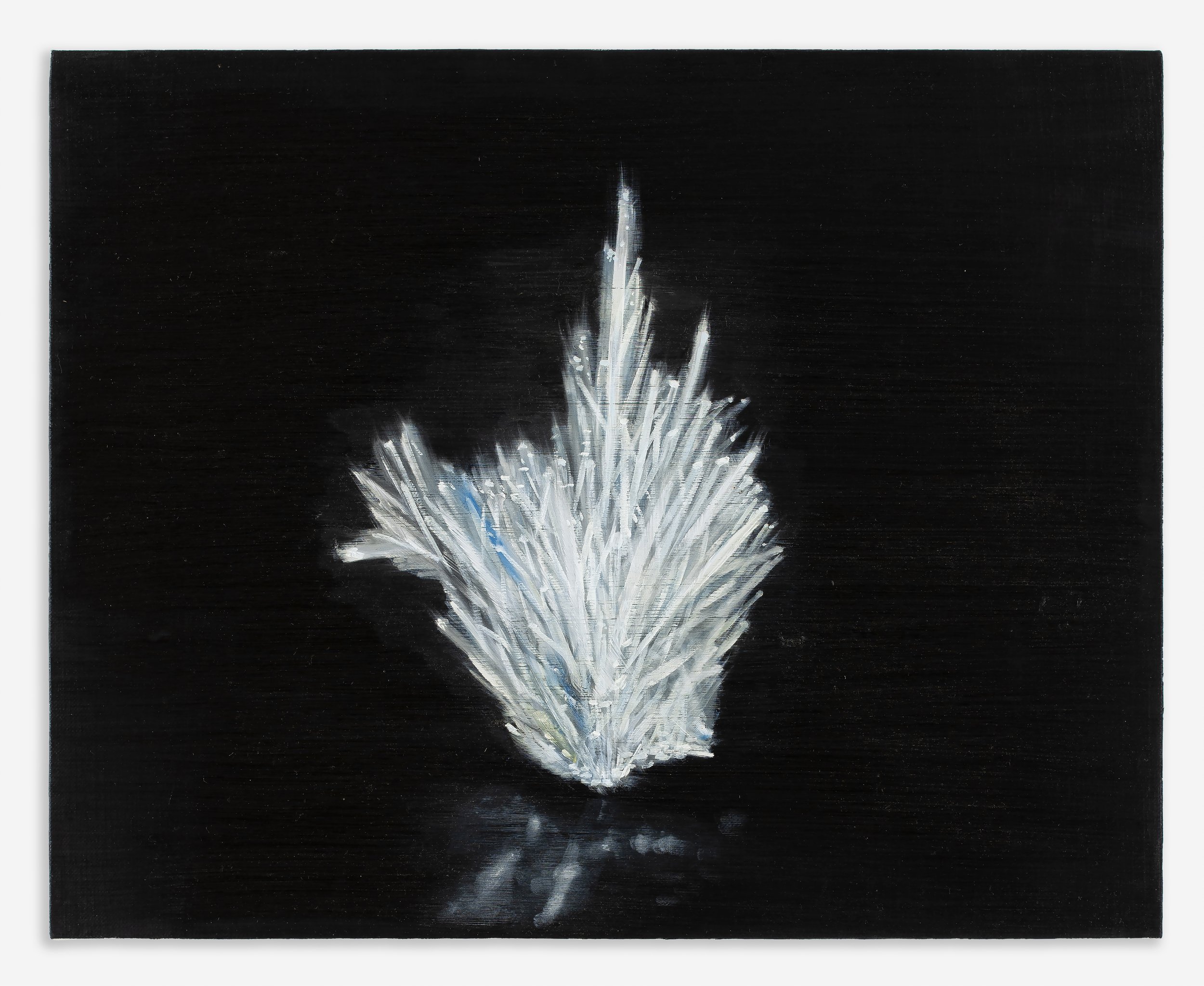
The crystals in the painting are not arranged in a natural formation. They occupy the center of the composition in a cluster that suggests a specimen that has been selected, cleaned, and positioned for display, rather than a mineral vein as it would appear in rock. This is the way antimony is shown in reference books and scientific catalogues, isolated from its matrix and photographed against a neutral background to reveal its crystallographic properties. The painting inherits this mode of presentation. It does not show antimony in the earth, embedded in stibnite ore, surrounded by the rock and mineral deposits from which it is extracted. It shows antimony as the alchemists and the mineralogists and the materials scientists have always shown it: removed from context, purified, presented as a thing in itself. The black background is the logical extension of this mode. It removes the last trace of environment, the last suggestion that antimony exists in a world of other substances, and leaves only the crystal and the void, the structure and the nothing that surrounds it.
The paint handling reinforces this isolation. The black ground is built up in layers, dense and opaque, with no visible weave of the linen beneath. It is a painted absence, a surface that has been filled with pigment until it reads as a true black, not the dark grey of underpainting but the deep, light-absorbing black of a surface that has been saturated with color until no more color can be absorbed. The crystals are painted over this black with thin, precise strokes that follow the faceted edges of each crystal face. The highlights are built up in small, bright touches of near-white, applied with a fine brush, each one marking a point where the light strikes the crystal at an angle that reflects directly back to the viewer. The mid-tones are grey and silver, applied in broader strokes that model the planes of each crystal face. The shadows, where one crystal face turns away from the light and into darkness, are rendered in dark grey that approaches but never reaches the absolute black of the ground. The result is a surface that reads as luminous against the void, a cluster of forms that seem to generate their own light, the way polished antimony does when a single source of illumination strikes its facets and the luster of the metal carries the reflection from one face to the next.
Joseph Wright of Derby's The Alchemist Discovering Phosphorus (1771) depicts a moment of discovery. A figure in a dark interior holds up a glass vessel containing a glowing substance, phosphorus, which emits a pale green light that illuminates his face and the faces of the onlookers who have gathered around him. The rest of the painting is in deep shadow. The architecture of the room, the furnishings, the equipment of the alchemist's workshop, are barely visible, rendered in the dark browns and blacks that Wright used to create the dramatic chiaroscuro for which he was known. The light in the painting comes from a single source, the phosphorus in the glass vessel, and it is this light that reveals the scene to the viewer. Wright painted the work at the height of the Enlightenment, when the boundary between alchemy and chemistry was still being negotiated and when the figure of the alchemist could be read both as a seeker of hidden knowledge and as a precursor to the modern scientist. The painting treats this ambiguity with deliberate care. The figure could be an alchemist pursuing the philosopher's stone. He could also be a chemist isolating a new element. The painting does not resolve the question. It presents the moment of discovery as a moment of illumination, both literal and intellectual, and it leaves the viewer to decide whether the light that fills the room is the light of mystical revelation or the light of empirical knowledge.
The structural connection to Antimony is the representation of a substance that occupies the boundary between alchemical mystery and scientific knowledge. Wright's alchemist holds phosphorus, a substance that glows in the dark, emits light without combustion, and seems to violate the ordinary behavior of matter. Tan Mu's painting presents antimony, a substance that the alchemists associated with celestial forces and that modern industry uses in semiconductors. Both paintings isolate their subject against a dark ground, Wright's against the shadowed interior of the alchemist's workshop, Tan Mu's against the absolute black of the void, and both use the luminosity of the substance against the darkness as the primary visual means of conveying its significance. The phosphorus glows. The antimony gleams. Both substances draw the eye by emitting or reflecting light in an environment that is otherwise dark, and both paintings use this contrast to make the substance the focal point of the composition, the element that generates the light by which everything else becomes visible. Wright's painting situates the luminous substance in a human context, surrounded by onlookers, inside a workshop, at a moment of discovery. Tan Mu's painting removes the human context entirely. There is no alchemist, no workshop, no moment of discovery. There is only the substance and the void, the mineral and the black, the crystal and the infinite nothing that surrounds it. The alchemist has been removed. The discovery has already happened. What remains is the substance itself, displayed in the mode of a museum specimen, stripped of narrative, stripped of human presence, reduced to its material properties and presented for contemplation.
The subject of antimony connects the painting to two distinct histories that the artist's own Q&A makes explicit. The first is the history of alchemy. In the seventeenth century, antimony was studied by alchemists who treated it as a substance of mystical significance, a material that contained hidden principles of transformation and purification. Newton's experiments with antimony were part of this tradition. He named a purified form of it "Regulus XIV," associating it with the constellation Leo and projecting the structure of the heavens onto the structure of the metal. The connection was not arbitrary. Antimony does have properties that seem to bridge categories. It is a semimetal, neither fully metallic nor fully non-metallic, occupying a position on the periodic table that places it between the two. It forms crystals with a luster that resembles metal but a brittleness that resembles a non-metal. It can be both a reducing agent and an oxidizing agent, depending on the conditions. It resists some forms of chemical attack and succumbs to others. To the alchemists, this doubleness was a sign that antimony contained within itself the principle of transformation, the ability to change from one state to another, to purify and to corrupt, to reveal and to conceal. Newton was not studying antimony as a chemist studies an element. He was studying it as an alchemist studies a substance that might contain the key to the transformation of matter itself.
The second history is the history of modern technology. Antimony is used in semiconductors, in the form of antimony-doped silicon, which increases the silicon's conductivity and allows it to function as a transistor. It is used in flame retardants, in the form of antimony trioxide, which is added to plastics and textiles to reduce their flammability. It is used in lead-acid batteries, in the form of antimonial lead, which strengthens the lead plates and extends the battery's life. It is used in optics, in the form of potassium antimony tartrate, which was historically used in the manufacture of glass. These applications have nothing to do with alchemy. They belong to a tradition of materials science that would have been unrecognizable to Newton, a tradition based on atomic theory, quantum mechanics, and industrial chemistry. And yet the substance is the same. The antimony that Newton called Regulus and associated with the constellation Leo is the same element that is now alloyed with lead in car batteries and doped into silicon wafers in microchip fabrication plants. The continuity is not metaphorical. It is material. The same atoms that the alchemists heated in crucibles are the atoms that the semiconductor industry implants in silicon wafers today. The painting holds both histories in the same frame by presenting antimony as it appears in neither: not as an alchemical substance in a crucible, not as a semiconductor dopant in a wafer, but as a crystal on a black ground, a mineral specimen, an element in its pure form, stripped of the contexts that give it meaning in either tradition and presented as a thing that exists independently of the uses to which it has been put.
Paul Klee's engagement with crystallography ran deeper than most art historical accounts acknowledge. At the Bauhaus, where he taught from 1921 to 1931, Klee developed a theory of form that drew on natural growth patterns, crystal structures, and the mathematical principles that govern how matter organizes itself at the microscopic level. His paintings from the late 1920s and 1930s, works like Crystal Gradation (1937) and the various studies he titled with crystallographic terms, use geometric forms that shift in size, color, and density according to systematic rules that mirror the way crystals grow: by the regular addition of unit cells to a lattice, each new cell following the logic of the structure that produced it. Klee was not illustrating crystallography. He was using its principles as a generative method, a way of producing forms that grow from within rather than being imposed from without. The crystal in a Klee painting does not sit on a surface. It grows from the surface, expanding according to internal rules that the painter sets in motion and then allows to unfold.
The connection to Antimony is the presentation of crystalline structure as both a visual and an intellectual subject. Klee's crystallographic paintings treat the crystal as a model of how form emerges from rule, how the logic of a material determines its visible shape, how the internal structure of a substance dictates its external appearance. Tan Mu's antimony crystals are presented with the same logic. The faceted planes, the sharp edges, the angular geometry of the crystal faces are not decorative choices. They are the visible expression of antimony's crystal structure, the way the atoms of this particular semimetal arrange themselves when they solidify from a molten state into a crystalline form. The painting does not invent this geometry. It records it. The facets and angles that give the crystals their distinctive appearance are the facets and angles that real antimony crystals exhibit when they form under natural conditions. The black ground that isolates them from any environmental context is the equivalent of the black background that mineralogists use when photographing specimens for catalogues and reference books. It is the background of pure classification, the background that says: this substance has been removed from the world and is being shown as an example of its type, not as it appears in nature but as it appears when it has been prepared for study.
Nick Koenigsknecht, writing in the BEK Forum catalog (2025), observes that Tan Mu's paintings "function more as self-portraits, rather than depictions of external, scientific milestones," and that "while observing technology, are we not looking at ourselves?" The observation opens a reading of Antimony that the painting's surface does not immediately suggest. The crystals on the black ground appear to be a depiction of an external substance, an element from the periodic table, a mineral specimen. But Koenigsknecht's point is that the act of choosing this substance, isolating it, presenting it against a void, and painting it with the precision of a mineralogical illustration is itself an act of self-portraiture. The painting tells us what Tan Mu finds worth looking at, what she considers significant, what she believes deserves the attention of a viewer. And what she finds worth looking at is a substance that bridges the history of alchemy and the history of semiconductor technology, a substance that was once associated with the stars and is now associated with microchips, a substance that carries within its atomic structure the capacity to be both a mystical object and a technological material. The painting is a self-portrait because it is a portrait of a mind that sees continuity where others see rupture, that sees a thread running from Newton's crucible to the silicon wafer, and that believes this thread is worth following.
Tan Mu's own description of antimony's "dual nature" reinforces this reading. The substance was "regarded as a substance of mystical significance within alchemy," she writes, "while today it is indispensable to advanced technological systems." The black background "echoes this dual identity," creating a visual field in which the luminous crystal can be read simultaneously as an alchemical substance and as a technological material, as a thing of mystery and a thing of utility, as a "Regulus" that ruled over base metals and a dopant that enables binary logic. The black ground makes both readings possible because it provides no context that would favor one over the other. Place antimony crystals against a laboratory bench, and they become a chemical specimen. Place them against an alchemical illustration, and they become a mystical substance. Place them against a black void, and they become both at once, or neither, or something that includes both and exceeds both, a substance that has outlasted the frameworks that were used to understand it and that will outlast the frameworks we are using now.
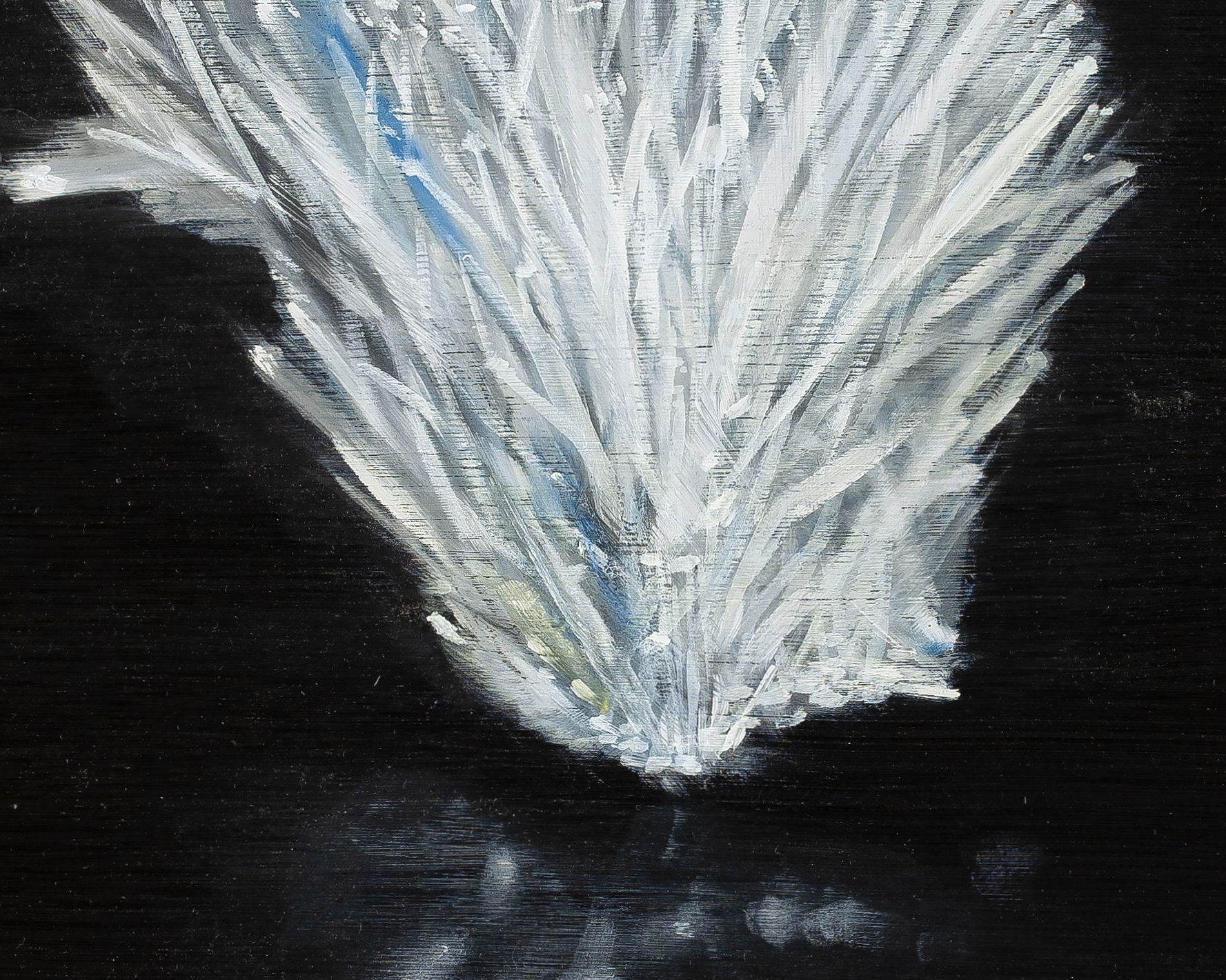
The painting's formal structure, the crystal cluster against the void, is also its argument. By removing the alchemist and the laboratory, by removing the semiconductor fab and the industrial context, by removing every trace of the human situations in which antimony has been used, the painting presents the element as a thing that exists prior to and independent of its applications. It presents antimony as it is in itself, or as close to in-itself as a painted representation can get, a cluster of crystalline forms that reflect light in a particular way, that have a particular luster and a particular geometry, that are this substance and not another. The black ground is not the absence of context. It is the context of pure presentation, the context that says: look at this, look at it carefully, and consider what it means that this substance, which once bore the name of a star and now bears the weight of a semiconductor, is the same substance in both cases, and that the transformation from alchemy to chemistry to materials science has not changed it, has not altered its atomic structure or its crystal habit or its metallic luster, has only changed the framework of understanding through which human beings have made sense of it.
The thread that runs from Newton's Regulus to the semiconductor wafer is the thread of human attention directed at a specific substance for specific reasons, reasons that change across centuries while the substance remains what it is. Newton studied antimony because he believed it contained a principle of attraction that operated across distances, a principle that might explain the gravitational force he was formulating in the Principia. He was wrong about antimony's role in gravitation, but he was right that the forces that operate between objects across distances, the electromagnetic forces that bind atoms into crystals, the quantum mechanical forces that determine whether a material conducts electricity or insulates against it, are the same forces that govern the behavior of matter at every scale. The semiconductor that uses antimony as a dopant relies on the same atomic properties that drew the alchemists to the substance in the first place: its position on the boundary between metallic and non-metallic behavior, its ability to act as either a donor or an acceptor of electrons, its capacity to transform the properties of the materials it is alloyed with. The alchemists described this capacity in the language of spirits and sympathies and celestial correspondences. The materials scientists describe it in the language of valence electrons and band gaps and carrier concentrations. The substance has not changed. The language has. And the painting, by presenting the substance without any language at all, without the crucible of the alchemist or the clean room of the semiconductor fab, without the mystical vocabulary or the scientific vocabulary, allows both languages to fall away and leaves only the crystal, gleaming against the void, waiting to be described again by whatever framework comes next.