The Orbit That Remade Landscape: Tan Mu's Horizons 04 and the View From Outside the Atmosphere
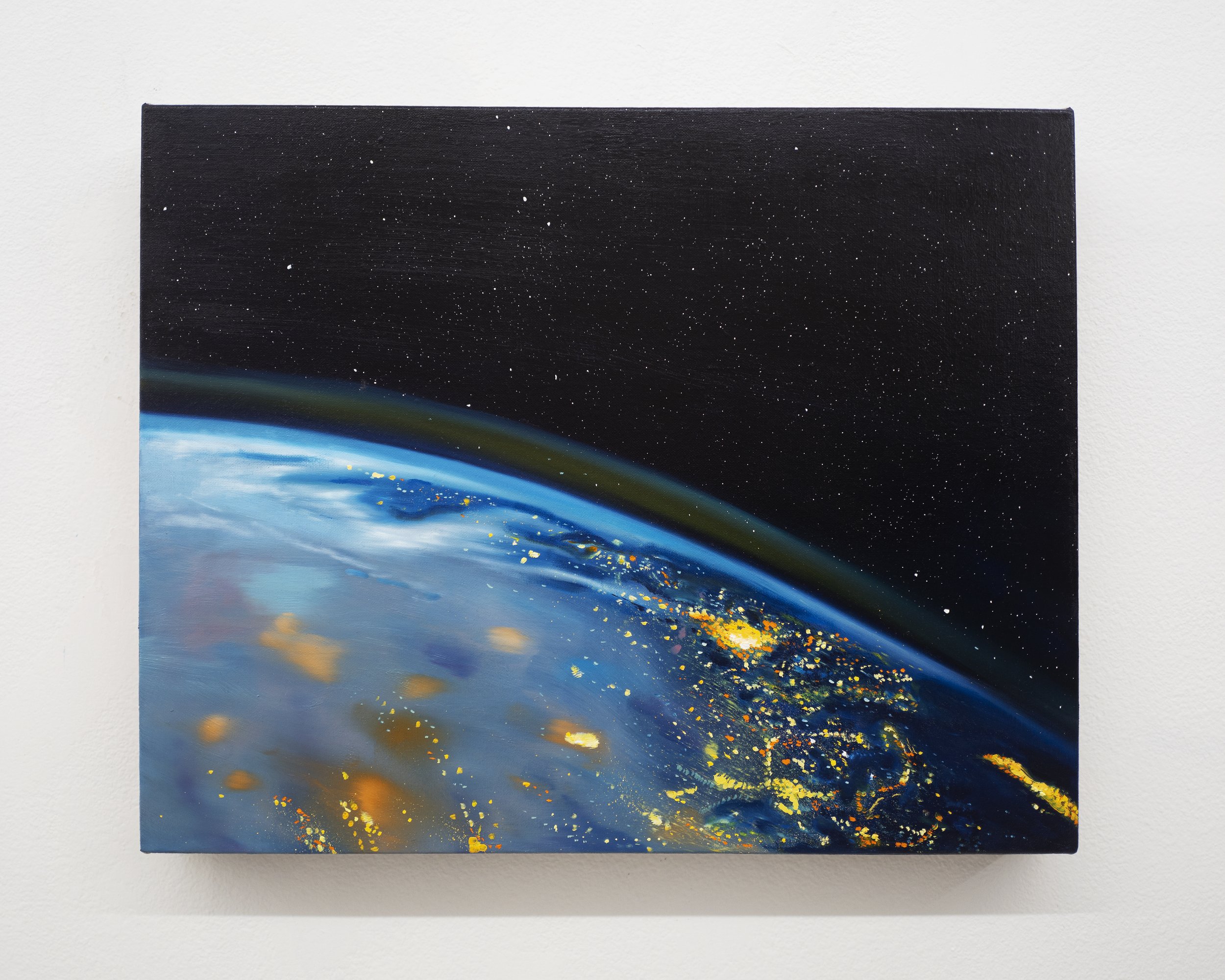
At arm's length, the surface of Horizons 04 reads as a single gesture: a band of amber light suspended between two fields of darkness. The upper third is a deep, near-black blue that holds warmth at its lowest edge, where a thin film of indigo separates sky from atmosphere. The lower two-thirds glow with the density of city light seen through cloud cover, gold and rust bleeding into bands of teal where the horizon's heat meets the cool of open water. Up close, the amber dissolves. It is not one gesture but hundreds, each mark a discrete decision about where light collects and where it scatters, layered in oil on linen so that the weave of the fabric catches pigment in its valleys and surrenders it along the ridges. The painting is modest in scale, 41 by 51 centimeters, small enough to hold. It belongs to a tradition of landscape that has never been satisfied with standing on the ground.
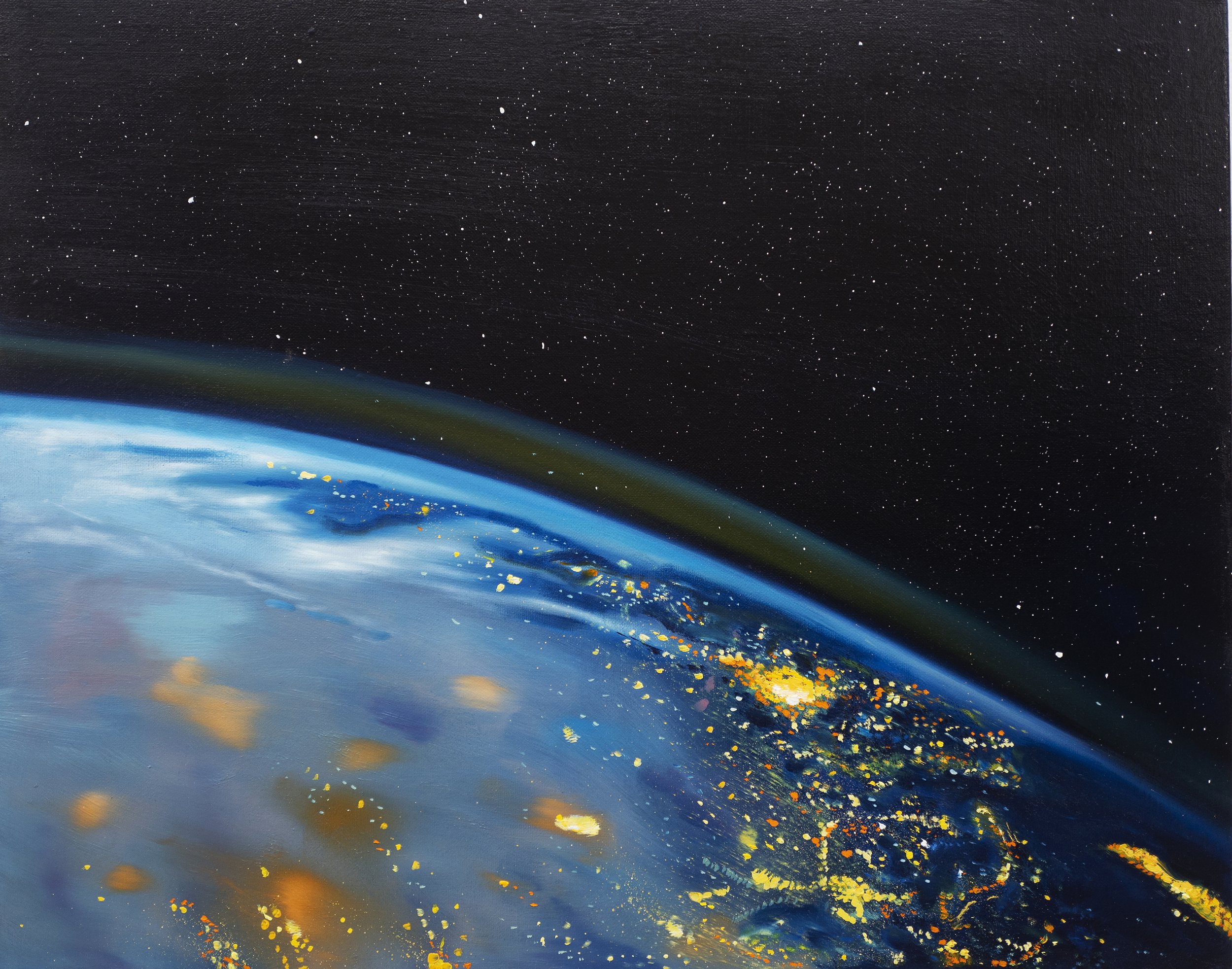
Tan Mu describes the Horizons series as drawing inspiration from the International Space Station, capturing "the radiant lights of megacities and the dreamlike reflections of Earth's atmosphere." The satellite perspective is not incidental to these paintings. It is their structural condition. The viewer is positioned outside the atmosphere, looking down at the limb of the planet as a band of luminous haze separates the black of space from the illuminated surface below. This is not landscape painting as it has been practiced for centuries, which assumes a viewer standing on terra firma, horizon at eye level, sky above. This is landscape after the overview effect, after the photograph taken by a V-2 rocket in 1946, after live feeds from the ISS made the planet's luminous edge into a screensaver and a screensaver into a collective visual memory. Tan Mu's question is not what landscape looks like from orbit. Her question is what painting becomes when the horizon is no longer a limit but a band of information.
The linen ground of Horizons 04 is visible in the darker passages, particularly along the upper edge where the black of space thins to reveal the weave beneath. This is not an accident of technique. It is a registration of the painting's material condition, a reminder that what the viewer encounters is a surface coated in pigment, not a window onto the world. The linen shows through most where the paint is thinnest, in the regions that correspond to the vacuum above the atmosphere. Where the atmosphere is densest, where city lights push through cloud and scatter into the stratosphere, the paint accumulates, thickened with wax to build a relief that catches the gallery light differently depending on viewing angle. The access points of luminosity are raised, tactile, almost sculptural. The dark zones are flat, absorptive. The painting constructs its own atmospheric perspective: the thicker the impasto, the closer to the viewer's world; the thinner the paint, the further into the void.
The color register operates within a deliberately narrow range. There are no greens, no reds, no local color of the sort that landscape painters have used since the seventeenth century to anchor a scene in a specific place and season. The palette is restricted to warm gold, burnt sienna, deep teal, and the blue-black of orbital night. These are not the colors of any particular city at any particular hour. They are the colors that satellite sensors and human eyes converge upon when the specifics of geography dissolve into the general condition of habitation seen from above. The gold is the color of sodium vapor streetlights, of window glass catching artificial illumination, of the cumulative glow of a metropolitan region as it registers on a camera sensor designed for astronomical observation. The teal is the color of the atmosphere's edge, the thin shell of nitrogen and oxygen that scatters blue light back toward space. The painting's restricted palette is itself an argument: that from orbital distance, the particularities of place resolve into the common condition of light on atmosphere.
Hiroshi Sugimoto's Seascapes, a series he has maintained since 1980, offer the closest precedent in contemporary art for what Tan Mu attempts in Horizons, though the difference between them is as instructive as the similarity. Sugimoto's Seascapes divide each composition precisely in half: water below, air above, the horizon line running through the exact center of the frame. The exposure times extend to hours, sometimes days, so that the sea surface blurs into a single luminous plane and the sky becomes a field of graduated tone. The result is an image that refuses to locate the viewer in time or space. It could be any ocean on any morning. It is the horizon reduced to its most essential structure, the boundary between two media, two states, two orientations. Sugimoto has described the series as an investigation of "the time before human memory," a prehistoric condition of seeing that precedes any particular cultural frame.
Tan Mu shares Sugimoto's commitment to the horizon as a generative limit, but her horizon is not the prehistoric one. It is the post-industrial, post-satellite, post-overview horizon. Where Sugimoto looks at the ocean from the shore and subtracts all specificity to reach a universal condition, Tan Mu looks at the entire planet from orbit and subtracts all specificity to reach a different universal: not the pre-human but the post-planetary. Her horizon is not a boundary between water and air but between atmosphere and void, between the thin shell where life is possible and the infinite darkness where it is not. The gold band that occupies most of Horizons 04 is not the color of any single city but the color of the cumulative effect of all cities, of ten thousand streetlights and a hundred million windows and the exhaust of a billion internal combustion engines refracted through the troposphere. Where Sugimoto reaches stillness through extreme duration, Tan Mu reaches it through extreme distance. Both are forms of abstraction, but Sugimoto's is temporal and Tan Mu's is spatial. One slows the eye until the world stops moving. The other lifts the eye until the world becomes a pattern of light.
The International Space Station orbits at an altitude of roughly 408 kilometers, completing one circuit of the Earth every 90 minutes. From that altitude, the planet's surface is visible in daylight, but the most compelling imagery comes during the transition from day to night, when the terminator line crosses a continent and the city lights emerge from darkness like bioluminescence in deep water. NASA's Earth Observatory archives contain thousands of such images, each one a document of collective habitation rendered as luminous clusters. The cities of the American Eastern Seaboard appear as a single unbroken line of amber from Boston to Washington, D.C., their individual identities dissolved into the continuity of settlement. The Nile Delta glows with the same density. The coastlines of China and Japan trace their geographies in light. These are not maps in any conventional sense. They are documents of energy consumption, population density, and the reach of electrical infrastructure, but they are also, unavoidably, beautiful. Tan Mu's Horizons series registers this beauty without apologizing for it.
Tan Mu has stated that the Horizons series "draws inspiration from the International Space Station, offering a transformative perspective on humanity and Earth." She frames the satellite view as one that "fosters collective awareness and redefines landscape art." The painting does not illustrate a specific photograph from the ISS. It translates the condition of seeing from that altitude into the logic of oil on linen. The city lights in Horizons 04 form clusters and filaments that resemble neural networks, a resemblance Tan Mu has acknowledged in her description of the series: "City lights play an important role in this process. They form intricate patterns that resemble neural networks or biological systems, suggesting that human activity mirrors natural structures." The comparison is not decorative. It identifies a structural correspondence between the pattern of habitation seen from orbit and the pattern of neural connection seen through a microscope, a correspondence that recurs across Tan Mu's practice, from Synapse (2023) through the Signal series (2024 to present). The same branching logic that organizes submarine cables across the ocean floor organizes axons across cortical tissue and cities across a darkened landscape. Scale changes; the pattern persists.
The painting's scale, 41 by 51 centimeters, positions it firmly within the realm of intimate viewing. This is not a mural or a spectacle. It is a painting that asks the viewer to come close, to see the grain of the linen and the ridges of impasto where the lights collect. The choice to work at this modest dimension is itself a claim. It says that the overview effect, the cognitive shift that astronauts report when seeing Earth from space, does not require a monumental canvas to register. The experience of distance, of the planet reduced to a luminous band, can be encountered at the scale of a book or a letter. The intimacy of the format contradicts the grandeur of the subject, and that contradiction is productive. It insists that the cosmic perspective is not reserved for astronauts or institutions. It is available to anyone willing to look closely enough at a small surface.
Albert Bierstadt's panoramic landscapes of the American West, painted between the 1860s and the 1890s, constructed a vision of wilderness that was as much about technological mediation as it was about direct observation. Bierstadt traveled with survey teams equipped with the latest photographic equipment, and his canvases synthesized multiple vantage points into compositions that no single human eye could have witnessed. Among the Sierra Nevada, California (1868) presents a valley floor bathed in golden light, with a lake reflecting the surrounding peaks and a sky filled with dramatic cloud formations. The light falls from a source that seems to exist beyond the canvas, illuminating the center of the composition while the edges recede into shadow. The effect is of a world arranged for viewing, as though the landscape had consented to present itself in its most favorable aspect.
Tan Mu inherits this luminist tradition and subjects it to a new vantage point. Where Bierstadt's light arrives from an implied sun outside the frame, Tan Mu's light rises from the surface of the planet itself. The cities are the light source. The atmosphere is the medium through which that light diffuses. The darkness that frames the composition is not the shadow of a mountain but the vacuum of space. In Bierstadt, the viewer stands on a rocky outcrop, looking across a valley. In Tan Mu, the viewer hovers 408 kilometers above the surface, looking down at the limb of the planet as it curves away. Both positions are technological constructs. Bierstadt's vantage required survey equipment, photographic documentation, and the railroad that carried him west. Tan Mu's vantage requires the ISS, satellite telemetry, and the real-time data streams that make orbital imagery available to anyone with an internet connection. The painting does not pretend that this perspective is natural. It acknowledges, through its restricted palette and its atmospheric logic, that seeing Earth from orbit is a mediated act, one that requires machines and institutions and the collective labor of aerospace engineering. The beauty it registers is inseparable from the technology that makes it visible.
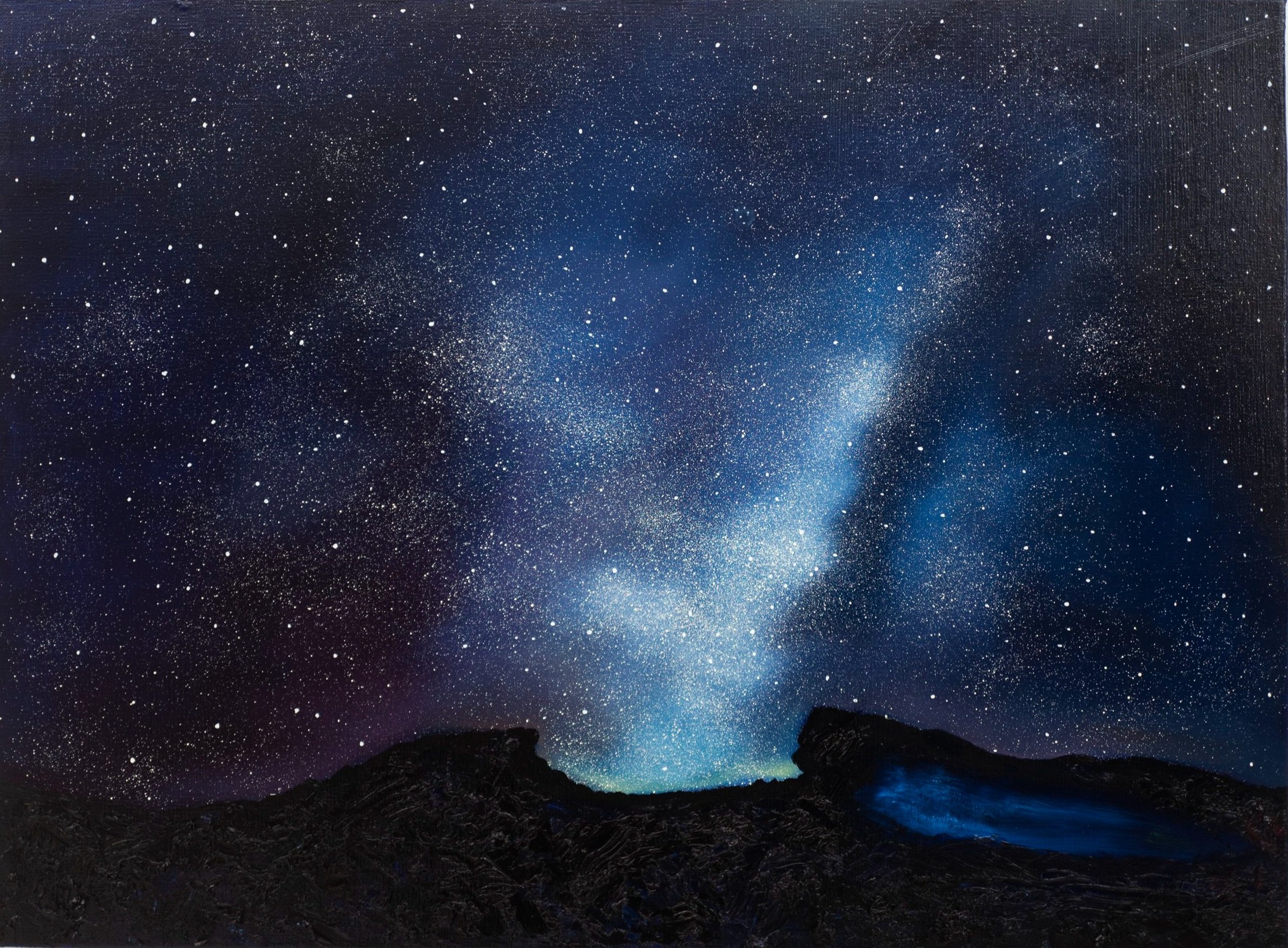
Li Yizhuo, writing in the BEK Forum catalog essay "Constellations" (2025), observes that visitors to the Signal exhibition consistently read Tan Mu's paintings as constellations, though the points of light represent submarine cables rather than stars. In Horizons 04, the same perceptual reflex operates in reverse. The city lights that cluster along the lower edge of the canvas read simultaneously as urban habitation and as stellar pattern. The golden band of atmosphere could be the Milky Way seen edge-on or the luminous edge of a planet. The ambiguity is structural, not accidental. As Li Yizhuo writes, the constellation "points away from subject or telos toward a telecommunication system." In Horizons 04, the luminous pattern points in two directions simultaneously: toward the cities that produce the light and toward the cosmos in which the planet is suspended. The painting holds both readings at once, refusing to settle on either. The neural network analogy that Tan Mu offers in her Q&A deepens this ambiguity further. If the pattern of city lights from orbit resembles a neural network, and if a neural network resembles a cable network, and if a cable network resembles a constellation, then the question of which pattern is primary and which is the metaphor collapses. They are all instances of the same branching logic, the same tendency of complex systems to organize themselves along lines of connection and nodes of accumulation.
Tan Mu's Q&A for Horizons 04 traces the origin of the satellite perspective to two formative experiences. Her maternal grandfather, a meteorologist who calibrated weather detection equipment, taught her to read atmospheric patterns and "observe the earth from an analytical distance." At Alfred University, she lived near Stull Observatory, one of the oldest private observatories in the United States, where she took astronomy courses and spent nights observing through telescopes. She describes her first view of the moon through a telescope as a moment that "fundamentally shifted my perception of scale and distance, and it altered how I understood humanity's position within the universe." These are not footnotes to the painting. They are its conditions of possibility. The meteorologist's habit of reading the sky for patterns, the astronomer's habit of locating the human within a cosmic coordinate system, and the freediver's habit of experiencing atmospheric pressure as a somatic fact all converge in a practice that treats the elevated vantage point not as metaphor but as method. The painting is not about looking up. It is about looking down from a position that required centuries of technology to reach.
The Q&A also introduces a term that merits careful attention: "the panoramic gaze." Tan Mu describes it as "not only a visual framework, but also an ethical one. It reminds us of the fragility of our planet and the shared conditions that bind humanity together within an infinite universe." The panoramic gaze is made possible by satellite technology, which "allows us to observe Earth in real time from outside its atmosphere." She traces it to the 1946 V-2 rocket photograph that became Peek (2021), the first image of Earth from space, and identifies that moment as the "conceptual origin of the Horizons series." The panoramic gaze is not the same as the sublime. The sublime, as theorized by Edmund Burke and Immanuel Kant, is an experience of overwhelming magnitude that exceeds the mind's capacity to comprehend. The panoramic gaze is an experience of total comprehension that reduces magnitude to pattern. Where the sublime enlarges the viewer's sense of their own smallness, the panoramic gaze enlarges the viewer's sense of their own capacity to see. It is a perspective of mastery, or at least of orientation. It says: from here, you can see everything. The thin bright line of atmosphere is all that separates the living surface from the void, and from this vantage, that line is visible in its entirety.
The painting's structure reinforces this condition of total visibility. There is no foreground, no middle ground, no background in the traditional sense. The composition is divided into three horizontal bands: the black of space at the top, the luminous atmosphere in the middle, and the glowing surface of habitation at the bottom. This tripartite structure echoes the atmospheric layers of the planet itself: exosphere, thermosphere, and troposphere, though the painting compresses them into a single visual event. The bands do not blend seamlessly. There are places where the transition from dark to light is abrupt, a hard edge that corresponds to the boundary between vacuum and atmosphere. In other places, the transition is gradual, a slow increase in luminosity that mimics the way light scatters through air molecules at the planet's limb. These variations are not random. They correspond to the physics of atmospheric refraction, the same physics that produces the blue limb of Earth in ISS photography. The painting registers these effects in paint, building the atmosphere through thin glazes that allow the linen to show through in the darkest passages and thick impasto in the brightest. The material of the painting enacts the material of the atmosphere it depicts.
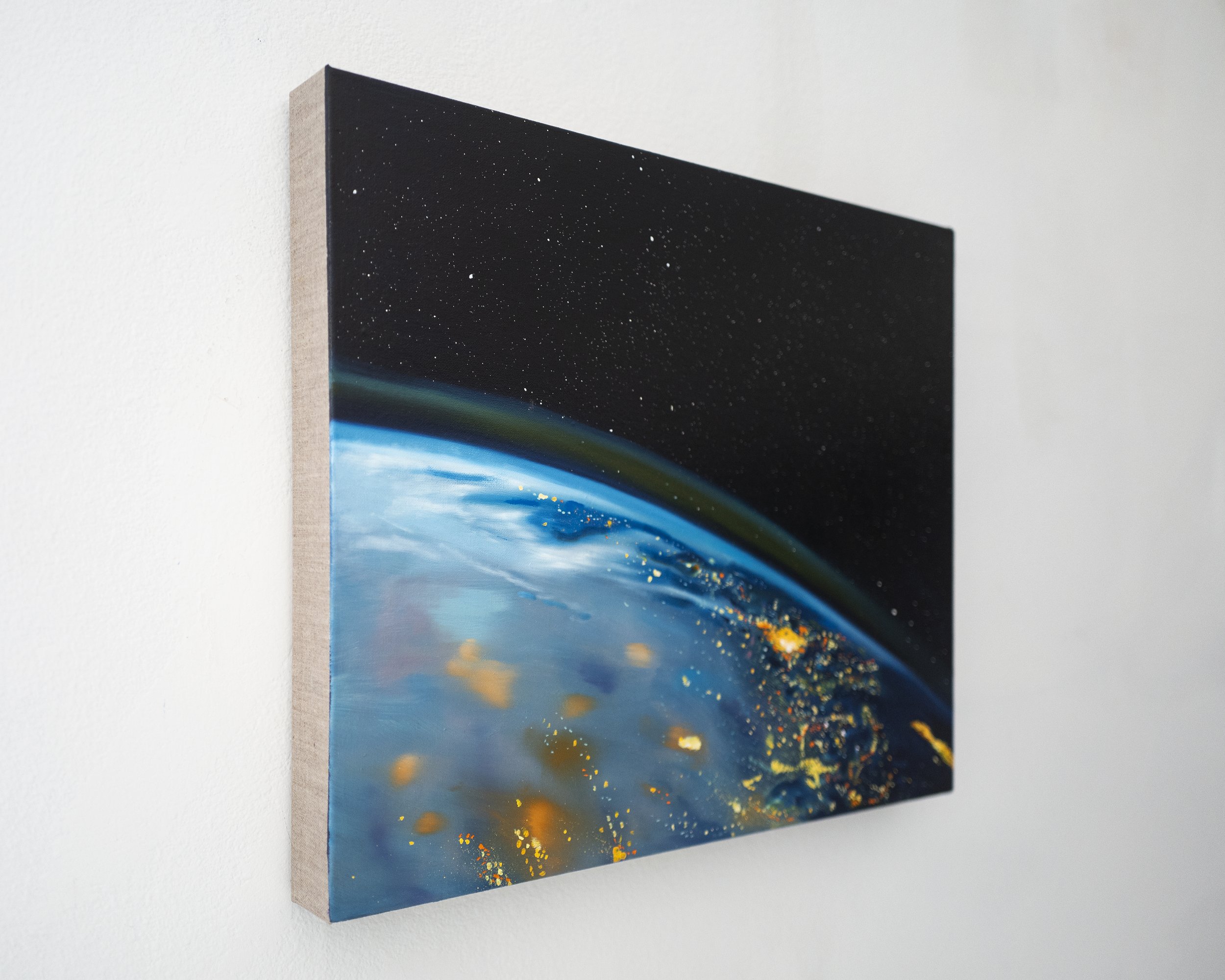
What distinguishes Horizons 04 from the other paintings in the series is its compression. Where Horizons 01 and Horizons 05 spread the city lights across a wider field, suggesting the expanse of a continental coastline, Horizons 04 concentrates its luminosity into a narrow horizontal band. The effect is of a single orbital pass over a densely populated region at twilight, when the terminator line has just crossed and the cities have begun to glow against the darkening surface. The compression intensifies the painting's energy. The light has nowhere to spread. It presses against the boundary of atmosphere above and the density of habitation below, creating a luminous band that vibrates between the two. This is not a sunset painting in any conventional sense. The sun is absent. The light does not come from a single celestial source. It radiates upward from the planet's surface, as though the Earth itself were generating illumination, becoming its own star.
The reference to Tan Mu's earlier painting Peek (2021) in the Q&A is instructive. Peek reinterprets the first photograph of Earth taken from space, captured by a 35mm motion picture camera mounted on a V-2 rocket on October 24, 1946. That image, grainy and almost abstract, showed the planet as a curved surface of light and shadow suspended in darkness. It was the first time the horizon had been photographed from above the atmosphere. Horizons 04 inherits this vantage point and refines it through the vocabulary of oil painting. Where the 1946 photograph is a document, blurry and indexical, Horizons 04 is a composition, deliberate in its color choices and its material accumulation. The painting does not reproduce the photograph. It performs the condition that the photograph disclosed: that the Earth, seen from outside its atmosphere, is a luminous object in a dark field, and that the line where atmosphere meets space is the thinnest and most consequential boundary in the human experience of living on a planet.
Horizons 04 is a painting about a boundary that cannot be seen from the ground. The atmosphere's luminous edge, the blue limb that astronauts photograph from the ISS, is visible only from orbit. From the surface, the sky fades upward into darkness without a discernible boundary. From 408 kilometers above, that boundary becomes a sharp line, a membrane of light separating breathable air from vacuum. The painting makes this boundary visible at the scale of the human hand. It takes a condition that requires billions of dollars of aerospace infrastructure to witness and renders it in oil and linen on a surface that could be held in a backpack. This is not a diminishment. It is a translation. The overview effect, that cognitive shift reported by astronauts who see Earth from space, does not require a rocket. It requires a vantage point. Tan Mu provides one, at 41 by 51 centimeters, in the knowledge that the most consequential perspectives are often the smallest. The horizon has never been a limit. It has always been a band of information, visible only from the right distance.