The Altar Beneath the Mountain: Tan Mu's Large Hadron Collider and the Ritual of Fundamental Truth
A circle twenty-seven kilometers in circumference does not look like a circle. It looks, from any single vantage, like a straight line receding into farmland, or a service tunnel beneath a Swiss village, or a cross-section of cable thicker than a human arm. The Large Hadron Collider at CERN, the largest machine ever built, is too large to see. It exists primarily as data, as proton beams circulating at nearly the speed of light, as terabytes of collision events recorded by detectors the size of cathedrals. What Tan Mu has painted, in her 2025 rendering of this machine, is not the Collider as it appears to physicists reviewing event displays on monitors. She has painted it as it appears to the imagination: a vast, intricate circuit suspended in darkness, its fine lines converging toward a vanishing point that may be a collision chamber or may be the point where matter yields to something more fundamental still.
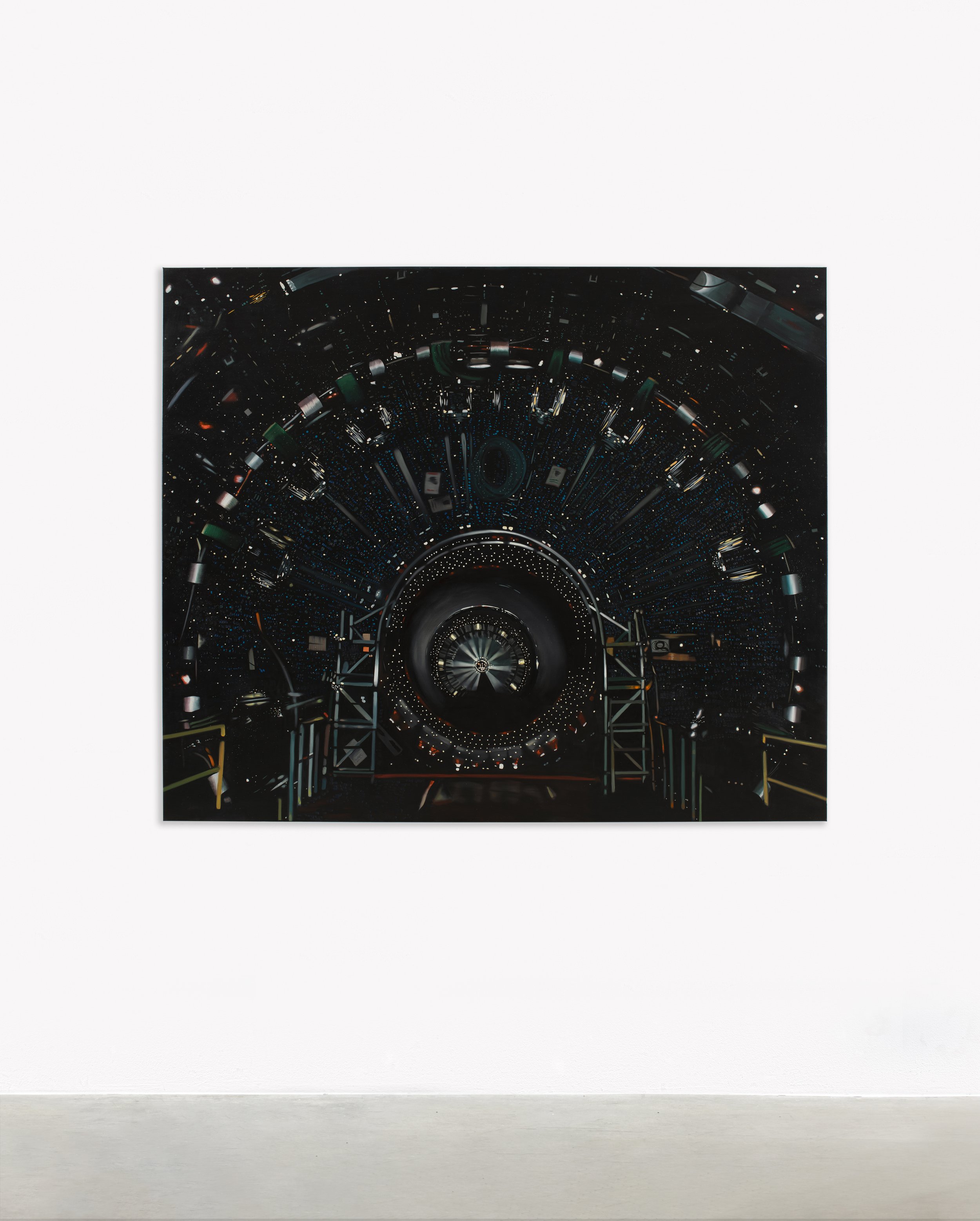
At 180 by 300 centimeters, this is the largest painting in Tan Mu's practice to date, a scale that matches the ambition of its subject. The canvas occupies the wall with the authority of a history painting, though what it depicts is not a battle or a coronation but an underground ring of superconducting magnets and particle detectors buried beneath the Franco-Swiss border. The format demands attention. The viewer cannot take it in from a single position. Standing close, the surface resolves into hundreds of fine brushstrokes tracing the tunnel's infrastructure: beam pipes, dipole magnets, cryogenic lines, and the thousands of connection points that hold the machine together. Stepping back, those marks coalesce into a luminous network, a web of light against a field of black so deep it absorbs the gallery light and returns nothing. The darkness is not an absence. It is the rock and earth that surround the Collider, the geological medium through which the machine was carved. It is also the void that particle physics seeks to illuminate.
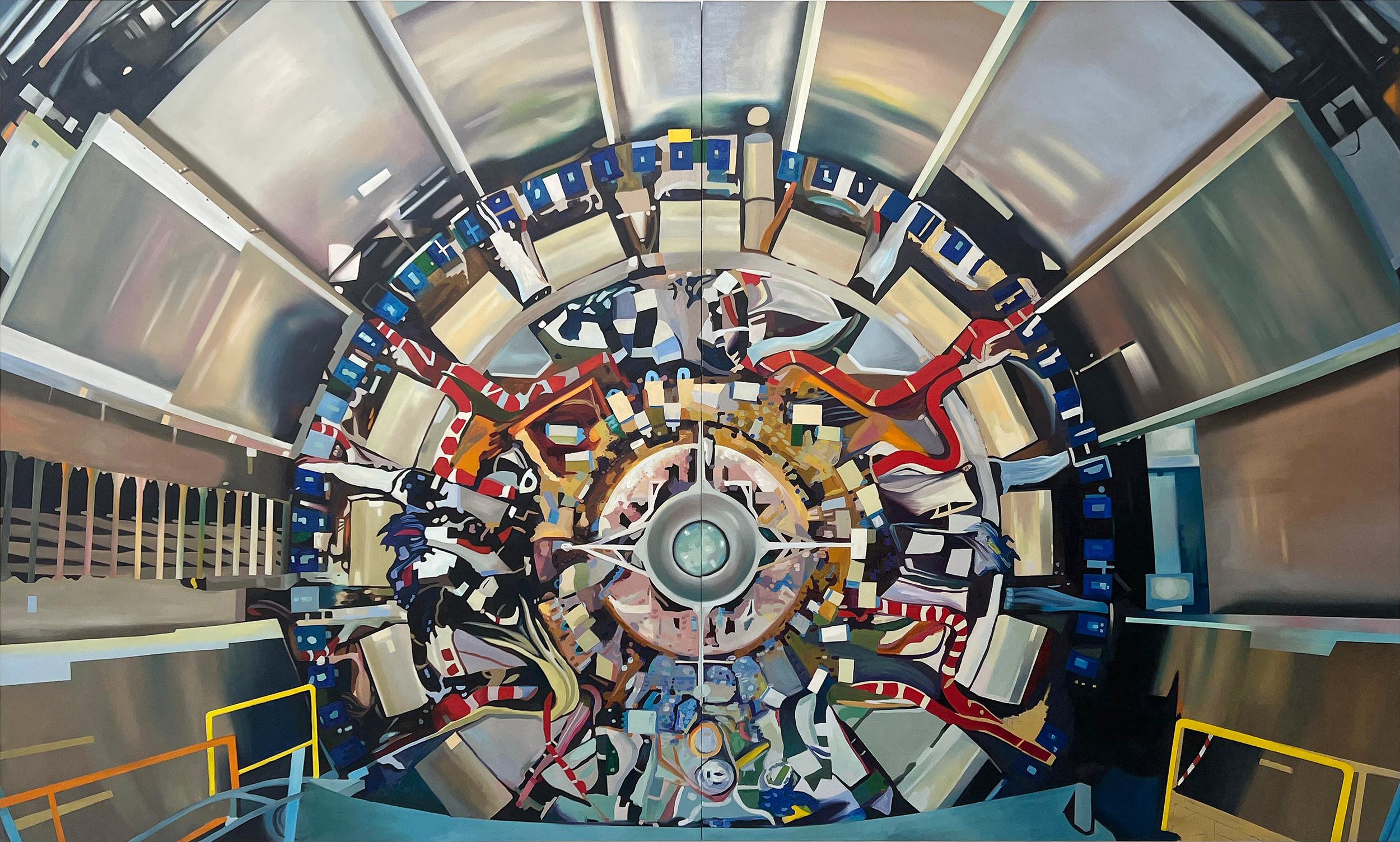
The painting's palette is restricted to black, white, and a narrow band of spectral color concentrated at the collision points, where the proton beams converge. Fine lines of pale gold and silver describe the beam path and its guiding magnets. Bursts of cobalt, cadmium red, and a vivid ultramarine mark the four detector stations: ATLAS, CMS, ALICE, and LHCb. These colors are not decorative. They correspond to the energy signatures that each detector is designed to capture. ATLAS and CMS, the two general-purpose detectors, glow with the full spectrum, their task to catch whatever the collisions produce. ALICE, built to study quark-gluon plasma, the state of matter that existed microseconds after the Big Bang, radiates a deep red. LHCb, focused on the asymmetry between matter and antimatter, emits a cool blue. Tan Mu has assigned each detector a chromatic identity that encodes its scientific purpose, turning the painting into a map of the machine's intellectual architecture.
The surface texture reinforces the painting's argument about scale and visibility. The fine lines that trace the Collider's beam path are painted with a precision that rewards close inspection, each stroke a deliberate gesture that mirrors the exactitude of the machine itself. Where the lines converge at the collision points, the paint thickens, accumulating in small nodes of impasto that catch the light differently from the thin lines that connect them. These nodes are the painting's events: the moments where energy concentrates, where something is produced that was not there before. The viewer's eye is drawn to them the way a physicist's attention is drawn to an anomaly in the data, a spike in the histogram that might be a new particle or might be noise. The painting does not distinguish between signal and background. It presents both with the same clarity, leaving the discrimination to the viewer, just as the Collider's detectors leave it to the algorithms that sift billions of collisions for the one that matters.
Agnes Martin's grid paintings, which she produced from the early 1960s through the 1990s, offer a structural parallel that illuminates what Tan Mu is doing with the fine lines that fill her canvas. Martin's grids, drawn in graphite on white or pale grounds, appear at first to be exercises in minimal geometry, the sort of thing a viewer might dismiss as simple. But Martin insisted that her paintings were not about geometry. They were about innocence, happiness, and the experience of perfection that cannot be held. "My paintings have neither objects nor space nor time nor anything," she wrote. "They are about light, lightness, about merging, about formlessness, breaking form." The grid was her instrument for achieving this dissolution of form, not its reinforcement.
Tan Mu's fine lines operate in a similar register. They do not describe the Collider's infrastructure the way an engineering diagram would. They trace a network of connection and convergence that functions, in the painting, as a visual analogue for the pursuit of knowledge itself. Each line is a path of inquiry. Each node where lines intersect is a point where knowledge concentrates. The overall pattern, when viewed from a distance, resolves into something that resembles a neural network or a constellation or a circuit board, depending on the viewer's frame of reference. This ambiguity is structural, not accidental. The painting's network of lines enacts the same branching logic that Tan Mu has traced through submarine cables, neural pathways, and the filaments of galaxy clusters. What changes is the scale. The LHC pushes that logic to its physical extreme: a machine built to find the smallest possible unit of matter by accelerating particles to the highest possible energy and smashing them together at four points around a ring that spans two countries. If Martin's grid is the architecture of contemplation, Tan Mu's network is the architecture of collision.
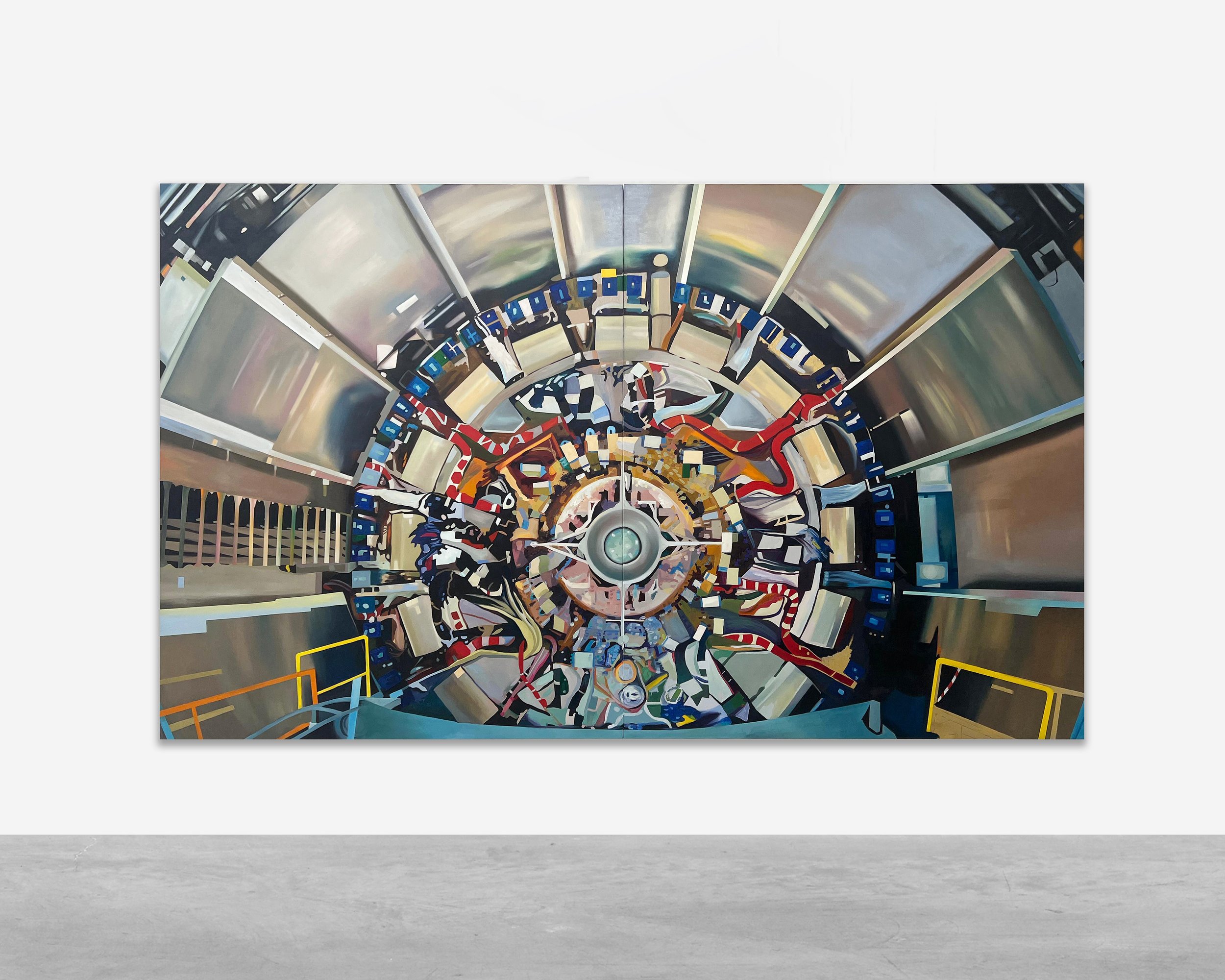
Tan Mu describes the Large Hadron Collider as a modern altar, a term she uses deliberately. In her Q&A for the artwork, she frames the LHC as a site where humanity's quest for the "basic building blocks of creation" echoes the spiritual ambitions of religious practice. "Scientists use this massive device to search for the 'basic building blocks of creation,'" she writes, "which reminded me of how art has always tried to depict similar themes, whether in religious depictions of the creation of the world or in the pursuit of eternity and truth." The comparison is not flippant. An altar is a site where the invisible is made present through ritual, where the intangible is approached through physical gesture. The LHC occupies a comparable position in the secular cosmology of the twenty-first century: a machine built to make visible what cannot be seen, to bring into detection what exists only in theory. The Higgs boson was predicted in 1964 and confirmed in 2012. For forty-eight years it existed only as a mathematical possibility, a notation in a physicist's equation, a ghost in the standard model. The LHC was built to give that ghost a body, to translate a theoretical entity into a measurable event, to turn a line of mathematics into a shower of particles in a detector. This is not so different from what an altar does, which is to make the divine present through the ritual of sacrifice.
The physics of the LHC reinforces the altar comparison with a precision that borders on the theological. The machine accelerates protons to 99.9999991 percent of the speed of light, then collides them at four points around the ring. Each collision produces a spray of secondary particles whose trajectories are recorded by detectors that weigh as much as the Eiffel Tower. The data generated by these collisions, some 600 million per second, is filtered by algorithms that discard 99.999 percent of events as irrelevant, preserving only the fraction that might contain something new. It is a process that depends on the systematic elimination of the ordinary in pursuit of the exceptional, a method that would be recognizable to any monastic tradition that practiced the stripping away of the worldly to reach the essential. The physicists at CERN are not looking for what they already know. They are looking for what the standard model does not predict, the anomalies and excesses that suggest physics beyond the current framework. Dark matter, extra dimensions, supersymmetry. These are the secular equivalents of revelation: truths that exist beyond the current model of understanding and can only be reached by pushing the existing model to its breaking point.
Anselm Kiefer's monumental paintings from the 1980s and 1990s share with Tan Mu's Large Hadron Collider a refusal to separate the spiritual from the material, the mythical from the scientific. Works like Osiris and Isis (1985-1987) and The Seven Heavenly Palaces (2002) construct vast architectural spaces from paint, lead, straw, and ash, spaces that function simultaneously as ruin, temple, and laboratory. Kiefer's materials carry their own history: the lead is from the roofs of Cologne Cathedral, the straw refers to the Egyptian myth of Osiris dismembered and scattered, the ash invokes the aftermath of destruction. The paintings do not illustrate these references. They embed them in the material of the work itself, so that the surface becomes a site of accumulated meaning rather than a window onto a scene.
Tan Mu operates in a related register. Her Large Hadron Collider does not illustrate the machine. It embeds the machine's logic in the painting's material structure. The fine lines of gold and silver are the beam path. The nodes of concentrated color are the detectors. The black ground is the rock through which the tunnel was bored. The scale of the canvas, 180 by 300 centimeters, is the scale of the machine's ambition made physical. This is not representation in the sense of copying an image. It is translation: the conversion of a twenty-seven-kilometer underground ring into a two-dimensional surface that preserves the machine's structural logic while compressing its physical dimensions. Kiefer's lead cathedrals and Tan Mu's particle accelerator share a conviction that the monumental scale of human aspiration, whether directed toward the divine or toward the Higgs boson, requires a monumental format to be felt. The painting does not ask the viewer to understand particle physics. It asks the viewer to feel the scale of the ambition that built a machine to find the smallest unit of matter by building the largest machine on Earth.
Tan Mu speaks of the Collider's "collective labor," a phrase that deserves unpacking. The LHC was built by more than ten thousand scientists from over a hundred countries. Its construction required the collaboration of nations that were, in some cases, political adversaries. The detectors were assembled from components manufactured in Japan, Italy, the United States, Russia, Germany, and dozens of other countries, then shipped to CERN and lowered into the tunnel through shafts dug into the Jura limestone. The machine is a physical embodiment of international cooperation on a scale that few other human endeavors have achieved. In her Q&A, Tan Mu describes this collectivity as "deeply moving," connecting it to a theme that runs through her entire practice: the network, the system, the web of connections that makes individual action legible as part of a larger structure. The submarine cables of the Signal series, the neural pathways of Synapse, the orbital networks of Mars and Sagittarius A*. Each of these works identifies a system of connection that exceeds any single node. The LHC is the most extreme version of this logic: a machine that could not exist without the coordinated effort of thousands, and that produces knowledge, when it produces knowledge at all, that belongs to no single nation or institution.
Nick Koenigsknecht, writing in the BEK Forum catalog (2025), argues that Tan Mu's paintings of technology function as self-portraits: "While observing technology, are we not looking at ourselves? Therefore perhaps these works function more as self portraits, rather than depictions of external, scientific milestones." The observation reframes the LHC painting. If the Collider is a portrait, it is not a portrait of the machine. It is a portrait of the desire that built it, the collective ambition to find out what matter is made of, to pursue a question that has no practical application and no economic return but that has consumed billions of dollars and decades of human labor. Koenigsknecht's insight identifies what is at stake in Tan Mu's practice more broadly: the machines she paints are not objects of study but mirrors. The quantum computer is a portrait of the desire to compute. The submarine cable is a portrait of the desire to connect. The LHC is a portrait of the desire to know what the universe is made of, at the level where matter ceases to be matter and becomes something else entirely, a probability, a field, a vibration in the Higgs.
The distinction Tan Mu draws between "motion and stillness" is worth attending to. In her Q&A, she describes the Collider as "both vast and intricate, calm yet full of energy," and identifies the contrast between the machine's physical stillness, a ring of superconducting magnets humming in its tunnel, and the immense energy released when protons collide at four points along that ring. The painting holds both conditions simultaneously. The overall composition is horizontal and stable, a network of fine lines distributed evenly across the canvas in a pattern that suggests equilibrium and order. The collision points interrupt this equilibrium with bursts of concentrated color and raised impasto, moments where the painting's surface breaks the even rhythm of the lines and asserts a different register of energy. The viewer reads the painting in two temporalities: the slow time of the lines, which trace the beam path around the ring, and the fast time of the collisions, which occur in fractions of a nanosecond but whose effects, the particles, the data, the discoveries, persist for decades.
This dual temporality connects the LHC painting to a broader argument in Tan Mu's practice about the relationship between stillness and event. In Memory (2019), the stillness of the painted surface holds the memory of a freediving blackout, an event that lasted seconds but reshaped the artist's understanding of consciousness. In Eruption (2022), the stillness of the painted volcano holds the force of the Tonga eruption, an event that severed the submarine cable connecting the islands to the global network. In each case, the painting does not depict the event in real time. It depicts the condition in which the event becomes visible: the surface, the stillness, the network that records what has happened. The LHC painting operates in the same register. The collisions it depicts are too fast and too small to see. What is visible is the machine that detects them, the network of instruments that translates a shower of particles into a line on a histogram. The painting paints the detector, not the collision. It paints the altar, not the sacrifice.
The choice of scale, 180 by 300 centimeters, is a choice about how the viewer's body relates to the painting. The canvas is wider than it is tall, matching the horizontal orientation of the Collider itself, which is a ring rather than a tower. Standing in front of it, the viewer must turn their head to take in the full width, just as the physicists at CERN must traverse kilometers of tunnel to move from one detector to another. The painting refuses to be seen all at once. It demands lateral movement, a scanning of the surface that mimics the proton beam's circular path. This is not incidental. The painting's format is part of its argument: that the knowledge the Collider produces is not available from a single vantage point, that understanding requires movement, that the network of connections, between detectors, between data sets, between nations, between centuries of inquiry, is the knowledge.
Tan Mu connects the LHC to her broader practice through the themes of temporality and transcendence. "Whether depicting meteorites, black holes, or the Large Hadron Collider," she writes, "I am attempting to use painting to document objects and phenomena that transcend time and space." The word "transcend" is carefully chosen. It does not mean "exist outside of." It means "exceed the limits of." The Higgs boson exceeds the limits of what was previously known about matter. The black hole at the center of Sagittarius A exceeds the limits of what was previously known about gravity. The LHC exceeds the limits of what was previously possible for a machine. Each of these subjects pushes against the boundary of the known, and each, in Tan Mu's painting, is rendered with the same attention to surface, structure, and the relationship between the visible and the invisible. The Collider is not an outlier in her practice. It is the practice's most extreme expression: the point where the desire to see what cannot be seen meets the technological capacity to build a machine that can see it, and the painting capacity to make that meeting visible on a rectangle of linen.
The altar metaphor returns the painting to a question that has animated Tan Mu's work from the beginning: what is the relationship between the human urge to document and the thing documented? In her Q&A, she describes the extended creative process as deeply immersive, allowing her to "reflect deeply on the significance of the LHC and how it connects science and art, the macro and micro." The process of painting, with its thousands of fine lines and its accumulated nodes of color, enacts the same patience and accumulation that the LHC itself requires. The Collider runs for months to produce a single statistically significant excess in a data set. The painting requires hours of concentrated work to build a surface that, from a distance, looks like a network of light in darkness but, up close, reveals the labor of each individual stroke. The painting is not a document of the machine. It is the machine's mirror: a structure built through collective attention to a question that exceeds any single mind, rendered in a medium that makes visible what would otherwise remain invisible. The altar does not answer the prayer. It makes the prayer possible.