The Circle That Changed Everything: Tan Mu's The Pill and the Object That Redesigned Autonomy
Enovid was the brand name. G. D. Searle and Company was the manufacturer. The Food and Drug Administration approved it on May 9, 1960, and by 1965, five million American women were taking it daily. The pill was not a single event. It was a daily repetition, a cycle of twenty-eight tablets, twenty-one active and seven placebo, arranged in a circular dial dispenser that could be rotated with a thumb click to advance to the next dose. The design of the dispenser was not incidental. It was engineered by the manufacturer to resemble a compact mirror, the kind of object a woman might carry in her purse and open in a restroom without drawing attention. The round case, the clicking dial, the tablets arranged in a ring like numbers on a clock face: these were design decisions that made the pill not only effective but discreet, not only medical but cosmetic, not only a drug but an accessory. The pill changed the biology of reproduction. The dispenser changed the sociology of taking it. And the painting that Tan Mu made of this object, The Pill (2021), changes the way of seeing it again, from a designed commodity into a portrait of a social transformation that began with a circle of twenty-eight tablets in a plastic case the size of a makeup compact.
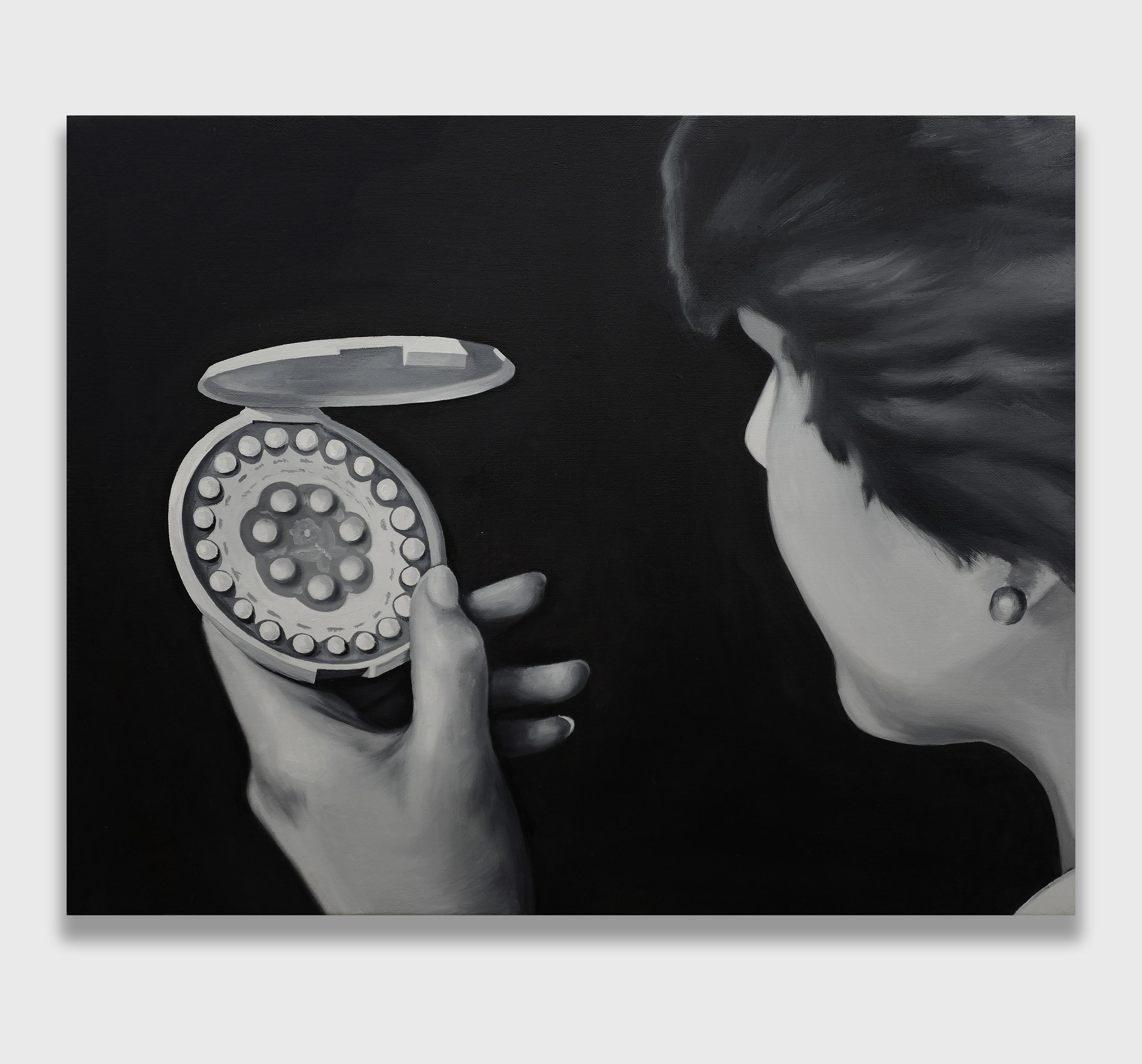
The Pill is oil on linen, 41 x 51 cm, a modest format that places the viewer at reading distance from the surface. The composition is divided into two elements: an open circular pill dispenser, rendered in profile or slightly angled, and the silhouette of a woman's head, also in profile, facing the dispenser. The pill case is open, its lid lifted, revealing the circular arrangement of tablets inside. The woman's profile is rendered as a flat, dark silhouette, the kind of graphic reduction that appears in advertisements and instructional diagrams. The relationship between the two elements is not spatial but conceptual. The woman does not reach for the pills. She looks at them. Her profile faces the open case, and the case faces her, and between them, the painting creates a space of consideration, of decision, of the moment before the hand moves. Tan Mu describes this moment in terms of the object's design history: the circular case "made the pill easier to use while also presenting it as something familiar and socially acceptable, especially in public contexts." The design made the drug invisible by making the container look like something else. The painting makes the container visible by removing everything else and presenting it as a portrait subject, the way a still life presents a fruit or a skull.
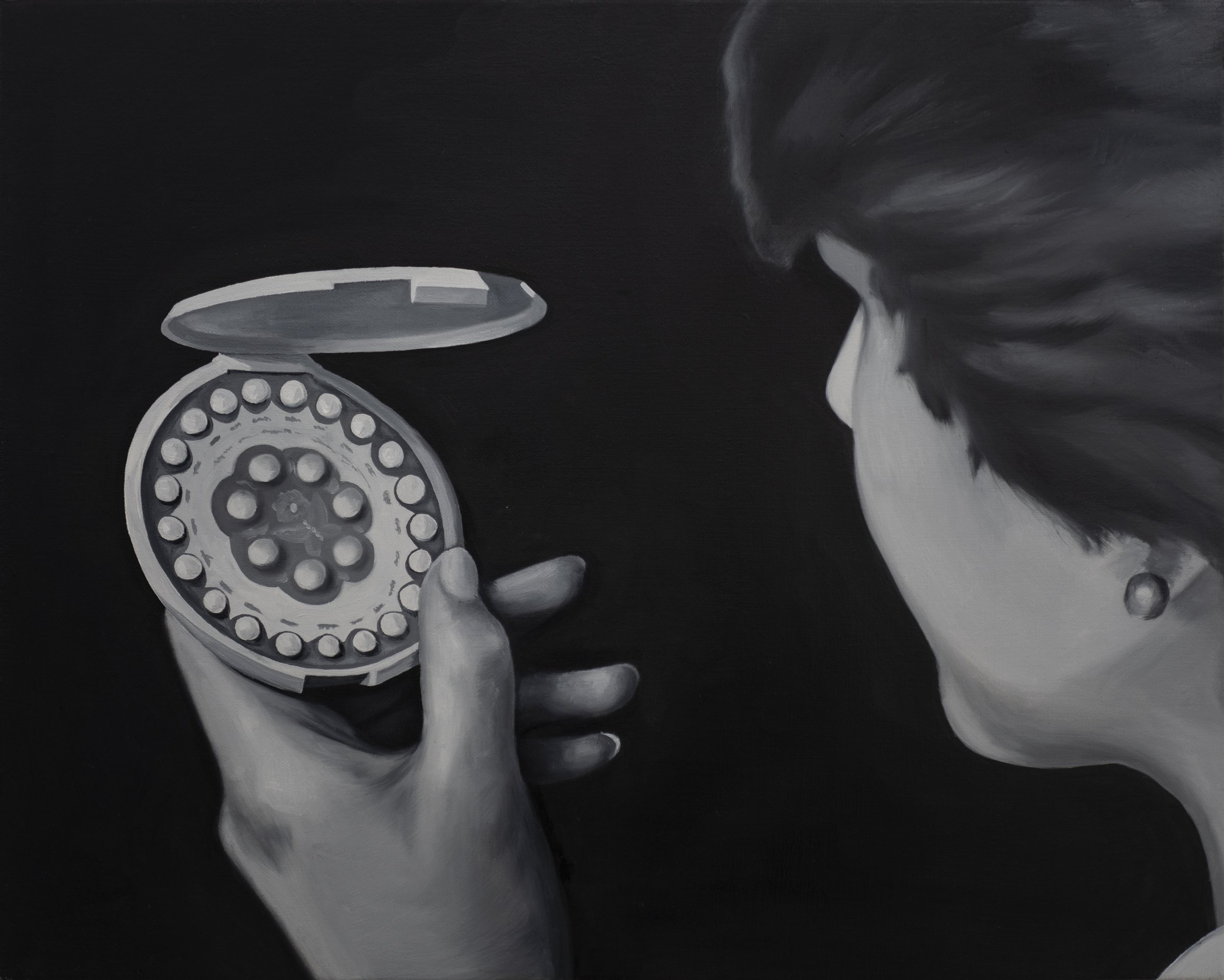
The pill case is rendered in a cool, muted palette of grey, white, and pale blue, with the individual tablets visible as small, round forms of white and pale pink arranged in a circular pattern inside the open lid. The case's plastic surface has the slight sheen of injection-molded polymer, a texture that Tan Mu captures with thin, even layers of oil that mimic the material's smoothness without attempting to reproduce it photographically. The circular arrangement of the tablets is the painting's dominant visual motif. Twenty-eight small circles inside a larger circle, the larger circle enclosed by the rectangular outline of the open case, the rectangular case set against the dark ground of the silhouette. The composition is a series of nested geometries: rectangle, circle, circles. The shape of the pill case echoes the shape of the compact mirror it was designed to resemble, and the compact mirror echoes the shape of the powder compact, and the powder compact echoes the shape of the pocket watch, and the pocket watch echoes the shape of the orrery, and the orrery echoes the shape of the solar system. Each is a circle that contains smaller circles, each is a mechanism that regulates time, and each is a technology of control that has been miniaturized to fit in the palm of a hand. The pill dispenser is the latest in this lineage. It is a clock that regulates the menstrual cycle, a mechanism that clicks forward one day at a time, a circle of tablets that governs the most fundamental biological rhythm of the female body.
The woman's silhouette is rendered in a dark, near-black tone that reads as an absence rather than a presence. The profile is not individuated. There are no facial features, no hair texture, no skin color. It is a generic form, the kind of silhouette that appears in public health pamphlets and pharmaceutical advertisements, the visual shorthand for "a woman" that reduces the category to its most essential outline. Tan Mu's Q&A describes the painting as focusing on "the open pillbox and the woman's profile," and the conjunction of the two elements produces a compositional tension: the specific, detailed, carefully rendered pill case on one side, and the generalized, featureless silhouette on the other. The object is particular. The subject is generic. The object has color, texture, and dimension. The subject has outline alone. The painting gives more visual attention to the pill than to the woman who takes it, and this imbalance is not an oversight. It is the painting's argument. The pill, in this composition, is the active agent. The woman is the recipient. The pill is the technology. The woman is the body the technology acts upon. The painting does not editorialize about this arrangement. It presents it, and the presentation is the critique.
Andy Warhol's Brillo Box (1964) is a sculpture, not a painting, but it operates on the same principle that Tan Mu's The Pill invokes: the principle that a mass-produced commodity, when removed from its context of use and placed in a gallery, becomes visible as a designed object with aesthetic, cultural, and political dimensions that its everyday users never see. Warhol's Brillo Box is a plywood box, silkscreened with the Brillo brand logo and product information, identical in appearance to the cardboard boxes of Brillo soap pads that sat on supermarket shelves. The difference is material: Warhol's box is wood, not cardboard. The difference is context: Warhol's box sits in a gallery, not a supermarket. The difference is price: Warhol's box sold for hundreds of dollars; the Brillo box on the shelf sold for less than a dollar. And the difference is intention: the Brillo box was designed to sell soap pads. Warhol's box was designed to sell a question about what constitutes art, what constitutes design, and what happens when the two categories collide in a space where the only rule is that anything can be art if the artist says it is and the market agrees to treat it as such.
Tan Mu's The Pill shares Warhol's interest in the designed commodity as a cultural artifact, but it diverges from Warhol in a crucial respect. Warhol's Brillo Box is neutral about the commodity it reproduces. The Brillo pad is a cleaning product. Its cultural significance is minimal. It is not a technology that restructures social relations. It does not change who can work, who can control their reproduction, who can participate in public life. The contraceptive pill does all of these things. It is a designed object that is also a social revolution, and the painting that depicts it cannot be neutral about this fact because the object itself is not neutral. The pill case was designed to look like a compact mirror because women in 1960 could carry a compact mirror in public without stigma, but they could not carry a contraceptive device in public without risk. The design was a form of camouflage, and the camouflage was a response to a social condition, and the social condition was that women's control over their own reproduction was contested, legislated, and in many jurisdictions illegal. Warhol's Brillo Box asks what happens when a soap pad box becomes art. Tan Mu's The Pill asks what happens when a contraceptive device becomes a portrait subject. The answer is that the portrait reveals what the camouflage was designed to conceal: that the pill is not merely a medical product. It is a technology of autonomy, and the compact mirror case is its uniform.
The FDA's approval of Enovid in May 1960 was not a medical decision. It was a political decision with medical consequences. The drug had been available since 1957 as a treatment for menstrual disorders, and its use as a contraceptive was well known to the prescribing physicians who wrote off-label prescriptions for it. The 1960 approval made this off-label use official, and it made the pill available to married women in all fifty states, though unmarried women in many states would have to wait until the 1972 Supreme Court decision in Eisenstadt v. Baird extended the right to contraception to all individuals regardless of marital status. The pill's social impact was immediate and far-reaching. Between 1960 and 1965, the birth rate among American women fell by 19 percent. The average age at first marriage rose. The percentage of women enrolled in colleges and professional schools increased. The number of women in the workforce grew. The feminist movement, which had been dormant since the suffrage era, found new momentum, new language, and new urgency, all of it fueled in part by a technology that allowed women to separate sex from reproduction for the first time in human history with a reliability that no previous contraceptive method had achieved. The pill did not cause the feminist movement. The movement had roots in labor organizing, civil rights activism, and the publication of Betty Friedan's The Feminine Mystique in 1963. But the pill provided the material precondition for the movement's demands. You cannot organize for workplace equality if you cannot control whether you will be pregnant nine months from now. The pill made the control possible, and the control made the organizing possible, and the organizing changed the law, the workplace, and the culture.
Tan Mu's Q&A makes the connection explicit: "The invention of the birth control pill marked a major turning point in women's social identity, particularly from the 1960s through the 1970s. As feminist movements gained momentum, access to reliable contraception allowed women to exert greater control over reproduction. This shift played a crucial role in expanding women's autonomy, enabling greater participation in the workforce and contributing to broader social change." The language is direct and unambiguous. The pill is not a metaphor. It is a mechanism of social transformation, and the painting documents it as such. The visual parallels that Tan Mu draws between the circular pill dispenser, the circular structure of logic circuits, and the circular form of the embryo are not decorative. They are structural. The pill dispenser, the circuit board, and the embryo are all circular systems of control. The pill dispenser controls fertility through hormonal regulation. The circuit board controls information through electronic regulation. The embryo controls development through genetic regulation. All three are designed objects that govern processes they did not create but can modify. All three are technologies of regulation, and all three, when viewed from above, share the same geometry: a circle containing smaller circles, a system of units arranged in a ring, a mechanism of control that operates by advancing one unit at a time through a prescribed sequence.
Barbara Kruger's Untitled (Your Body is a Battleground) (1989) is a photomontage that divides a woman's face into positive and negative halves, one side printed in white on black, the other in black on white, with the words "YOUR BODY IS A BATTLEGROUN" superimposed across the image in bold red text. The work was created for the 1989 Women's March on Washington, a protest against the Supreme Court's Webster v. Reproductive Health Services decision, which had upheld a Missouri law restricting access to abortion. Kruger's image divides the woman's face along the vertical axis, creating a split between visibility and erasure, between presence and absence, between the body as a site of personal autonomy and the body as a site of political contestation. The text does not ask whether the body is a battleground. It states it. The body is a battleground. The question is not whether it will be fought over. The question is who will win.
Kruger's work and Tan Mu's share a subject, the contested status of women's reproductive bodies, and a method, the use of visual reduction to make the contestation legible. Kruger reduces the woman's face to a split silhouette. Tan Mu reduces the woman's profile to a dark outline. Both works use graphic simplicity to make a political argument. But where Kruger's text declares the body a battleground, Tan Mu's painting points to the object that made the battleground winnable. The pill is not the battleground. It is the weapon. Or, more precisely, it is the technology that allowed women to fight on the battleground of their own bodies and win. The painting does not depict the battleground. It depicts the instrument. The instrument is small, circular, plastic, and designed to look like a compact mirror. The instrument contains twenty-eight tablets, twenty-one of which deliver synthetic hormones that suppress ovulation, and seven of which are inert placebos that maintain the habit of daily dosing. The instrument is a clock, a calendar, a mechanism of control, and a compact mirror, all in one. Kruger's work says: your body is a battleground. Tan Mu's work says: this is what you carry into battle.
Li Yizhuo, in her 2022 essay "Imaginary of an Image," writes that Tan Mu's paintings "do not aim at diagnosing the modern spectacles from a distance. They conjure up a kind of vitality and depth of their own." The observation applies directly to The Pill. The painting does not diagnose the contraceptive revolution from a distance. It conjures the object that made the revolution possible, and it presents that object with a specificity that refuses to let the viewer forget that the revolution was not abstract. It was carried in purses. It was taken with a glass of water at the same time every morning. It was dispensed from circular cases that clicked when rotated. It was designed to look like makeup. It was hidden in bathroom cabinets. It was discussed in whispers between friends. It was legislated against by men who would never have to take it. It was approved by an agency that had never before approved a drug for healthy people to take every day. All of this history is embedded in the object that Tan Mu paints, and the painting makes it visible by removing the object from the context of use and placing it in the context of art, where it can be seen for what it is: a circle of twenty-eight tablets in a plastic case, the size of a compact mirror, that changed the reproductive capacity, the social identity, and the economic participation of half the human species. The circle was the mechanism. The case was the disguise. The painting is the record. And the woman's silhouette, facing the open case, is not a profile of a specific person. It is the profile of everyone who ever held one of these objects in her hand, considered it, and clicked the dial forward one more day.