The Image Assembled From Nothing: Tan Mu's Powehi and the Telescope That Became a Printmaker
On April 10, 2019, six press conferences around the world revealed the same image simultaneously: a bright ring of orange-gold light surrounding a perfectly dark circle, set against a field of black. The Event Horizon Telescope collaboration had produced the first direct image of a black hole, the supermassive object at the center of the Messier 87 galaxy, fifty-five million light-years from Earth. The photograph was not a photograph in any conventional sense. No single telescope could have captured it. The image was assembled from data collected by eight radio observatories on four continents, synchronized by atomic clocks, and processed by a supercomputer running algorithms that stitched the fragments into a coherent whole. The bright ring was not visible light. It was radio wave radiation emitted by superheated gas falling into the black hole's gravitational well, rendered in false color for human eyes. The dark circle at its center was not a void. It was the event horizon, the boundary beyond which nothing, not even light, can escape. What the world saw that day was not what the black hole looks like. It was what the black hole looks like when eight telescopes agree to act as one.
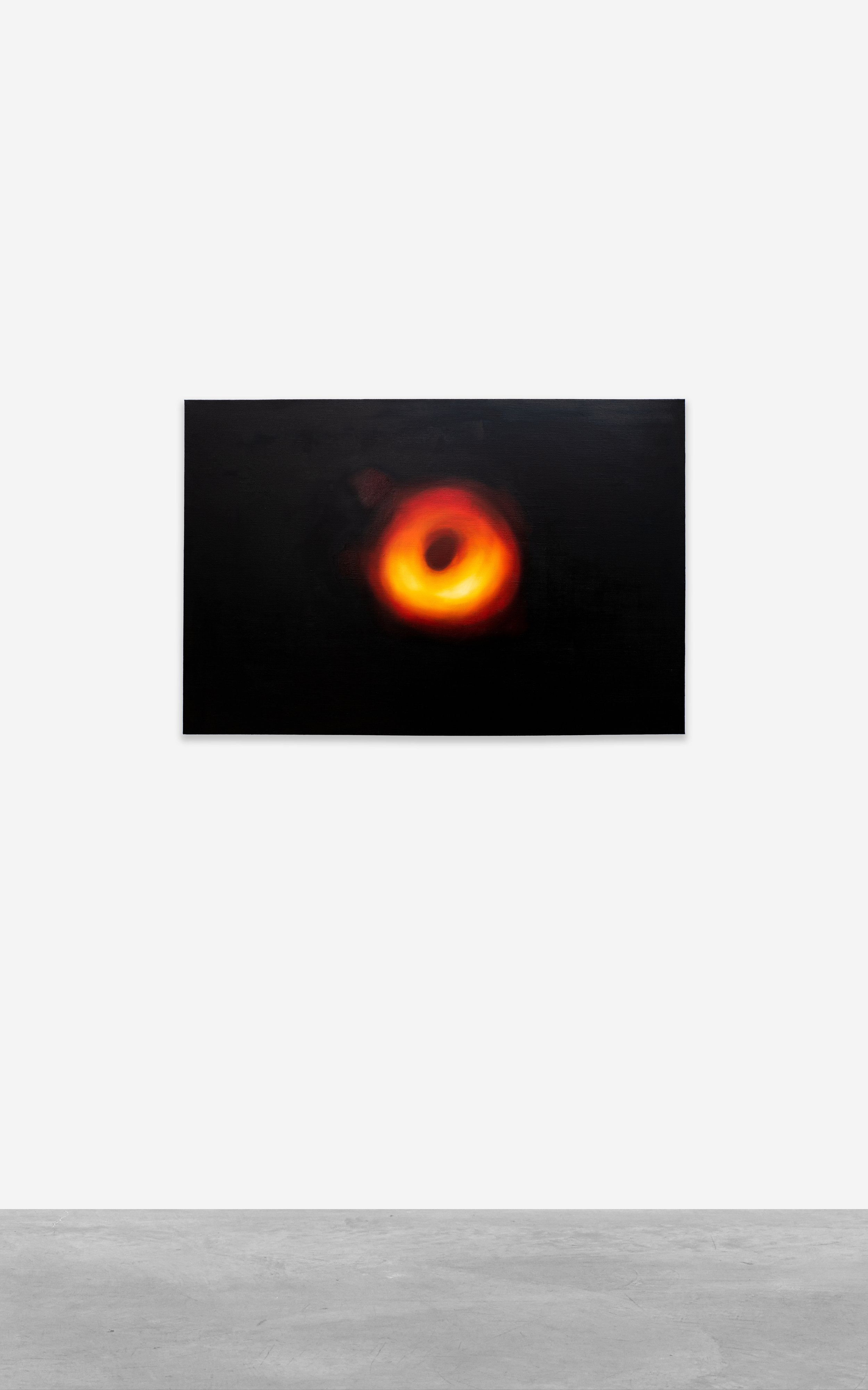
Tan Mu's Powehi (2022), oil on linen, 61 by 91 centimeters, translates this image into paint with a specificity that honors both its astronomical subject and the collective labor that made it visible. The painting presents the black hole as a luminous ring against a black ground, but it is not a copy of the EHT image. The ring in Tan Mu's version is warmer, more amber than orange, and it does not appear to glow with the even intensity of a digital rendering. Instead, its surface is built from layers of cadmium orange and burnt sienna applied in brushstrokes that follow the curvature of the ring, each stroke a discrete act of looking and marking. The black center is not the uniform black of a digital void. It is painted black, applied over a ground that shows traces of the linen weave beneath, a material darkness that registers the physical effort of covering a surface with pigment. The distinction matters. The EHT image was assembled from data fragments. Tan Mu's painting is assembled from brushstrokes. Both are acts of construction from partial information, and both produce a visual object that is more than the sum of its sources.
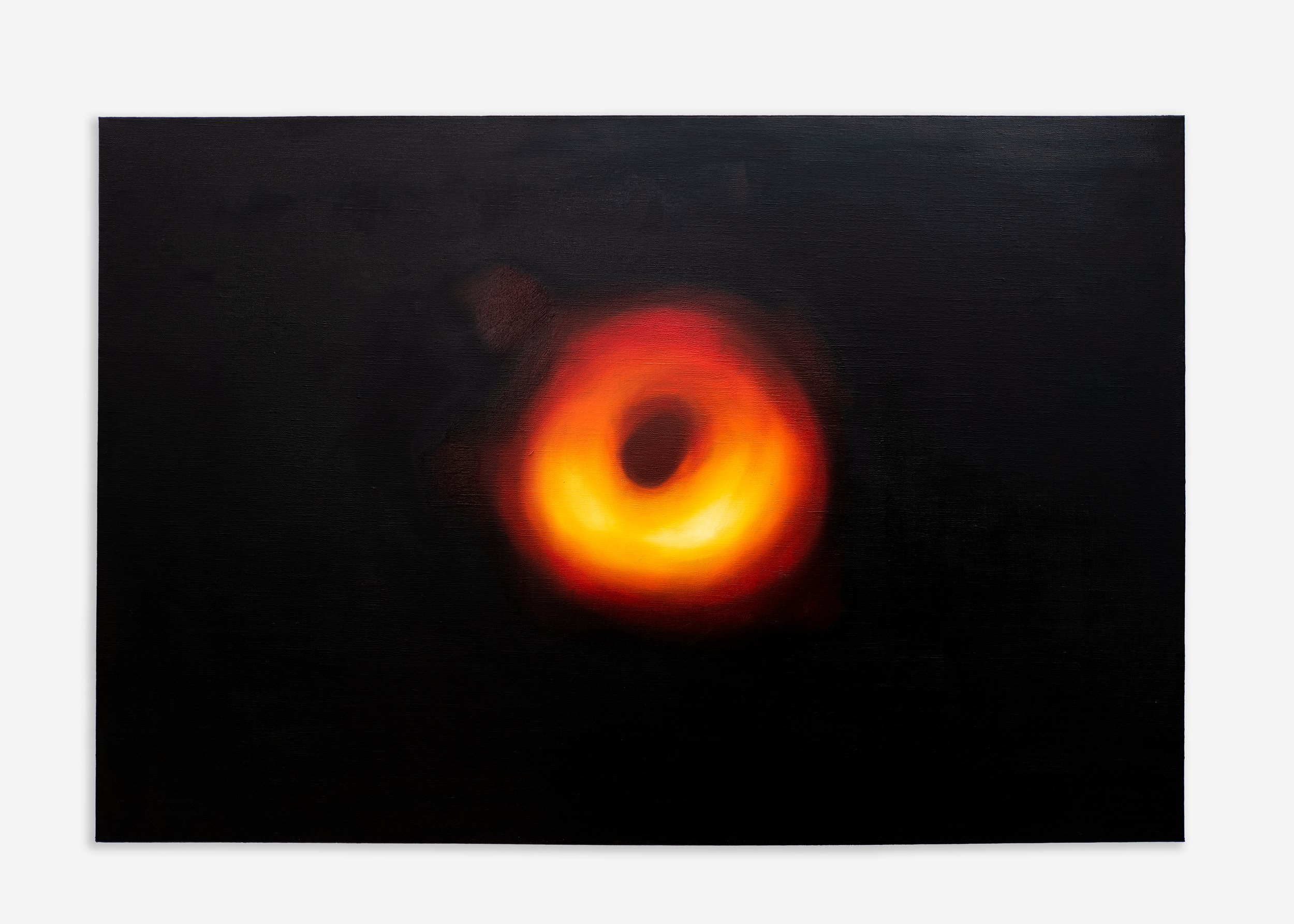
The ring in Powehi is not uniform. Its luminosity varies around its circumference, brighter at the top and thinning toward the bottom, an asymmetry that corresponds to the relativistic effects predicted by general relativity. The gas falling into M87 rotates at a significant fraction of the speed of light, and the side of the disk moving toward the observer appears brighter due to relativistic beaming, while the receding side appears dimmer. Tan Mu renders this asymmetry through graduated brushwork, laying pigment more thickly where the ring is brightest and thinning it where the emission fades. The bottom of the ring does not disappear entirely; it persists as a faint trace, a film of sienna barely distinguishable from the black ground, as though the paint itself is being drawn into the gravitational field and is only barely escaping. This is not a decorative decision. It is an observation encoded in material. The paint enacts the physics it depicts.
The black ground extends to the edges of the canvas, unmodulated except for the ring itself and a faint scattering of particulate matter, barely visible, that suggests the accretion disk's outer envelope or the diffuse glow of distant stars. This is the same black that Tan Mu employs throughout her practice, from Quantum Computer (2020) to Sagittarius A (2022), and its function is consistent: it isolates the subject from any context that might anchor it to a specific place or time. In Powehi, the black carries an additional charge. It is not merely the absence of light. It is the visual equivalent of the event horizon itself, the boundary beyond which information cannot pass. The painting's black ground and the black center of its ring describe the same condition from opposite directions: one is the cosmic darkness from which the ring emerges, and the other is the gravitational darkness that consumes the ring from within. The viewer is suspended between these two darknesses, looking at a ring of light that exists only because it is falling into something that will not release it.
Ad Reinhardt's black paintings, produced between 1960 and 1967, reduce the canvas to near-monochrome fields of black so dark that their internal structure, the faint cruciform divisions between subtly different black tones, becomes visible only after the viewer's eyes have adjusted over minutes of sustained looking. Reinhardt described these works as "ultimate paintings," the endpoint of a historical progression toward the purest possible form. He insisted that they were not about anything. They were, he said, "art-as-art," paintings that refused to refer to anything outside themselves. The black paintings were objects of contemplation that generated their meaning through the viewer's perceptual process, not through reference to a subject in the world. The longer one looks, the more one sees, until the painting appears to shift and breathe, its dark geometry emerging from the void like a slow revelation.
Tan Mu shares Reinhardt's commitment to the black ground as a space of perceptual intensity, but her use of black serves an opposite purpose. Where Reinhardt's black paintings are self-referential, withdrawing from the world into their own surface, Tan Mu's black paintings point outward. The black in Powehi is not the endpoint of modernism. It is the backdrop of the cosmos, the color of interstellar space, the visual condition under which celestial objects reveal themselves. Reinhardt wanted the painting to be the subject. Tan Mu wants the black to be the medium through which a subject, in this case a supermassive black hole fifty-five million light-years away, becomes visible. The painting does not withdraw from reference. It intensifies it. The black ground functions not as negation but as the space of observation itself, the dark room in which the image appears. This is why the ring glows the way it does: not because Tan Mu has applied fluorescent pigment, but because she has calibrated the contrast between the luminous ring and its black surround to produce the maximum perceptual effect, the same calibration that radio astronomers performed when they assigned false color to the EHT data in order to make the invisible visible.
The name Powehi comes from a Hawaiian chant, Kumulipo, and was chosen by Larry Kimura, a Hawaiian language professor, for the black hole in M87. The word means "embellished dark source of unending creation." The name was not a label. It was an argument. By naming the black hole after a phrase that describes a creative darkness rather than a destructive one, Kimura reframed the object from a cosmic void that consumes everything to a generative source from which new structures emerge. The accretion disk around M87 is precisely this: a region of such extreme gravitational force that it heats matter to billions of degrees, producing the radiation that the EHT detected. The black hole does not only destroy. It organizes. Its gravity shapes the matter around it into a disk, accelerates it to near-light speed, and drives jets of plasma that extend thousands of light-years into intergalactic space. The "unending creation" of the chant is not metaphor. It is astrophysics. The black hole at the center of M87 is one of the most energetic objects in its galaxy, and that energy is a direct consequence of its gravity.
Tan Mu's Q&A for the artwork draws out this generative reading. "What interests me most is not only the final image of a black hole," she writes, "but the process through which that image is generated. Black holes cannot be photographed directly. Instead, data is gathered by telescopes positioned around the world and then synthesized into a visual form. This process feels similar to printmaking, where fragmented information is gradually consolidated into a complete image." The printmaking analogy is precise. In intaglio printing, the image is incised into a plate, inked, and transferred to paper through pressure. The plate itself is never seen by the viewer. What the viewer sees is the impression, the trace left by the plate on the paper. The EHT image is an impression in exactly this sense. The telescopes collect radio wave data, not visible light. The data is processed, calibrated, and reconstructed by algorithms into an image that no single telescope could have captured. The result is not a photograph of the black hole. It is a print, an image assembled from fragments distributed across the surface of the Earth, just as an etching is assembled from lines incised into a copper plate.
The collectivity that produced the image is central to Tan Mu's reading. "The generation of black hole images depends on a global collaboration involving observatories and scientists across many regions," she states. "This collective effort deeply moved me. It is not simply a scientific achievement, but a symbol of shared human labor and exploration." The EHT collaboration involved over two hundred scientists at sixty institutions on four continents. Its eight telescopes, located in Arizona, Hawaii, Mexico, Chile, Spain, and Antarctica, acted as a single Earth-sized virtual telescope through a technique called very-long-baseline interferometry. Each telescope recorded the same radio signal from M87 at the same time, and the differences in arrival time between stations were used to reconstruct an image with a resolution equivalent to reading a newspaper in New York from a cafe in Paris. The image that appeared on screens around the world on April 10, 2019, was not the product of one instrument. It was the product of a network, a distributed system of observation that could only produce its result through coordination. No single telescope, no single nation, no single team could have produced it alone.
Vija Celmins's night sky paintings and prints, produced from the mid-1980s through the 2000s, offer a structural parallel to Tan Mu's method that illuminates the relationship between surface and cosmos in Powehi. Celmins's night skies, such as Night Sky #6 (1992) and Untitled (Web #10) (2007), are built from thousands of individual marks, each one a star or a node in a web, applied one at a time to a prepared ground. The process is slow and cumulative. Celmins has described the work as a form of sustained attention, each mark a discrete decision about placement, density, and intensity. The resulting surfaces do not depict the night sky so much as they enact it, constructing the experience of looking upward into darkness and finding it populated with points of light through a process that mirrors the patience and accumulation that astronomical observation itself requires.
Tan Mu works in a related register. The ring of Powehi is not a single gesture of orange paint. It is built from dozens of overlapping brushstrokes, each one applied individually, each one calibrated for thickness and hue to produce the graduated luminosity that the ring requires. The painting accumulates its effect through the same kind of patient layering that Celmins employs in her night skies, and the same kind of patient layering that the EHT employed in assembling its image from data fragments collected across the planet. The parallel is not incidental. It is the painting's argument: that both the scientific image and the painted image are products of collective, cumulative labor, and that the black hole becomes visible only through the same process that makes a painting visible, one mark at a time. Celmins's stars and Tan Mu's ring share a methodological commitment: the construction of a cosmic image through the accretion of small gestures, each one insignificant on its own, each one essential to the whole.
Danni Shen, writing in her essay "Signal and Noise" (2024), argues that Tan Mu's practice operates through a logic of "constructive interference," a term borrowed from wave physics that describes what happens when two waveforms align to produce a combined amplitude greater than either could produce alone. Shen identifies this logic in the way Tan Mu's paintings "layer scientific imaging with painterly gesture, so that neither system of representation cancels the other out but instead produces a third term that belongs to neither and exceeds both." In Powehi, the constructive interference operates at every level. The ring is a painting of an image that was itself a construction, an image assembled from data that was collected by instruments that were themselves coordinated through constructive interference across a planetary baseline. The painting does not depict the black hole. It depicts the image that the collaboration produced, and in doing so, it adds another layer of construction to a chain that already includes radio waves, atomic clocks, algorithms, false color, and the consensus of two hundred scientists. Each layer amplifies the signal. Each layer is a form of looking.
The tension between accuracy and uncertainty that Tan Mu identifies in the Q&A is worth examining. "Although these images are grounded in precise data," she writes, "they still involve human interpretation. Colors are added to enhance clarity. Adjustments are made to reveal structure. This uncertainty fascinates me because it reveals a shared condition between science and art. Both attempt to make the invisible visible, and both operate within limits, interpretation, and imagination." The EHT team faced this tension directly. The original data from the telescopes was not an image. It was a set of correlation measurements, mathematical quantities that described the interference patterns between pairs of telescopes. Reconstructing an image from these measurements required choices: choices about algorithms, about weighting schemes, about which features to emphasize and which to suppress. Different teams within the collaboration produced slightly different images from the same data set. The famous orange ring was not the only possible reconstruction. It was the one that best balanced resolution against reliability, the one that the collaboration agreed to release as the public face of the discovery. The color was arbitrary. The EHT detects radio waves, not visible light. The orange was chosen because it is legible to human vision and because it conveys the temperature gradient across the ring. The choice was a translation, not a transcription. Tan Mu's painting is a translation of a translation. Her amber ring is not the orange of the EHT image. It is a further interpretation, a further set of choices about what to emphasize and what to suppress, made not by an algorithm but by a hand holding a brush.
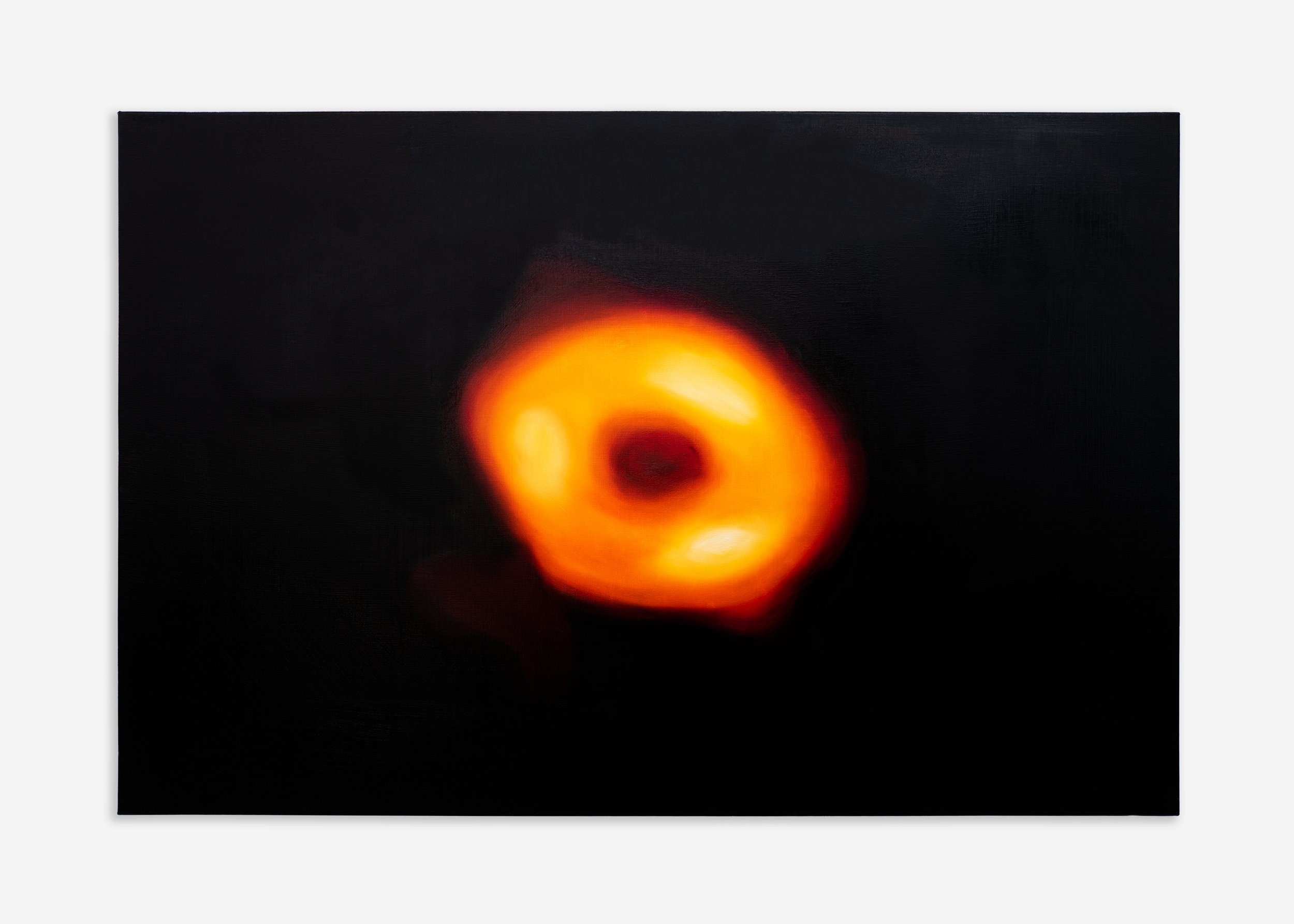
Tan Mu describes the process of painting Powehi and Sagittarius A as one of cumulative brushstrokes that mirror the cumulative data collection of the EHT. "Through the accumulation of brushstrokes, layered one after another," she writes, "I try to convey this invisible collective labor. In this way, the painting process mirrors the gradual assembly of data that makes these images possible." The analogy is not decorative. It is structural. Each brushstroke in the ring corresponds to a decision about where the accretion disk is brighter and where it is dimmer, a decision informed by the astronomical data but executed through the material logic of oil paint on linen. The paint does not represent the ring. It enacts the process by which the ring becomes visible: the slow accumulation of information, the calibration of contrast, the emergence of form from noise. When Tan Mu says the painting process mirrors the data-assembly process, she is not making a metaphor. She is describing what the painting does.
The dimensions of the canvas, 61 by 91 centimeters, position Powehi as an intimate object rather than a monumental one. This is a painting that asks the viewer to come close, to see the grain of the linen and the texture of the brushstrokes, to register the material effort that produced the ring's luminosity. The choice is deliberate and contrarian. The black hole in M87 has a mass 6.5 billion times that of the Sun. Its event horizon spans roughly 40 billion kilometers. The EHT image that revealed it was produced by a telescope the size of the Earth. Tan Mu's painting, which renders this immensity visible, measures roughly two feet by three. The discrepancy between the scale of the subject and the scale of the canvas is not an accident. It is an argument about what scale is required to see something. The black hole required a planet-sized telescope. The painting required a hand, a brush, and a rectangle of linen. Both produced an image of the same object. The question Powehi poses is not which image is more accurate. The question is whether the image assembled from fragments, whether those fragments are radio data or brushstrokes, is ever anything other than a collective construction, a thing made visible through the coordination of many acts of looking.
The Hawaiian word powehi, meaning "embellished dark source of unending creation," names the black hole as a source rather than a void. Tan Mu's painting names the image of the black hole as a print rather than a photograph, a construction rather than a capture, a ring of light assembled from the labor of many hands and many instruments rather than a revelation delivered whole from the cosmos. The distinction between source and void, between print and photograph, between construction and revelation, is where the painting lives. Powehi is not a hole. It is a forge. And the ring of light that surrounds it is not the light escaping. It is the light being made.