The Shell That Would Swallow a Star: Tan Mu's Dyson Sphere and the Architecture of Infinite Ambition
It began with a footnote. In 1960, the physicist Freeman Dyson published a short paper in Science titled "Search for Artificial Stellar Sources of Infrared Radiation," in which he proposed that a sufficiently advanced civilization might enclose its host star in a shell of solar collectors so vast that it would capture the entire energy output of the star, converting a flicker of light into an engine of galactic ambition. Dyson was not predicting that such a structure existed. He was calculating what to look for if one did. A star enclosed by a sphere of collectors would radiate in the infrared rather than the visible spectrum, and an astronomer scanning the sky for excess infrared emission might, in theory, detect the signature of a civilization that had outgrown its planet and reached for the power of its sun. The paper was three pages long. The idea it contained has since become one of the most recognized thought experiments in astrophysics, a fixture of science fiction, and, in 2023, the subject of a painting by Tan Mu that measures 152 by 183 centimeters and glows with the color of harvested sunlight.
Tan Mu's Dyson Sphere (2023) is a field of gold suspended in darkness. The canvas, her largest to date in the energy series alongside the Large Hadron Collider, presents a composition that is immediately legible and structurally complex. A central luminosity, not a circle but a field of radiance, occupies the upper register, its edges bleeding into a constellation of smaller golden forms that orbit and drift across the black ground. These forms are rectangular, some wider than they are tall, others tilted at slight angles, each one rendered in tones of cadmium yellow, pale gold, and warm amber. They are panels. They are collectors. They are the surface area that would, in Dyson's thought experiment, surround a star and absorb every photon it emits. Tan Mu does not show the star itself. She shows the shell that would enclose it, the apparatus that would convert stellar fire into civilizational power, and she renders it in the color of the light it was designed to capture.
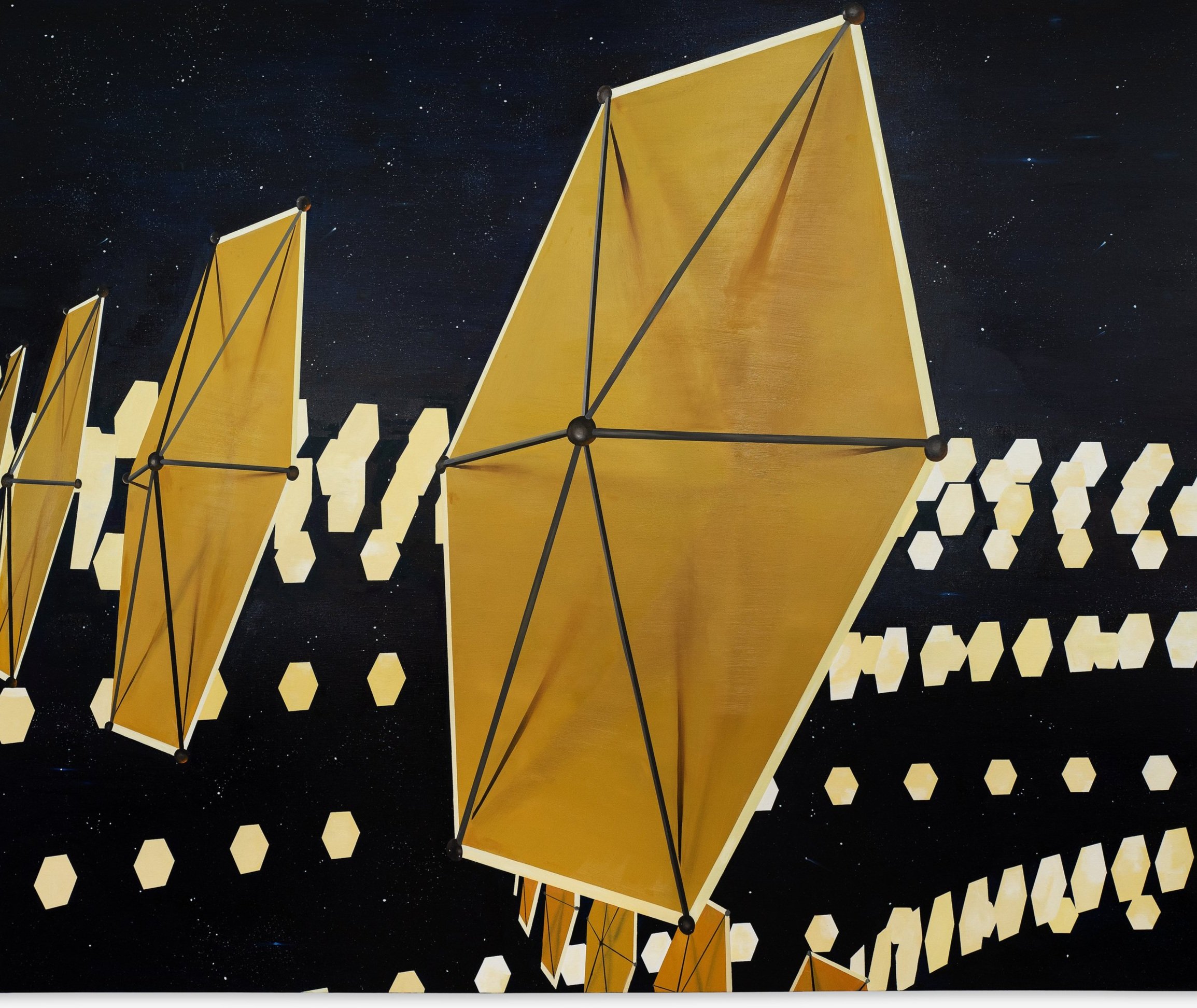
The surface of the painting rewards close inspection in a way that its overall composition does not prepare the viewer for. From a distance, the panels appear as flat geometric forms distributed across a black field. Up close, each panel reveals a history of accumulation. The gold is not a single flat application. It is built from layers of paint, each one slightly different in tone and opacity, laid down in brushstrokes that follow the rectangular shape of the form but vary in direction and density. Some panels have been worked and reworked, their surfaces carrying the ghost of earlier states, earlier decisions about where the light should concentrate and where it should thin. The black ground between the panels is not empty space. It contains a field of small white and pale yellow points, applied individually, each one a star in the background field against which the panels float. Tan Mu describes this as her "first sustained attempt to depict the starry sky," and the care she took is visible. These are not spattered dots. They are placed, each one a decision about position and luminosity, and they produce a visual effect that the flat background of earlier works in the series does not achieve: a sense of depth, of the panels existing in a three-dimensional field rather than pasted onto a flat surface.
The color register is dominated by gold, but it is a gold that shifts across the canvas. In the upper register, where the luminous field is densest, the gold is at its most saturated, a warm cadmium that approaches orange at its brightest moments. As the panels drift toward the lower register, the gold cools, thins, and turns amber, as though the energy they have collected is gradually dissipating, radiating away from the point of greatest concentration. This gradient is not continuous. It is punctuated by panels that are brighter than their neighbors, isolated concentrations of light that break the pattern of gradual diminishment and suggest that energy collection is not a uniform process but one with local intensities, nodes of surplus and deficit. The overall effect is of a system in motion, a swarm of collectors rotating around a hidden center, each one at a different angle to the light source, each one catching a different fraction of the star's output.
The dimensions of the canvas, 152 by 183 centimeters, are significant. This is not a small painting. It demands wall space and positions the viewer at a distance where the individual brushstrokes dissolve and the overall pattern of light and dark resolves. But it is also not a painting so large that the viewer is dwarfed by it. The scale is domestic, the scale of a door or a window, something that can be seen whole from across a room. This choice of scale encodes an argument about the Dyson Sphere itself. The concept is unimaginably vast, a structure that would dwarf a planet, and yet Tan Mu renders it at a size that fits inside a living space. The painting insists that the most extreme forms of technological ambition can be encountered at the scale of the human body, that the gap between the star and the shell is also the gap between the concept and the canvas, and that the work of translation, from a three-page physics paper to a rectangle of linen covered in gold pigment, is itself a form of energy collection.
Gustav Klimt's Danaë (1907) is a painting about a body receiving divine energy. In the Greek myth, Zeus descends to Danaë as a shower of golden rain, and Klimt renders the moment with a density of gold leaf and ornamental pattern that makes the divine light indistinguishable from the paint on the canvas. Danaë's body curls into the gold, her flesh merging with the ornamental field until the boundary between the mortal and the divine, the physical and the decorative, dissolves. Klimt was working in a tradition of gold-ground painting that extends back to Byzantine icons and forward through the gilded surfaces of medieval altarpieces, where gold signified not wealth but the radiance of the sacred, the visible manifestation of an invisible presence. His innovation was to bring that sacred gold into the intimate space of the female nude, collapsing the distance between the theological and the erotic, the devotional and the decorative.
Tan Mu's gold operates in a different register but carries a comparable charge. In Dyson Sphere, the gold is not ornamental. It is functional. It is the color of the energy being collected, the visible signature of stellar radiation absorbed and converted. Where Klimt's gold signifies divine presence descending into the mortal world, Tan Mu's gold signifies human technology ascending to collect the power of a star. The panels are not receiving a visitation. They are harvesting. They are the apparatus, the infrastructure, the machine that converts cosmic energy into civilizational capacity. The parallel between Klimt's Danaë and Tan Mu's Dyson Sphere is not visual. It is structural. Both paintings depict the moment when an overwhelming external force, whether divine or stellar, is received by a form that is shaped to receive it, and both render that reception in gold. The difference is in what the gold does. In Klimt, it sanctifies. In Tan Mu, it powers.
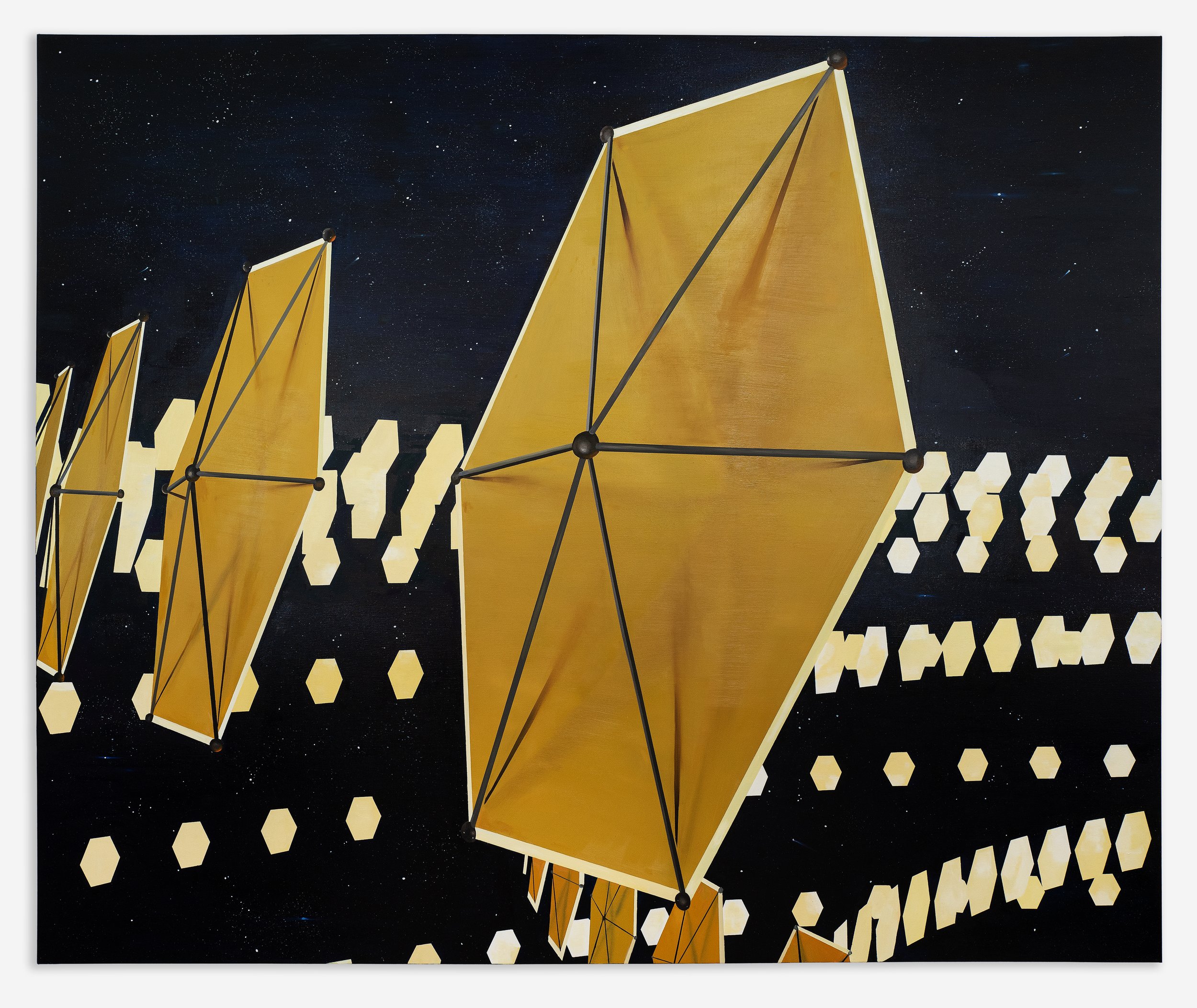
The Dyson Sphere as Freeman Dyson proposed it in 1960 was not a sphere. It was a swarm. Dyson's original paper described "a loose collection or swarm of objects" orbiting a star, each independently harvesting solar energy, their collective surface area gradually increasing until the star's output was fully captured. The popular image of a solid shell enclosing a sun, familiar from science fiction and from the Star Trek episode "Relics," is a later simplification of Dyson's original idea. Tan Mu's painting is faithful to the earlier version. Her panels are not a shell. They are a swarm, distributed across the black field with no rigid structure connecting them, each one oriented at a slightly different angle, each one catching a different fraction of the light. The painting does not show the star. It shows the collection apparatus, the distributed intelligence that has arranged itself to maximize the capture of energy. The star is present only as the source of the light that the panels reflect. It is an absence that generates a presence, a center that is never shown but whose gravitational and radiative influence organizes every element of the composition.
Tan Mu's Q&A for the artwork describes the painting process as a negotiation between scientific logic and emotional intuition. "I used a field of golden tones to depict energy collection panels orbiting a star," she writes. "The flowing gradients suggest light being reflected, absorbed, and transformed, while the rotating posture of the panels evokes continuous motion and accumulation." The word "rotating" is precise. The panels are not static collectors bolted to a frame. They are in orbit, rotating around the hidden star, their orientation shifting as they move, so that the pattern of light and shadow across their surfaces changes continuously. The painting captures a single moment in this rotation, but the gradients that Tan Mu describes suggest the moments before and after, the panels in the process of tilting toward and away from the light source, accumulating energy in a cycle that has no beginning and no end. The Dyson Sphere is not a building. It is an orbit. The painting captures the logic of orbital mechanics in the language of oil paint.
The scale problem that Tan Mu identifies in her Q&A is worth examining. "The true dimensions of such a structure are almost impossible to comprehend," she writes, "so rather than aiming for literal representation, I approached the composition metaphorically." The true dimensions of a Dyson Sphere built around our Sun would be approximately 186 million miles in radius, with a surface area roughly 600 million times the surface area of Earth. No painting could represent this literally. No human mind could hold it as a single image. The painting's task, then, is not to depict the Sphere but to produce an experience that corresponds to the experience of thinking about it. The metaphorical approach that Tan Mu describes is not a compromise. It is a method. The gold panels are not meant to be mistaken for solar collectors. They are meant to produce, in the viewer's body, the sensation of standing before an apparatus designed to capture the entire output of a star, an apparatus so vast that it would blot out the sky and turn the sun into a hidden engine. The painting does not represent this. It translates it. The gap between the concept and the canvas is not a failure of representation. It is the subject of the work.
Olafur Eliasson's The Weather Project (2003) installed at the Tate Modern's Turbine Hall, offers a structural parallel that clarifies what Tan Mu is doing with the star that is not there. Eliasson filled the vast industrial space with a semicircular array of yellow mono-frequency lamps, a ceiling of mirrored panels, and a fine mist that diffused the light throughout the hall. The result was an artificial sun that drew visitors to lie on the floor and gaze upward, watching the reflection of their own bodies floating in the mirrored ceiling above the light. The Weather Project did not represent weather. It produced an atmospheric condition inside a museum, a condition that visitors experienced with their bodies rather than interpreting with their minds. The sun was obviously artificial, its lamps and mirrors clearly visible, and yet the experience of standing in its light produced real physiological effects: warmth on the skin, a sense of expanded space, a collective orientation toward a single source of illumination. Eliasson's achievement was to make the artificial feel actual, to produce a real experience from an obviously constructed apparatus.
Tan Mu operates in a related register. The star in Dyson Sphere is not shown. It is produced, indirectly, by the panels that orbit it and the light that they reflect. The painting does not ask the viewer to imagine a star. It asks the viewer to experience the gravitational logic of a system organized around a central source of energy, even when that source is invisible. The panels are the evidence. Their orientation, their brightness, their distribution across the field all point toward a center that cannot be seen, just as Eliasson's mono-frequency lamps point toward a condition of warmth and collectivity that no actual sun could produce inside a turbine hall. Both works use an artificial light source to produce a real experience of orientation. Both acknowledge their own artificiality while generating effects that exceed their materials. And both insist that the experience of facing an overwhelming source of energy, whether stellar or artificial, is not a metaphor for something else. It is the thing itself, or as close to the thing as a constructed apparatus can bring you.
Yiren Shen, writing in her essay "On Tan Mu's Signal" (2025), identifies a recurring logic in Tan Mu's practice that she calls "the constellational mode," in which "individual points of light, whether stars, neurons, or submarine cable nodes, are organized into networks that reveal structure only at a distance." Shen's observation applies directly to Dyson Sphere. The individual panels, viewed up close, are discrete objects, each one a rectangle of gold on black with its own history of paint application and its own angle of luminosity. Viewed from a distance, they resolve into a pattern, a structure, a system of collection and distribution that could not be perceived from any single point within it. The same logic governs the starry background field, where individual white and yellow points, each one applied separately, produce the illusion of cosmic depth when the viewer steps back far enough to let them merge. The painting enacts, in its own material, the same transition from individual point to collective structure that the Dyson Sphere enacts at the scale of stellar engineering: a swarm of independent collectors, each one following its own orbit, each one contributing a fraction of the total energy output, each one invisible from the surface of the planet that the Sphere would, if it existed, power.
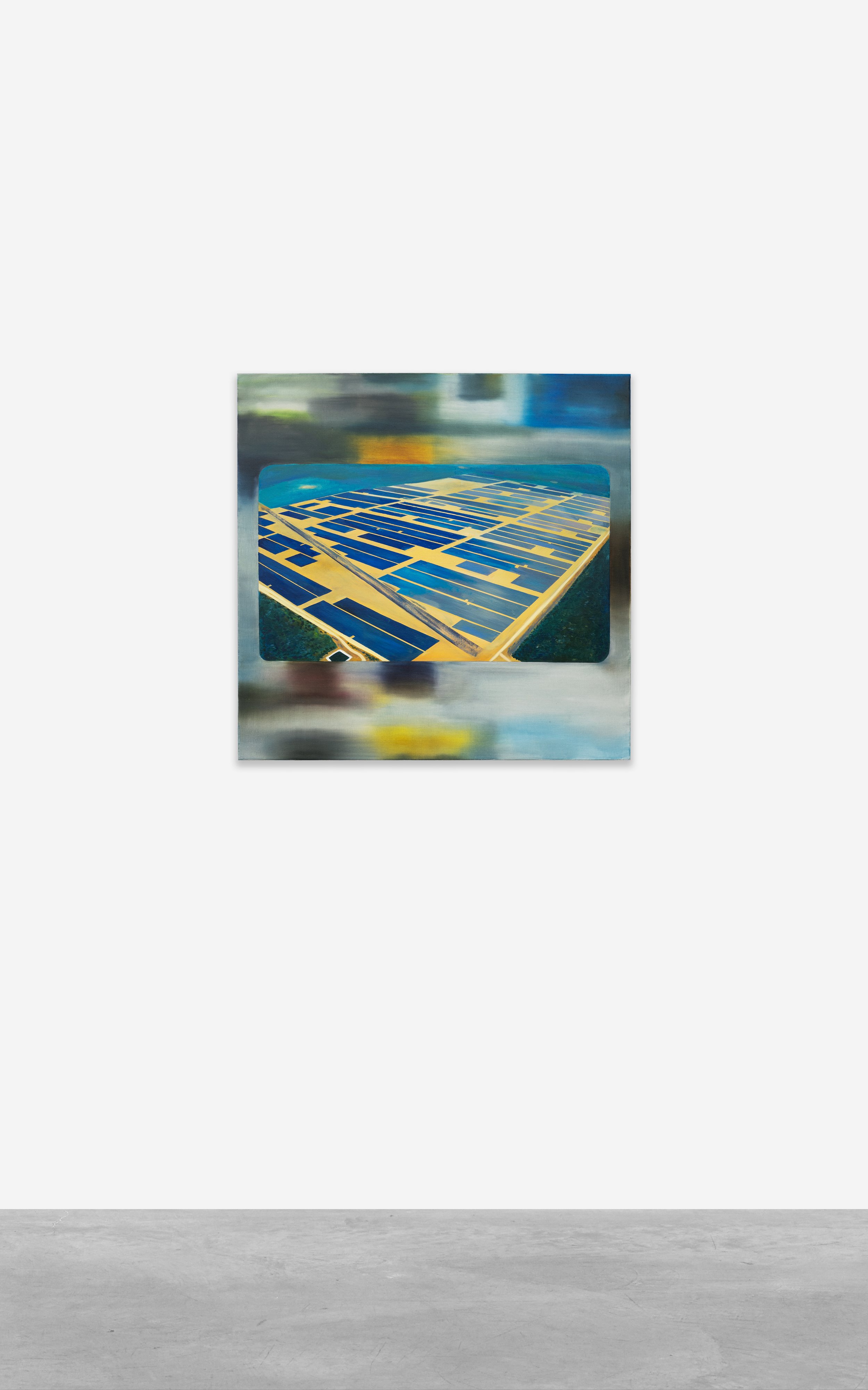
Tan Mu's Q&A connects Dyson Sphere to her broader energy series, which includes Solar Farm (2022), the Large Hadron Collider, and earlier works depicting electrical infrastructure and nuclear power. "Throughout my practice," she writes, "I have been documenting key moments in the evolution of energy, from early electrical infrastructure and nuclear power to solar energy and speculative scientific ideas." The progression from Solar Farm to Dyson Sphere traces a trajectory from the terrestrial to the cosmic, from the actual to the speculative. Solar Farm depicts a real technology, arrays of photovoltaic panels installed on the ground, converting sunlight into electricity at a scale that is currently achievable. Dyson Sphere depicts a hypothetical technology, a swarm of collectors so vast that it would enclose a star, converting the entire energy output of a sun into civilizational power. The two paintings share a visual logic, panels of gold against a dark ground, panels organized in a field that suggests both collection and rotation, but they differ in their relationship to reality. Solar Farm exists. Dyson Sphere does not. The difference between them is the difference between what has been built and what has been imagined, and the painting insists that this difference is one of degree, not of kind. Every solar farm begins as a speculative idea. Every Dyson Sphere begins as a footnote in a physics paper. The gap between the footnote and the structure is the gap that the painting occupies.
The starry sky in Dyson Sphere marks a turning point in Tan Mu's practice. In her Q&A, she describes it as "my first sustained attempt to depict the starry sky," and notes that it "became a foundational visual language in my later work." The field of individually placed points that fills the black ground between the panels would reappear in the Horizons series (2024-2025), where it serves as the cosmic backdrop against which the luminous edge of the planet is visible, and in the Signal: Submarine Network series (2024-2025), where the same point-based language migrates from the sky to the ocean floor, the stars becoming cable nodes, the cosmos becoming a network. In Dyson Sphere, the starry field serves a dual function. It establishes the depth of the space through which the panels orbit, converting the flat black ground into a three-dimensional void, and it provides a counterpoint to the golden panels, a field of small, cold lights against which the warm, artificial collectors stand out. The stars are natural. The panels are constructed. The painting holds both in the same field, the found and the made, the given and the harvested, and the relationship between them is the subject of the work.
Tan Mu identifies a "constant tension between scientific logic and emotional intuition" as essential to the painting's composition. The tension is not between two opposed forces but between two modes of understanding the same subject. Scientific logic says: a Dyson Sphere is a swarm of solar collectors orbiting a star, each one independently harvesting energy, the whole system capturing the entire stellar output. Emotional intuition says: a sphere of gold panels surrounding a hidden sun is an image of ambition so vast that it reorganizes the relationship between a civilization and its star. The painting holds both descriptions simultaneously. It is a diagram and a vision. It is a technical specification and a myth of unlimited power. The panels are machines and they are golden fragments of a shattered halo. The star they orbit is a fusion reactor and it is a god. The painting does not resolve this tension. It sustains it. Every brushstroke is a decision made in the space between calculation and feeling, and the painting's power resides in the fact that none of those decisions could have been made by calculation alone or by feeling alone. The gold had to be placed where the logic of collection and the logic of radiance converge. That convergence is the painting's subject, and it is the reason the Dyson Sphere, a structure that does not exist, can be painted as though it does.