The Seven Fractions of a Second: Tan Mu's Trinity Testing and the Instant Stretched Into Duration
Seven paintings, each one the size of a sketchbook page, hang in a line. Read left to right, they trace the expansion of a mushroom cloud from its first emergence through its full development into a column of vapor and debris. Each panel measures 28 by 36 centimeters, 11 by 14 inches, a scale designed to be held in the hand, the scale of a portrait miniature or a field drawing, not the scale of an event that killed a hundred thousand people and reshaped the political architecture of the planet. The overall span of the seven panels, 28 by 252 centimeters, extends just over eight feet, wide enough that the viewer must walk along it to see each stage, wide enough that the sequence cannot be taken in at a glance. This is the first structural paradox of Trinity Testing (2020): an event that lasted a fraction of a second, rendered in a format that requires time to traverse. The painting stretches what the explosion compressed. It turns a fraction of a second into a walk across a gallery wall.
Each panel is painted in oil on linen, monochrome, executed in a narrow register of white, grey, and black. The mushroom cloud develops across the sequence in increments that correspond not to fixed intervals of time but to stages of visual transformation. In the first panel, a small bright form rises from the bottom edge, a condensation of heat and pressure that has not yet resolved into the shape that will give the phenomenon its name. By the third panel, the classic mushroom profile is visible, the bulbous top rising on a narrow stem of updraft and fallout. By the seventh, the cloud has expanded to fill the panel's vertical dimension, its edges softening into the surrounding atmosphere, its internal structure beginning to lose definition as the turbulence that created it dissipates. The sequence is not a continuous film strip. It is a series of freeze-frames, each one a discrete moment isolated from the flow of time and sealed in paint, like a time capsule of a fraction of a second.
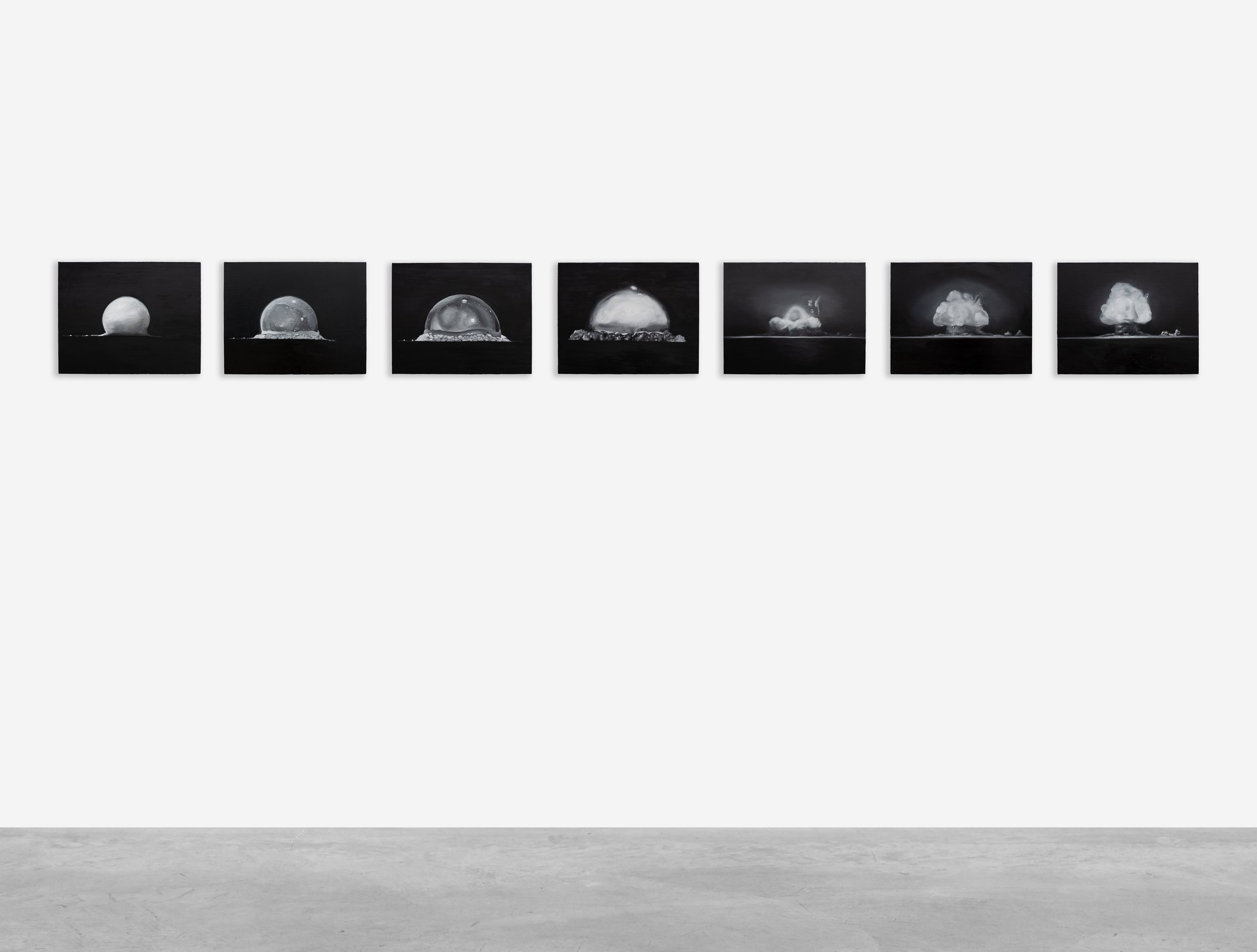
The monochrome palette is a deliberate choice, and Tan Mu addresses it directly in her Q&A. "Removing color helps strip away the familiarity of the visible world," she writes. "When images are rendered in black and white, familiar environments become strange, and what we think we understand begins to operate within a different system." The mushroom cloud is one of the most recognizable images of the twentieth century. It has appeared in newspapers, documentary films, propaganda posters, protest banners, and science fiction movies. It carries a load of cultural association so heavy that any representation in color would immediately trigger a cascade of reference: the orange of the fireball, the grey of the fallout, the blue of the desert sky at the Nevada Test Site. By removing color, Tan Mu removes the trigger. The cloud becomes a form rather than an icon, a shape rising in a field of grey rather than a symbol of nuclear annihilation. This defamiliarization is not an evasion. It is a reorientation. It forces the viewer to see the cloud as a physical event, a volume of superheated air expanding according to the laws of thermodynamics, rather than as a political symbol. The politics have not been removed. They have been deferred, held in reserve until the viewer has had time to see what the cloud looks like before assigning it meaning.
Tan Mu goes further than defamiliarization. She argues that the monochrome treatment converts the mushroom cloud from an image of explosion into "a visual expression of vibrational frequency." The claim is not decorative. Historical accounts of nuclear detonations describe not only the visual shockwave, the flash of light and the expanding dome of pressurized air, but also the vibrational energy that accompanies it. The sound arrives after the light. The ground shakes. Windows rattle. The shockwave propagates outward at the speed of sound, and the frequencies it carries are felt as much as heard. Tan Mu's connection between the visual form of the mushroom cloud and the concept of vibration links Trinity Testing to her broader practice, which includes the Signal series and her research into electronic music. "Whether it is the shockwave of a nuclear blast, the tremor of a volcano, the oscillation of data signals, or the frequencies in electronic music," she writes, "each represents energy crossing a critical threshold." The monochrome palette is not a subtraction. It is a translation. It translates the visual frequencies of the explosion into a register where vibration becomes legible as form, where the pulse of energy manifests as gradations of grey.
Francis Bacon's Three Studies for Figures at the Base of a Crucifixion (1944) presents three figures on three separate panels, each one contorted into a posture of agony or anguish, each one isolated from the others by the triptych format while belonging to the same narrative of suffering. The work was painted in the final year of the Second World War, and its first exhibition at the Lefevre Gallery in London in April 1945 placed it in a city still recovering from the Blitz, a public still processing the revelations of the concentration camps, a world that had just witnessed what Bacon would later call "the brutality of fact." The three figures are not Christ and the two thieves. They are something more disturbing: the attendants at the base of a cross that is never shown, the witnesses to a crucifixion that may or may not have occurred. The absence of the cross makes the figures' contortions more unsettling, not less, because it removes the narrative frame that would make their suffering legible. They suffer without a reason that the viewer can see. They are pure response, pure physical reaction to an event that exists outside the frame.
Tan Mu's seven panels operate in a related register. The mushroom cloud develops across the sequence, but the bomb that created it is never shown. The moment of detonation, the flash that preceded the cloud, the light brighter than a thousand suns that witnesses at the Trinity test described, all of this occurs before the first panel. What the panels show is the aftermath, the expansion of heated air and vaporized material into the atmosphere, the physical consequence of a decision made outside the frame. The serial format distributes this aftermath across seven discrete moments, each one a fragment of a process too fast for the unaided eye to parse. Where Bacon's triptych freezes three figures in simultaneous agony, Tan Mu's septptych distributes a single event across sequential panels, turning simultaneity into succession. The effect is the opposite of slow motion. Slow motion expands a fraction of a second into a duration that can be studied. Tan Mu's sequence does not expand time. It samples it, taking seven moments from a continuous process and presenting them as separate paintings, each one complete in itself, each one dependent on its neighbors for context, each one a freeze-frame of a fraction of a second that changed the world.
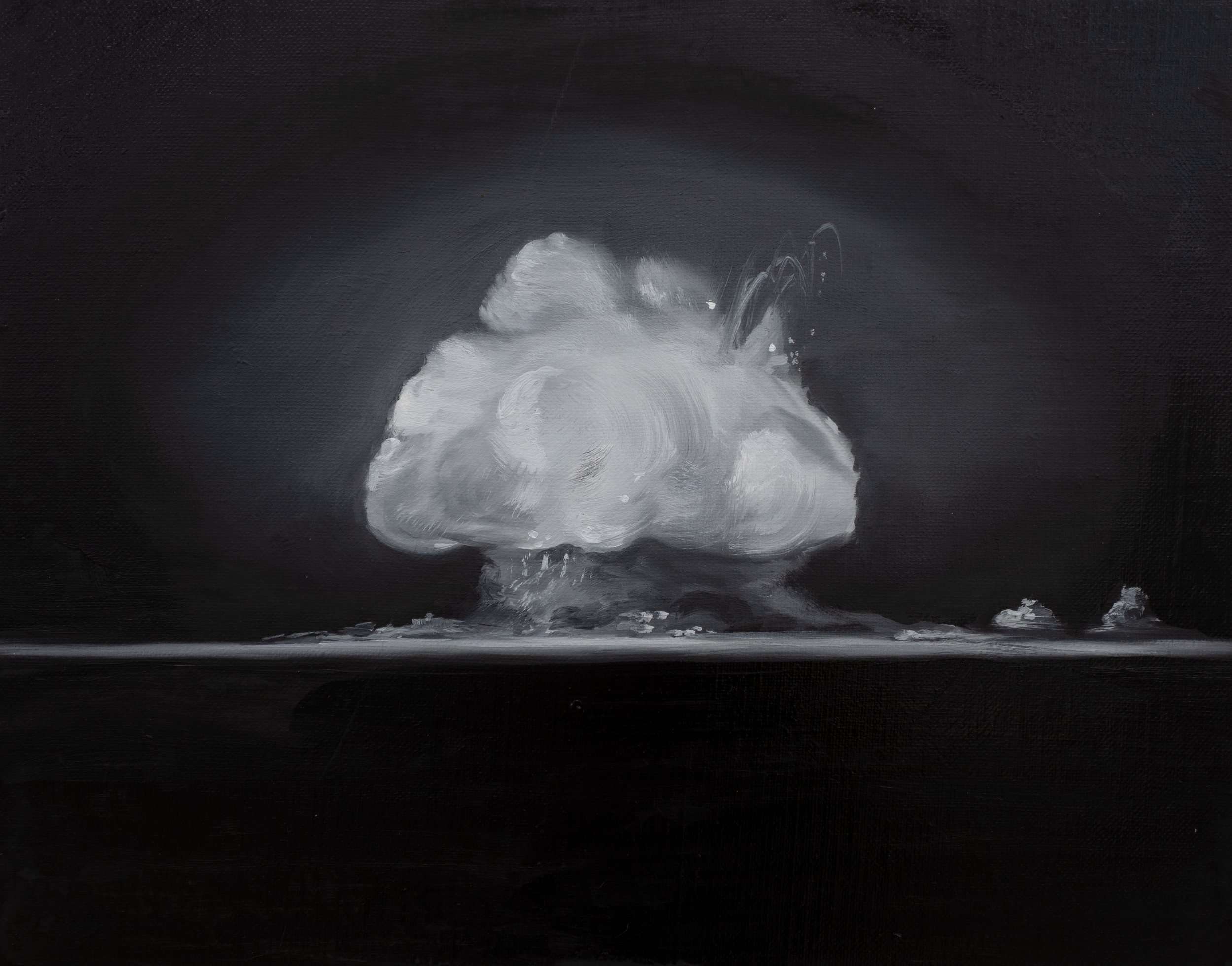
The Trinity test took place at 5:29 a.m. on July 16, 1945, in the Jornada del Muerto desert in New Mexico. The device, an implosion-type plutonium bomb code-named "the Gadget," was detonated on a tower approximately 30 meters above the ground. The yield was approximately 20 kilotons of TNT equivalent. The fireball rose to a height of roughly 200 meters before forming the mushroom cap that would become the iconic image of nuclear detonation. The entire sequence, from the initial flash to the full development of the cloud, took less than two seconds. Two seconds. The event that inaugurated the Atomic Age, that led to the bombings of Hiroshima and Nagasaki, that triggered the arms race and the doctrine of mutually assured destruction and the test-ban treaties and the anti-nuclear movements that shaped the second half of the twentieth century, took less time than it takes to read this sentence aloud. Tan Mu's seven paintings do not attempt to reproduce this duration. They extend it. Each panel took roughly a day to complete. The seven panels together took slightly more than a week. Ten hours a day, for ten days, painting a fraction of a second.
Tan Mu describes the process in terms that connect the act of painting to the event depicted. "Each painting took about a day," she writes, "and the entire group unfolded over slightly more than a week. During each session, I focused intensely on a single image and a single moment, the instant when massive energy is released. Each painting represents a fragment of time, transformed into a visual record. It felt as though I was stretching time, entering that brief instant and examining its impact from within." The metaphor is precise. The painting does not slow down the explosion. It stretches the time in which the explosion can be examined. It creates a duration that the original event did not have, a duration in which the viewer can walk along the wall, see each stage in isolation, and construct a mental model of the continuous process from which the stages were sampled. The painting is not a representation of the explosion. It is an instrument for examining it, a device for extending the fraction of a second into a temporal field that the viewer can inhabit.
Eadweard Muybridge's Animal Locomotion series (1887) dissected the continuous motion of running horses, walking men, and flying birds into discrete frames that, when viewed in sequence, revealed the mechanics of movement invisible to the unaided eye. Muybridge's breakthrough, achieved initially at the request of Leland Stanford to settle a bet about whether a running horse ever has all four hooves off the ground, depended on a bank of cameras triggered by the subject's passage across a trip wire. Each camera captured a single moment, and the resulting plates, arranged in sequence, transformed the continuous flow of motion into a series of still images that could be studied, compared, and understood. The motion picture, which Muybridge's work anticipated, would later reverse this process, recombining the frames into the illusion of continuous movement. But Muybridge's original plates do not recombine. They remain sequential, each one a complete image that belongs to a set, each one legible on its own but meaningful only in relation to its neighbors.
Tan Mu's seven panels share this logic of sequential completeness. Each one is a finished painting, capable of standing alone as a depiction of a mushroom cloud at a particular stage of its development. But their meaning accumulates across the sequence, in the way that Muybridge's plates accumulate meaning across the grid. The first panel without the seventh is a bright form rising from a dark ground. The seventh without the first is an amorphous cloud filling a vertical rectangle. Together, the seven panels narrate the full arc of the explosion's expansion, from emergence to dissipation. The serial format is not a convenience. It is the painting's argument about time. The explosion is not a single event. It is a process, and a process can only be represented through succession, through the distribution of a continuous event across discrete frames. Muybridge used this logic to reveal the hidden mechanics of galloping horses. Tan Mu uses it to reveal the hidden mechanics of nuclear detonation, the gradual, sequential, almost geological way that a fireball rises, expands, and flattens into a cap of condensation and debris.
Li Yizhuo, writing in her review of the DAWN exhibition at Peres Projects (Kaltblut Magazine, 2022), observes that Trinity Testing and The Splash of a Drop (2022), "of radically different topics, bear striking resemblance in their form, palette, and sequence." The formal observation is precise. Both works are serial, monochrome, small in scale, and concerned with the fraction of a second in which energy is released. One depicts the detonation of a nuclear weapon. The other depicts the impact of a drop of water on a surface. The difference in scale between the two events, the energy released by a 20-kiloton explosion versus the energy released by a falling droplet, is approximately twenty orders of magnitude. And yet the paintings look alike. Li Yizhuo reads this resemblance as evidence that Tan Mu's practice is concerned not with the specific content of the events she depicts but with the structure of the instant in which energy transforms matter. "The artist has carefully made a group of paintings based on photographs of atomic bomb testing," Li Yizhuo writes, "their repetition imbuing these works with a sense of spiritual mystification." The word "spiritual" is not casual. It identifies something that the formal resemblance to The Splash of a Drop makes visible: that the instant of energy release, whether in a nuclear detonation or a falling droplet, is not merely a physical event. It is a moment of transformation, a threshold where one state of matter gives way to another, where the rules that governed the system before the event no longer apply.
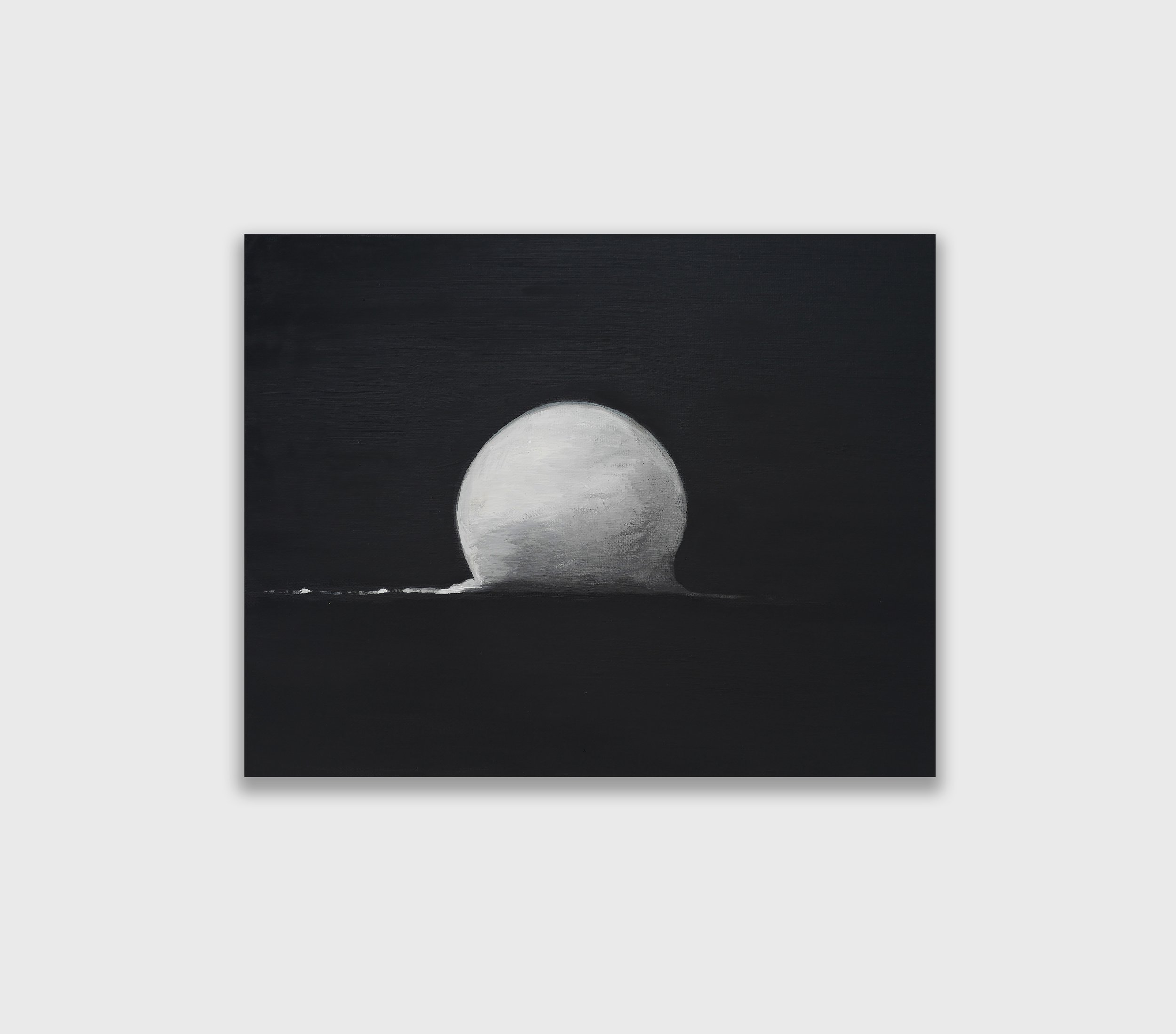
The scale of each panel, 28 by 36 centimeters, enacts a paradox that Tan Mu identifies in her Q&A. "The carefully controlled size of the canvas stands in quiet contrast to the uncontrollable nature of the energy being depicted," she writes. "I approach the mushroom cloud as if it were a calm and precise object, yet the behavior of the paint itself introduces unpredictability and instability." The contrast is not merely between the size of the painting and the scale of the event. It is between the intimacy of the format and the enormity of the consequences. A 28 by 36 centimeter painting is a domestic object. It can be held, carried, stored in a portfolio, placed on a shelf. It belongs to the world of personal possession, of private contemplation, of the quiet interior. The event it depicts belongs to the world of geopolitical strategy, of military planning, of state secrecy and mass death. The painting refuses the monumentality that the subject would seem to demand. It insists that the most consequential event of the twentieth century can be held in the hand, that the mushroom cloud can be seen at the scale of a portrait, that the instant that killed a hundred thousand people and reshaped the global order can be examined in a format designed for private looking.
This refusal of monumentality is not an act of diminishment. It is an act of translation. The mushroom cloud, as it appears in newspaper photographs and documentary footage, is always seen from a distance, always at a scale that makes it public and collective, a shared image of shared catastrophe. Tan Mu's seven panels bring the cloud close, close enough that the brushwork becomes visible, close enough that the viewer can see where the paint accumulates and where it thins, close enough that the act of painting, the daily labor of applying pigment to linen, becomes as legible as the event being painted. The tension that Tan Mu describes between control and unpredictability operates at the level of the brushstroke. Each panel was painted with intention, the cloud carefully shaped, the tones calibrated to produce the gradient from bright center to dark periphery. But the behavior of oil paint, its tendency to bleed, to pool, to dry at different rates in different conditions, introduces an element of chance that parallels the unpredictability of the explosion itself. The paint does what it wants at the margins, just as the shockwave does what it wants at the edges of its blast radius. The painting holds a temporary equilibrium between intention and accident, between the artist's control and the material's resistance, just as nuclear physics holds a temporary equilibrium between the forces that hold an atom together and the forces that tear it apart.

Tan Mu connects the nuclear explosion to her broader interest in "the defining moments of human progress," a phrase that carries its own paradox. The detonation at Trinity was both a triumph of scientific achievement and a catastrophe of human consequence. The same chain reaction that proved the feasibility of nuclear energy proved the feasibility of nuclear annihilation. "The nuclear explosion is the ultimate metaphor for the release of energy," Tan Mu writes. "It marks humanity's breakthrough beyond physical limitations and embodies a moment of creation, while also containing the duality of creation and destruction." The word "duality" is careful. It does not resolve the paradox. It holds it. The painting holds it too. The seven panels depict an event that is simultaneously a scientific milestone and a moral catastrophe, and they refuse to adjudicate between these readings. The monochrome palette removes the emotional trigger of color. The intimate scale removes the monumental rhetoric of public memory. The serial format distributes the instant across time, refusing the viewer the comfort of a single, totalizing image. What remains is the process itself, the expansion of heated air into the atmosphere, the transformation of solid matter into vapor, the fraction of a second in which the rules changed and did not change back.
Saul Appelbaum, writing in his catalog essay for the BEK Forum exhibition (2025), identifies a recurring logic in Tan Mu's practice in which "the painting becomes the instrument through which the event is measured, rather than the surface on which it is depicted." The distinction is precise. An instrument does not represent. It registers. A seismograph does not depict an earthquake. It records the vibrations that the earthquake produces. A thermometer does not depict a fever. It registers the temperature that the fever causes. Tan Mu's seven panels, in Appelbaum's reading, function as instruments for registering the fraction of a second in which nuclear energy was released. They do not show what the explosion looked like to a witness standing at a safe distance. They register the expansion, the turbulence, the dissipation, as a seismograph registers the tremors that propagate outward from the epicenter. The monochrome palette is the instrument's calibration. The serial format is its time axis. The intimate scale is its sensitivity. And the paint's unpredictability, the way it bleeds and pools at the margins of each cloud, is the instrument's margin of error, the acknowledgment that no measurement is exact, that every instrument introduces noise into the signal it records.
The seven panels of Trinity Testing hang in a line because the event they depict unfolded in time. The line is not decorative. It is structural. It enacts the temporal logic of the explosion, which is to say the temporal logic of all energy release: accumulation, threshold, expansion, dissipation. The first panel shows the threshold. The middle panels show the expansion. The final panels show the dissipation. The sequence is irreversible. The viewer cannot read it from right to left and make sense of it in the same way, because the cloud does not contract back into its point of origin. The line of panels is an arrow. It points in one direction, the direction of entropy, the direction of irreversible change. This is the direction of the Atomic Age itself, which began at 5:29 a.m. on July 16, 1945, and has not ended, cannot end, because the knowledge that made the explosion possible cannot be unlearned. The seven paintings are not a memorial. They are a measurement. They measure a fraction of a second that is still expanding, still dissipating, still reshaping the conditions under which human beings live on the surface of a planet that can, at any moment, be made uninhabitable by the same force that the panels so calmly, so precisely, so intimately depict.