The Largest Cell and the Smallest Choice: Tan Mu's IVF and the Asymmetry of Design
A human egg is roughly one hundred micrometers in diameter. It is the largest single cell in the human body. You can see it without magnification if you know where to look, a pale dot about the size of the period at the end of this sentence. A human sperm is roughly five micrometers long at the head, with a tail that extends another forty-five. The entire sperm, head and tail together, is invisible to the unaided eye. You need a microscope, and not a cheap one, to resolve it. The volume ratio between them is staggering. An egg is roughly one hundred thousand times the volume of a single sperm. If you placed them side by side on a surface, the egg would be a balloon and the sperm would be a grain of sand. And yet in the procedure called intracytoplasmic sperm injection, or ICSI, it is the sperm that moves. A micromanipulator, operated by an embryologist watching through a microscope, selects a single sperm from a sample of millions, immobilizes it by crushing its tail with a glass pipette, and injects it directly through the zona pellucida, the thick outer wall of the egg, into the cytoplasm within. The needle that performs this injection is roughly seven micrometers in diameter, slightly larger than the sperm it carries. The egg does not move. The egg does not choose. The egg receives. The asymmetry of scale, an egg that fills the visual field and a sperm that is barely visible within it, is compounded by an asymmetry of agency, in which the smallest object in the frame is the one that acts, and the largest object is the one that is acted upon. IVF (2020) paints this convergence at the scale at which it occurs, which is to say, at the scale at which a human eye looking through a microscope would see it, and through this alignment it makes visible an asymmetry that is simultaneously biological and cultural.
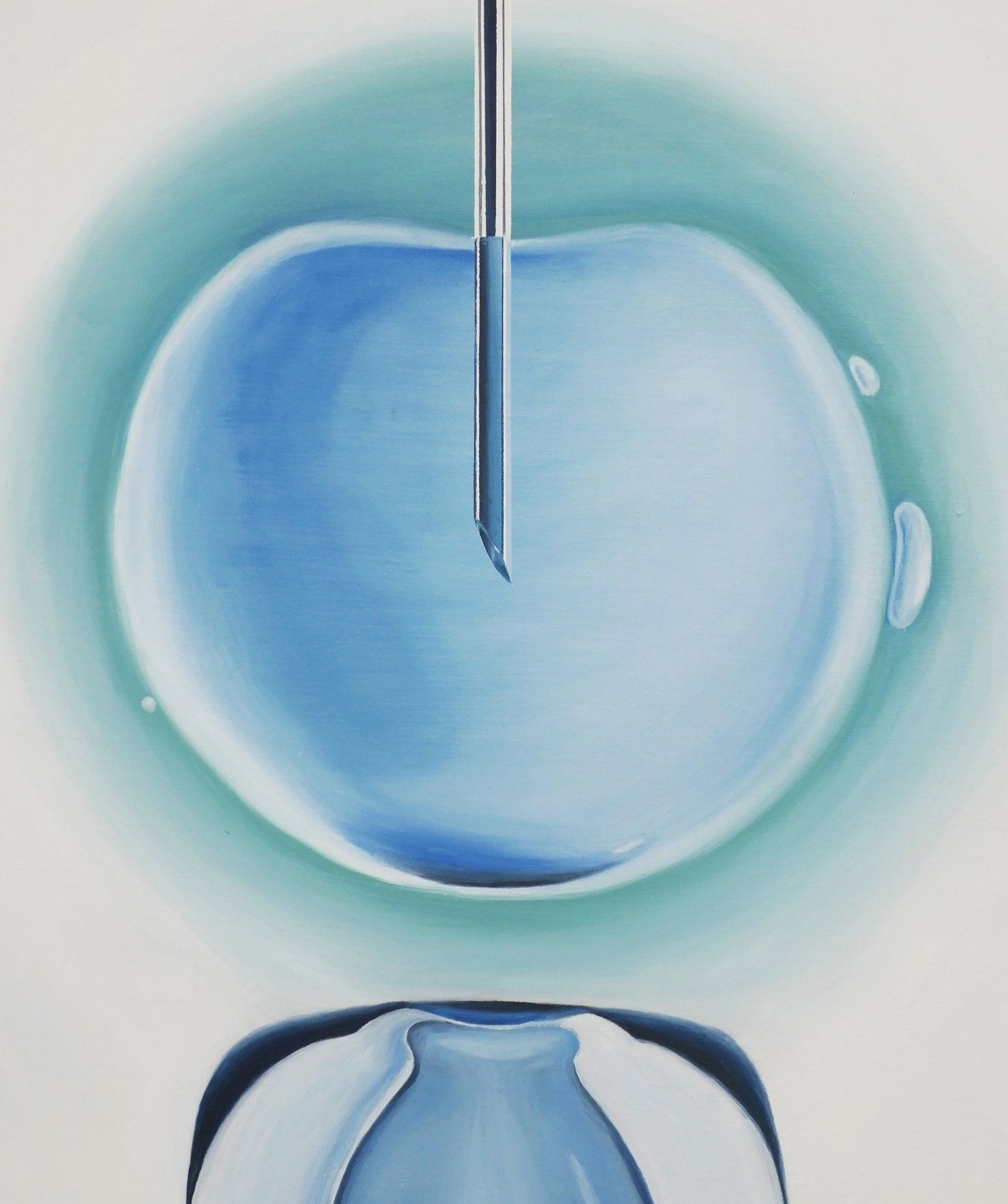
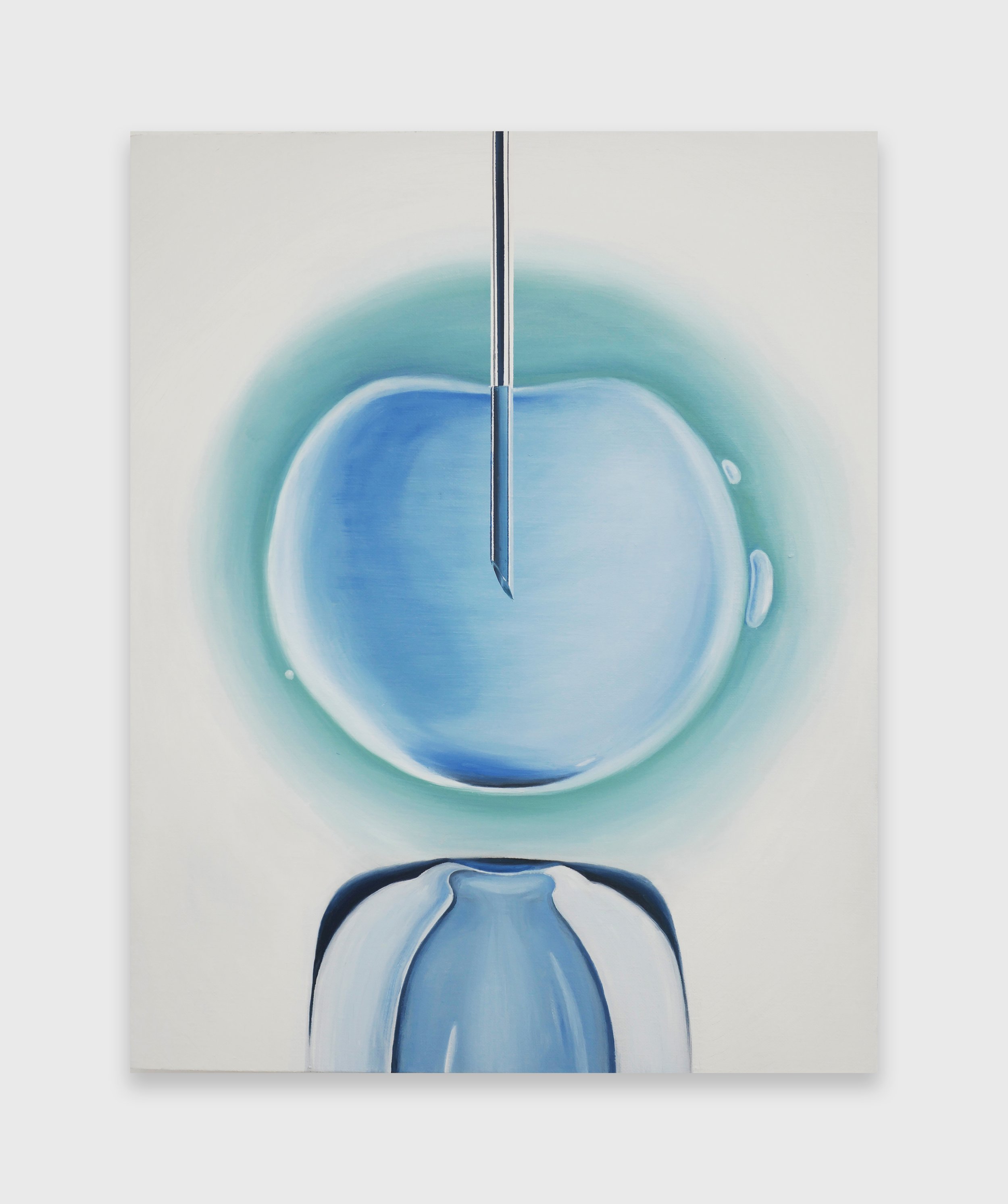
IVF, 2020, oil on linen, 51 x 41 cm (20 x 16 in), presents a near-circular field of cool blue against a dark ground. The composition is dominated by the egg, a large, luminous form that occupies the center of the canvas, its membrane rendered as a thin, precise ring of slightly lighter blue that separates the interior cytoplasm from the dark space surrounding it. Into this field, from the right side of the canvas, enters a needle: a straight, vertical line that terminates in a point aimed at the egg's center. Where the needle meets the zona pellucida, Tan Mu has painted a slight indentation, a moment of compression that suggests the membrane yielding to the needle's pressure before the puncture occurs. The needle is rendered in a cooler, more clinical tone than the egg, a silvery white that contrasts with the warmer, almost violet blue of the cytoplasm. Around the point of contact, a faint halo of lighter blue suggests the disturbance that the injection will create when the needle penetrates and the sperm is released into the egg's interior. The overall palette is restricted to blues, with a single note of warmer color in the cytoplasm and a darker, almost black ground that reads as the medium in which the procedure takes place: culture fluid, the viscous liquid that sustains the egg in the petri dish during manipulation. Tan Mu has described this palette as intentional: "In IVF, I primarily used cool blue tones to reflect the clinical calm and neutrality of laboratory environments, while also evoking the purity and vulnerability of life at its earliest stage." The blues are not decorative. They are diagnostic. They are the blues of the laboratory, the blues of the microscope's illumination, the blues of the culture medium that keeps the egg alive during the seconds or minutes between extraction and injection.
The composition sets up a formal contrast that Tan Mu has articulated explicitly: "The composition contrasts vertical needle forms with rounded cellular shapes. The needle represents the precision and power of technological intervention, while the circular forms of the cells suggest softness, fragility, and potential." The vertical line of the needle cuts across the horizontal format of the canvas with a decisiveness that borders on violence. The egg is round, full, centered, at rest. The needle is straight, pointed, entering from outside the frame, in motion. The contrast is not just formal. It is narrative. Something is about to happen to the egg. The needle is the instrument of that happening, and the painting holds the moment just before the puncture, when the membrane has yielded but has not yet been breached, when the intervention is imminent but has not yet been completed. This suspended moment is the painting's subject as much as the procedure itself. The egg does not know what is coming. The needle does. The painting places the viewer in the position of the embryologist, watching through the microscope, seeing both the target and the instrument, understanding the asymmetry of the encounter and the precision of the intervention, and recognizing that the outcome, the creation of a potential human life, will emerge from an act that looks more like microsurgery than like anything we recognize as biological reproduction.
Leonardo da Vinci's embryological studies in the Windsor folios, produced between approximately 1489 and 1492, represent the first sustained attempt in Western art to depict the human fetus inside the uterus. The drawings, executed in red chalk and pen and ink on blue paper, show the fetus in various positions within what Leonardo called the "second womb," the chorionic membrane that surrounds the amniotic sac. In the most famous of these sheets, now catalogued as RL 19102 at the Royal Library, Windsor, Leonardo drew the fetus in a breech position, its legs folded and its arms crossed, floating within the membranes like a seed inside a fruit. The drawing is precise, measured, and accompanied by notes in mirror script that describe the relationship between the fetus, the membranes, and the uterine wall. But the drawing is also beautiful. The blue paper gives the entire composition a tonal unity that makes the membranes look like veils and the fetus look like a small god, floating in a blue darkness that is simultaneously anatomical and numinous. Leonardo was not a detached observer. He was an artist who used drawing as a method of understanding, and the understanding he produced was not purely anatomical. It carried with it a sense of wonder at the architecture of life that no purely medical illustration could achieve. The Windsor sheets are the work of someone who is drawing to find out what something looks like and discovering, in the act of drawing, that what it looks like is more astonishing than what he expected.
The connection to IVF is structural, not merely thematic. Leonardo drew the fetus inside the uterus because he wanted to understand the container in which life develops. Tan Mu paints the egg under the microscope because she wants to understand the container in which life is intervened upon. Both artists face the same representational problem: how to depict something that is normally invisible, that exists at a scale below the threshold of ordinary vision, and that carries a charge of meaning that exceeds its physical dimensions. Leonardo solved this by drawing on blue paper, which gave his studies a tonal coherence that made the womb look like a cosmos and the fetus look like a planet floating in space. Tan Mu solves this by restricting her palette to blues, which gives her canvas the same tonal coherence, making the petri dish look like a night sky and the egg look like a celestial body. In both cases, the formal solution is also an emotional proposition. The blue says: this is a space of contemplation, not merely of observation. The container is not just a vessel. It is a world. And the thing inside the container is not just a cell or a fetus. It is a potential that has not yet been realized, an existence that has not yet been chosen or rejected, a life that is still, in the most literal sense, up for grabs.
ICSI, the procedure depicted in IVF, was developed in 1992 by Gianpiero Palermo at the Vrije Universiteit Brussel, and it transformed in vitro fertilization from a procedure that depended on the natural capacity of sperm to penetrate the egg into a procedure that bypassed that capacity entirely. Before ICSI, IVF required sperm that could swim, that could navigate the zona pellucida, and that could fertilize the egg under conditions that approximated natural conception. After ICSI, a single sperm, even a non-motile one, even one that could not swim at all, could be selected by an embryologist, loaded into a pipette, and injected directly into the egg. The procedure removed the single greatest barrier to fertilization: the sperm's own capacity to reach and penetrate the egg. It was, in the language of reproductive medicine, a revolution. It was also, in the language that Tan Mu uses in her Q&A for this painting, a step toward a world in which "genetic screening is increasingly positioned as a consumer choice rather than solely a medical intervention." The same technology that allows a non-motile sperm to fertilize an egg also allows the embryologist to select which sperm to use, and the criteria for selection have expanded over the three decades since Palermo's first successful ICSI procedure. Sperm banks now present donor profiles that include education, physical traits, health history, and family genetics. Tan Mu has described these profiles as resembling "curated catalogs of idealized genetic attributes," and the comparison to the film Gattaca, which she mentions explicitly in her Q&A, is apt: in Gattaca's world, genetic selection is not a medical option but a social expectation, and the distinction between treating disease and optimizing traits becomes indistinguishable.
The painting registers this expansion of choice through its compositional structure. The needle enters from outside the frame. It is not generated by the egg. It does not emerge from within the biological system. It comes from elsewhere, from the laboratory, from the embryologist, from the technology that makes the procedure possible. The needle is the instrument of choice, and the choice it represents is not the egg's choice. The egg receives. The needle selects. The asymmetry of scale, which Tan Mu has described as "the dramatic difference in scale between sperm and eggs," is compounded by an asymmetry of agency that the painting makes visible through the simple geometry of its composition: the round, passive, centered form of the egg versus the straight, active, entering form of the needle. The egg is the largest cell in the human body and it is the one that waits. The sperm is among the smallest and it is the one that is selected and directed. The painting holds this paradox in a single visual field. The thing that is biggest is the thing that is most vulnerable. The thing that is smallest is the thing that is most directed. And the technology that mediates between them, the needle, the micromanipulator, the microscope, the embryologist's trained hand, stands outside the biological system entirely, representing not the natural process of reproduction but the designed process of intervention, a process in which the criteria for selection are determined by human judgment and the outcome is measured against human standards of what constitutes a desirable or acceptable life.
Gustav Klimt's Danaë (1907) depicts the moment in Greek mythology when Zeus, having transformed himself into a shower of golden rain, descends upon the imprisoned princess Danaë and impregnates her. The painting shows Danaë lying on her back, her body curled in a posture that oscillates between ecstasy and resignation, her thighs parted and her face turned away from the golden stream that falls between her legs. The gold is not decorative. It is the agent of conception. It is Zeus. It is the divine made material, the god reduced to a flow of particles that enters Danaë's body and fertilizes her without her consent, without her knowledge, and without any possibility of refusal. Klimt painted this subject at least twice, and the 1907 version in the collection of the Belvedere, Vienna, is the most complete. The gold falls in a vertical stream that dominates the right side of the composition, a column of luminous particles that descends from above and disappears into the dark space between Danaë's thighs. The stream is straight, directed, purposeful. It knows where it is going. Danaë's body receives it. The compositional structure is the same as IVF's: a vertical, directed element entering a round, receptive form. The agency is external. The recipient is passive. The outcome is predetermined by forces that the recipient does not control.
The parallel is not decorative. Klimt's Danaë is a painting about conception as divine intervention, about a power that descends from above and creates life without the consent of the person who will bear it. Tan Mu's IVF is a painting about conception as technological intervention, about a power that enters from outside the biological system and creates life according to criteria that the system itself does not determine. Both paintings depict the moment before conception, the moment when the agent of fertilization, whether divine rain or a glass pipette, is about to enter the egg, and both paintings hold that moment in suspension, not yet resolved, not yet completed, still capable of being stopped. The difference is that Klimt's Danaë has no power to stop the rain. She is imprisoned in a tower by her father, who has been told by an oracle that his grandson will kill him, and the rain comes through the window of her cell as an act of divine will that overrides both her imprisonment and her agency. Tan Mu's egg has no power to stop the needle either, but the needle is operated by a human being who has made a series of choices that the egg cannot make for itself: which sperm to select, which egg to inject, which embryo to transfer, which embryo to freeze, which embryo to discard. Saul Appelbaum, writing in the BEK Forum catalog, described Tan Mu's paintings as operating through "arbitration," a term drawn from electro-acoustic music in which an input passes through a process of decision and emerges as an output. ICSI is literal arbitration. The embryologist decides. The egg receives. The painting makes this decision visible as a compositional fact. The needle enters from outside the frame. The choice comes from elsewhere. The egg, the largest cell in the human body, the cell that contains half the genetic material for a potential human being, the cell that has been waiting since before the woman who carries it was born, sits in the center of the canvas and does not move. The asymmetry is not just in the scale of the cells. It is in the architecture of the procedure, which places the power of selection outside the biological system and inside the technological one, and which presents that arrangement as a clinical necessity while simultaneously opening it to the possibility that the criteria for selection may expand beyond medical need into the territory of optimization, preference, and design.
The painting refuses to resolve this tension. It holds the needle at the moment before puncture, the egg at the moment before injection, the sperm at the moment before release, and it holds all three in a visual field where the blues of the laboratory and the blues of the cytoplasm are indistinguishable from the blues of contemplation and the blues of the night sky. The egg is a planet. The needle is a trajectory. The sperm is a passenger. The procedure is a story about selection, about who gets to choose and who is chosen, about the difference between a medical intervention that saves a life and a technological platform that designs one, about the distance between the largest cell in the human body and the smallest decision that determines whether that cell will become a person. Tan Mu has said that she was "deeply fascinated by this phenomenon because it is both fleeting and endlessly repeatable," and the painting captures this doubleness: the procedure lasts seconds, but the choice it represents lasts a lifetime, and the system that enables it is expanding in ways that nobody in 1992, when Palermo performed the first ICSI, could have foreseen. The needle has not yet entered the egg. The membrane has yielded but has not broken. The moment is still suspended. The choice is still pending. And the painting, holding that suspension indefinitely, makes visible what the procedure itself obscures: the fact that the moment of intervention is also a moment of design, and that the design is not the egg's.