The Heat That Remains: Tan Mu's Touch and the Hand That Left Its Mark
In the Río Pinturas canyon in Argentine Patagonia, the rock overhangs known as the Cueva de las Manos preserve hundreds of human handprints stenciled in mineral pigment across the canyon walls. The oldest of these marks date to roughly 7300 BCE. They were made by placing a hand against the rock face and blowing pigment around it, producing a negative image: a silhouette of the hand surrounded by a halo of red ochre and white, the hand itself a void. No two are identical. Some are large, some small enough to belong to children. Some are missing fingers, the result of ritual amputation or frostbite. Others overlap, one hand placed where another had been, centuries apart, layering human presence into the stone until the wall becomes a palimpsest of touch. The people who made these marks did not sign their names. They could not have imagined that nine thousand years later, a visitor with a camera would stand before these walls and recognize in them the same impulse that now drives her to press her own hand, translated through infrared radiation and oil paint, against the void of a stretched linen canvas.
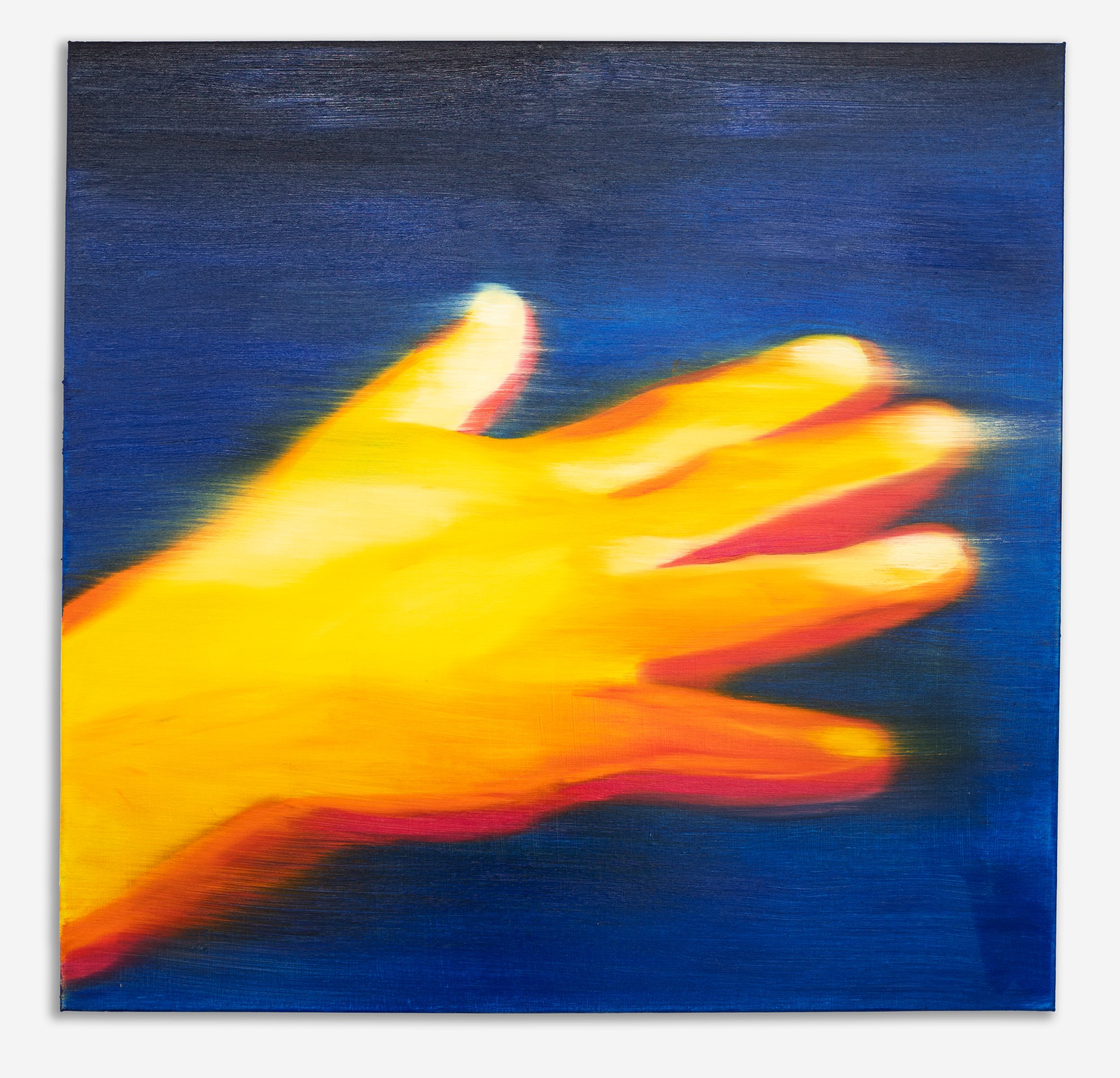
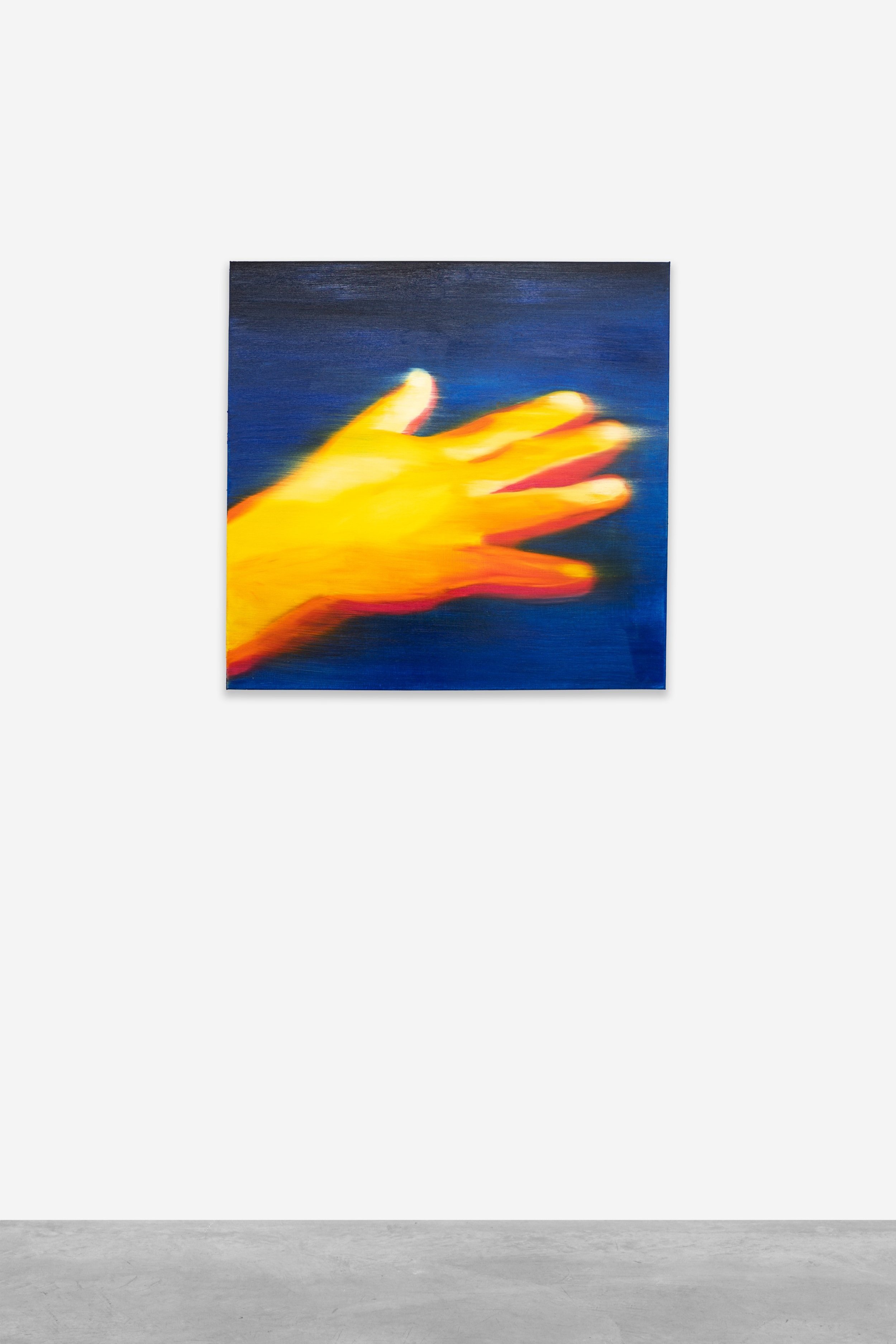
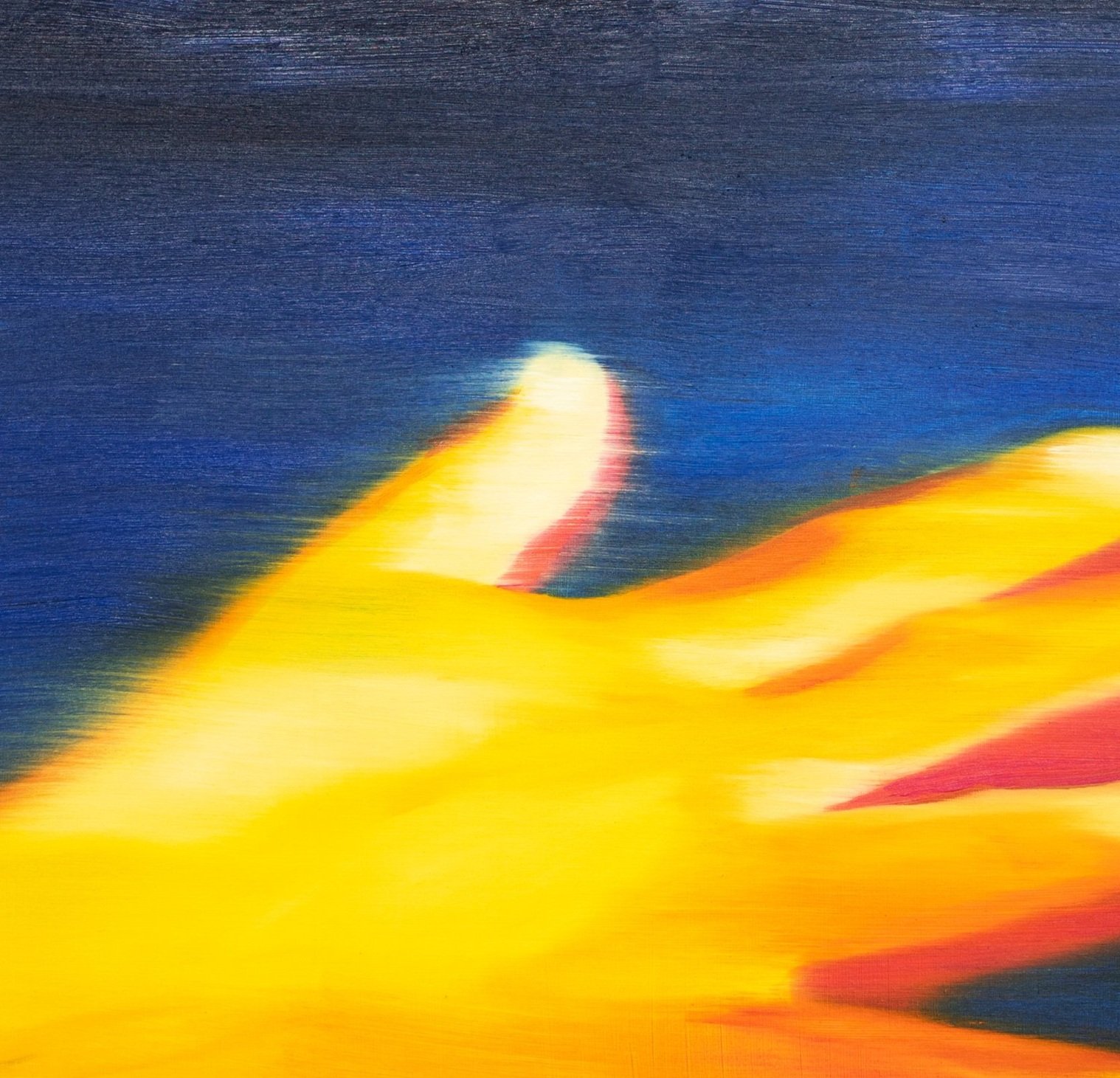
Tan Mu's Touch (2022) is a square painting, 76 by 76 centimeters, oil on linen. The square format is deliberate and exact: it gives the hand nowhere to escape, no horizon to drift toward, no landscape to contextualize it. The hand fills the canvas the way a face fills a portrait, and the comparison holds. This is a portrait, but not of a person. It is a portrait of heat. The image is based on a thermographic photograph, the kind generated by infrared cameras that map the surface temperature of a body by assigning each degree a corresponding hue. In thermal imaging, the hottest zones register as white or bright yellow, cooler areas grade through orange and red, and the coldest regions, where blood flow is minimal or absent, appear as deep blue or black. The hand in Touch blazes in the upper register of this spectrum. The palm radiates cadmium yellow, the fingers grade through burnt orange toward the tips, where the cooler extremities shift into a deep amber that almost merges with the surrounding ground. That ground is a saturated, close-valued navy blue, the color thermal cameras assign to the coldest zones and the color of the cave wall at Río Pinturas after the sun has left it. The edges of the hand are not sharp. They dissolve into the blue in soft, blurred transitions, as if the heat were radiating outward from the palm and losing coherence at its perimeter. The paint surface here is thin and washy, the linen visible beneath it, whereas the center of the palm carries a denser, more opaque application where the yellow is built up in two or three layers. This variation in impasto maps the temperature scale directly onto the material thickness of the painting: the hottest zones are the thickest, the coolest the thinnest, until the fingers trail off into near-transparency and the hand becomes indistinguishable from the cold field it inhabits.
The handprints in the Cueva de las Manos were made by a technique that produces a negative image: the hand blocks the pigment, and the area around it receives the color. The hand itself remains blank, a void in the pigment field, a silhouette of absence. This is not representation. It is imprint. The pigment does not depict the hand. It records the fact that a hand was there. Tan Mu's thermographic hand operates through an opposite logic and arrives at a related conclusion. The thermal camera does not record the hand as shape. It records the hand as temperature. It sees the body not as an outline but as a gradient of heat, the warmest zones at the center and the coolest at the extremities, and it assigns each gradient a color from a predetermined palette. The resulting image is a positive, not a negative: the hand appears in warm tones against a cold background, its form filled in rather than cut out. But the effect, when the hand is isolated on a deep blue field as it is in Touch, echoes the cave stencil. In both cases, the hand is not drawn. It is captured by a process that bypasses depiction entirely. The cave dweller blew pigment. The infrared camera detected radiation. The painter applied oil to linen. In all three cases, the hand itself did not make the mark. It was the agent whose presence caused the mark to appear. The hand is the subject and the instrument simultaneously, and the mark it leaves behind, whether in ochre on stone or in yellow on blue linen, is a record of contact, of touch, of a body pressing itself against a surface and leaving evidence that it was there.
The distinction between negative and positive matters here because Touch holds both in suspension. The hand in the painting is filled with color, a positive image. But the blurred edges, the way the fingers dissolve into the blue ground, suggest dissolution, as though the hand is in the process of disappearing, of becoming a negative. This doubleness is the painting's structural argument. Tan Mu has described the soft colors and blurred edges as mirroring the erosion of physical closeness during the pandemic, when touch was replaced by screens and warmth was reduced to data. The thermographic image visualizes heat without touch, presence without proximity. It is a record of a body that can be scanned from a distance, measured by a machine that never needs to make contact. The cave handprint, by contrast, required direct contact. The hand had to be there, pressed against the rock, while someone blew pigment around it. No distance was possible. The two images, separated by nine thousand years, represent opposite ends of a single arc: from touch as the only way to leave a trace, to touch as something that can be recorded without ever occurring.
In 1953, Robert Rauschenberg asked Willem de Kooning for a drawing, which he then spent two months erasing. The result, Erased De Kooning Drawing, is a sheet of paper with the ghost of charcoal and graphite marks still visible under raking light, mounted in a gold-leaf frame with a label that identifies it by its title and date. The erasure was not destruction. It was transformation. Rauschenberg understood that the trace left by removal is itself a kind of mark, a negative presence that declares what has been subtracted. The erased drawing does not show de Kooning's hand. It shows the space where that hand was, and in showing that space, it records the act of removal with a precision that a finished drawing never could. The visible ghost lines, the places where the eraser did not quite reach, the faint graphite stains embedded in the paper fiber, all of these are evidence of a hand that was there and then was taken away.
Tan Mu's Touch occupies a related register. The hand in the painting is present, warm, vivid. But the blurred edges and the dissolving contours suggest a hand that is already beginning to disappear, as though the heat is radiating away from the center and will eventually leave nothing but the cold blue field. The thermographic image, by its nature, captures a body at a specific moment in its thermal cycle. Minutes after the hand withdraws from the sensor's range, the heat dissipates and the image is gone. Rauschenberg's erased drawing preserves the trace of removal indefinitely. Tan Mu's thermographic hand preserves the trace of heat at the instant before it vanishes. Both works share an understanding that what is most revealing about a mark is not its presence but its attenuation. The hand that is withdrawing, the drawing that is being erased, the heat that is dissipating: in each case, the fading of the trace tells you more about the conditions of its making than the trace at its fullest intensity ever could. Saul Appelbaum, writing about Tan Mu's Signal series in his 2025 essay "Dreaming in Public," argues that her paintings unfold through a process of "arbitration," mediating between input and output, and that "what matters is not a direct alignment between system and representation, but the act of arbitration... the human effort to make sense of a signal as it passes through multiple notations, forms, materials, processes, and consciousnesses." Touch is arbitration in this precise sense. The thermographic camera arbitrates between the body's heat and the visual spectrum, translating infrared radiation into color. The painting arbitrates between the camera's output and the canvas, translating digital data into oil paint. And the viewer arbitrates between what they see, a glowing hand on a blue field, and what they know, that the hand in a thermographic image is already gone, that the heat has already dissipated, that what they are looking at is a record of contact that occurred at a distance.
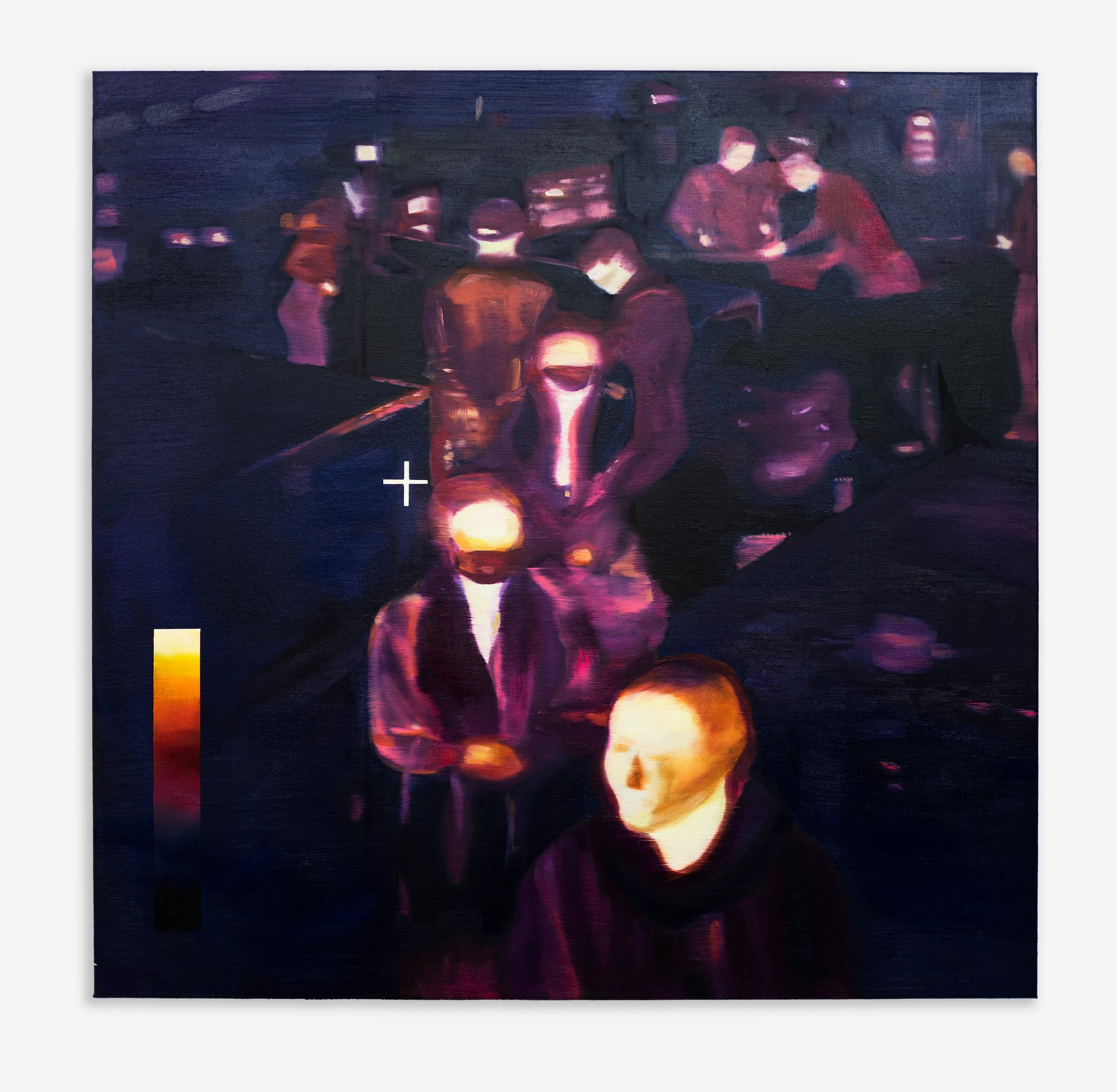
Thermography was not a peripheral technology during the pandemic. It was ubiquitous. Mounted on tripods at building entrances, aimed at foreheads in airports, integrated into security systems in office lobbies, thermal cameras became the primary interface through which the state and its institutions processed bodies. A person's temperature was read before their face was recognized, their heat signature assessed before their name. The technology reduced the body to a data point: 36.6 degrees Celsius, normal, proceed; 38.2 degrees Celsius, elevated, stop. In this context, Touch becomes a document of its moment. The thermographic hand, isolated against a void of blue, is the body as surveillance sees it: a heat map, a collection of temperature readings, a set of colors that correspond to degrees of warmth. The warmth that the painting celebrates, the warmth of a hand that might touch another hand, is mediated by the same technology that was deployed to monitor and restrict the movement of bodies during a global health emergency. The painting does not illustrate this tension. It enacts it. The viewer sees a hand that glows with warmth, and the warmth is real, it is there on the canvas in thick cadmium yellow, but the technology that produced the image is the same technology that replaced touch with temperature scans, intimacy with data. Tan Mu has spoken directly about this condition: "Thermographic imaging visualizes heat without touch, presence without proximity. In the painting, the warm yellows and oranges of the hand contrast sharply with the deep blue background. This opposition reflects what was obscured or lost during that period: intimacy, physical connection, and the immediacy of human contact."
The pandemic, Tan Mu has said, felt like an enclosed space, almost like a cave. She began painting at home in March 2020, when physical movement and social interaction became limited. Temperature became a central marker of health. Technologies like thermal imaging and AI-based monitoring were widely deployed in public spaces, reducing the body to data points and reinforcing a sense of distance and surveillance. The comparison between pandemic isolation and cave dwelling is not incidental. A cave is a space of enclosure, protection, and also confinement. The handprints in the Cueva de las Manos were made by people who lived in the cave, who pressed their hands against its walls as an assertion of presence within a confined world. Touch was made by an artist working in isolation during a period of confinement, pressing the image of a thermographic hand against a canvas as a similar assertion. Both the cave stencil and the painting are acts of witness. Both say: I was here. The difference is that the cave handprint requires touch. The thermographic image does not. It is a record of touch's absence, a portrait of warmth made by a machine that never held the hand it scanned.
The hand in Touch is not specific. It has no fingerprints, no creases, no identifiable features. In a thermographic image, these details are lost. The camera reads surface temperature, not surface texture. The ridges and whorls that make a fingerprint unique, that identify an individual hand among billions, are invisible to infrared. What remains is the shape: five radiating lines from a central mass, the most ancient and most universal symbol of human presence. Tan Mu has described the hand as "one of the most direct extensions of human presence. It is how we touch, create, communicate, and understand the world. Even a simple gesture, such as a handshake, carries deep social meaning." During the pandemic, when physical contact was restricted, the hand took on what she calls "an intensified symbolic weight," representing both connection and its absence. The thermographic image intensifies this doubleness. It captures the hand's warmth while stripping away its individuality. It records the presence of a body while eliminating the evidence that would identify whose body it was. In Touch, this depersonalization is not a loss. It is the condition of the image, and the painting holds it in suspension with the hand's insistence on being recognized, on being known, on reaching out toward another hand across a void of blue.
The Cueva de las Manos handprints and Touch share more than a subject. They share a medium. The cave stencil was made by blowing pigment through the mouth, using the human body as both the mask and the spray mechanism. The pigment, mixed from local minerals, was a material substance that adhered to the rock face and has remained there for nine millennia. Oil paint on linen is also a material substance, a mixture of ground pigment and drying oil, applied by hand to a stretched fabric surface. The cave dwellers did not have infrared cameras, and Tan Mu did not have red ochre from the Pinturas River valley. But both makers understood something fundamental about the relationship between the hand and the trace it leaves. The hand is not just the instrument of mark-making. It is the mark itself, or it can be. When pressed against a surface and surrounded by pigment, it becomes a stencil. When held before a thermal lens, it becomes a heat map. When painted in oil on linen from a thermographic source image, it becomes a painting that holds all three registers at once: the hand as stencil, the hand as data, the hand as painted surface, each one a different mode of the same fundamental impulse, which is the impulse to leave evidence of one's presence in a world that is constantly erasing it.
What remains after the hand withdraws is the question that both the cave stencil and Touch pose, each in its own way. In the cave, what remains is pigment on stone: a halo of color where the hand was not, surrounding a void where the hand was. In the painting, what remains is a hand made of heat, suspended on a field of cold blue, its edges dissolving as though the warmth were leaking out of it and into the surrounding space. But the warmth does not spread. The blue does not warm. The two zones, the yellow palm and the navy ground, exist in a thermodynamic standoff, neither yielding to the other, the hand locked in its moment of maximum heat, the background locked in its cold indifference. This is not how physics works. In reality, heat dissipates. The warm hand cools. The surrounding air absorbs the energy and warms slightly, then the hand and the air reach equilibrium, and the heat is gone. The painting refuses this. It freezes the hand at the instant of its greatest thermal contrast, the moment when the difference between the body and its environment is at its sharpest, and it holds that instant indefinitely. Every time someone looks at Touch, the hand is still warm. Every time someone looks at the cave stencil, the hand is still there, pressing against the rock. Neither image will let the hand go cold.