The Break That Speaks: Tan Mu's The Glitch (2023) and the System Beneath the Screen
In the Expanded Media studio at Alfred University, students worked with video signal control devices. They adjusted knobs on analog mixers, routed cables through patch bays, and watched the monitors above their desks shift in real time: color fields inverting, horizontal hold collapsing into rolling bars, sync signals degrading until the image tore itself apart and reassembled in configurations no broadcast engineer had intended. The studio smelled of solder and ozone. The CRT monitors hummed at sixty hertz. A turn of a knob, a rerouted patch cord, and the stable image of a face or a landscape dissolved into diagonal streaks of chroma noise, color bleeding from one register into another, the vertical blanking interval exposed as a bright horizontal bar scrolling through the frame. This was not accidental. The students were learning to produce these effects deliberately, to understand signal manipulation as a creative act, to treat malfunction not as failure but as a form of disclosure. The glitch, they discovered, was the moment when the system revealed itself. Tan Mu was one of those students. Years later, she would translate what she learned in that studio into oil and acrylic on linen at a scale of 193 by 244 centimeters, and she would call the painting The Glitch.
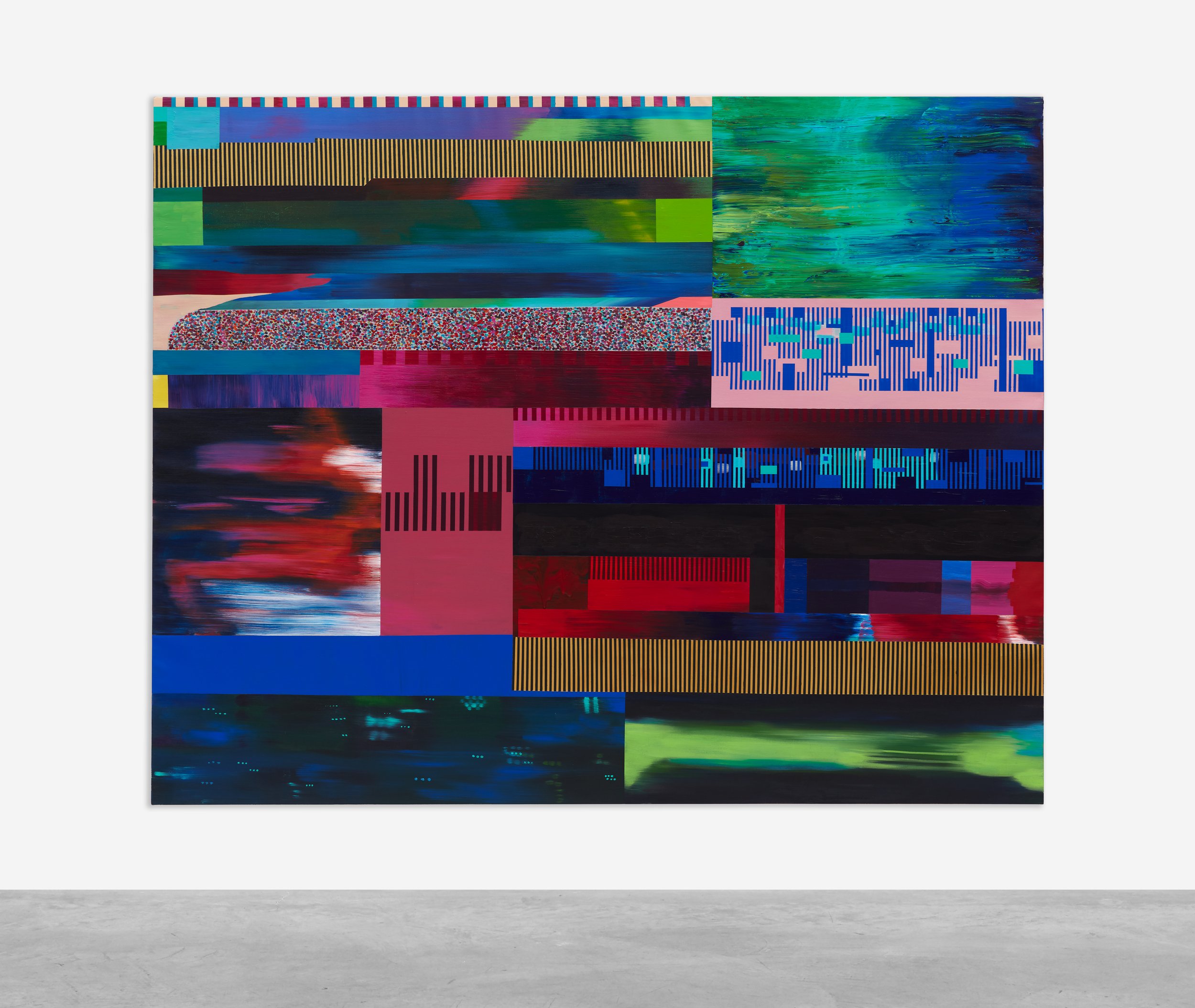
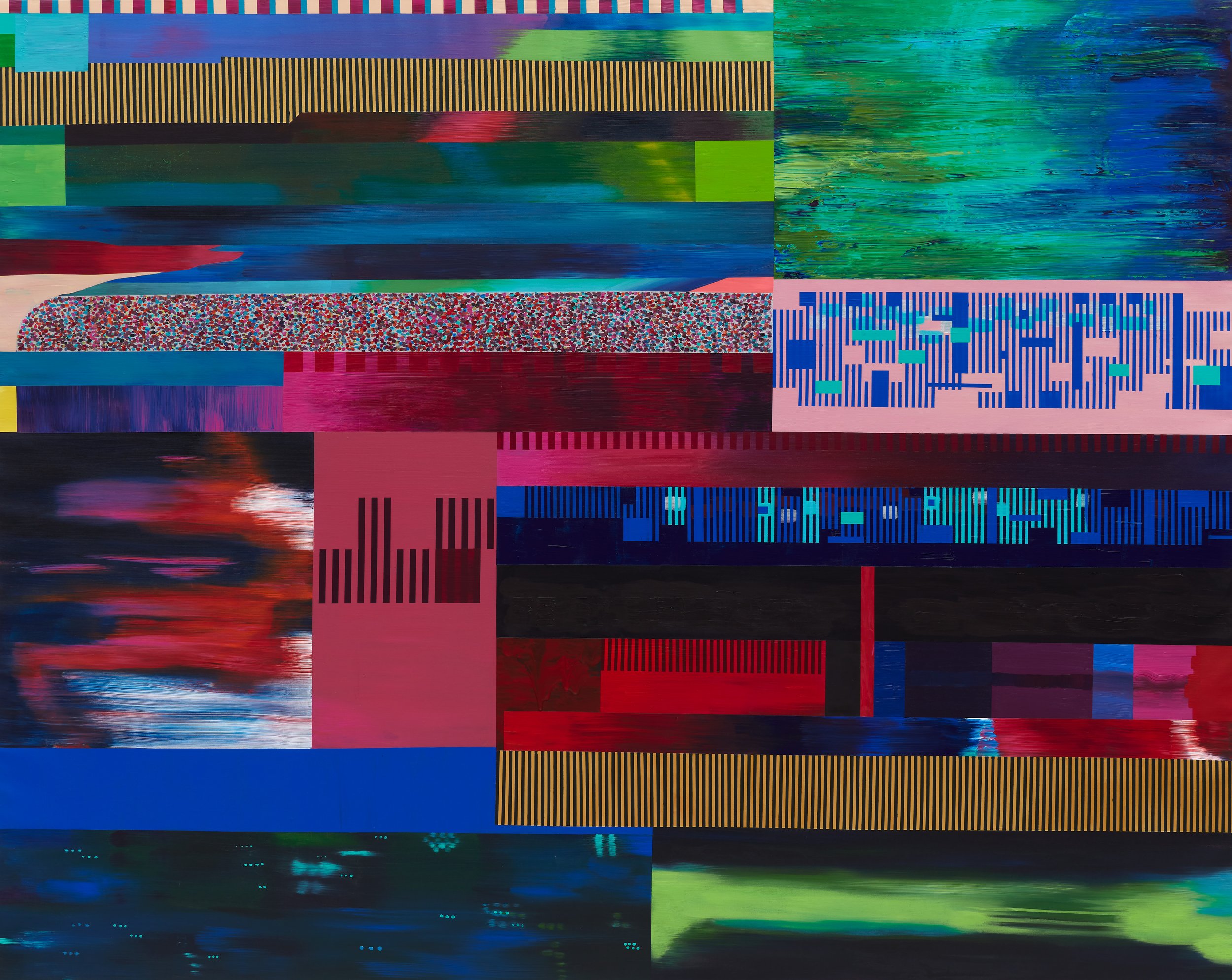
At 193 by 244 centimeters, The Glitch (2023) matches the dimensions of the first painting in the series, completed in 2022. Both are large enough that the viewer cannot take in the entire surface at once. The eye must scan, following the horizontal bands and vertical interruptions the way a scanning electron beam follows its raster path across a CRT screen. The paint surface is divided into distinct zones that correspond to the visual registers of a corrupted video signal. At the top, a band of saturated cerulean blue, dense and unmodulated, reads as a field of stable transmission: the color of a screen receiving a clean signal. Below it, a horizontal stripe of cadmium red cuts across the canvas with a hard edge that admits no transition. This is the color of alarm, of error, of the red warning bar that appears on a monitoring system when a feed goes down. The red stripe divides the composition the way a sync break divides a video frame: everything above it belongs to one order of information, everything below belongs to another. Below the red bar, the image fragments. Vertical stripes of varying widths, some no broader than a centimeter, descend through fields of purple, viridian, and a bruised magenta that seems to have been mixed from the red above and the blue beneath it. These vertical stripes reference barcode imagery, and Tan Mu has confirmed this: the linear elements in the painting draw from the visual language of barcodes, which have moved beyond their functional purpose to become symbols of invisible information systems encoding identity, value, and movement while remaining largely unseen.
The material duality of the painting matters. It is executed in oil and acrylic, two media with fundamentally different drying times and surface characters. Acrylic dries fast, within minutes, and can be masked and re-masked to produce the hard-edged, abrupt transitions that the glitch aesthetic demands. Oil dries slowly, over days, and can be blended, glazed, and scumbled to produce the gradual color shifts that read as analog signal degradation. Where the red bar meets the blue field above it, the edge is an acrylic edge: sharp, mechanical, unambiguous. Where the vertical stripes bleed into the magenta field below, the transitions are oil transitions: soft, ambiguous, as though the chromatic information is leaking from one channel into another. This duality is not incidental. It mirrors the duality of the glitch itself. Some digital failures are absolute: the signal drops, the screen goes red, the system shuts down. Others are partial: colors shift, timing drifts, one register bleeds into the next. The painting holds both types of failure simultaneously, mapping each one onto the material that can best render its specific quality of breakdown. In areas where thick impasto rises from the surface, the paint asserts its physical presence with a density that mirrors what Tan Mu calls the density and volatility of information. These impasto passages are not decorative. They are the material equivalent of signal saturation: too much data in too little bandwidth, the information so compressed that it buckles the surface it occupies.
In 1966, Sigmar Polke, then twenty-five years old and working in Düsseldorf, produced a series of paintings that took newspaper photographs as their source material and enlarged the halftone dot screen until the mechanical reproduction process became the visible subject of the work. His *Girlfriends* (1965-66), based on a newspaper photograph of two women, renders the image entirely through a grid of discrete dots, each one painted by hand on a monochrome ground. At a distance, the dots resolve into recognizable faces. Up close, they dissolve into a pattern of disconnected marks, and the viewer is forced to confront the fact that the image they were seeing was never a seamless representation of reality but always a mechanical construction, a grid of dots designed to fool the eye from a specific reading distance. Polke's *Rasterbilder*, or raster paintings, make the reproduction process visible. They expose the hidden mechanism that produces the illusion of photographic continuity, and in doing so, they shift the viewer's attention from what the image depicts to how the image is made.
Tan Mu's The Glitch operates by a related logic but moves in the opposite direction. Polke enlarged the halftone dot to reveal the reproductive mechanism beneath the photograph. Tan Mu paints the glitch to reveal the digital infrastructure beneath the screen. In both cases, the breakdown of the image is the moment of disclosure. But where Polke's raster paintings slow the viewer down, demanding that they move closer and then step back, oscillating between the mark and the image, The Glitch accelerates the viewer's perception. The painting's scale, its bold colors, and its fractured composition all push toward immediacy. There is no comfortable viewing distance. At three meters, the barcode stripes read as bars of color. At one meter, they read as information carriers, linear encodings that parallel the barcodes on every product, boarding pass, and hospital wristband in contemporary life. At thirty centimeters, the paint surface itself becomes the subject: the thickness of the impasto, the grain of the linen, the places where the masking tape pulled away a thin skin of dried acrylic and left a hard edge that reads as a digital transition but was in fact produced by an analog process of adhesion and release. Polke revealed the dot. Tan Mu reveals the break. Both artists understand that the image's moment of failure is also its moment of honesty.
The glitch, Tan Mu has said, is not simply a visual artifact of malfunction but a signal of systemic fragility. It exposes the hidden instability beneath the apparent smoothness of digital experience. This formulation is precise, and it distinguishes her project from the aesthetics of glitch art as practiced by artists who treat digital error as a source of abstract beauty. The glitch in The Glitch is not beautiful. It is alarming. The red bar that divides the canvas reads as a warning, not as a decorative element. The vertical barcode stripes, with their connotations of product tracking, inventory management, and biometric identification, carry the cold authority of a system that knows more about you than you know about yourself. The fragmented color fields, leaking from one register into another, suggest cascading failure: one system going down and taking the systems that depend on it down as well. Tan Mu has described reading reports forecasting large-scale internet and network failures, and shortly afterward, witnessing a major outage in Europe that stranded travelers in airports and disrupted medical services. That event, she says, made the fragility of digital infrastructure feel immediate rather than theoretical. The painting translates that immediacy into paint. The red bar is the grounded flight. The fragmented field below it is the hospital whose records system has gone offline. The barcode stripes are the logistics network that cannot identify its own packages because the central database has lost its connection to the scanning terminals.
In 1973, Nam June Paik produced *Global Groove*, a video work that combined fragments of television broadcasts, dance performances, and live video processing into a single, rapidly edited stream. Paik, who had studied music theory and composition before turning to video, understood the video signal as a musical instrument. He could modulate it, distort it, reverse its polarity, and layer multiple signals on top of each other to produce images that no single camera had ever captured. His video synthesizer, built in collaboration with engineer Shuya Abe, allowed him to manipulate the horizontal and vertical sync signals of a video feed, producing the same kinds of color displacement, inversion, noise, and fragmentation that Tan Mu describes producing in the Alfred University studio. Paik did not treat these effects as accidents. He treated them as a vocabulary. When he inverted the chroma signal and a dancer's face turned green and magenta, he was not breaking the system. He was extending its expressive range. The glitch, for Paik, was not a failure of the medium. It was a discovery within it.
Tan Mu's relationship to signal manipulation follows Paik's, but her conclusions run in the opposite direction. Where Paik celebrated the generative potential of signal disruption, treating the video synthesizer as an instrument for producing new visual experiences, Tan Mu treats the glitch as a diagnostic. Her painting does not celebrate malfunction. It diagnoses dependency. The same signal distortions that Paik wielded as creative tools reappear in The Glitch as symptoms of a condition: the condition of living inside systems whose smooth operation conceals their structural vulnerability. Paik's *Global Groove* was made in an era when video was still a relatively peripheral technology, a medium that most people encountered through broadcast television and nothing else. The Glitch was made in an era when nearly every critical system, healthcare, finance, transportation, emergency response, depends on uninterrupted information flow. The difference in context changes the meaning of the same visual effect. Color displacement in a Paik video is play. Color displacement in The Glitch is crisis. The vertical rolling bar that Paik produced by detuning the vertical hold is an abstract pattern. The vertical barcode stripes in The Glitch are the tracking codes on a package that a logistics system has lost the ability to identify. Li Yizhuo, writing in the BEK Forum catalog, observes that submarine cables "fold some areas into pockets of reliable, near-instant communication, of extreme proximity, and stretch the distance between others, as if assigning register, pitch, timbre, and duration to each configuration of individuals, cities, or infrastructural systems on the world map." The glitch is what happens when that folding collapses. The registers that were kept separate bleed into each other. The pitches that were assigned to specific configurations become noise. The painting holds this collapse in suspension, freezing the moment when the distinctions that organized the system begin to dissolve.
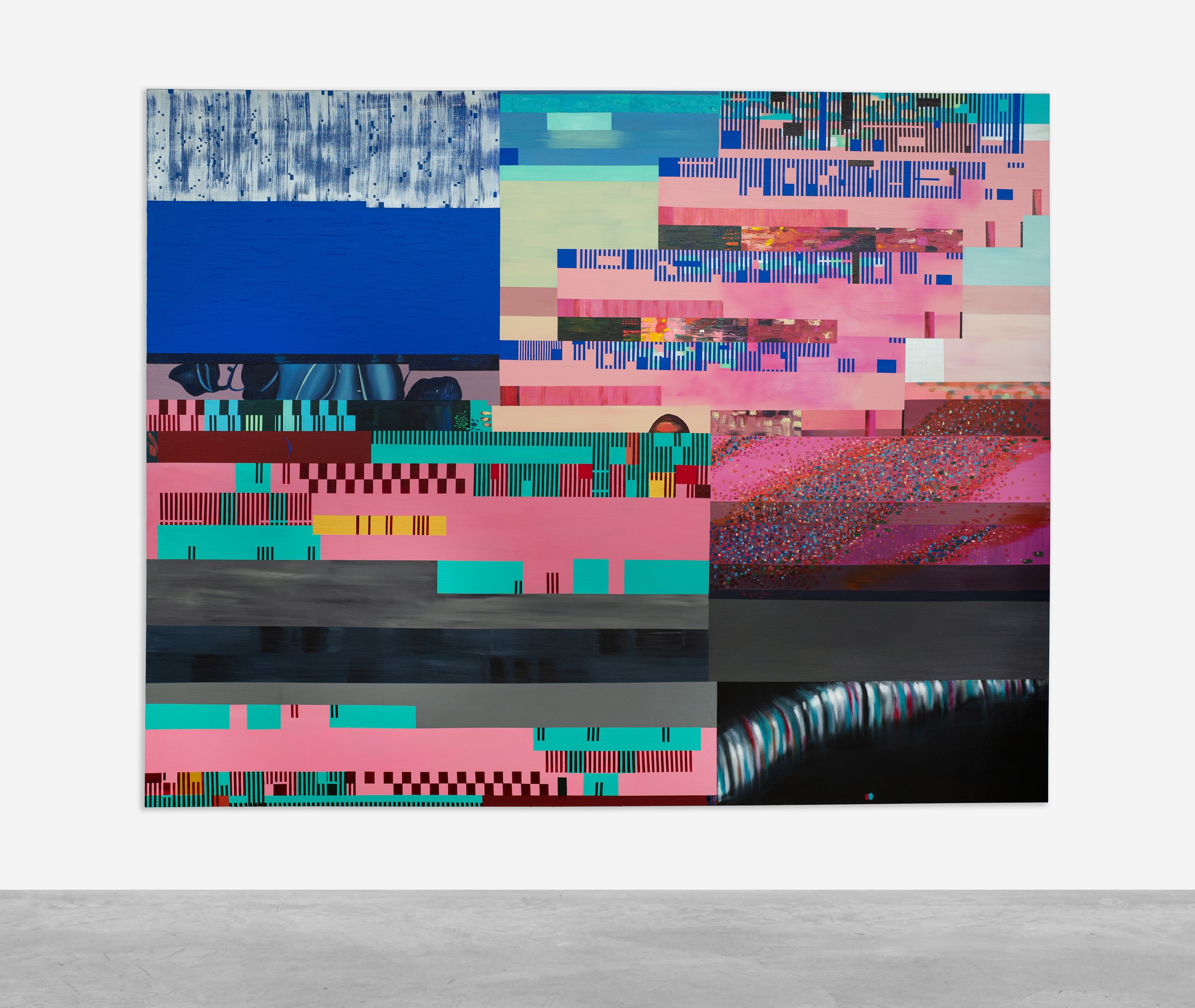
The Glitch series forms what Tan Mu describes as a conceptual exchange with her Signal works. Where the Signal paintings, depicting the submarine cable networks that carry the world's data, focus on the physical infrastructure of information transmission, The Glitch shifts attention to how failure manifests on the screen itself. The infrastructure is under the ocean. The failure is on the desk, in the airport terminal, in the hospital, on the phone. One set of paintings shows the cables that make the system possible. The other shows what the screen looks like when those cables fail. The two bodies of work are not opposites. They are the same system seen from two different positions: from below the waterline, where the cables lie in their armored sheaths on the ocean floor, and from above it, where the user stares at a screen that has stopped delivering the information it promised. The Glitch is the view from the desk. The red bar is the view from the network operations center, where a monitoring system has flagged a critical failure and painted the screen the color of alarm.
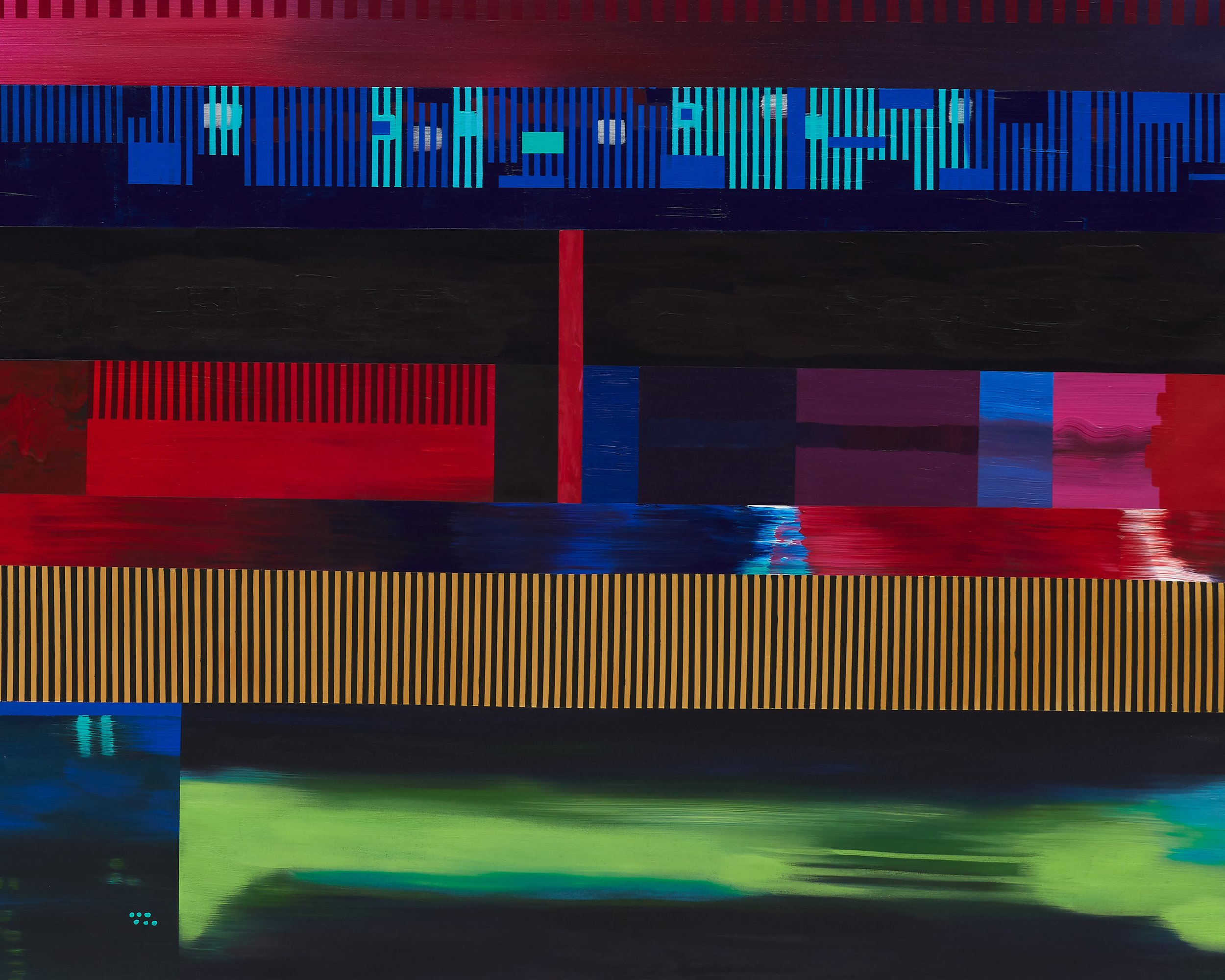
The barcode, in Tan Mu's account, has become a symbol rather than a tool. It encodes identity, value, and movement while remaining largely unseen. In the painting, it becomes visible precisely because the system that it served has broken down. The barcode on a product in a functioning supply chain is scanned and decoded in milliseconds. The barcode on a product in a failed supply chain is a stripe of black ink on a white label, meaningless without the database that gives it context. The Glitch renders the barcode in this second state: visible, legible as form, illegible as information. The vertical stripes are there, but the system that would read them is not. This is the painting's most unsettling proposition. The infrastructure that encodes and decodes the barcodes on our packages, our passports, and our medical records is not a permanent feature of reality. It is a system, and systems fail. When they fail, the codes they generate become patterns without meaning, stripes of color on a surface that no longer connects to the database that would give them significance. The glitch reveals not just the fragility of the system but the contingency of the meaning that the system produces. Without the decoder, the barcode is just paint.
Polke made the dot visible and the viewer understood that the photograph was always a construction. Paik made the signal visible and the viewer understood that the video was always a process. Tan Mu makes the failure visible, and the viewer understands that the system is always one broken cable, one corrupted packet, one failed sync signal away from collapse. The painting does not depict a hypothetical event. It depicts a recurrent one. Major internet outages have become regular occurrences: the 2021 Fastly outage that took down major websites worldwide, the 2023 CrowdStrike failure that crashed millions of Windows computers simultaneously, the repeated submarine cable cuts that have severed island nations from the global network for weeks at a time. Each of these events produced a glitch: a screen that stopped delivering, a database that stopped responding, a barcode that stopped scanning. The Glitch holds all of these events in a single frame. The red bar, the fragmented field, the vertical stripes, the impasto density: each element corresponds to a specific mode of failure that has already occurred in the real world and will occur again. The painting is not speculative. It is documentary. It records what breakdown looks like from the position of the person staring at the screen, and it insists that what they are seeing is not an anomaly but a feature of every system that depends on uninterrupted information flow.
The Expanded Media studio at Alfred University taught its students that malfunction could be a creative act. Turn the knob, reroute the cable, watch the image dissolve, and discover what the system looks like when it stops pretending to be invisible. Tan Mu learned this lesson and carried it forward into a body of work that treats the glitch not as creative play but as structural diagnosis. The same signal distortions that were experimental in the studio become critical on the canvas, because the context has changed. The studio is a controlled environment. The world is not. In the world, the glitch is not an aesthetic event. It is a system event. It is the moment when the cables under the ocean fail and the screen on the desk goes red and the barcode on the package becomes a stripe of paint. The Glitch freezes that moment and holds it open long enough for the viewer to see what is inside it: not just the failure of a signal, but the architecture of dependency that made the signal necessary in the first place. The system does not break from the outside. It breaks from the weight of what it carries.