The Field That Generates: Tan Mu's Solar Farm and the Landscape Converted
From the window of a car on the highway south of Gainesville, the solar farms appear first as a band of dark blue on the horizon, then as a grid, then as a field of glass that stretches across what used to be pasture. Florida has more sunshine than any other state in the continental United States, and its flat terrain makes it ideal for the installation of photovoltaic arrays. Drive past one and you see rectangles of deep blue and silver, angled toward the sun at roughly twenty-seven degrees, row after row after row, covering hundreds of acres that a decade ago grew peanuts or raised cattle. The light hits the panels and refracts across their surfaces, producing subtle color shifts that change with the angle of the sun and the position of the viewer. In the morning, the field appears blue-black, almost absorptive. At noon, it flashes white and chrome. In the late afternoon, it catches the amber of the declining sun and holds it in suspension across the surface of thousands of tilted panels, as though the entire installation were a single membrane stretched between the earth and the sky, converting one into the other.
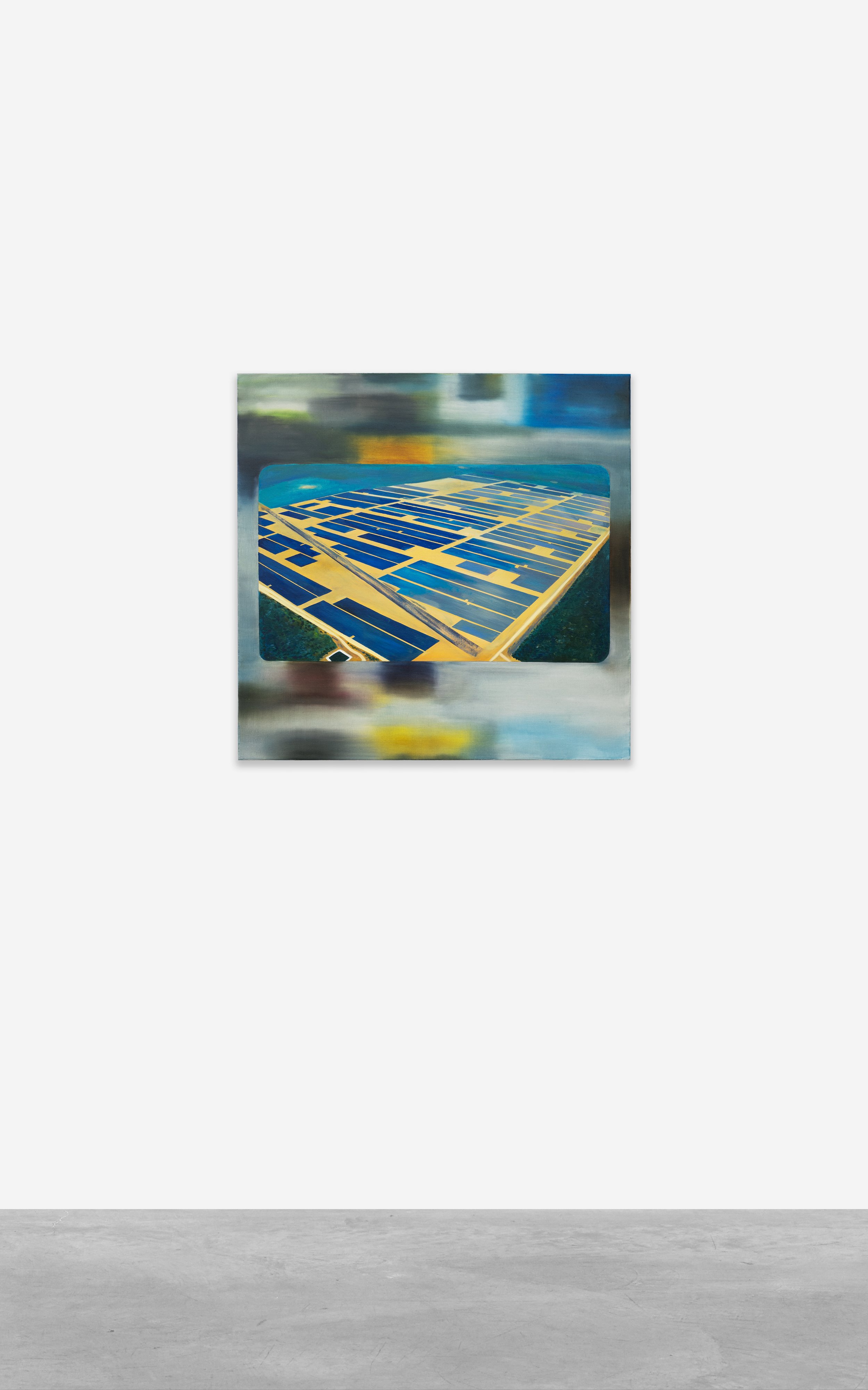
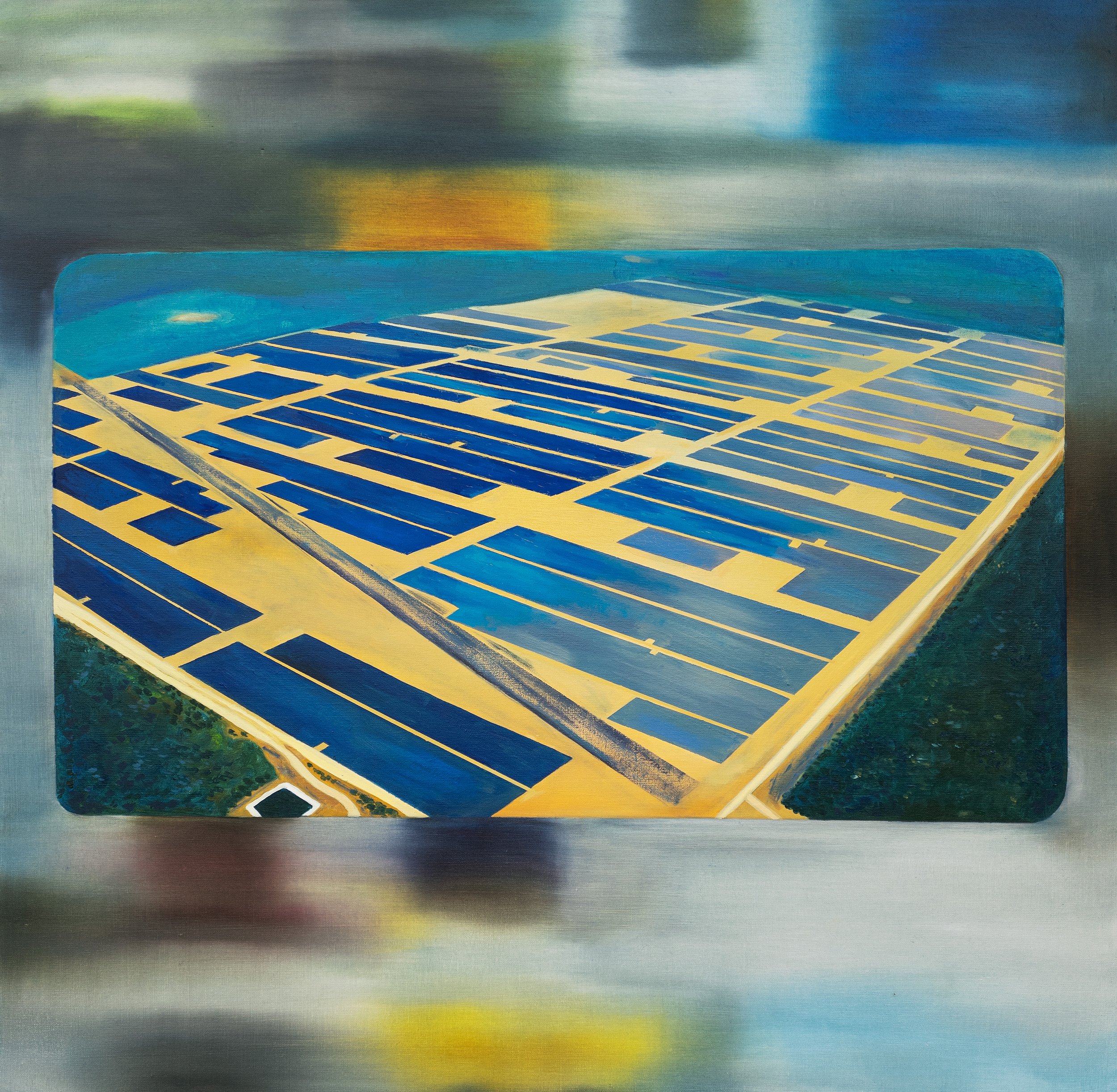
Tan Mu's Solar Farm (2022) is a square painting, 76 by 76 centimeters, oil on linen. The square format is a deliberate choice. A landscape is conventionally horizontal. A solar farm, seen from above, is not a landscape in that conventional sense. It is a grid, a plan, an aerial view that compresses three-dimensional terrain into a two-dimensional field of rectangles. The square canvas accommodates this compression. There is no horizon in the traditional sense, no receding distance that draws the eye toward a vanishing point. Instead, the composition is organized as a vertical stack of horizontal bands, each one a different register of information. At the top, a thin strip of pale blue sky, barely wider than a finger, anchors the painting in atmospheric space. Below it, the solar panels begin: rows of dark blue and cobalt rectangles arranged in a tight grid, each one slightly different in value from its neighbor because of the way light strikes it at a different angle. The panels are painted with a precision that verges on the mechanical. The edges are hard. The colors are flat. The grid is regular. This is not the hand imitating a machine. This is the hand producing what the machine produces: an image of rationalized terrain, land that has been converted from organic growth to geometric productivity.
Beneath the panel grid, the terrain changes. The lower half of the painting shifts into a register of blurred, soft-edged color fields: greens and ochres and pale grays that read as agricultural land, the earth that the panels have replaced or the land that surrounds the installation. These passages are painted with a different technique. Where the panels are precise and opaque, the terrain is loose and washy, with visible brushwork and transparent glazes that allow the linen to show through. The contrast is deliberate. It enacts in material terms the distinction that the painting is making in conceptual terms: between the engineered and the organic, between the grid that converts sunlight into electricity and the soil that converted it into crops, between the land as a system and the land as a medium. The source image for the panel section, Tan Mu has confirmed, came from her phone camera. The blurred terrain below came from her photo gallery, dissolved and abstracted, as though the digital image were returning to the pixelated uncertainty from which it was extracted. The painting holds both registers in a single frame: the sharp grid of the captured image and the soft dissolution of the digital background, the archived and the forgotten, the data and the noise.
In 1877, Claude Monet exhibited seven paintings of the Gare Saint-Lazare at the Third Impressionist Exhibition in Paris. The paintings depicted the interior of a railway station: iron and glass architecture filled with the steam of arriving and departing trains, light filtering through the glass roof in shafts that dissolved the industrial interior into a haze of blue and white and amber. The steam, the iron, and the glass were all recent additions to the Parisian landscape. The station had been rebuilt in 1851 to accommodate the new rail lines that were transforming the geography of France, connecting Paris to the provinces in hours rather than days. Monet was not painting a timeless landscape. He was painting the landscape of his present, a landscape that included the steam of locomotives and the iron ribs of train sheds as naturally as an earlier generation's landscape had included rivers and forests. The paintings were controversial. Critics accused him of painting ugliness, of choosing a subject that no one had previously considered worthy of sustained attention. But Monet understood what the critics did not: that the railway station was the new landscape, and that painting it was not a choice of subject but a choice of allegiance. He was documenting the transformation of the visual world by industrial technology, and he was doing it in real time, while the steam was still in the air.
Tan Mu has described Monet's railway paintings as a direct precedent for her own work. "I often think about Impressionist painters such as Claude Monet, who documented industrial transformations in their time," she has said. "His paintings of train stations and factories not only captured new technologies but later became valuable historical records. Scholars now study those works to understand environmental conditions and technological shifts of the nineteenth century." The comparison is precise and structural. Monet painted the Gare Saint-Lazare when it was new. He painted the steam when it was still steam, not yet nostalgia. Tan Mu paints the solar farm when it is new, when the panels are still gleaming and the land beneath them is still recovering from the transition from agriculture to energy production. Both artists chose a subject that their contemporaries might not have recognized as a landscape, and both insisted on treating it with the full rigor of their medium. Monet used the steam to dissolve the iron architecture into light. Tan Mu uses the photovoltaic grid to dissolve the pastoral terrain into data. In both cases, the painting does not merely depict the new technology. It adopts its logic. The Gare Saint-Lazare paintings are organized around the geometry of the train shed and the atmospheric logic of steam. Solar Farm is organized around the geometry of the panel grid and the digital logic of the screenshot. The painting's composition mirrors the composition of the phone screen that captured the image: a sharp, defined rectangle of captured information floating above a field of compressed, low-resolution background data.
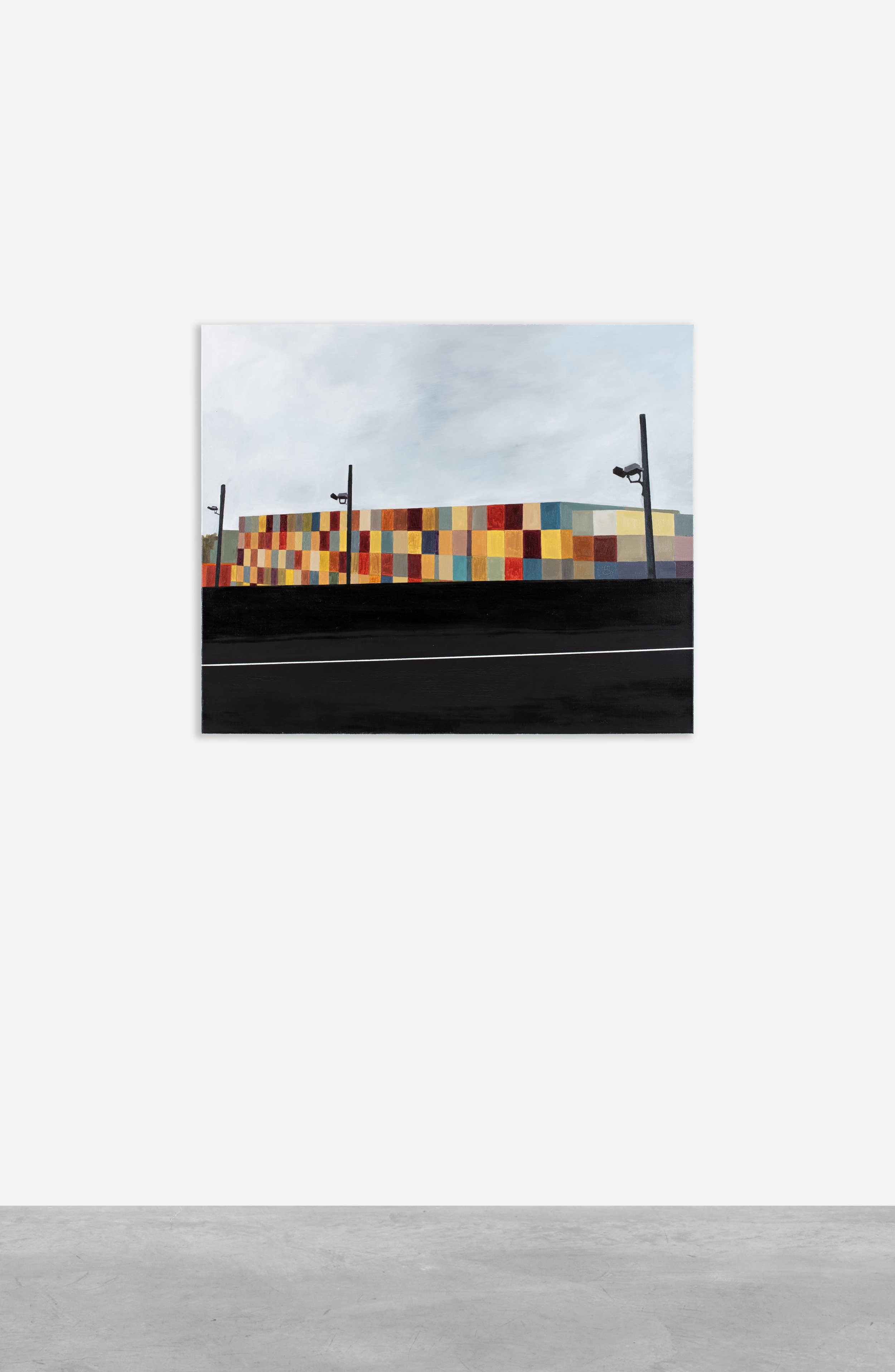
Solar panels have a distinctly geometric form defined by straight lines and precise repetition, qualities that are rarely found in natural scenery. Tan Mu has spoken directly about this: "When panels are installed in large clusters across flat terrain, they create an overwhelming sense of order that sharply contrasts with the irregular rhythms of nature. This tension is central to the work." The grid of the panels is not merely a visual pattern. It is the trace of a decision about land use. A field that once grew soybeans now generates electricity. The same acreage, the same sunlight, the same soil, but the extraction method has changed. Where photosynthesis once converted solar energy into chemical energy stored in plant tissue, photovoltaic cells now convert the same energy into electrical current carried by wire to a substation and from there to a grid. The painting makes this conversion visible by treating the grid of panels not as an overlay on the landscape but as a replacement for it. The upper half of the canvas, where the panels dominate, contains almost no organic shapes. The lower half, where the terrain appears, contains almost no straight lines. The painting is divided at the horizontal seam between these two regimes, and the seam is not gentle. It is a hard break, an edge where one way of organizing land meets another, and neither side fully absorbs the other.
To understand what the grid of panels does to the land it occupies, it helps to look at the work of Edward Burtynsky, the Canadian photographer who has spent three decades documenting industrial landscapes from the air. In his *Oil Fields* series (2003), Burtynsky photographed the oil fields of Alberta from an elevated vantage point that renders the pumpjacks, access roads, and tailings ponds as a vast pattern of geometric forms imposed on the boreal forest. The photographs are formally beautiful. The tailings ponds shimmer in shades of rust and ochre that recall Turner. The grid of roads reads like a Mondrian composition rendered in asphalt. The pumpjacks, spaced at regular intervals across the terrain, echo the regular spacing of the solar panels in Tan Mu's painting. But Burtynsky's beauty is not an aestheticization of destruction in the conventional sense. It is a record of the fact that industrial landscapes are beautiful, that the same geometric regularity that organizes a solar farm also organizes an oil field, and that this regularity is what industrial extraction looks like from above. The grid is not incidental to the extraction. It is the mechanism of extraction. It organizes the land into units of production, each one identical, each one maximally efficient, each one stripped of the irregularity that characterizes terrain that has not been engineered for output.
Tan Mu's Solar Farm shares Burtynsky's elevated perspective and his formal sensitivity to the geometry of extraction, but the painting diverges from the photograph in a crucial respect. Burtynsky's photographs are documents. They record what the oil field looks like. Solar Farm is not a document. It is a construction that layers two different modes of seeing, the sharp grid of the phone camera and the blurred field of the digital background, in order to make an argument about how the landscape is mediated through technology. The phone camera captures the panels with the clarity of a screenshot. The background, compressed and low-resolution, represents the way the rest of the world is experienced in the digital age: fragmented, peripheral, always slightly out of focus because it is not the object of the capture. Danni Shen, writing in her 2024 studio visit with Tan Mu for Emergent Magazine, observes that her works "serve as a kind of witness to human socio-technological histories." Solar Farm is a witness, but it is not a neutral one. It witnesses the landscape from a specific position: the position of the phone screen, the position of the aerial view, the position that converts terrain into data and then compresses the data that does not fit the frame.
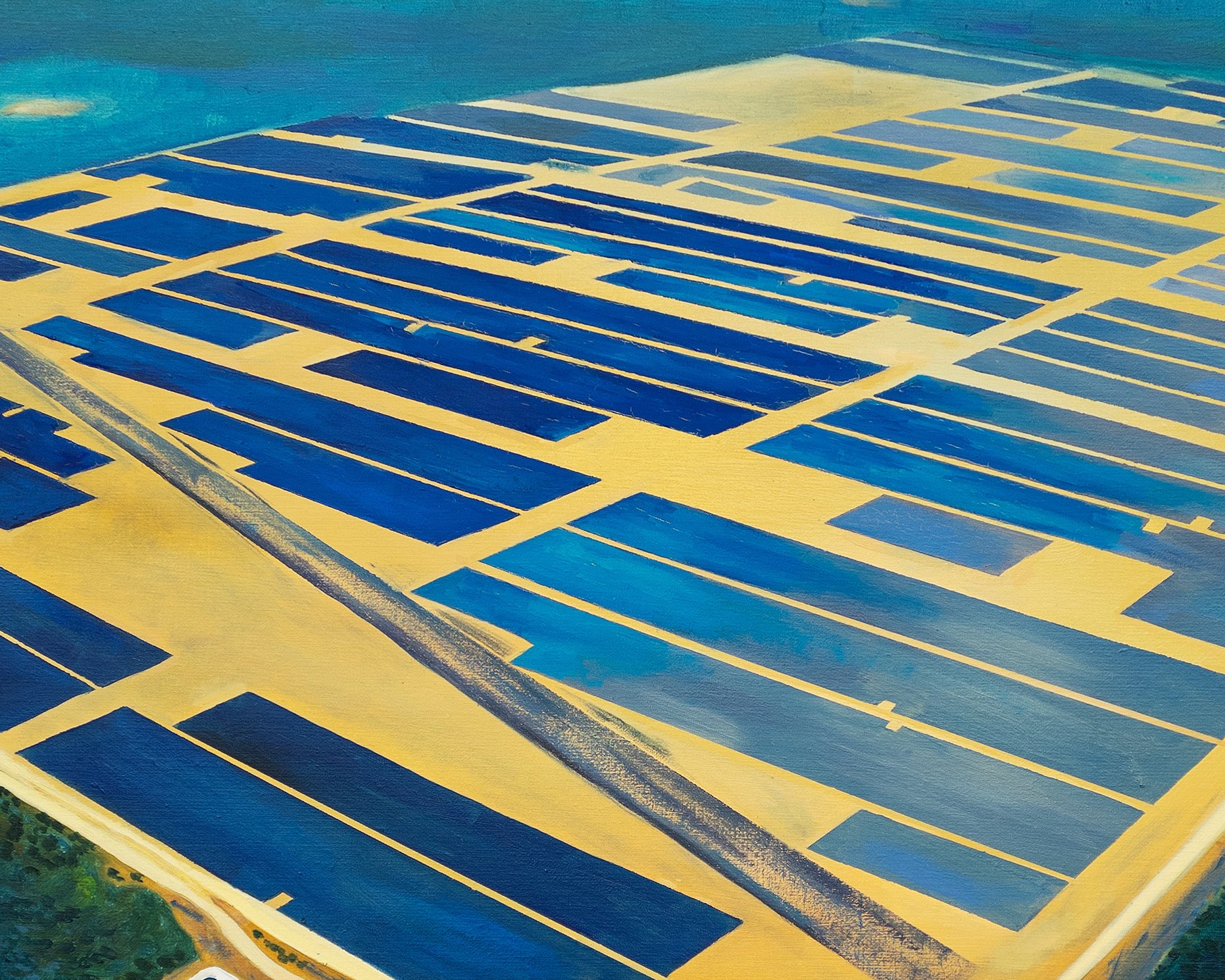
Tan Mu has described solar panels as "symbols of capital, infrastructure, and humanity's intervention in nature." Their presence on the land, she notes, "marks a significant transition in how land is used. Historically, land was cultivated primarily for food production. Today, large areas are repurposed to host solar panels that harvest energy instead." This transition is not merely a change in output. It is a change in the visual character of the land itself. Agricultural fields have their own geometry, the grid of crop rows, the rectangle of a cultivated parcel, but this geometry is soft, organic, subject to the irregularities of soil, weather, and the curve of the terrain. The geometry of a solar farm is hard. The panels are mounted on steel racks driven into the ground. Their angle is calculated to maximize exposure to the sun. Their spacing is determined by the need to avoid one panel casting a shadow on the next. The result is a landscape that looks designed rather than grown, and the painting registers this distinction in its material handling: the panels are painted with the precision of a technical illustration, the surrounding terrain with the looseness of a landscape sketch. The hard edge where the two meet is the edge where design overtakes growth, where the land ceases to be a medium for plants and becomes a medium for panels.
The scale of this transformation is not abstract. Florida ranked third among American states in installed solar capacity by 2022, the year Tan Mu painted Solar Farm, and much of that capacity was built on former agricultural land in the central and southern counties. Citrus groves, cattle pasture, and peanut fields were converted to photovoltaic installations at a pace that surprised even the industry's own projections. The economics drove the conversion: a landowner who leased acreage to a solar developer could earn two to three times the per-acre revenue that the same land generated from farming, and the leases ran for twenty to twenty-five years, longer than most crop rotation cycles. From the ground, the change was visible as a fence line where pasture ended and panel rows began. From the air, the change was visible as a color shift: the irregular greens and browns of cultivated land giving way to the uniform dark blue of photovoltaic glass. The painting reproduces this shift exactly. The panel grid is not painted over the terrain. It replaces the terrain, occupying the upper half of the canvas with the authority of a new order that has already displaced the old one. The terrain beneath, rendered in washy translucent greens and ochres, is not the land as it currently exists. It is the land as it was, or as it exists in memory, or as it appears in the compressed, low-resolution background of the phone camera that captured the panel grid. The painting holds both versions of the landscape simultaneously, but it does not give them equal weight. The grid dominates. The terrain recedes. This is not a compositional preference. It is an observation about what has actually happened to the land.
The elevated perspective of Solar Farm, which Tan Mu describes as "similar to what one might see from an airplane window or within a video game interface," is not an aesthetic choice. It is an epistemological one. A landscape seen from ground level is a place you walk through. A landscape seen from above is a system you survey. The elevated view converts terrain into information. It makes the land legible as a pattern of rectangles and colors rather than as an experience of soil, grass, and sky. This conversion is the same one that the solar panels perform on the sunlight that falls on them. The panels do not capture sunlight in the way that a plant does, by absorbing it into organic tissue. They convert it into electrical current, which is a form of information: a flow of electrons that can be measured, transmitted, and stored. The painting, seen from above, converts the landscape into a pattern of grids and color fields, which is also a form of information: a visual system that can be read, decoded, and analyzed. The parallel between the painting's perspective and the panels' function is not incidental. Both are doing the same thing to the landscape. They are converting it into data.
Monet painted the Gare Saint-Lazare in 1877 and the painting became, as Tan Mu predicts her own work will become, an archaeological record of a technological transformation. The steam from the locomotives that Monet captured in oil was real steam. The iron roof was real iron. The passengers on the platform were real passengers, and the train they were waiting for was a real train that would take them to a real destination. But the painting is no longer read primarily as a document of a railway station. It is read as a document of the moment when the railway station became visible, when a painter decided that industrial steam and iron architecture were as worthy of sustained attention as the Seine at Argenteuil. Solar Farm occupies the same position in its own century. The solar panels are real panels, installed on real land, generating real electricity. But the painting is not about electricity. It is about the moment when the solar panel became visible, when a painter decided that a grid of photovoltaic cells arranged across former farmland was as worthy of sustained attention as any landscape that preceded it. The painting asks its viewers to see what is actually in front of them: a terrain that has been converted from one form of production to another, a field that no longer grows crops but generates current, a landscape that has been redesigned from the soil up to harvest a different kind of sunlight. The conversion is complete. The field that once absorbed the sun now converts it. And the painting, caught between the sharp grid of the phone screen and the blurred dissolution of the digital background, records the conversion with the same precision that Monet brought to the steam of the Gare Saint-Lazare: not nostalgia for what the land was, but attention to what it has become.