The Metal That Moves the Water: Tan Mu's The Wave 03 and the Propeller as Devotional Object
A ship's propeller is the largest single piece of forged metal that most human beings will never see. It sits below the waterline, hidden in turbid wake, spinning at speeds that would tear a human arm from its socket. A modern cargo vessel propeller can weigh over a hundred tons and span eight meters in diameter. It is the organ of global trade, the rotating heart of the supply chain that moves ninety percent of everything that reaches you. And it is invisible. Nobody watches a propeller work. The container stacks rise above deck, the cranes load and unload, the hull cuts through the water, but the propeller remains below, out of sight, out of thought, performing the single function upon which all the other functions depend. Tan Mu painted it in gold.
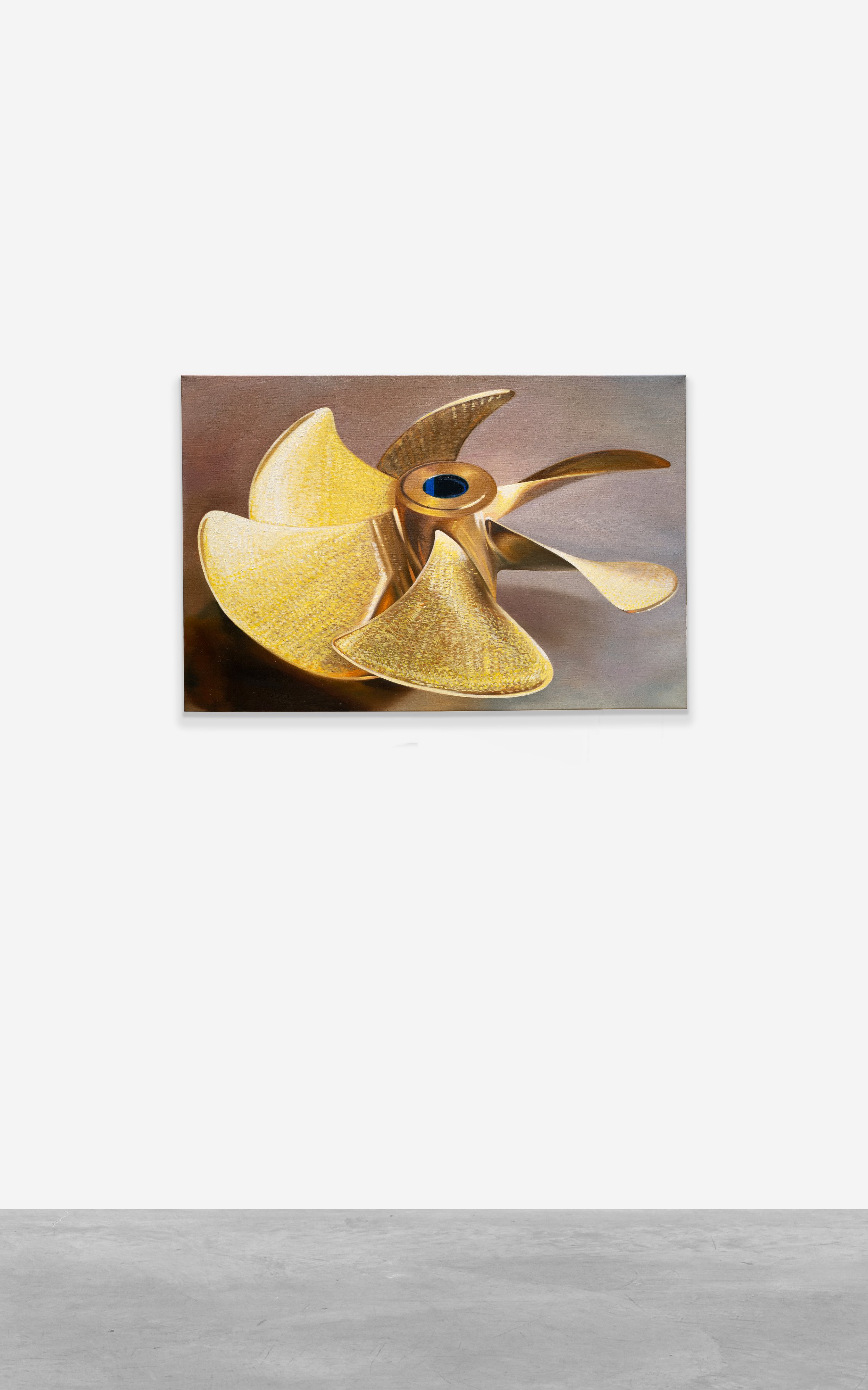
The Wave 03, from 2024, is oil on linen, 51 x 77 cm (20 x 30 in). The format is landscape, wider than it is tall, which is the format of the ocean seen from the deck of a ship. The propeller dominates the composition. Its blades extend from a central hub in a configuration that suggests both rotation and stasis, as though the artist has frozen the object at the precise instant when its movement becomes legible as form. The color is gold. Not a decorative gold, not a gilded accent along the edge of a frame, but a gold that saturates the entire surface of the propeller, filling the blades with a warm, burnished luminosity that reads as both metallic and organic, both industrial and devotional. The background is a deep, dark field, near-black, against which the gold propeller advances like a sun rising from the ocean floor. The contrast is absolute. There is no horizon, no waterline, no ship's hull. The propeller exists alone, suspended in the dark, its blades catching light that has no visible source.
At arm's length, the surface reveals itself as a carefully modulated field of warm tones: amber, ochre, raw sienna, and the particular metallic gold that Tan Mu achieves through layers of translucent oil paint built over a warmer ground. The paint is not flat. It shifts in value across each blade, darker toward the root where the metal thickens and catches less light, lighter at the leading edge where the polished surface would flash as it breaks the water. At three meters, these modulations resolve into the image of a single, massive propeller seen from below, its geometry precise, its proportions those of an actual marine screw. At thirty centimeters, the image dissolves into brushwork: deliberate, directional strokes that follow the curvature of each blade, the paint laid down in passes that respect the object's manufactured surface while remaining unmistakably the work of a hand. The linen shows through in places, its weave contributing a faint texture that reads as the grain of polished metal under raking light. There is no impasto here, no thick wax-heavy buildup of the kind Tan Mu uses in the Signal series for cable access points. The surface of The Wave 03 is smooth, almost glassy, as though the artist wanted the paint to behave like the surface it depicts: a polished bronze propeller, its alloy burnished by years of saltwater friction into a surface that catches and holds light with the efficiency of a mirror.
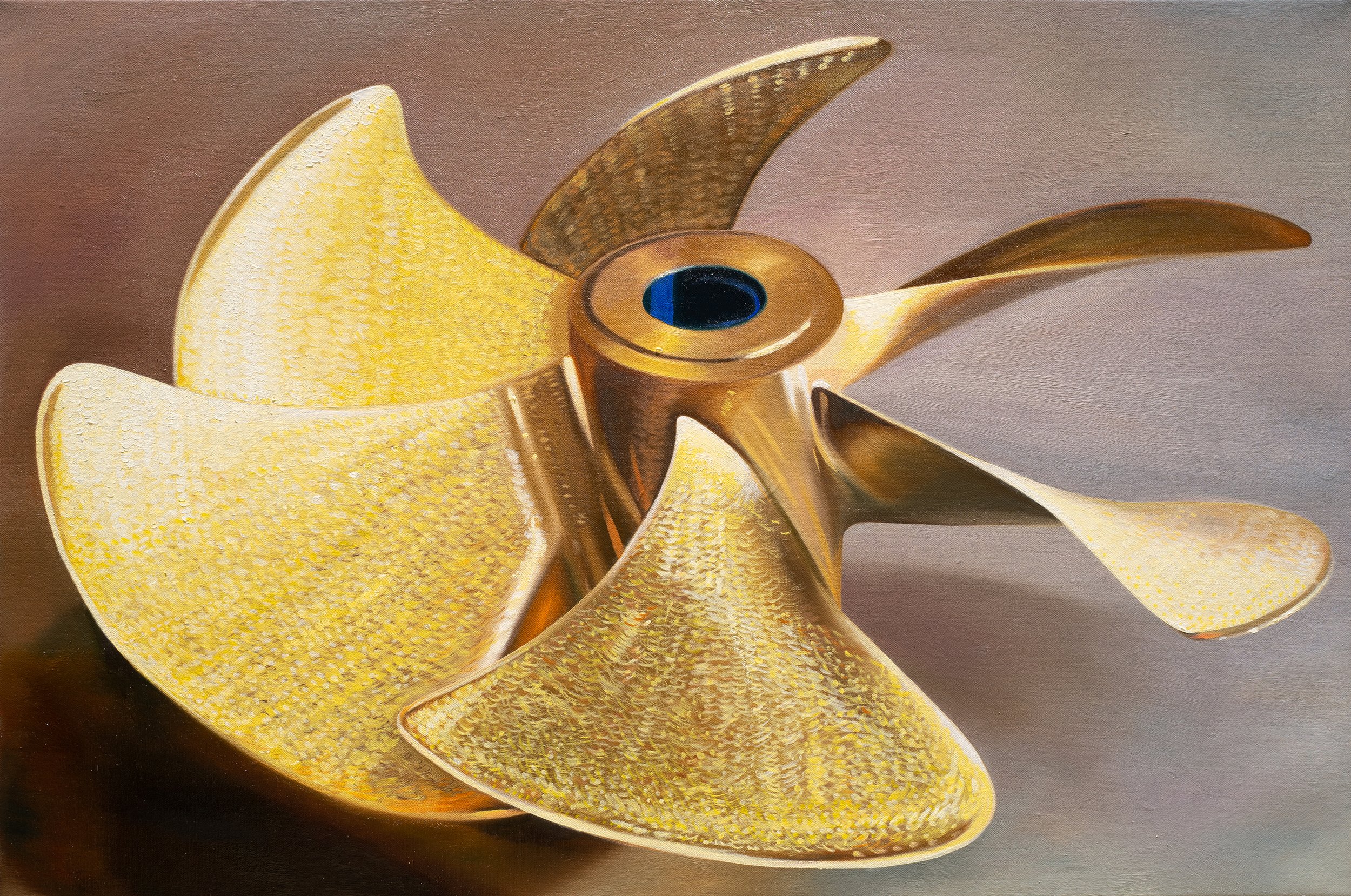
The color is not incidental. Tan Mu has spoken about gold as a deliberate symbolic choice in The Wave series. "Gold is not simply a visual choice," she says. "It carries symbolic weight. Historically, gold has been associated with reverence, power, and devotion. In The Wave, I use gold to render the polished surface of the propeller, transforming it into an object that feels almost sacred." The word "sacred" is precise and deliberately chosen. A propeller is a manufactured object. It is designed in CAD software, cast in a foundry, machined to tolerances measured in microns, and bolted to a shaft by marine engineers wearing hard hats. There is nothing sacred about any step in this process. And yet the painting makes it sacred, or rather, it reveals that the sacred was already there, embedded in the culture's relationship to the object, waiting for someone to make it visible. The gold surface of the propeller in The Wave 03 does not imitate the appearance of gilded devotion. It enacts it. The painting does not represent a devotional object. It produces one.
Constantin Brancusi understood this transfiguration. His Bird in Space (1928), a slender column of polished bronze that rises from a stone base to a flared point, was seized by United States customs officials in 1926 because they could not believe it was a work of art. They classified it as "a manufactured article of metal" and assessed a duty accordingly. The legal proceedings that followed required Edward Steichen, the photographer who had purchased the work, to prove that a polished bronze shaft could be a sculpture. The customs officials argued that it did not look like a bird. Steichen's lawyers argued that it did not need to. Brancusi had taken the idea of flight and distilled it into a single, luminous vertical form, and the polished surface of the bronze was the medium through which that distillation became visible. The shine was not decoration. It was the argument. Light moved across the surface of Bird in Space the way air moves across the wing of a bird in flight, and the viewer who stood before it experienced the upward pull of that movement as a bodily sensation, a lightness in the chest, a feeling of being drawn upward toward the point where the bronze flared and vanished.
Tan Mu's propeller occupies the same register. The gold surface is not an aesthetic flourish. It is the mechanism through which the painting converts an industrial object into a devotional one. Brancusi polished his bronze to reveal the luminosity that the material already contained, a luminosity that raw, unpolished bronze conceals beneath a crust of oxidation. Tan Mu paints her propeller in gold to reveal the reverence that the object already carries within the culture that produced it. The cargo ship is the largest moving object that human beings have ever made. Its propeller is the organ that makes it move. The shipping container revolutionized global trade in the 1950s and 1960s, but the propeller was there first, and it is still there, still spinning, still pushing ninety percent of the world's goods across the oceans. We do not see it. We do not think about it. We open the package and we do not consider the propeller that brought it across the Pacific. The painting makes us consider it. It does so by giving the propeller the one treatment that human cultures have historically reserved for objects that demand consideration: it gilds it.
The propeller is a mechanical object, but its function depends entirely on forces that are not mechanical. A propeller does not push water the way a bulldozer pushes earth. It generates thrust by creating a pressure differential across the blade surface, a region of low pressure on the forward face and a region of high pressure on the aft face, and the water moves from high to low, carrying the blade with it. This is fluid dynamics. It is the same physics that governs ocean currents, atmospheric circulation, the flow of blood through the heart, and the spiral arms of galaxies. The propeller's blade is shaped like an airfoil, and an airfoil is shaped like a wing, and a wing is shaped the way it is because air moves the way water moves, and water moves the way it does because the universe prefers laminar flow and resists it at the same time, producing turbulence, vortices, eddies, and the particular kind of rotational energy that a propeller harvestes and converts into forward motion.
Tan Mu identifies this convergence as the core of the series. "The propeller represents a convergence of nature and machinery," she writes. "Although it is a mechanical object, its function relies on fluid dynamics, turbulence, and flow. Its motion echoes natural systems such as ocean currents, air circulation, and even biological structures like DNA. This coexistence of mechanical force and natural rhythm is what draws me to the subject. I am interested in moments where technology does not oppose nature, but mirrors it." The sentence is carefully constructed. The propeller does not conquer nature. It does not dominate the water. It mirrors it. The blade's rotation produces vortices that are indistinguishable, at the scale of fluid dynamics, from the vortices produced by a fish's tail, a whale's fluke, or the current that wraps around a headland and spirals into an eddy on the lee side. The propeller is not an imposition on the ocean. It is an extension of the ocean's own movement, shaped by human engineering to harvest the same rotational energy that the ocean generates on its own whenever water encounters an obstacle and has to go around it.
The spiral structure of the propeller connects The Wave 03 to the toroidal geometries that recur throughout Tan Mu's practice. She has explored these forms in Torus (2020 and 2021), the Gaze series, and paintings of cells, atoms, black holes, and cosmic phenomena. "These forms reflect a continuous energy cycle that exists across scales," she observes, "from the microscopic to the cosmic." The propeller belongs to this sequence. It is a torus that has been cut and flattened into blades, a loop of rotational energy that has been given a mechanical form capable of entering the water and being driven by it at the same time. The painting registers this kinship through its composition. The blades radiate from a central hub in a pattern that is not circular but spiral, and the spiral, in the context of Tan Mu's broader practice, is the signature of energy that moves in cycles, returns to its origin, and departs again.
Leonardo da Vinci spent years studying exactly these vortices. In the Codex Leicester, compiled between 1508 and 1510, he produced page after page of drawings that map the behavior of water as it encounters obstacles, curves around bends, and forms the spiraling eddies that he called "revolutions." His drawings are not illustrations. They are analyses. He drew water from above, from below, in cross-section, and in longitudinal section. He drew the vortices that form behind a flat plate placed perpendicular to the flow, the spirals that develop at the confluence of two streams, and the circular patterns that appear when water drains from a basin. He drew them with a precision that anticipates computational fluid dynamics by five centuries. And in the same pages, he drew designs for devices that could harvest the rotational energy of water: water wheels, screw pumps, and what amount to early propeller concepts, curved blades mounted on a central shaft, designed to move water or be moved by it. The connection between Leonardo's vortex studies and his engineering designs is not coincidental. The same hand that drew the eddies drew the machines that would enter the eddies and convert their rotational energy into useful work. The understanding of flow and the design of the propeller are not two separate activities. They are one activity, and Leonardo performed them simultaneously on the same sheets of paper, the drawings of natural turbulence and the drawings of mechanical devices occupying the same space, the same thought, the same hand.
Tan Mu's practice recapitulates this unity. Her research into fluid dynamics, her study of propeller design, and her attention to the spiral forms that recur across natural and technological systems are not preliminary to the act of painting. They are continuous with it. The Wave 03 is not an illustration of a propeller. It is a painting that knows what a propeller is, that has studied the way water moves around it, and that uses the medium of oil paint to make visible the kinship between the manufactured blade and the natural vortex. Leonardo drew the vortex and then drew the machine that enters it. Tan Mu paints the machine and, through the gold surface and the spiral composition, makes the vortex visible within it. The blade is not merely shaped by fluid dynamics. In the painting, it is fluid dynamics, frozen at the instant when the rotational energy of the water and the rotational energy of the metal become indistinguishable.
Yiren Shen, writing in 10 Magazine about Tan Mu's practice, observes that the artist's engagement with ocean infrastructure extends from the submarine cables of the Signal series to the propellers of The Wave, and that these two systems, one carrying information and the other carrying goods, together constitute "the foundation of globalization." Shen's framing is useful because it positions the propeller not as an isolated mechanical object but as one node in a network of oceanic systems that Tan Mu has been mapping for years. The Signal series focuses on undersea fiber-optic cables, the hidden networks that carry data. The Wave series focuses on the ship's propeller, the hidden organ that carries physical goods. Both systems operate below the surface. Both are infrastructure in the most literal sense: the structures that lie beneath, the structures that make everything above possible. And both, in Tan Mu's rendering, become luminous. The cables in the Signal paintings glow against a dark ground, their access points built up in thick, wax-heavy paint that catches the light like soldered circuit connections. The propeller in The Wave 03 glows against a dark ground, its surface painted in a gold that catches the light like a burnished altar object. The visual rhyme between the two series is not accidental. It is an argument: that the infrastructure we do not see is the infrastructure that matters most, and that painting, by giving it light, gives it the visibility that its function denies it.
The gold also connects The Wave 03 to a specific history of exhibition and veneration. In 1934, the Museum of Modern Art in New York mounted an exhibition called Machine Art, curated by Alfred H. Barr Jr. The exhibition displayed industrial objects, propellers, ball bearings, kitchen utensils, coils of wire, on pedestals and against white walls, as though they were sculptures. The propellers on display were less than one meter in diameter. They were presented as objects of beauty, their forms determined by function, their surfaces polished to a shine. The exhibition argued, through its display strategy, that industrial design could produce objects of aesthetic merit equal to those of fine art, and that the museum was the proper place to recognize this merit. It was a landmark argument in the history of modernism, and it established a precedent that The Wave 03 both inherits and redirects. MoMA displayed the propeller as an object of beauty. Tan Mu paints the propeller as an object of devotion. The distinction matters. Beauty can be appreciated from a distance. Devotion requires proximity, submission, the acknowledgment that the object has power over the viewer. The gold surface of the propeller in The Wave 03 is not an aesthetic choice made in the spirit of Machine Art. It is a liturgical choice. It gives the propeller the visual language of the reliquary, the gilded icon, the object that has been set apart from ordinary use and consecrated to a purpose that exceeds utility.
The personal dimension of this consecration runs through Tan Mu's family history. Her maternal great-grandfather was a maritime trader during the Republican era, navigating international waters between China and Korea. "Through his stories," Tan Mu writes, "I became aware that the ocean is not only a route for goods, but also a carrier of culture, memory, and exchange." The propeller, in this context, is not merely a mechanical component. It is the instrument of transnational movement, the device that made it possible for a trader to cross the Yellow Sea and return with goods, stories, and the cultural residues that accumulate around trade routes. The gold that covers the propeller in The Wave 03 covers this history as well. It gilds not just the metal but the memory of three generations of oceanic connection, from the great-grandfather's trading vessel to the container ships that Tan Mu painted in Container (2021) to the submarine cables that carry the data she maps in the Signal series. Each generation's technology is the substrate of the next, and the gold surface of the propeller unifies them by giving them the same luminous treatment: the same warmth, the same burnished glow, the same refusal to let the infrastructure of connection remain invisible.
The Wave 03 does not argue that technology is sacred. It argues that we treat it as if it were. The painting holds this distinction in suspension. The gold surface is beautiful, and the beauty is real, but it is the beauty of an object that has been removed from its function and placed on an altar. A propeller that is gilded is a propeller that cannot turn. The gold seals the surface, freezes the blades, converts a rotating machine into a stationary image. The painting knows this. The stillness of the propeller in the composition, its suspension in a dark field without water, without ship, without shaft, is the condition of its visibility. It can be seen only because it has been stopped. It can be gilded only because it has been removed from the ocean where it works. The Wave 03 gives the propeller back to the viewer by taking it away from the water, and the gold that makes it visible is also the gold that immobilizes it. The propeller that pushes ninety percent of the world's goods across the ocean is, in the painting, an object of contemplation, and contemplation requires stillness. The gold produces the stillness. The stillness produces the visibility. The visibility produces the devotion. And the devotion, which is the painting's final register, is directed not at the propeller itself but at what the propeller makes possible: the movement that connects one shore to another, the rotation that converts fuel into passage, the invisible work beneath the surface that keeps the entire system of global exchange in motion. The propeller was never the object of worship. The movement was.