The Space Between Pages: Tan Mu's Web and the Moment That Has No Name
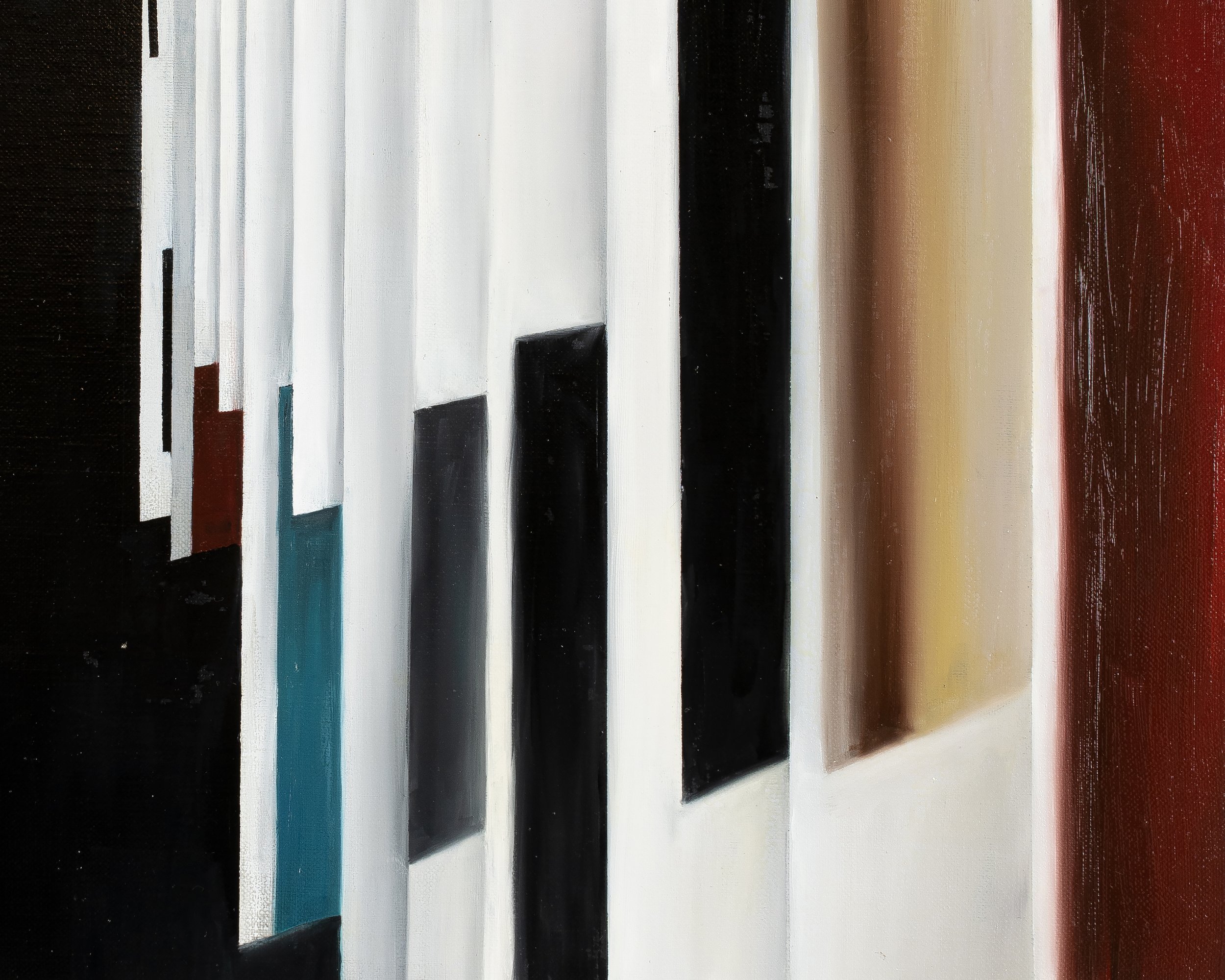
At six inches from the surface, the painting is a grid of rectangles. Some are large, occupying the upper register of the canvas. Others are small, tucked into the lower corners or half-hidden behind a larger neighbor. The rectangles overlap. They do not align. Each one carries a different field of color, a pale blue that might be a social media feed, a white that might be a search page, a thin strip of red that could be a notification bar or a video progress indicator. The edges of the rectangles are sharp, straight, and hard. There are no curves anywhere on this canvas, no organic shapes, no biomorphic residues. The geometry is the geometry of the screen: right angles, parallel lines, the orthogonal vocabulary of the graphical user interface. The background between the rectangles is absolute black, not dark gray, not deep blue, but the pure achromatic black that a monitor produces when every pixel is turned off. The contrast between the colored rectangles and the black ground is extreme, and it produces a particular optical effect: the rectangles appear to float, held in position by no visible support, suspended in the dark the way browser windows float on a desktop when every other application has been minimized or closed.
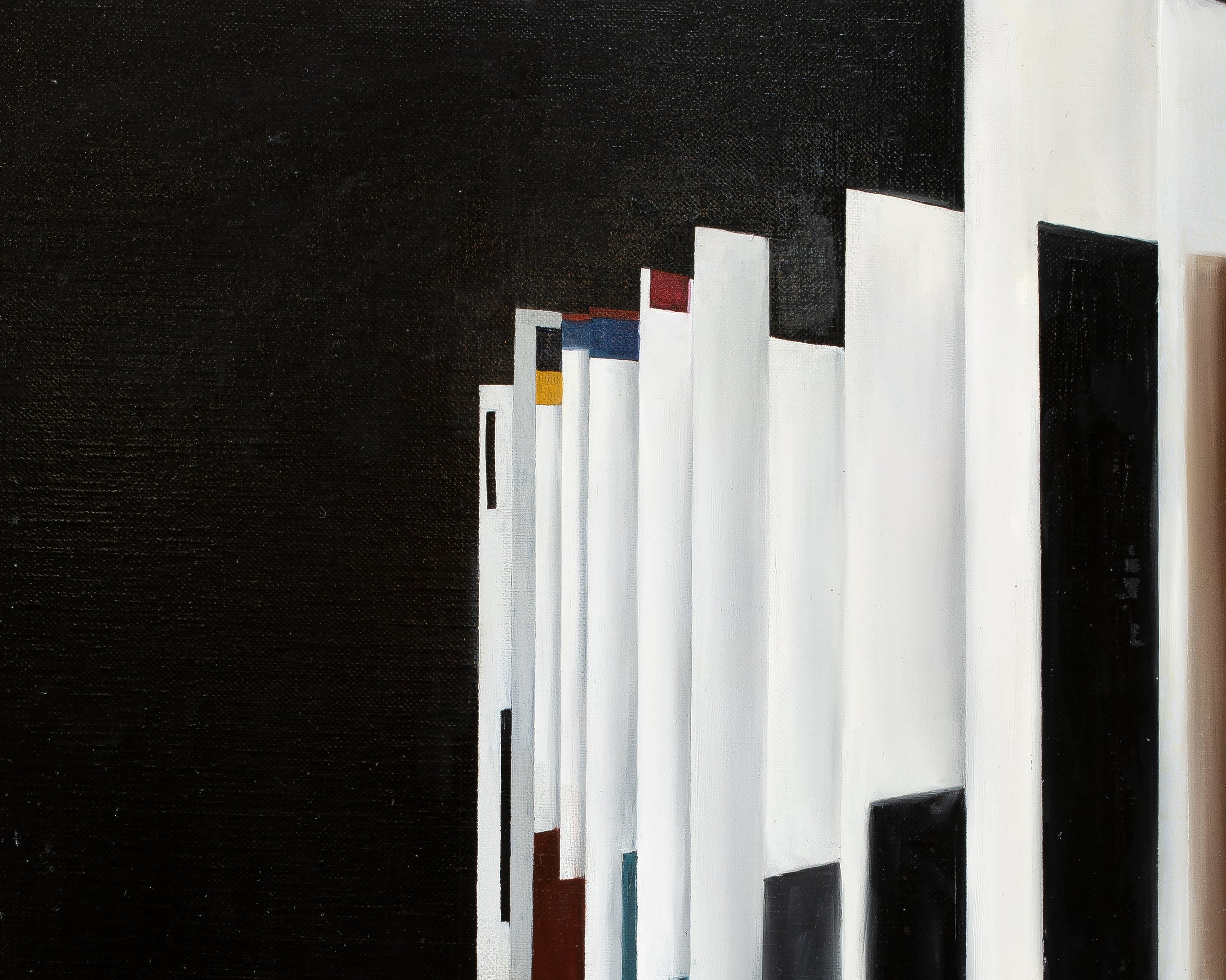
Web, 2021, is oil on linen, 18 x 24 in / 45.7 x 61 cm. The dimensions are modest. This is not a painting that fills a wall. It is a painting that approximates the scale of a laptop screen, and the scale is part of the argument. The experience of information overload that the painting registers is not a spectacle. It is intimate. It happens at arm's length, in the space between the face and the monitor, in the posture of a person sitting alone at a desk with multiple windows open. The modesty of the canvas keeps the painting in that private register. A larger format would turn the browser windows into architecture, into something public and monumental. At 18 x 24 inches, the rectangles remain the size of what they are: windows on a screen, fragments of attention, the visual debris of a consciousness that is trying to be in several places at once.
The paint handling is precise and deliberate. Each rectangle has been laid down with a straight edge. The boundaries between the colored fields and the black ground are knife-sharp, the kind of edge that requires masking tape or a ruler, and the precision of these edges is itself a reference to the medium being depicted: a graphical user interface draws its windows with pixel-perfect boundaries, and the painting honors that precision by refusing to let the paint bleed, smear, or soften at the borders. But the interiors of the rectangles are not flat. They carry subtle modulations of tone, slight shifts in hue and value that suggest content without depicting it. A pale blue rectangle darkens slightly toward its lower edge, as though a scroll has moved the content downward and the upper portion is now slightly faded with disuse. A white field carries a faint warmth in one corner, the residue of an image that has just been closed. These modulations are the painting's most sophisticated decision. They give the rectangles a temporal dimension. The windows are not static. They have been used. Someone has scrolled, clicked, minimized, expanded, and closed. The faint variations in the paint record these actions as physical traces, the way a worn spot on a keyboard records which keys have been pressed most often. The black ground between the rectangles shows the weave of the linen, a fine, regular texture that the artist has left visible rather than building up a perfectly smooth ground. The linen weave reads as the substrate of the painting, the physical surface upon which the floating windows have been rendered, and its visibility reminds the viewer that these rectangles, for all their digital precision, are made of oil paint applied to woven fabric by a human hand.
Hannah Hoch understood the disorienting logic of media bombardment before anyone had a word for it. Her photomontage Cut with the Kitchen Knife Dada through the Last Weimar Beer-Belly Cultural Epoch of Germany (1919) is a single work that contains an entire media ecosystem. Newspaper clippings, magazine photographs, typographic fragments, and machine parts collide across a field roughly four and a half feet wide, their edges cut with scissors and pasted into overlapping layers that refuse to resolve into a single focal point. The faces of Weimar politicians share space with ball bearings, map fragments, and the disembodied heads of actresses. Text runs in every direction. Scale collapses: a human head the size of a gear, a word as large as a building. The montage registers the experience of living in a society where the mass press has made every image simultaneously available and therefore simultaneously meaningless, where the volume of visual information has exceeded the mind's capacity to process it sequentially, and where the only honest representation of that condition is a surface that refuses to settle into a hierarchy of importance.
Tan Mu's Web occupies the same structural position a century later. Hoch's Weimar was the first society to experience mass media as an ambient condition: daily newspapers, illustrated magazines, radio broadcasts, and cinema newsreels producing a constant stream of images that no individual could absorb in full. The photomontage was her formal response to that condition: a composition that does not select, prioritize, or sequence, but accumulates, layering fragments until the density of the surface matches the density of the experience. The browser window in 2021 is the heir to that Weimar newspaper. It delivers the same flood of images, headlines, advertisements, and fragments of text, but faster, and without the material constraint of ink on paper. The browser tab can be opened in quantities that no newspaper front page could accommodate. The screen can hold more windows than the eye can track. And the experience of having too many tabs open, of being unable to close any of them because each one contains something you intend to read, is the 2021 version of the condition that Hoch diagnosed in 1919: the condition of receiving more information than you can process, and of arranging that surplus not into a coherent narrative but into a spatial configuration, a layout of overlapping rectangles that represents not understanding but the inability to finish understanding.
The critical difference between Hoch's photomontage and Tan Mu's painting is the black ground. Hoch's fragments share a single, continuous surface. They press against each other, overlap, and compete for space like passengers in a crowded train. There is no empty space in Cut with the Kitchen Knife. Every inch is occupied. The density is the argument: Weimar media fills every corner of consciousness. Tan Mu's rectangles do not touch. They float in a field of absolute black, separated from each other by gaps that are not gaps but the visual representation of the space between attention and inattention, between the window you are reading and the windows you have minimized, between the page you are on and the page you are about to load. The black ground is not emptiness. It is the substrate of the digital environment, the inactive pixel, the state of a screen that is displaying nothing because the user has not yet decided what to display next. It is the color of waiting, the color of the interval between one content and the next, and it occupies more of the canvas than the windows do. This is the painting's most radical structural decision. The information is not the dominant element. The space between the information is. The black ground is where the mind resides when it is between tabs, between thoughts, between the last click and the next one. It is the temporal thickness of the present moment, stretched across a canvas and given a color.
Tan Mu has identified this moment, the page transition, as the painting's central temporal event. "I have always been drawn to temporality and the power of fleeting moments," she says. "Like several of my other works, Web focuses on an instant that appears insignificant but carries deep consequences." She places this instant in a sequence alongside two other works: The Splash of a Drop, which captures the moment a water droplet hits a surface, a reference to how high-speed photography reshaped visual perception, and Trinity Testing, which captures the seconds of a nuclear explosion, the beginning of the atomic age. The comparison is exacting and deliberate. The water droplet's impact takes less than a second. The nuclear detonation's flash takes less than a second. The browser page transition takes less than a second. Each of these instants is visually unremarkable in itself. A droplet hitting a surface is something that happens millions of times every time it rains. A nuclear flash is visible only to witnesses within line of sight. A page loading is something that happens billions of times every day, on every connected device, in every time zone, without anyone registering it as an event. Tan Mu's argument is that the insignificance of the moment is proportional to the magnitude of its consequences. The droplet's impact, captured by Harold Edgerton's strobe in 1936, demonstrated that photography could decompose time into intervals shorter than human perception, and this demonstration reshaped every field that depends on visual evidence. The nuclear flash, captured by high-speed cameras at the Trinity site in 1945, inaugurated an era of existential risk that has not ended. The page transition, occurring continuously across the global internet, marks the moment when one body of information is replaced by another, when one state of attention is dissolved and a new one is assembled in its place, and this replacement, multiplied across billions of daily instances, constitutes the temporal texture of contemporary consciousness. We do not experience the page transition as an event. That is precisely why it matters. An event that happens below the threshold of attention is an event that shapes attention without being subject to it. The page transition is the structural unit of digital experience, the instant during which the mind is not reading, not watching, not scrolling, but simply waiting for the next content to appear, and during that waiting, the mind is in a state that no previous era has had a name for, a state of active receptivity, of attention without object, of consciousness that has been primed for input and is receiving none.
Piet Mondrian spent the last two years of his life painting the grid as rhythm. Broadway Boogie Woogie (1942-43), his final completed canvas, replaces the black lines of his earlier compositions with strips of yellow that pulse with small blocks of red, blue, and gray. The painting was made in New York, where Mondrian had fled from the war in Europe, and its title names two things: the street grid of Manhattan, where avenues and cross streets intersect at right angles from river to river, and the boogie-woogie piano style, with its percussive, broken rhythms in the left hand and its melodic fragments in the right. The painting does not illustrate either of these things. It translates them into a visual language of straight lines and rectangular forms, a language that Mondrian had spent four decades developing, from the early landscapes through the De Stijl period to the late New York paintings, and the translation is not decorative. It is structural. The grid in Broadway Boogie Woogie is not a representation of city streets. It is the visual equivalent of the experience of moving through a grid, the rhythm of crossing and recrossing, the regular interruption of one direction by another, the way the orthogonal layout of Manhattan organizes movement into patterns that feel both mechanical and musical, predetermined and syncopated.
Tan Mu's grid in Web is Mondrian's grid after the internet. Mondrian's rectangles are colored. Tan Mu's rectangles are colored. Mondrian's lines are yellow. Tan Mu's background is black. Mondrian's painting vibrates with the energy of the city. Tan Mu's painting vibrates with the energy of the screen. But the deeper structural connection is in the way both artists understand the grid not as a neutral container but as the shape of a particular kind of consciousness. Mondrian's grid is the shape of urban modernity: the regular division of space into orthogonal cells that organize movement, perception, and social interaction. Tan Mu's grid is the shape of digital modernity: the regular division of screen space into rectangular windows that organize attention, information, and the flow of thought from one subject to the next. Both grids are geometries of control. The city grid controls movement by limiting the possible paths between any two points to a finite set of right-angle turns. The browser grid controls attention by limiting the possible subjects of thought to whatever is currently visible in an open window. And both grids, in the hands of an artist who understands their power, become the medium through which the experience of being controlled is made visible as aesthetic form. Mondrian's painting makes the grid beautiful. Tan Mu's painting makes the grid legible. In both cases, the beauty and the legibility are not consolations. They are recognitions. They are the artist's way of saying: this is the shape of the world you live in. Look at it.
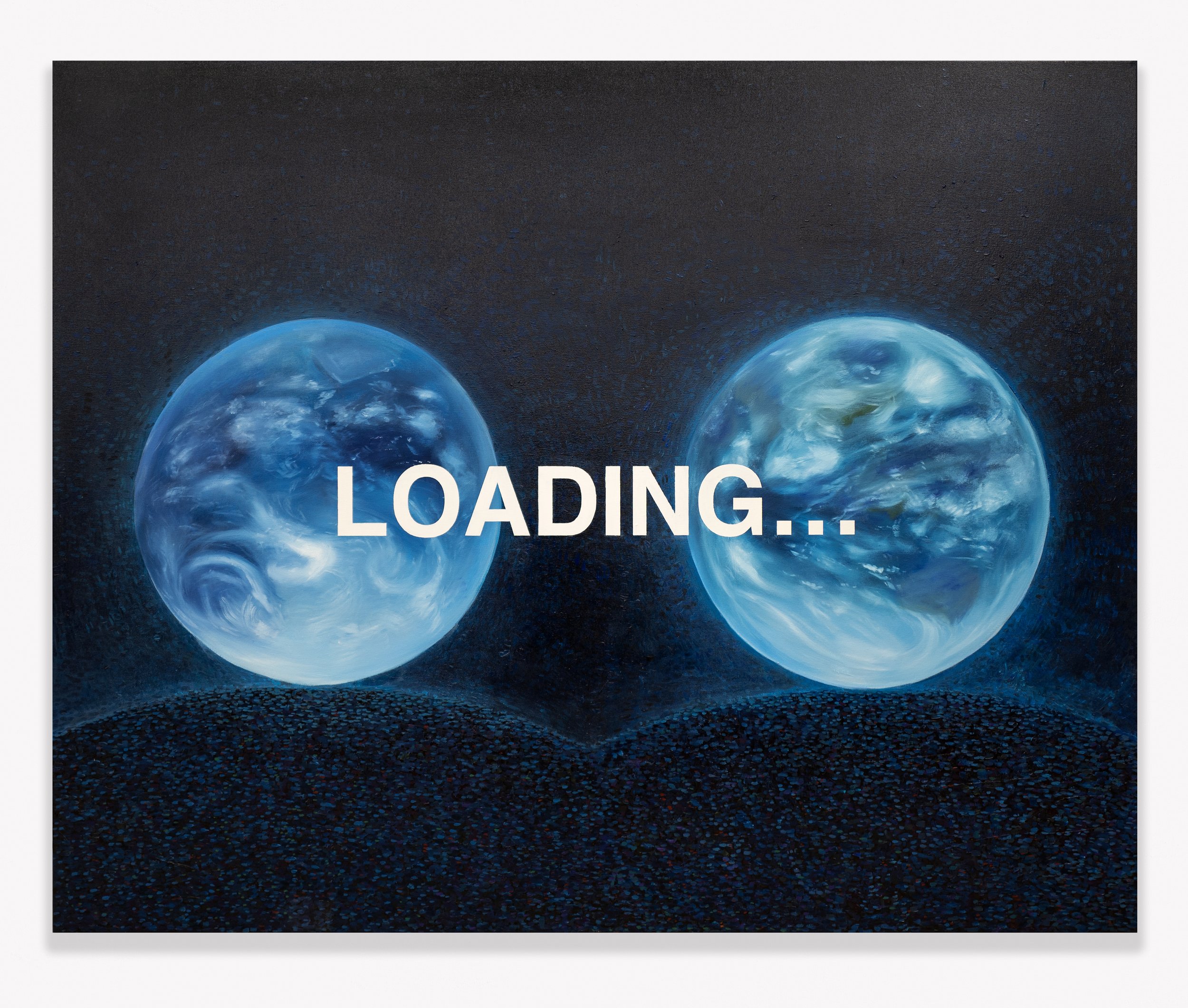
Nick Koenigsknecht, writing in the BEK Forum catalog about Tan Mu's practice, argues that her paintings function as "self-portraits" of technology rather than depictions of it. "While observing technology, are we not looking at ourselves?" he asks. "Therefore perhaps these works function more as self portraits, rather than depictions of external, scientific milestones." The observation is particularly acute when applied to Web. A browser window is not a piece of technology in the way that a propeller or a circuit board is. It is an interface, a surface that mediates between a human mind and a body of information, and its appearance, the rectangular window, the overlapping layers, the black ground of the desktop, is a design that was made for human cognition. The graphical user interface was developed at Xerox PARC in the 1970s and commercialized by Apple in the 1980s specifically because the command line, the text-based interface that preceded it, was too abstract for most users to navigate efficiently. The window, the desktop, the folder, and the trash can were metaphors borrowed from the physical office, imposed on the digital environment to make it legible to minds that had been trained by paper and desk lamps and filing cabinets. Web is a painting of those metaphors. It is a painting of the interface that was designed to make the computer look like something other than a computer, and in painting it, Tan Mu reverses the metaphor. The interface, which was supposed to disappear, to become transparent, to let the user forget that they were looking at a screen and believe that they were looking at content, is made opaque again. The windows are no longer transparent. They are the subject. The content they were designed to display has been removed, simplified into abstract color blocks, and what remains is the frame itself, the structure of the interface, the visual grammar of digital attention. This is why Koenigsknecht's formulation of the self-portrait is so precise. The browser window was designed to be invisible. The painting makes it visible. And when you look at it, what you see is not a computer. You see the shape of your own attention.
Tan Mu's childhood memory of the early internet is a memory of waiting. The dial-up connection required a modem linked to a telephone line, and the process of connecting produced the iconic sequence of tones and static that announced, over the course of thirty seconds or more, that a connection was being negotiated between one machine and another. The wait was audible and physical. You heard the modem dial. You heard the handshake protocol complete its frequency exchange. You watched the progress bar fill. And then the page loaded, first the text, then the images, each one appearing line by line from the top of the screen downward, because the bandwidth could not deliver the entire page at once. This was a different temporal experience from the instant page transitions of 2021. The dial-up connection made the interval between pages visible, audible, and felt. You knew you were waiting because the machine told you so. The contemporary page transition is silent and instantaneous, and the interval it marks has become invisible. Web restores visibility to that interval. The black ground between the floating windows is the dial-up progress bar translated into a spatial field, the waiting that the broadband connection eliminated from conscious experience but did not eliminate from the structure of digital interaction. The interval is still there. The page still has to load. The server still has to respond. The signal still has to travel from one point on the network to another. The speed of the connection has compressed the interval below the threshold of perception, but it has not removed it, and the painting, by giving the black ground more space than the windows, makes the interval the dominant element of the composition, not the content it surrounds.
The floating pages in Web do not contain legible content. Tan Mu initially included recognizable elements, news articles, advertisements, media logos, and then chose to simplify them, transforming text and logos into "abstract color blocks, allowing the composition to become more universal and less tied to specific sources." The decision is crucial. If the windows contained legible text, the painting would be about what is on the screen. By removing the text, the painting becomes about what is behind the screen: the structure of attention that the screen imposes on the mind that is looking at it. The color blocks are the residue of content that has been deliberately erased. They are the shapes that remain when the information has been removed, and these shapes, the rectangles, the overlapping layers, the sharp edges, the black gaps between one window and the next, are the permanent architecture of the digital environment, the forms that persist regardless of what content fills them. Content changes. The window remains. The page loads and unloads. The rectangle persists. And the painting, by emptying the rectangles of content, makes this persistence visible as a fact about the medium that no amount of technological improvement will alter, because the improvement consists of loading the content faster, not of eliminating the frame that contains it. The frame is the technology. The content is what passes through it. The painting attends to the frame.
Web does not argue that information overload is a problem. It argues that information overload is a condition, and that the condition has a visual shape. The shape is rectangular, it is layered, it floats on a black ground, and it occupies the scale of a laptop screen. The painting holds this shape in a state of suspension. The page has not finished loading. The transition has not completed. The user has not decided which window to bring to the front. The black ground between the rectangles is the interval during which none of these resolutions has occurred, and the interval, not the content, is where the mind actually lives. Consciousness under digital conditions is not the stream of information that flows through the open windows. It is the moment between one window and the next, the instant of active receptivity when the mind has released one subject and has not yet attached to another. The page transition has no name because it is not an event. It is the space between events, the dark ground on which the rectangles float, and it is where the experience of being alive in the information age actually takes place: not in the content, but in the gap between one content and the next, not in the window, but in the black.