The Vial That Held the Year: Tan Mu's Vaccine and the Object That Became a Promise
The photograph appeared in the first week of December 2020. A small glass vial, roughly six centimeters tall, with a purple cap and a label bearing a brand name. It had been manufactured in Puurs, Belgium, by a company called Pfizer, in partnership with a German biotechnology firm called BioNTech, and it contained 0.3 milliliters of a lipid nanoparticle suspension wrapped around a strand of messenger RNA encoding the spike protein of SARS-CoV-2. Within hours of its release, the image of this vial had been reproduced on every news platform, every social media feed, every government press conference backdrop on the planet. It became, for a period of months, the most widely recognized manufactured object in the world, more identifiable than any car model, any smartphone, any logo. The vial was not the vaccine. The vaccine was the lipid nanoparticles, the mRNA sequence, the immunological response, the clinical trial data, the cold chain logistics, the global distribution network. The vial was the container. But the container was what people saw, and what they saw was what they remembered, and what they remembered became the image that stood for the entire apparatus of rescue. Tan Mu painted it.
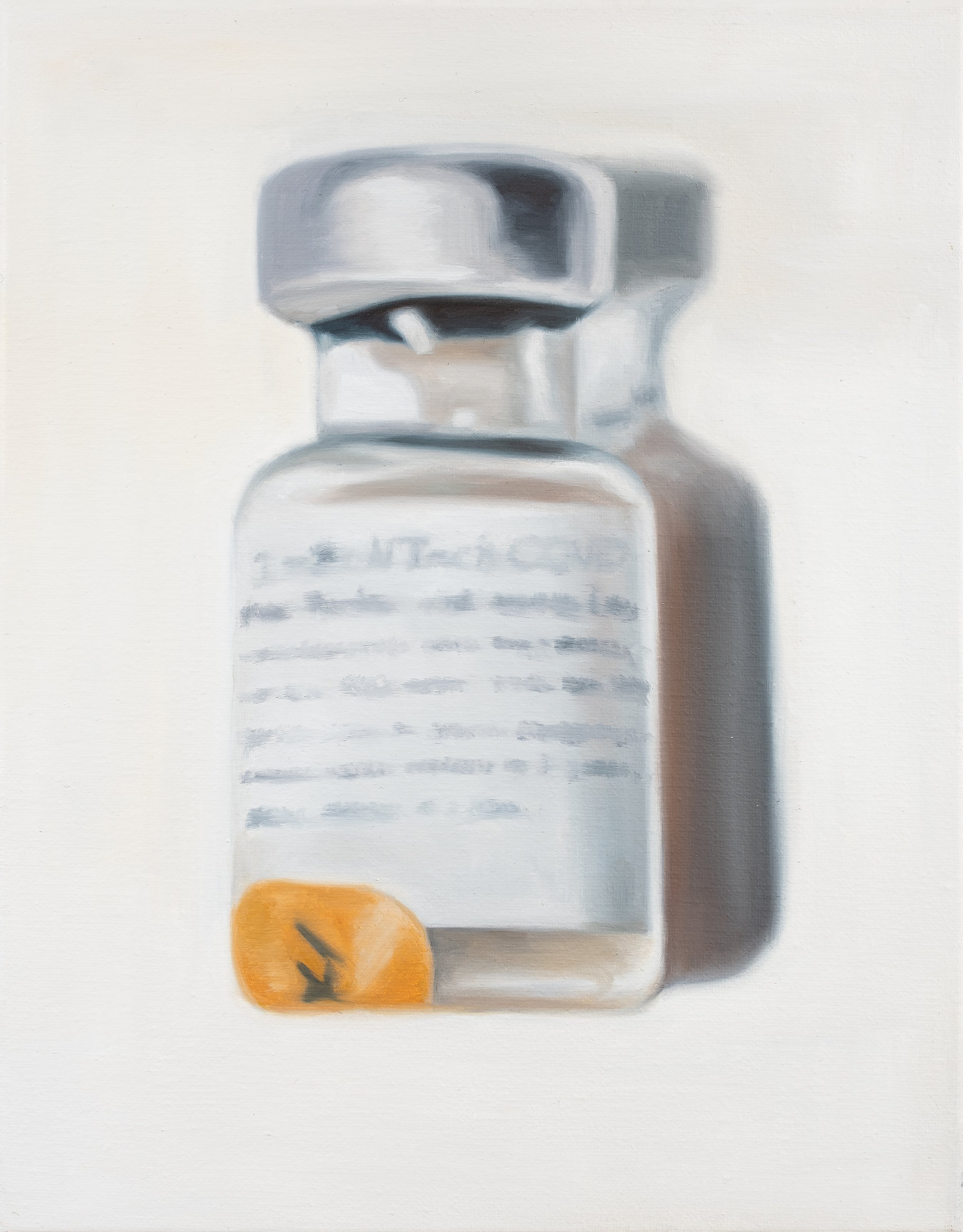
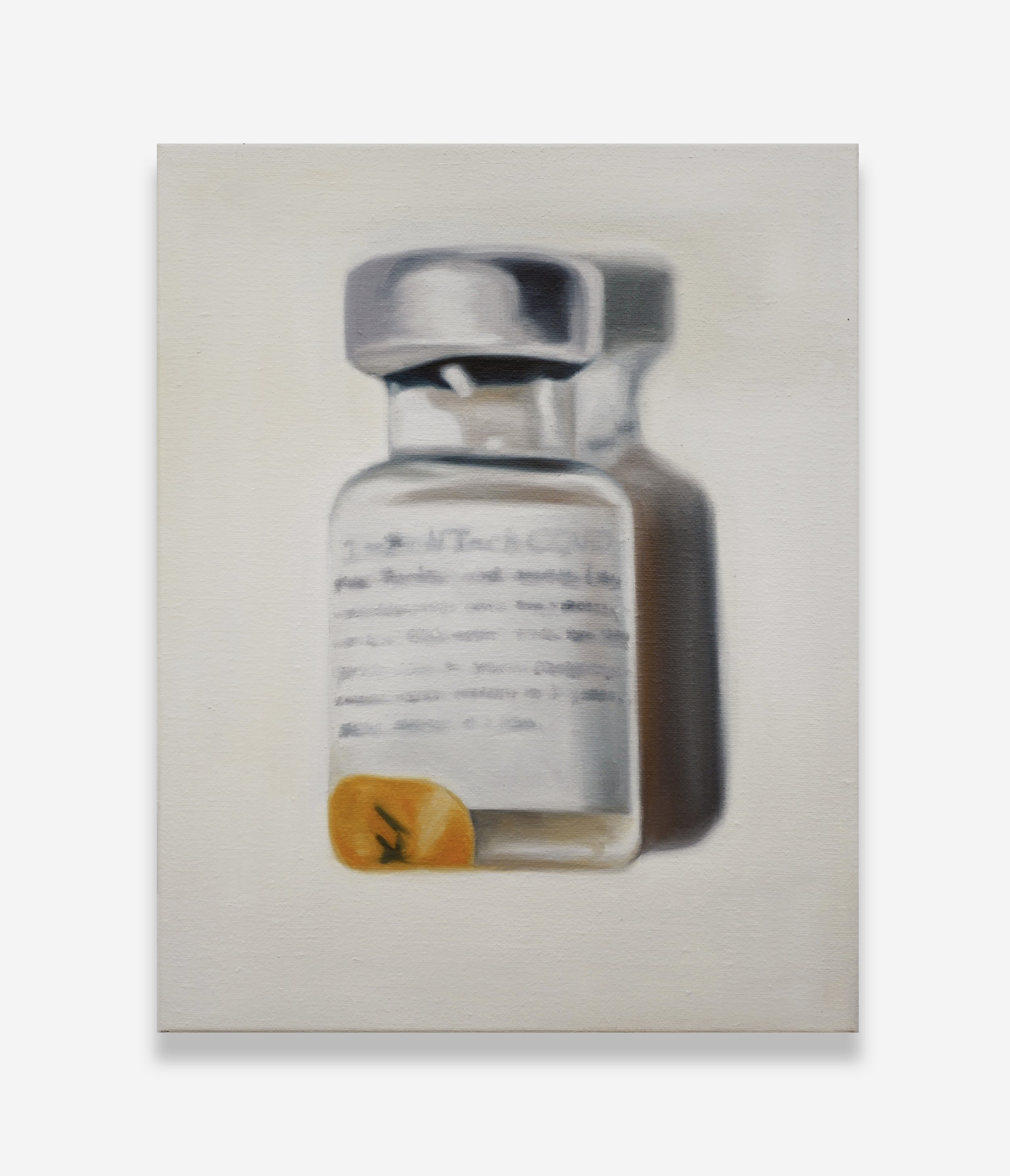
Vaccine, 2021, is oil on linen, 36 x 28 cm (14 x 11 in). The format is small. This is a painting that fits in the hand, a scale that corresponds to the size of the object it depicts. The vial occupies the center of the composition, vertical, slender, its glass walls catching light from an unseen source. The background is dark, not the absolute black of Web or The Glitch, but a deep, warm umber that suggests the controlled interior of a laboratory or a pharmacy refrigerator, a space where light is managed and temperature is regulated and every surface has been designed for hygiene. The vial itself is rendered in a register that moves between representation and abstraction. The glass walls are visible as two parallel lines that define the left and right edges of the cylinder, converging slightly toward the base where the vial narrows. The contents glow. This is the painting's central visual decision. The liquid inside the vial is not depicted as a transparent or translucent fluid. It emits light, a soft, cool luminescence that radiates outward from the center of the vial and fades toward the edges, as though the mRNA suspension were itself a source of illumination. The cap, rendered in a muted purple that references the Pfizer color coding without replicating it as a brand mark, sits at the top of the cylinder like a stopper or a seal, the thin line between the sealed contents and the outside world. Below the vial, a faint shadow or reflection anchors it to an invisible surface, grounding the floating luminosity in the physical reality of a container that rests on something.
The paint handling shifts between precision and diffusion. The glass walls are defined by thin, sharp lines, the kind of edge that a fine brush can produce in a single pass, the kind of edge that glass actually has when it is manufactured to pharmaceutical tolerances. But the light that radiates from the contents is not sharp. It bleeds outward in soft gradations, the pigment applied in thin washes that allow the dark ground to show through, producing a glow that intensifies toward the center of the vial and diminishes toward its edges. This is not the hard-edged glow of a digital screen. It is the softer luminescence of a biological material under controlled lighting, the kind of light that a translucent liquid produces when a fluorescent tube shines through it in a refrigerated case. The surface of the painting is smooth. There is no impasto, no texture that catches the raking light, no visible weave of the linen. The artist has built up the ground in thin layers until the surface is as uniform as the glass it depicts, a surface that reflects light rather than absorbing it, a surface that the eye slides across the way it slides across the curved wall of a vial in a photograph. This smoothness is a material decision that serves the argument. The vial is a manufactured object, produced by industrial processes that eliminate irregularity, and the painting's surface mirrors that manufactured regularity, refusing the handmade gesture in favor of the machine-made finish.
Giorgio Morandi spent decades painting bottles. Not all bottles. Not wine bottles, not perfume bottles, not the decorative vessels that appear in Dutch still lifes surrounded by peeled lemons and half-eaten bread. Morandi painted small, plain containers, the kind of bottles that hold ink, or medicine, or nothing at all, the kind of bottles that are designed to be functional and that nobody looks at twice. He arranged them on a table in his studio in Bologna, in groups of three or five or seven, and he painted them over and over, in the same gray-brown light, from the same angle, at the same distance, for thirty years. The bottles in a Morandi still life are never labeled. They carry no branding, no indication of what they once held. They are pure form: the cylinder, the cone, the slight swelling of the belly, the narrow neck. The paint is thick but muted, the colors a range of muted ochres, pale blues, dusty pinks, and earth tones that refuse to declare themselves as anything other than the color of the object under the studio light. Morandi's bottles are objects that have been stripped of their utility and held in a state of sustained attention, not as vessels that contain something, but as shapes that occupy space and reflect light. The content is irrelevant. The form is everything.
Tan Mu's vial is a Morandi bottle turned inside out. Morandi removes the content and attends to the form. Tan Mu removes the label and attends to the content. The vial in Vaccine is not branded. It carries no Pfizer logo, no lot number, no expiration date. The purple cap is a reference, not a replication. The painting has stripped the identifying marks from the container in exactly the way Morandi stripped the labels from his bottles, and for exactly the opposite reason. Morandi stripped the labels because he wanted the bottle to be nothing but a shape. Tan Mu stripped the labels because she wanted the viewer to see the vial not as a pharmaceutical product but as what the artist calls "a container of layered significance," an object that "holds scientific knowledge, political tension, public anxiety, and collective hope all at once." The removal of the brand does not make the vial generic. It makes it universal. Without the logo, the vial could be any vaccine vial, and that is precisely the point. The painting is not about Pfizer. It is about the category of object that the Pfizer vial represents: the small glass container that holds a substance produced by collective scientific effort and distributed through collective political will to address a collective crisis. Morandi's bottles are containers that hold nothing. Tan Mu's vial is a container that holds everything.
The Pfizer BioNTech vaccine was the first mRNA vaccine authorized for human use. The technology had been in development for over two decades, primarily by Katalin Kariko and Drew Weissman at the University of Pennsylvania, who discovered in 2005 that modified nucleosides could prevent the immune system from rejecting synthetic mRNA. This was the foundational insight. Without it, the mRNA would be destroyed by the body's defenses before it could instruct a cell to produce the spike protein. Without the spike protein, there would be no immune response. Without the immune response, there would be no vaccine. The lipid nanoparticle was the delivery mechanism, a microscopic envelope of fat molecules that could encase the fragile mRNA strand, protect it from degradation, carry it through the bloodstream, and fuse with a cell membrane to deposit its payload inside the cell. The entire apparatus, the mRNA sequence, the lipid envelope, the cold chain, the vial, the syringe, the needle, the logistics network, the government approval, the public trust, or the lack of it, was compressed into a six-centimeter container that was photographed, broadcast, distributed, and recognized across every time zone on the planet within days of its public release. The speed of that recognition was unprecedented. The polio vaccine, announced in 1955, was celebrated in newspapers and on radio, but its image did not circulate with the velocity or the ubiquity that the Pfizer vial achieved in the age of the internet. The vial photograph became a visual shorthand for an entire set of emotions: relief, hope, skepticism, anger, political division, scientific pride. It was reproduced so often and in so many contexts that it acquired the status of an icon, an image that meant more than what it depicted, an image that had been separated from its referent and attached to a constellation of feelings that no single vial could contain.
Tan Mu describes the vial as "a cultural artifact of the pandemic." The phrase is exact. An artifact is an object made by human hands that carries information about the culture that produced it. A potsherd tells an archaeologist about the people who made the pot: their materials, their firing techniques, their decorative conventions, their trade networks. The vaccine vial tells a future archaeologist about the people who made the vaccine: their biotechnology, their cold chain logistics, their regulatory apparatus, their political divisions, their capacity for global cooperation under existential pressure. The vial is small because it needs to be. It contains 0.3 milliliters because that is the volume required to deliver the dose. The glass is borosilicate because it needs to withstand extreme cold. The cap is color-coded because the distribution network needs to identify the product at a glance. Every detail of the vial's physical form is determined by function, and the function is determined by the science, and the science is determined by the biology, and the biology is the virus, which is not made by human hands at all. The vial sits at the junction of these determinations, a manufactured object that mediates between the non-human biology of a pathogen and the human institutions that mobilized to counter it. Painting it is an act of attention to that junction, to the point where nature and technology and politics and collective feeling converge in a single container small enough to hold in the palm of your hand.
Joseph Beuys understood that everyday materials could carry the weight of biography, history, and mythology. His Felt Suit (1970) is a suit, seven pieces of felt cut and sewn in the shape of a standard business suit, hung on a hanger, displayed on a wall. It looks like a suit. It is a suit. But it is also, according to Beuys's own mythology, the material that saved his life. During the Second World War, Beuys claimed, he was shot down over Crimea and rescued by Tatar nomads who wrapped him in fat and felt to preserve his body heat. The story is almost certainly fictional. The Tatars who actually found Beuys after the crash were German search and rescue personnel, and his injuries were treated in a military hospital. But the mythology matters more than the facts, because the mythology is what gave felt its charge in Beuys's practice. Felt, in Beuys's system, means insulation, warmth, protection, survival. Fat means energy, storage, transformation. The materials are not chosen for their aesthetic qualities. They are chosen for their symbolic charge, which Beuys builds through narrative, repetition, and the sheer accumulation of installations, lectures, and performances that circle around the same set of materials with the persistence of a liturgy.
The vaccine vial in Tan Mu's painting carries a comparable symbolic charge, but the charge is not built through mythology. It is built through history. The vial does not need a personal narrative to give it meaning because the pandemic has already given it meaning. Every person who sees this painting has already seen the photograph of the Pfizer vial. Every person who sees it has already experienced the year of isolation, the political arguments, the queue for the injection, the arm soreness that followed, the relief, or the suspicion, or both at once. The vial arrives on the canvas pre-charged, carrying the accumulated significance of the worst global public health crisis in a century, and the painting's decision to strip the label, remove the brand, and render the contents as a soft glow rather than a transparent fluid is a decision to shift the charge from the specific to the universal, from the pharmaceutical product to the category of object it represents. Danni Shen, writing about Tan Mu's practice in Emergent Magazine, observes that her works "serve as a kind of witness to human socio-technological histories." Vaccine is a witness, but it is a witness to a history that is still being written. The pandemic is not over. The political divisions that crystallized around the vial have not resolved. The vial in the painting is not a historical artifact in the way that Morandi's bottles are historical artifacts, objects whose meaning has been settled by time. It is an active artifact, an object that still carries its charge, and the painting registers that charge by making the contents glow. The glow is not decorative. It is the visible sign of the energy that the vial contains, not the chemical energy of the mRNA, but the social energy of a global crisis that was concentrated into a six-centimeter container and distributed, one dose at a time, to the species that made it.
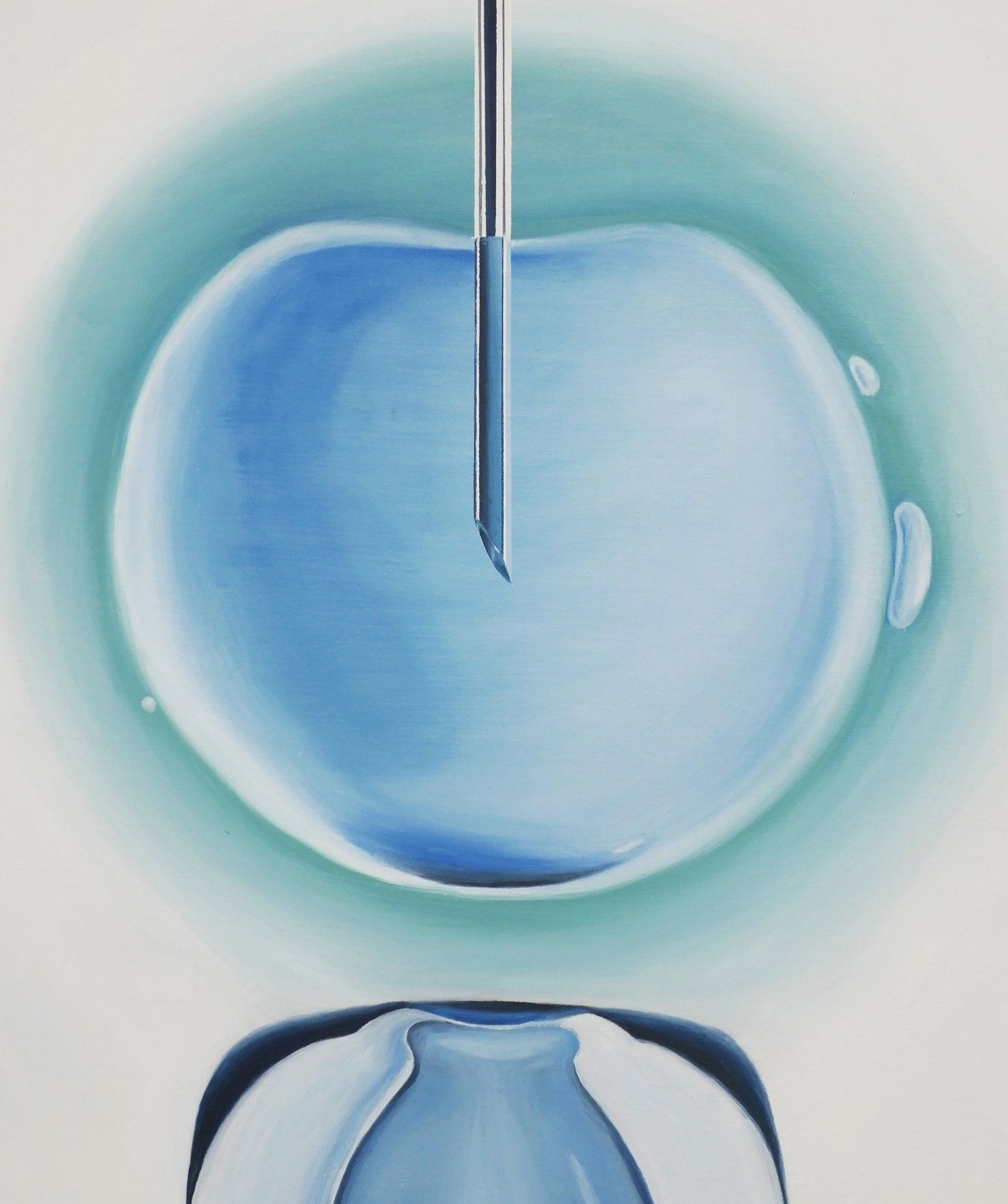
Tan Mu's own statement about Vaccine emphasizes the continuity between this work and her earlier investigations of genetics and human DNA. "The mRNA technology in particular felt like a continuation of my long-standing interest in genetic codes," she says, "but now embedded within an urgent social reality." The connection to IVF (2020), to Embryo (2022), to Chromosomes (2022), and to the broader body of work that addresses the microscopic structures of life is not incidental. It is structural. IVF depicts the in vitro fertilization procedure, the glass pipette entering the egg, the technician's hand guiding the needle. Embryo renders the first week of cell division. Chromosomes maps the genetic structures that determine biological inheritance. Each of these works places the viewer at the scale of the microscopic, where the structures that govern life are too small to see with the naked eye but are rendered visible through scientific imaging and then rendered again through oil paint, translated from the photographic register to the painterly one. Vaccine belongs to this sequence. The mRNA strand inside the vial is not visible in the painting. It is too small. A strand of messenger RNA is roughly a thousandth the width of a human hair. The painting cannot depict it. But the painting can make it glow. The luminescence that radiates from the center of the vial is the visual equivalent of what the mRNA does inside the body: it instructs a cell to produce a protein, it transmits information from the outside to the inside, it carries a message across a membrane. The glow is the message made visible. It is the instruction, the code, the genetic text, rendered as light.
The painting's size, 36 x 28 cm, places it in the same intimate register as the vial itself. This is not a painting that overwhelms. It is a painting that you lean toward. The vial is small. The canvas is small. The gesture of looking at the painting replicates the gesture of looking at the vial in a pharmacy refrigerator, or on a news feed, or in the hand of a nurse about to draw the dose. You bring it close. You examine it. The intimacy of the scale is not an aesthetic choice. It is a structural correspondence between the size of the object and the size of the painting, and it produces a particular physical experience in the viewer: the experience of holding something small that contains something large. A vial that holds a vaccine that holds an mRNA sequence that encodes a spike protein that triggers an immune response that protects a body that prevents a transmission that slows a pandemic that changes the trajectory of a species. Each layer is contained by the layer before it, and the painting, by matching the scale of the outermost layer, makes the viewer hold all of the inner layers in the same gesture of attention, the same act of looking that the vial itself demands when you encounter it in the world: a small thing that carries an impossible weight.
Vaccine is not a painting about hope. Hope is one of the emotions that the vial accumulated during its circulation, but it is not the only one, and it is not the one the painting privileges. The vial accumulated skepticism, anger, political division, and exhaustion in the same measure that it accumulated hope. The painting does not resolve these emotions. It does not depict the vial as an object of salvation or an object of suspicion. It depicts the vial as an object of attention. The glow that emanates from the contents is not the warm glow of reassurance. It is the cool luminescence of a substance that is doing something, a substance that is active, that has been designed to enter a body and instruct it to perform a task it would not otherwise perform. The painting holds this activity in suspension. The contents are glowing, but they are contained. The vial is sealed. The cap is on. The mRNA has not yet been injected. The pandemic has not yet been addressed. The political divisions have not yet been resolved. The painting holds the moment before the moment, the instant when the promise is still inside the glass, still concentrated, still entire, before it has been divided into 0.3-milliliter doses and distributed across a distribution network that no single painting can depict. The vial is the promise in its concentrated form. The painting is the promise in its visual form. Both are small. Both are containers. Both hold more than they appear to hold.