The Distance Between Bodies: Tan Mu's Yoga Isolation and the Geometry of Being Together Apart
Li Yizhuo, writing in the BEK Forum catalog about Tan Mu's monochrome works, observes that the absence of color "intensifies emotional distance and stillness" and creates "an uncanny quality reminiscent of vintage science fiction or archival records." The observation is precise, but it describes the effect of the monochrome without identifying its cause. The uncanny quality that Li Yizhuo identifies does not arise from the removal of color alone. It arises from the removal of color combined with the presence of figures who are performing an activity that is, by definition, communal and who are performing it at a distance from each other that violates the activity's own logic. Yoga, in any of its traditions, is a practice of connection: connection between breath and body, between the individual and the universal, between the practitioner and the lineage of practitioners who have performed the same postures across centuries. The figures in Yoga Isolation are performing these postures in a public park, on a summer day, in a city under lockdown, and the distance between them, six feet, two meters, the span of an outstretched arm, the length of a yoga mat placed end to end with a gap in between, is a distance that the practice itself cannot accommodate. You cannot adjust another person's alignment from six feet away. You cannot receive a correction from a teacher who is standing beyond arm's reach. You cannot feel the collective breath of the room when the room has been moved outdoors and expanded to a size that makes every breath a private event. The monochrome makes this contradiction visible by stripping the scene of the visual pleasure that would otherwise disguise it. Without color, there is no grass, no sky, no green of the park or blue of the summer morning. There is only the geometry of the arrangement: the figures, the distances, the repetition, and the silence between them.
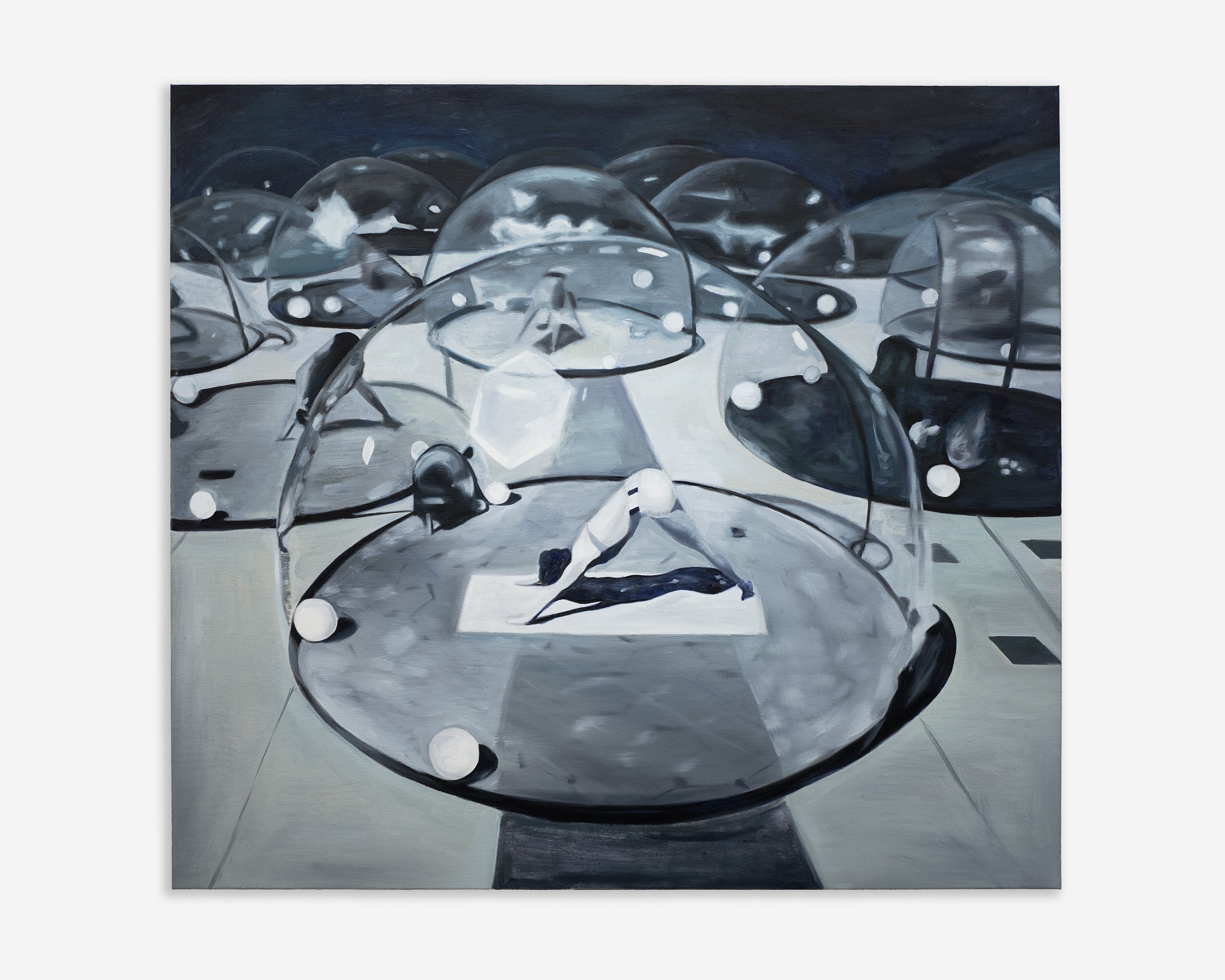
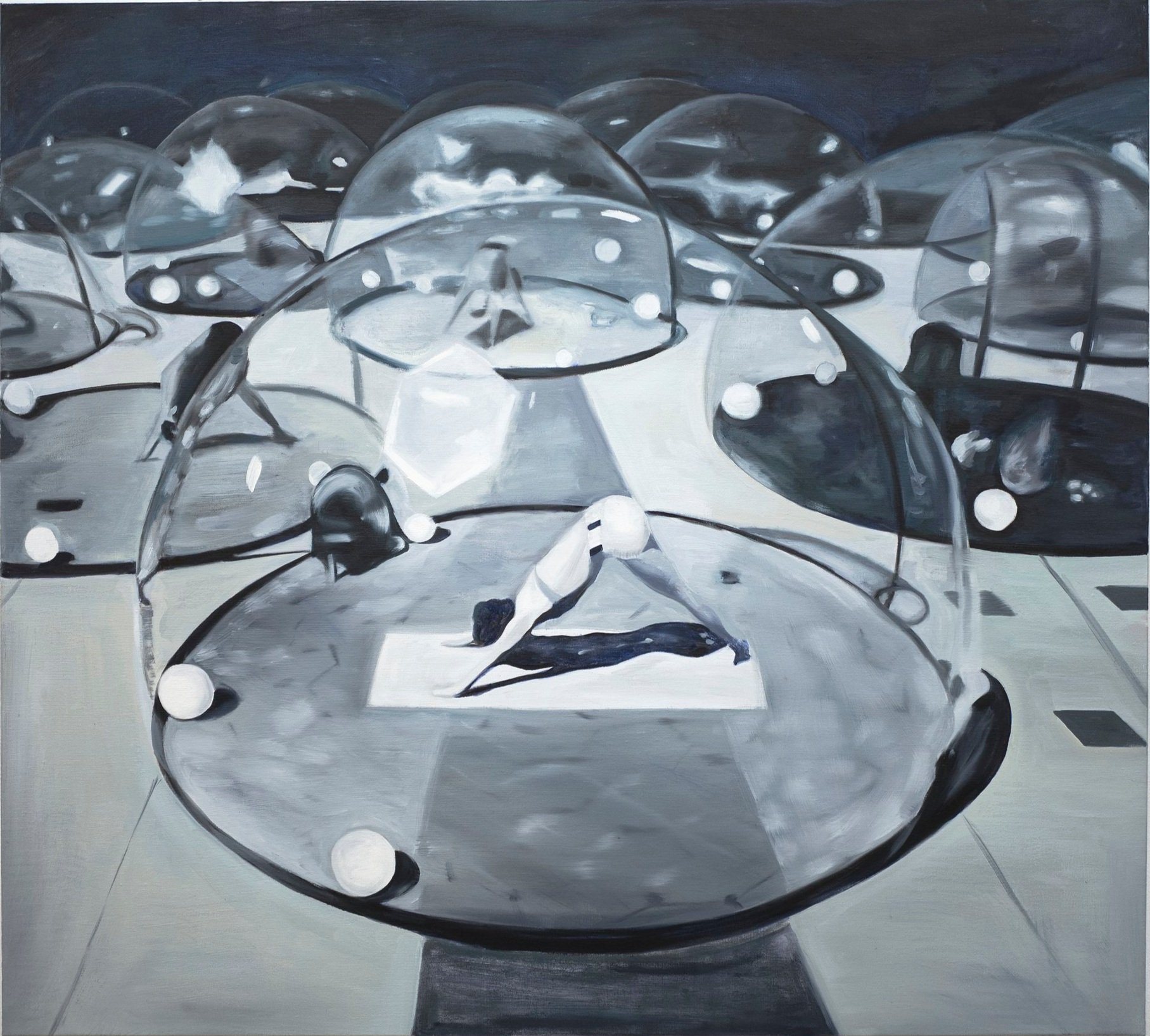
Yoga Isolation, 2022, is oil on linen, 91 x 102 cm (36 x 40 in). The format is landscape, wider than it is tall, which is the format of a park viewed from across its length. The figures are arranged in rows. They are performing yoga postures, and their postures are synchronized: arms raised, legs extended, spines curved in the same arc at the same moment, as though a single instruction has been given and a single body has responded to it in multiple places at once. The synchronization is the painting's most immediately striking formal feature. The bodies repeat. The postures repeat. The spaces between the bodies repeat. The composition is a grid of human figures held in a state of coordinated stillness, and the grid is the geometry of social distancing rendered visible as a compositional principle. The figures are not arranged by a choreographer. They are arranged by a protocol, a set of rules that governs the minimum distance between bodies in a public space during a pandemic, and the protocol has produced a composition that is, whether or not the health officials who wrote the protocol intended it, formally rigorous. The equal spacing between figures, the uniform posture, the landscape format that extends the rows beyond the frame, all of these compositional decisions are not decisions at all in the conventional sense. They are the visual consequence of a public health directive, and the painting makes this consequence legible by rendering it in a visual language that the history of painting has prepared the viewer to read as deliberate, composed, and intentional.
The paint handling is deliberate and restrained. The monochrome palette ranges from near-white to near-black, with the vast majority of the surface occupying the middle registers of gray. The figures are rendered in a mid-gray that reads as skin without specifying skin tone, as clothing without specifying color, as bodies without specifying identity. The background is a lighter gray that suggests open air and daylight without specifying weather, season, or time of day. The ground beneath the figures is a darker gray that suggests grass or turf without specifying its condition. This systematic suppression of chromatic information is not a subtraction. It is a translation. The original photograph, taken on June 21, 2020, during an outdoor yoga session in Toronto, contained all of the color that the painting withholds: the green of the grass, the blue of the sky, the varied skin tones and clothing colors of the participants, the ambient warmth of a summer morning. The painting has taken this information and converted it into a single continuum of value, from dark to light, without hue. The result is a scene that looks like it could have been photographed at any point in the last century. The monochrome places the image outside of chronological time. It could be 2020, it could be 1920, it could be a scene from a documentary about urban life in any decade that had a camera capable of black-and-white photography. This timelessness is not an accident. It is a structural feature of the monochrome strategy, and it serves the painting's argument, which is that the experience of being together apart is not unique to the COVID-19 pandemic. It is a condition that recurs whenever a society imposes spatial restrictions on its members, and the monochrome, by removing the specific visual markers of 2020, makes the recurrence visible.
Gustave Caillebotte's Paris Street; Rainy Day (1877) is a painting about the geometry of social distance in public space, although it has rarely been described that way. The painting shows a wide Parisian boulevard, newly constructed as part of Baron Haussmann's renovation of the city, populated by figures who are walking in various directions at various speeds, and the most immediately striking feature of the composition is the space between them. The boulevard is enormous. It stretches across the full width of the canvas, and the figures who traverse it are small in relation to the space they occupy. A couple on the left walks toward the viewer. A man on the right walks away from the viewer. Other figures are scattered across the cobblestones, each one maintaining a distance from every other figure that feels deliberate, planned, as though the city has been designed to hold this many people and no more, and each person has been assigned a position that maximizes their separation from their neighbors while preserving the appearance of casual urban movement. The umbrellas reinforce the separation. Each umbrella creates a private dome of dry air around its holder, a small portable shelter that excludes the rain and, by extension, the other pedestrians who are sharing the same wet street. The painting is usually described as a portrait of modern urban life, a celebration of the new boulevards and the new social relations they made possible. But it is also, and perhaps more precisely, a portrait of the distance that modern urban life requires. The boulevard is wide because Haussmann designed it to accommodate troops and artillery, not because it needed to be pleasant for pedestrians. The distance between figures is a consequence of the boulevard's width, not a sign of urban sociability. The figures in Caillebotte's painting are together in the same space, under the same sky, walking the same street, and they are alone. The painting makes this aloneness visible through the geometry of the composition: the wide street, the regular spacing, the umbrellas that convert each person into a self-contained unit of shelter.
Tan Mu's Yoga Isolation shares Caillebotte's understanding that social distance is not an absence of social relation but a specific form of it, one that can be made visible through the geometry of composition. The figures in Yoga Isolation are not separated by a boulevard. They are separated by a protocol. But the visual result is the same: a grid of human figures, evenly spaced, each one occupying a clearly defined personal territory, each one performing the same action as the others, and each one performing it alone. Caillebotte's umbrellas are Tan Mu's yoga mats. Both are portable territories that define the boundary of the individual's space in a public setting, and both convert that boundary into a visual element that the painter can arrange, repeat, and organize into a compositional pattern. The repetition of the umbrella in Caillebotte's painting is the visual equivalent of the repetition of the social code that governs how close a stranger may walk to another stranger on a Parisian boulevard. The repetition of the yoga posture in Tan Mu's painting is the visual equivalent of the repetition of the health protocol that governs how close a stranger may stand to another stranger in a Toronto park. Both repetitions produce the same visual effect: a regular, almost mechanical arrangement of human figures that looks deliberate from a distance and lonely from up close, and that reveals, upon sustained attention, that the distance between bodies is not a natural feature of public space but a designed feature, a rule that someone wrote and that everyone follows, and that the painting makes visible by turning it into a compositional principle.
The source photograph was taken on June 21, 2020, the summer solstice, which is also International Yoga Day. The coincidence of dates gives the event a double significance: it is both the longest day of the year, the day of maximum light, and the day that the United Nations designated, in 2014, as an annual celebration of yoga's contribution to global health and well-being. In 2020, International Yoga Day occurred during a global pandemic that had shut down yoga studios, closed community centers, and driven practitioners outdoors, where they could practice together only by remaining apart. The photograph that Tan Mu used as her source captures this double meaning: a practice of unity being performed under conditions of enforced separation, on the day that celebrates unity, during the season of maximum light, in a moment of collective darkness. Tan Mu has spoken about the paradoxical quality of this scene. "Yoga traditionally represents unity, harmony, and shared energy," she says, "but within the context of the pandemic, these meanings were reshaped. In Yoga Isolation, yoga becomes a paradoxical symbol. The practice remains communal in spirit, yet it is performed in isolation, with each individual contained within a clearly defined personal space." The paradox is not resolved by the painting. It is held in suspension. The synchronized postures suggest unity. The spacing between figures enforces separation. The monochrome palette unifies the visual field while the composition partitions it. Every element of the painting enacts the contradiction that the pandemic imposed on this particular practice on this particular day: the practice of being together, performed alone.
The monochrome is the painting's most consequential formal decision, and Tan Mu has explained its logic with characteristic precision. "During the pandemic, I became increasingly sensitive to the emotional weight carried by physical distance and silence. Removing color allowed me to strip the image down to its essential structure and emotional core." The structure that remains after the color has been removed is the structure of the arrangement: the rows of figures, the equal spacing, the synchronized postures, the landscape format that extends the rows beyond the frame. The emotional core that remains is the feeling of distance that the monochrome produces. Color is proximity. It creates visual warmth, it suggests the temperature of the air, it tells you whether the light is warm or cool, whether the day is pleasant or overcast. Monochrome is distance. It removes the information that would allow you to feel the air, and it replaces it with information that allows you to see the space between bodies more clearly. The monochrome does not make the scene sadder. It makes the scene more legible. It removes the comfort of the summer morning and leaves only the geometry of the protocol, the arrangement of bodies in a pattern that was designed by a public health department and that the painting reveals, through the act of rendering it in oil on linen, as a composition that a painter could have designed. This is the painting's most unsettling observation. The social distancing protocol produced an arrangement that looks like art. The six-foot spacing between figures, the synchronized postures, the rows extending across a landscape format, all of these are compositional decisions that a painter would make if they were designing a painting about collective isolation. The pandemic produced the composition. The painting merely recorded it.
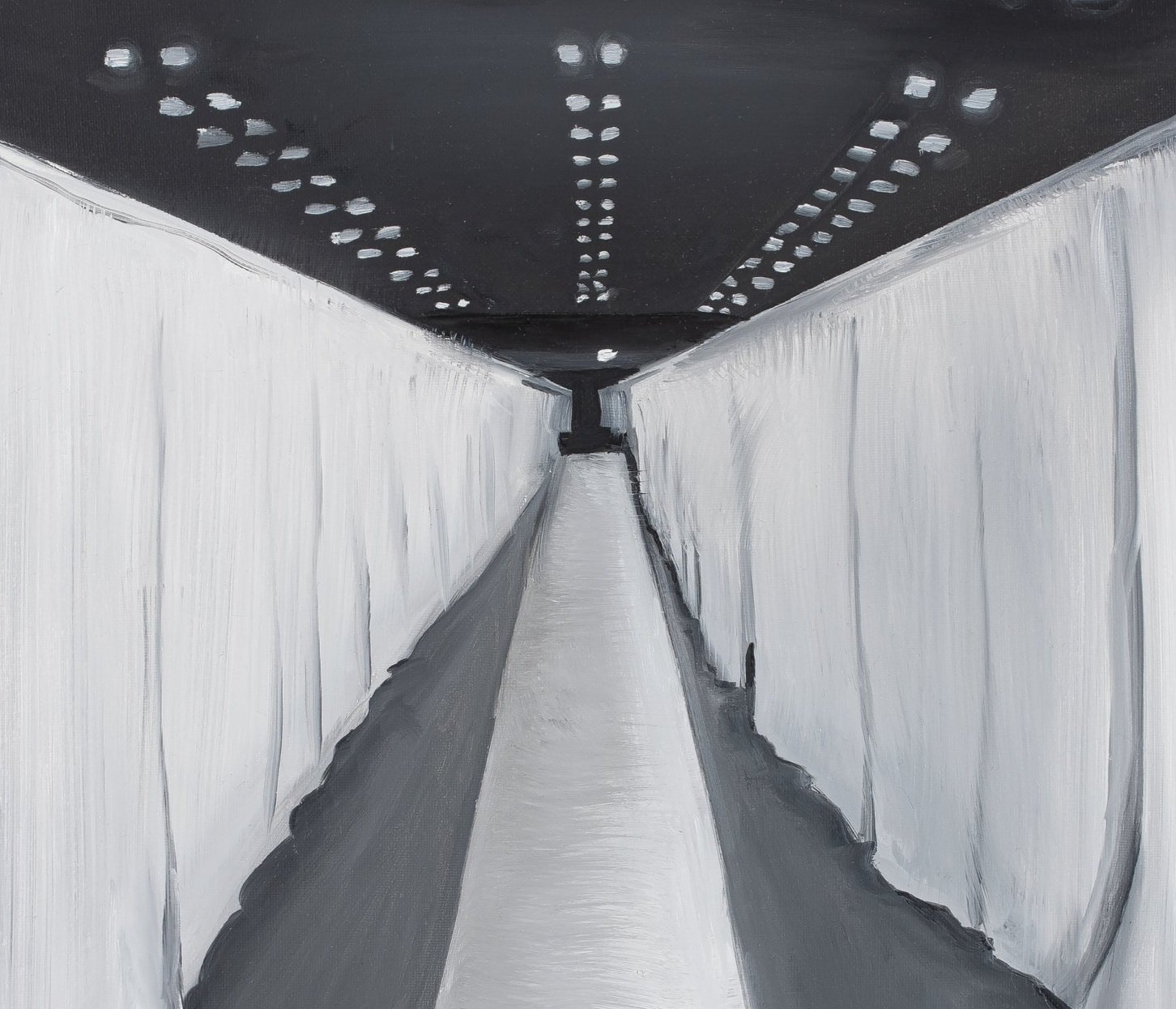
Tan Mu's decision to reduce the color palette to monochrome places Yoga Isolation within a specific tradition in her own practice. She has identified this tradition explicitly. "In works related to space and technology, such as Peek, DEC's PDP-10, and Blue Box, black and white reflect the technical and historical origins of the imagery. In pieces drawn from historical events, like Bikini Atoll and Trinity Testing, monochrome reinforces their documentary gravity. In works addressing isolation and disconnection, including Yoga Isolation, Isolation, and Torus, the absence of color intensifies emotional distance and stillness." The tradition is one in which the removal of color is not an aesthetic preference but an analytical tool. Monochrome is used not because the artist prefers black and white to color, but because the removal of chromatic information reveals structural information that color conceals. In Yoga Isolation, the structural information that the monochrome reveals is the geometry of the arrangement. The equal spacing, the synchronized postures, the rows, the grid, the regularity that makes the social distancing protocol look like a compositional decision. This geometry would be visible in a color photograph, but it would be competing with the grass, the sky, the clothing, the skin tones, and all of the other chromatic information that tells you that this is a pleasant summer morning and that the people in the park are having a nice time. The monochrome removes the pleasant summer morning and leaves only the protocol, and the protocol, viewed without the reassurance of color, is a protocol of separation.
Li Yizhuo, in the same catalog essay, identifies the monochrome in Tan Mu's pandemic works as producing "an uncanny quality reminiscent of vintage science fiction," and the comparison to science fiction is revealing. Science fiction, at its best, is not a genre of prediction. It is a genre of defamiliarization. It takes a familiar arrangement, a city, a family, a workplace, and it alters one variable: the technology, the social structure, the physical laws. The resulting world is recognizable but strange, and the strangeness is what allows the reader to see the original arrangement with new eyes. Yoga Isolation performs this defamiliarization through the monochrome. The scene is recognizable: people doing yoga in a park. The strangeness is produced by the removal of the visual information that would make the scene comfortable. Without the color of the grass and the sky, the arrangement of bodies looks like what it is: a design imposed from outside, a pattern that no one chose but everyone follows. The monochrome makes the familiar strange, and the strange scene reveals that the familiar arrangement was always a design, always a protocol, always a set of rules governing the distance between bodies, and that these rules, which were invisible before the pandemic because they were enforced by social convention rather than public health directive, have always been present in every public space, determining how close we stand to strangers, how we navigate crowds, how we arrange ourselves on a sidewalk or in a park or in a yoga studio. The pandemic did not invent social distance. It legislated it. The painting makes the legislation visible by removing the color that would make it comfortable, and what remains is the geometry, which is the shape of the rule, and the silence, which is the sound of the rule being followed.
Yoga Isolation does not argue that the pandemic was an anomaly. It argues that the pandemic made visible a geometry of social distance that was already present in every public space, every urban boulevard, every gym, every studio, every arrangement of bodies that follows a rule about proximity that no one explicitly stated. The painting makes this geometry legible by translating it into a compositional principle: the grid, the spacing, the synchronized posture, the monochrome that removes every visual distraction and leaves only the distance between figures, which is the distance that the protocol specified and that the painting, by making it the dominant element of the composition, elevates from a public health measure to a formal property of the image. The final scene is not sad. It is not heroic. It is precise. The figures are together, and they are apart, and the painting holds both of these conditions in the same composition without resolving the contradiction, because the contradiction is the condition itself, and the condition, as the monochrome makes clear, is not unique to a pandemic summer in Toronto. It is the condition of being a body in public space, a body that is always already at a distance from every other body, and that discovers, in the moment when the distance is measured and legislated, that the distance was always there, was always being maintained, was always the invisible rule that organized every public space, and that the pandemic merely made visible by painting it in black and white.