The Cloud That Looked Like Cotton: Tan Mu's Bikini Atoll and the Still Life of Destruction
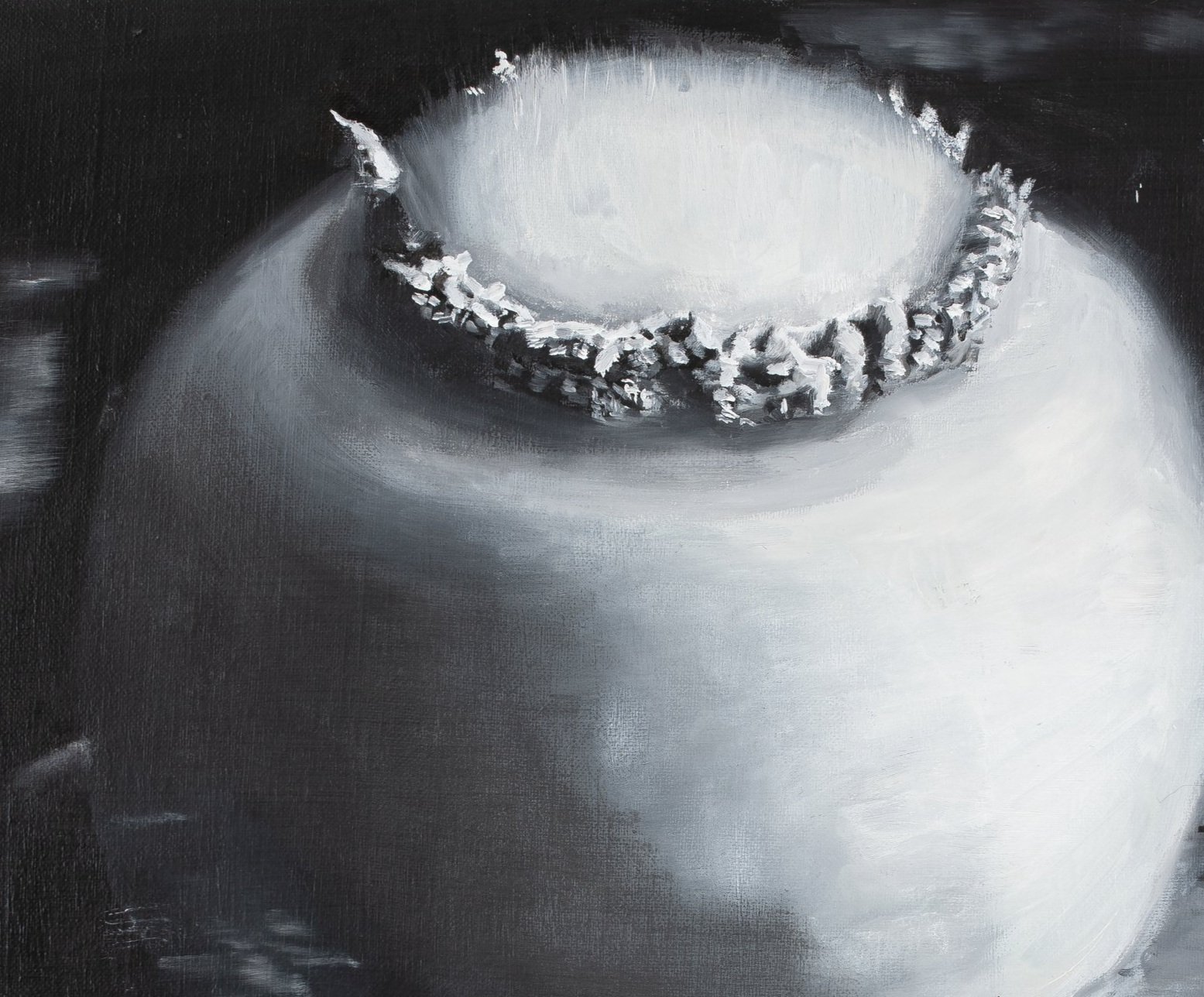
At arm's length, the painting is small. It could fit inside a backpack. It could rest on a shelf beside a coffee mug and a stack of books. The cloud that occupies its center is roughly the size of a fist, a compact form that rises from a narrow stem into a swollen cap and then dissolves at its edges into the dark ground that surrounds it. The cloud is white. The ground is black. Between the cloud and the ground, there is no horizon, no ocean, no island, no sky. There is only the form itself, suspended in darkness, its edges soft and irregular, the paint blended and feathered to produce the appearance of a volume that is expanding as you watch it, pushing outward against the containment of the canvas, but contained nonetheless, held within a rectangle that is small enough to hold in two hands. The painting is 41 x 51 cm (16 x 20 in). Oil on linen. The mushroom cloud of the Baker test at Bikini Atoll, July 25, 1946, compressed into a format that could be carried on a subway, stored in a drawer, or mailed in a flat envelope. The compression is the argument.
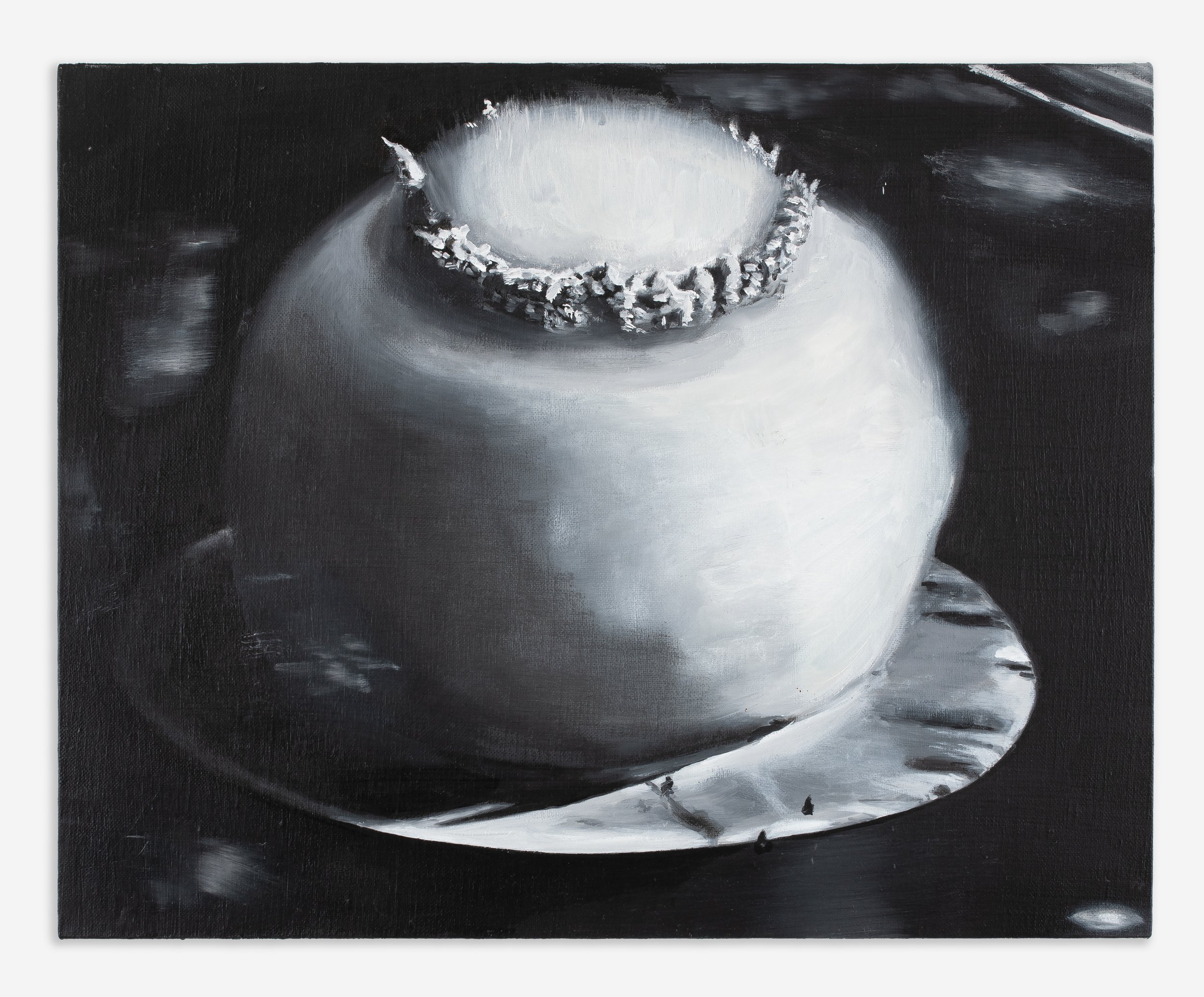
The scale of the painting is its most aggressive formal decision, and Tan Mu has discussed it explicitly. "While studying historical photographs," she says, "I noticed that the mushroom cloud often resembles something deceptively small, like a snowball or cotton candy. Viewed this way, it begins to feel less like a landscape and more like a still life. I deliberately reduced the scale of the painting, compressing the visual impact of the event and treating the explosion as an object rather than a vast scene." The observation about the archival photographs is precise. The mushroom cloud, when photographed from a distance of thirty miles, does look small. The camera reduces the scale of everything it captures. A detonation that rises forty thousand feet into the atmosphere can be made to look like a cotton ball on a dark field, and this reduction is not a distortion. It is a feature of the medium. Photography compresses scale. The question that Tan Mu's painting asks is what happens when the compression is made deliberate, when the artist chooses to reduce the scale not because the camera reduced it first but because the reduction reveals something about the event that the vastness conceals. The vastness of the mushroom cloud, its terrifying scale, its capacity to annihilate everything within its radius, these qualities are real, and they are the qualities that the photograph of the detonation is usually expected to convey. The smallness of the mushroom cloud, its resemblance to a snowball, its visual kinship with a still life, these qualities are also real, and they are the qualities that Tan Mu has chosen to emphasize by reducing the canvas to a format that a viewer can hold.
The paint handling shifts across the surface of the cloud in a way that mirrors the physical behavior of the explosion it depicts. The interior of the cloud, the dense core where the fireball has pushed the vaporized material into its highest concentration, is rendered in the brightest whites, applied in thin, smooth layers that allow the light to reflect off the paint surface with a muted, almost photographic luminosity. This is not the blazing white of a sun. It is the white of an overexposed photograph, a white that reads as the maximum value that the medium can produce, the point at which the recording apparatus has reached its limit and can register nothing beyond this intensity. The edges of the cloud are where the paint handling becomes most expressive. Here the white dissolves into the black ground through a series of feathered transitions, the pigment dragged and blended with a soft brush or a rag, producing the irregular, billowing edge that the mushroom cloud presents in photographs, the edge where the expanding volume of gas and dust meets the undisturbed atmosphere and begins to mix with it, losing its definition, losing its coherence, becoming something else. The linen weave is visible in the black ground, a fine, regular texture that reads as the grain of a photographic negative, the substrate of the archival image from which the painting has been translated.
Chaim Soutine painted carcasses. Between 1921 and 1929, working mostly in the village of Cagnes-sur-Mer in the south of France, he produced a series of still lifes depicting dead animals, usually poultry or beef, suspended from hooks or draped across tables, their bodies twisted, their surfaces rendered in thick, turbulent paint that vibrated with an energy that the dead animal could no longer generate on its own. The most famous of these is Carcass of Beef (c. 1925), now in the Minneapolis Institute of Art, which shows a split carcass of beef hanging from a hook, its red flesh exposed, its bones visible where the knife has cut away the meat, its surface glistening with the wetness of fresh blood and rendered in strokes of red, orange, and deep crimson that seem to be in motion even though the animal is dead. The painting is a still life, the most conventional genre in the European tradition, the genre of flowers in a vase and fruit on a table, and Soutine uses the genre's conventions against itself. A still life is supposed to be still. The animal in Soutine's painting is not still. The paint is in motion. The flesh seems to be breathing. The carcass vibrates with a vitality that belongs to the act of painting, not to the subject, and the disjunction between the genre's expectation of stillness and the painting's delivery of movement produces a disturbance that the viewer feels in the body, a slight nausea, a recoil, a recognition that the painting is doing something to the genre that the genre was not designed to accommodate. It is making a still life move.
Tan Mu's Bikini Atoll performs the same genre inversion, but in the opposite direction. Soutine takes a still subject and makes it move. Tan Mu takes a moving subject and makes it still. The mushroom cloud is not a static object. It is a process. It is an event that unfolds over time, expanding outward and upward at speeds that exceed the capacity of the human eye to track, and the archival photographs that document it capture it at a single moment in that process, freezing the expansion at a particular instant that the camera has selected from the continuous flow of the detonation. The painting goes further. It removes the photograph's context, the ocean, the island, the sky, the fleet of observation ships, and it isolates the cloud in a dark field, floating, with no horizon to anchor it and no landscape to give it scale. The result is a still life. A cloud in a dark room. A volume of vaporized material that has been stripped of its context and treated as an object, the way a seventeenth-century Dutch painter would treat a lemon or a skull. The genre inversion is the same as Soutine's, but the direction is reversed. Soutine makes the dead animal live. Tan Mu makes the live explosion hold still. Both painters use the still life genre to create a tension between what the genre expects and what the painting delivers, and in both cases, the tension produces a recognition that the genre, for all its conventions, is capable of containing subjects that its tradition never imagined.
The Baker test was conducted on July 25, 1946, at Bikini Atoll in the Marshall Islands. It was the second of twenty-three nuclear tests conducted by the United States as part of Operation Crossroads, and it was the first nuclear detonation to be photographed extensively and broadcast to the global public. The test was underwater, the bomb suspended ninety feet below the surface of the lagoon, and the detonation produced a column of water and spray that rose six thousand feet into the air and then collapsed back into the lagoon, carrying radioactive contamination across the atoll and into the ocean beyond. The displacement of water was so massive that it created a wave ninety-four feet high that crashed over the target fleet of decommissioned ships anchored in the lagoon. The photographs of the Baker test were reproduced in newspapers and magazines around the world, and they introduced the global public to a visual vocabulary of destruction that would become, over the following decades, the defining imagery of the atomic age: the mushroom cloud, the fireball, the shock wave, the vaporized island. Tan Mu describes this visual vocabulary as a "condensed image of Cold War power dynamics" that also serves as "a catalyst for developments in technology, economics, and energy." The mushroom cloud, in her reading, is not merely a record of destruction. It is a nexus point where military power, technological ambition, environmental devastation, and the political ideology of nuclear deterrence converge in a single visual form. The painting treats this nexus as a still life because the still life, as a genre, is designed to hold a single object in sustained attention, to invite the viewer to look at what they might otherwise walk past, and the mushroom cloud, which has been reproduced so often that it has become a visual cliché, an image that the eye slides over without really seeing, needs precisely this kind of sustained attention if its significance is to be recovered from the familiarity that has dulled it.
The monochrome is a deliberate reference to the archival photograph. "I chose to work in black and white," Tan Mu says, "partly because of the historical photographs that informed the image, but also because the absence of color allowed me to focus on light, shadow, and form." The archival photographs of the Baker test are black and white. They were taken on high-contrast film by military photographers positioned on ships at a safe distance from the detonation, and their tonal range, from the blazing white of the fireball to the absolute black of the ocean, is determined by the chemistry of the film, not by the colors of the scene. The painting adopts this tonal range as its palette, restricting itself to the same spectrum of values that the photograph produces, and in doing so, it aligns itself with the documentary tradition that the photograph represents. But the alignment is not submission. The painting does not reproduce the photograph. It translates it. The photograph captures the mushroom cloud at a specific moment in its expansion, a fraction of a second in a process that lasts minutes. The painting captures the cloud as an object, independent of time, held in a state of permanent suspension, its edges still expanding but never reaching the boundary of the canvas, its interior still bright but never illuminating the darkness around it. The monochrome, in this context, is not a nostalgic effect. It is a structural decision that aligns the painting with the documentary tradition while simultaneously extracting the cloud from the documentary's temporal logic, removing it from the sequence of events that the photograph was made to record and placing it in the atemporal space of the still life, where objects exist outside of narrative time, where a lemon on a table is not ripening, a skull is not decaying, and a mushroom cloud is not expanding. It is just there, held in attention, held in paint, held in a format that you could carry in your hands.
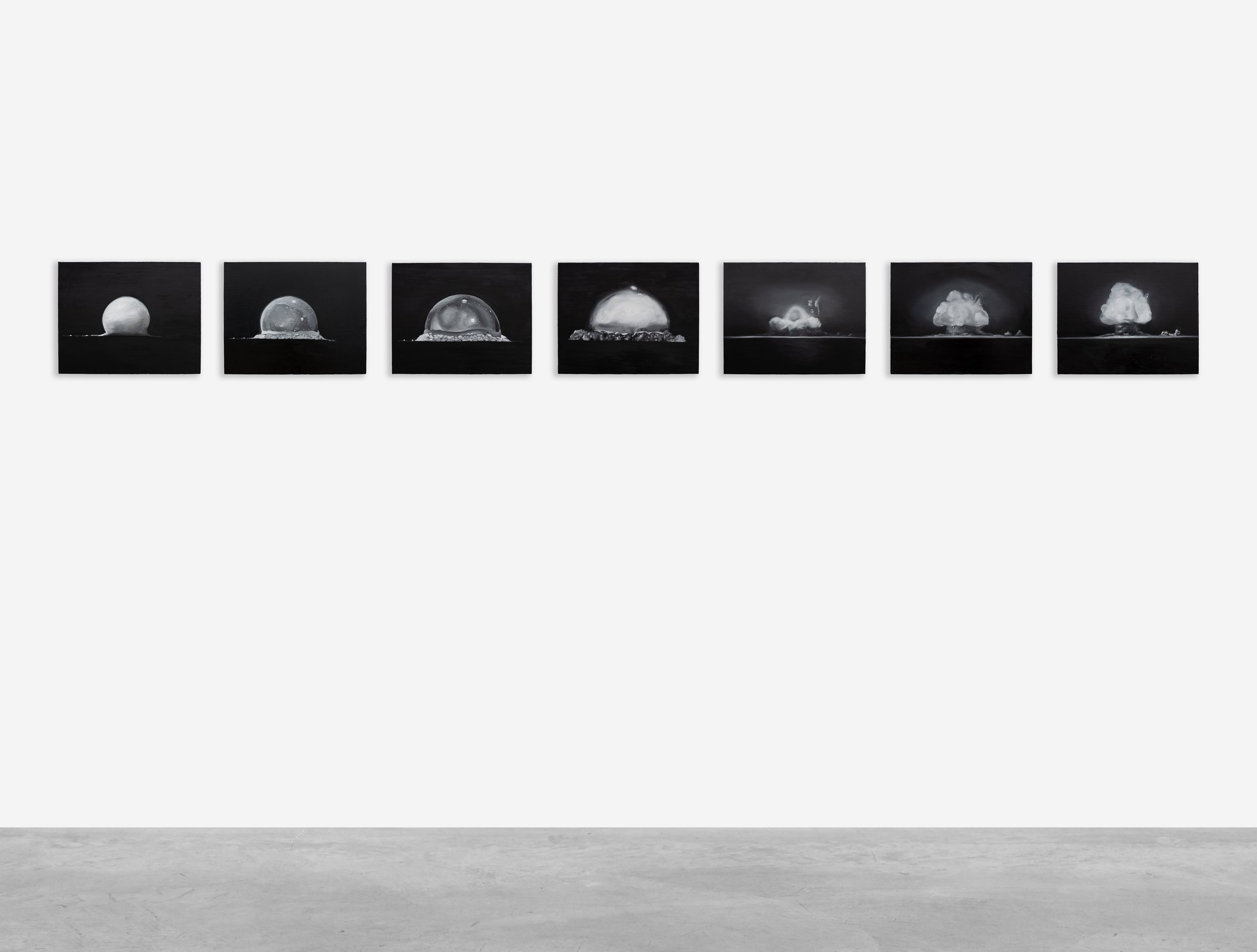
Saul Appelbaum, writing in 2025 about Tan Mu's practice, identifies a structural pattern in her treatment of historical events. Her paintings, he observes, do not document the event. They document the way the event has been mediated through photography, through archival reproduction, through the visual systems that make the event available to a viewer who was not present at the original site. The mushroom cloud in Bikini Atoll is not the mushroom cloud of July 25, 1946. It is the mushroom cloud as it has been mediated through seventy-five years of photographic reproduction, through the grain of the film and the contrast of the print and the resolution of the scan, and it is this mediated image, not the event itself, that the painting holds in sustained attention. Appelbaum's observation clarifies the relationship between the painting and its source. The painting is not a representation of a nuclear explosion. It is a representation of the photographic record of a nuclear explosion, and the distinction matters because the photographic record is the only form in which most human beings have ever encountered a nuclear explosion. Nobody who views this painting has seen a mushroom cloud in person. Everyone who views it has seen a photograph of one. The painting addresses this condition by making the mediation visible, by adopting the monochrome palette and the high-contrast tonal range of the archival photograph, and by compressing the scale to the size of a photograph that could be held in the hand, the painting makes explicit what the photograph conceals: that the image of the mushroom cloud that circulates in the public imagination is not the event itself but a representation of the event, produced by a specific technology, at a specific distance, for a specific purpose, and that this representation, not the event, is what has shaped the collective understanding of what a nuclear explosion looks like and what it means.
The layering of the paint, as Tan Mu describes it, enacts the layering of historical memory. "The layering and blending of oil paint mirror the accumulation and reconstruction of historical memory," she says. "As viewers look at the painting, their minds instinctively translate the brushstrokes into associations with nuclear explosions, energy, and control." The instinct she identifies is the instinct of the mediated viewer, the viewer who has seen the photograph before seeing the painting, and who brings to the painting all of the associations that the photograph has accumulated over its seventy-five years of circulation: the Cold War, the arms race, the environmental devastation of the Marshall Islands, the forced relocation of the Bikini islanders, the subsequent promotion of nuclear energy as a clean alternative to fossil fuels, and the ongoing debate about whether a technology that can destroy a city in a single detonation can also power a civilization. The painting does not depict any of these things. It depicts a cloud in a dark room, rendered in black and white, at a scale small enough to hold in two hands. The associations arrive from the viewer, and they arrive because the monochrome palette, the photographic tonal range, and the small format have activated the visual vocabulary of the archival photograph, which is the vocabulary through which the public has encountered nuclear detonations for three generations. The painting is a trigger, not a depiction. It triggers the associations that the photograph has already installed in the viewer's mind, and it holds those associations in the space of a still life, a genre that is designed for contemplation, for slow looking, for the sustained attention that the mushroom cloud, in its photographic circulation, never receives because it is always reproduced alongside headlines that tell you what to think about it.
Tan Mu has identified the tension between progress and destruction as the painting's conceptual entry point. "Nuclear energy is often promoted as a form of clean energy," she says, "yet its destructive legacy continues to damage the environment. This tension between progress and destruction became the conceptual entry point for the painting." The tension is not resolved. The cloud hangs in the dark, and it hangs there indefinitely, neither expanding nor dissipating, neither detonating nor calming, and this indefinite suspension is the condition that the painting names. Nuclear technology has always existed in this suspension, between the promise of unlimited energy and the threat of unlimited destruction, between the reactor and the bomb, between the power plant and the detonation, and the painting, by freezing the cloud at a single moment and holding it in a format that can be carried, makes this suspension visible as a visual condition: an object that is neither one thing nor the other, that is both the detonation and the photograph of the detonation, that is both the event and the memory of the event, that is both the destructive force that can annihilate a city and the small white form that could be a snowball, a cotton ball, or a cloud on a dark night, depending on how close you stand and how long you look. The painting asks you to look long enough to see both, and to hold both in the same frame, and to recognize that the frame is small enough to hold in your hands, and that the cloud, for all its vastness, has been compressed into an object that fits on a shelf, which is where the still life has always kept its subjects: on a shelf, in a room, within reach, under control, and this is the final contradiction that the painting delivers, because the mushroom cloud is the opposite of an object under control. It is the image of an object that has escaped all control, and the painting, by compressing it into a still life, by reducing its scale, by stripping it of its context and holding it in a dark room at a size that a person could carry, performs the same act of control that the nuclear powers performed when they photographed the detonation and released the images to the public: it makes the uncontrollable visible, and in making it visible, it makes it appear to be within the frame, within the frame of the photograph, within the frame of the painting, within the frame of understanding, and the frame, as anyone who has ever held a photograph knows, can be cropped, enlarged, reduced, reproduced, and distributed, but it cannot contain the thing it depicts, because the thing it depicts is still expanding, and the frame, no matter how small it is drawn, can only hold a fraction of a fraction of the force that the image represents.