The Veins Beneath the Water: Tan Mu's Signal: Submarine Network 05 and the Body the Ocean Became
Before Tan Mu ever saw a submarine cable, she saw marine maps. Her grandfather was a marine engineer who worked on large-scale coastal projects, port design, land reclamation, the construction of the artificial shoreline that a maritime nation builds when the natural one is not sufficient, and through him she was exposed, as a child, to the technical drawings and engineering plans that convert the ocean floor from a dark and unknown space into a legible surface, a surface that can be surveyed, planned, and built upon. These maps showed the ocean not as it appears from the deck of a ship, a shifting field of blue and gray that changes with every cloud and every wind, but as it appears to the engineer: a stable terrain with fixed coordinates, measurable depths, and routes that can be drawn and followed. The maps turned the ocean into a document. They made it readable. And they introduced the young Tan Mu to the idea that the ocean, which she already knew as a physical environment through her mother's windsurfing and her own sailing, was also an information environment, a space that contained structures which could not be seen from the surface but which determined what happened on the surface, where ships could travel, where cables could be laid, where the continental shelf dropped away into the abyssal plain and the water became too deep for any anchor to hold.
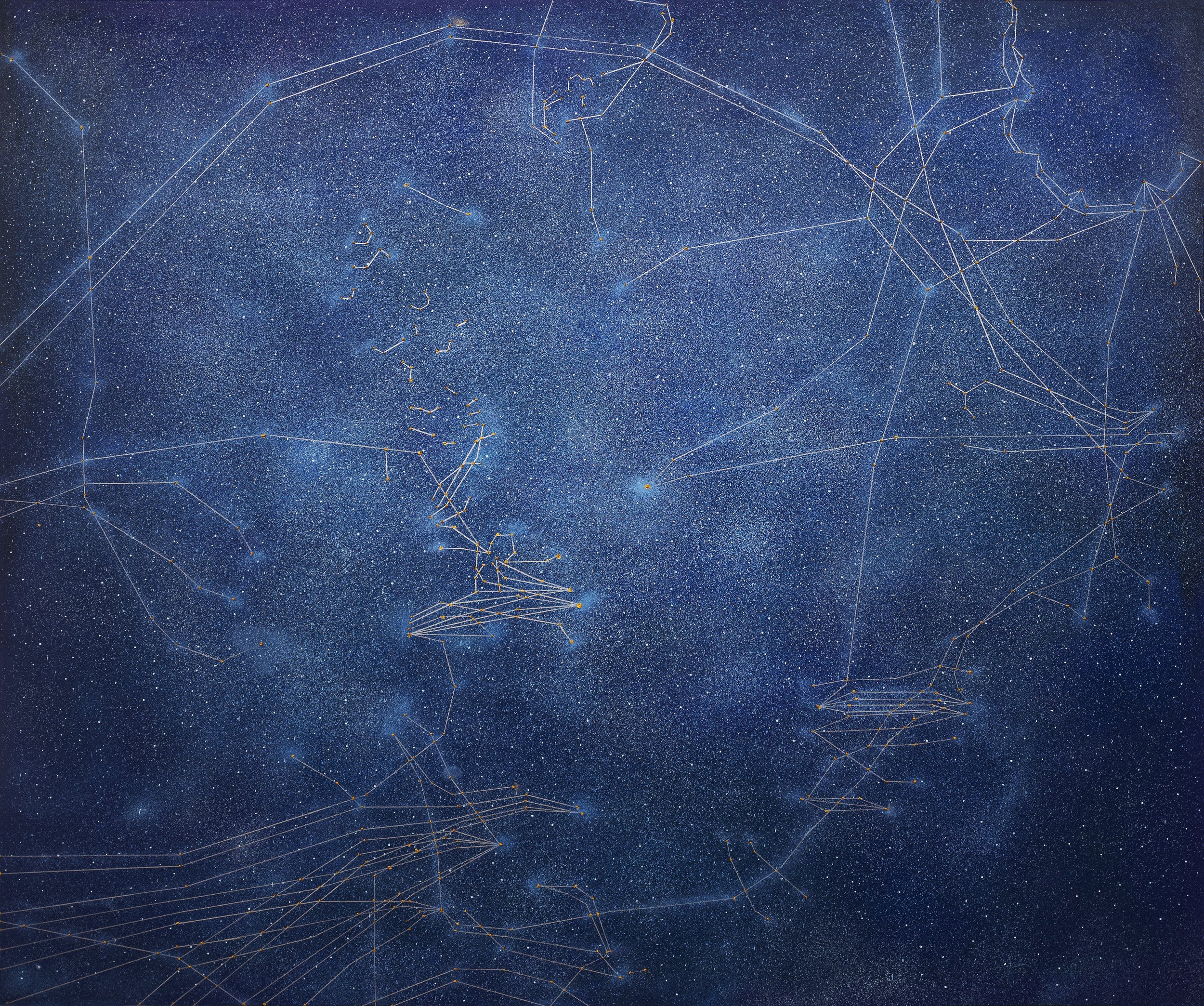
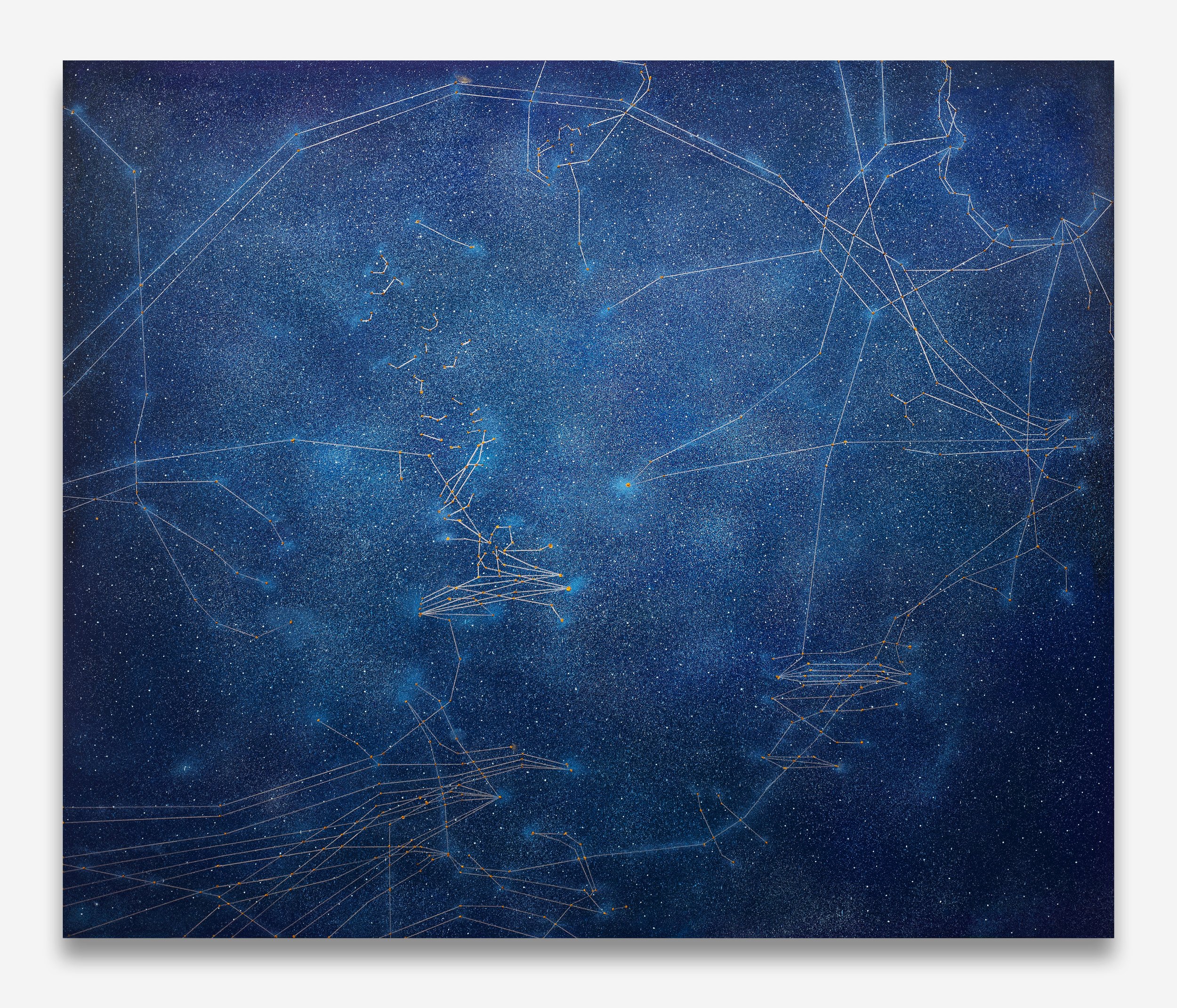
Signal: Submarine Network 05 (UK), 2025, is oil and acrylic on linen, 152.5 x 183 cm (60 x 72 in). The format is landscape, wider than it is tall, the format of the ocean viewed from altitude, and the painting occupies a scale large enough that the viewer stands before it as before a window rather than holding it as an object. The composition is a field of dark blue, close to black, across which lines and dots trace the submarine cable networks that encircle the British Isles. The lines are thin, luminous, and pale, ranging in color from cool white to pale blue to faint gold, and they follow the routes that the actual cables follow: across the North Sea, through the English Channel, around the coastlines of England, Scotland, and Ireland, and outward into the Atlantic and toward continental Europe. The dots mark the landing points, the nodes where the cables emerge from the ocean floor and connect to the terrestrial networks that carry their data onward to the data centers, exchanges, and end users that constitute the visible internet. The dots are small, some no larger than a pencil point, others slightly larger, and they cluster densely along the coastlines, where the concentration of landing points is highest, and thin out toward the open ocean, where the cables run for hundreds of kilometers without a node.
The paint handling distinguishes between the lines and the dots in a way that mirrors the distinction between the cables and the landing points in the actual network. The lines are rendered in thin, continuous strokes of acrylic, the pigment mixed to a fluid consistency that allows it to be drawn across the surface in a single pass, producing a line that is even in width and consistent in value from one end to the other. This evenness is the visual quality of a manufactured cable: a glass fiber sheathed in polyethylene and armored in steel wire, produced in a factory and laid on the ocean floor by a cable ship in a single, continuous operation. The dots are rendered in oil paint, built up in small, concentric applications that produce a slight impasto at each node, a tiny ridge of paint that catches the light differently from the flat surface of the lines. This difference in material, acrylic for the lines and oil for the dots, is a technical decision that produces a perceptual effect: the nodes glitter slightly when the viewer moves past the canvas, catching the gallery light and releasing it in brief flashes, while the lines remain stable and continuous, absorbing and reflecting light with the uniformity of a wire. The dark blue field between the lines and dots is not flat. It carries subtle modulations of value, slightly lighter in some areas and slightly darker in others, that suggest the bathymetry of the ocean floor, the ridges and trenches and continental shelves that the cables cross, without depicting them. The field breathes. It is not the dead black of a screen or a void. It is the living dark of deep water, where light from the surface has been absorbed and the remaining illumination comes from the bioluminescence of organisms that generate their own light in the absence of the sun.
Agnes Martin spent her career making grids that tremble. The Islands (1961), a suite of twelve small paintings, each one a square field of pale gray or white traversed by a grid of penciled lines so fine that they are almost invisible, is among the most austere works in the history of American abstraction. The grid in each painting is regular, the horizontal and vertical lines spaced at equal intervals, and the intersections are marked by small, barely visible dots where the pencil has pressed slightly harder into the gesso ground. The effect is of a structure that is on the verge of dissolution. The lines are there, and you can see them if you look closely, but they refuse to assert themselves. They recede. They hover. They suggest a pattern without insisting on it, and the result is a painting that is simultaneously structured and open, ordered and empty, a grid that contains everything and nothing, depending on the state of mind that the viewer brings to it. Martin described her grids as representations of innocence, of the experience of being in the landscape and feeling its emptiness as a form of plenitude, not as a lack. The grid, she said, was a way of making that feeling visible without attaching it to a specific object or a specific place. It was abstract because the feeling was abstract, and the grid was its most precise visual equivalent.
Tan Mu's cable networks are Martin's grids after the internet. Both artists work with lines and dots on a dark or neutral field. Both organize those lines and dots into patterns that suggest structure without depicting a specific object. Both use the grid as a way of making visible a system that is too large and too diffuse to be seen in its entirety. But the systems are different, and the difference produces a different kind of painting. Martin's grid is empty. It does not carry information. It is a structure that has been stripped of content, a vessel that has been cleaned out and presented to the viewer as a pure form. Tan Mu's grid is full. Every line is a cable carrying data. Every dot is a landing point processing that data. The structure has not been stripped of content. It is the content, and the content, in the form of the data that flows through the cables at speeds approaching the speed of light, is invisible in the painting, just as it is invisible in the ocean. The painting makes the structure visible and leaves the content to the viewer's imagination, and this is its most significant departure from Martin's practice. Martin's grid is contemplative because it is empty. Tan Mu's grid is contemplative because it is full of something that cannot be seen. The invisible data flowing through the visible cables produces a tension that the empty grid does not contain, a tension between the material infrastructure that the painting can depict and the immaterial information that the painting can only suggest, and this tension, the distance between what is visible and what is known to be there, is the space in which the painting operates, the space between the wire and the signal, between the cable and the data, between the vein and the blood.
The British Isles are among the most densely cabled coastlines on the planet. The geographic position of the archipelago, at the junction of the North Sea, the English Channel, and the Atlantic Ocean, makes it a natural hub for the submarine cable networks that connect Europe to North America, and the concentration of landing points along the coasts of Cornwall, Kent, and the Scottish Highlands is a direct consequence of this geography. The first transatlantic telegraph cable was laid from Valentia Island, off the west coast of Ireland, to Heart's Content, Newfoundland, in 1866, and the route it followed, the great circle arc that minimizes the distance between the Old World and the New, is still the route that the majority of modern fiber-optic cables follow. The cables have been upgraded, from copper to glass, from analog to digital, from telegraph to internet, but the routes have remained the same because the ocean floor has not changed. The continental shelf still drops away at the same coordinates. The mid-Atlantic ridge still rises at the same latitude. The abyssal plain still stretches between the same boundaries. The cables follow the geography, and the geography determines the network, and the network, for all its technological sophistication, is constrained by the same physical facts that constrained the first telegraph cable in 1866: the shape of the ocean floor, the depth of the water, the distance between the continents.
Tan Mu describes the cable networks as "the veins of the planet," comparing them to "meridian lines in traditional medicine, circulating energy and information through a living body." The comparison is not metaphorical. It is structural. A vein is a vessel that carries blood from one part of the body to another. A submarine cable is a vessel that carries data from one part of the planet to another. Both systems are distributed. Both operate beneath the surface. Both are essential to the functioning of the organism they serve, and both are invisible to the organism's conscious attention. You do not feel your veins working. You do not feel the cables working. Both systems are infrastructure in the most literal sense: the structures that lie beneath, the structures that make everything above possible. And both systems, when they fail, produce the same kind of crisis: a disruption of flow, a loss of connection, a sudden awareness that the organism is not self-sufficient, that it depends on vessels it cannot see and does not think about, and that the interruption of those vessels threatens the integrity of the whole. The Tonga eruption of January 2022, which severed the submarine cables connecting the island nation to the rest of the world and cut it off from global communication for weeks, was a cardiac event at the scale of a nation. The cables were cut. The flow stopped. The body went dark. The painting series that grew from this event, the Signal series, is Tan Mu's attempt to make the circulatory system of the planetary body visible, to paint the veins that everyone depends on and nobody sees.
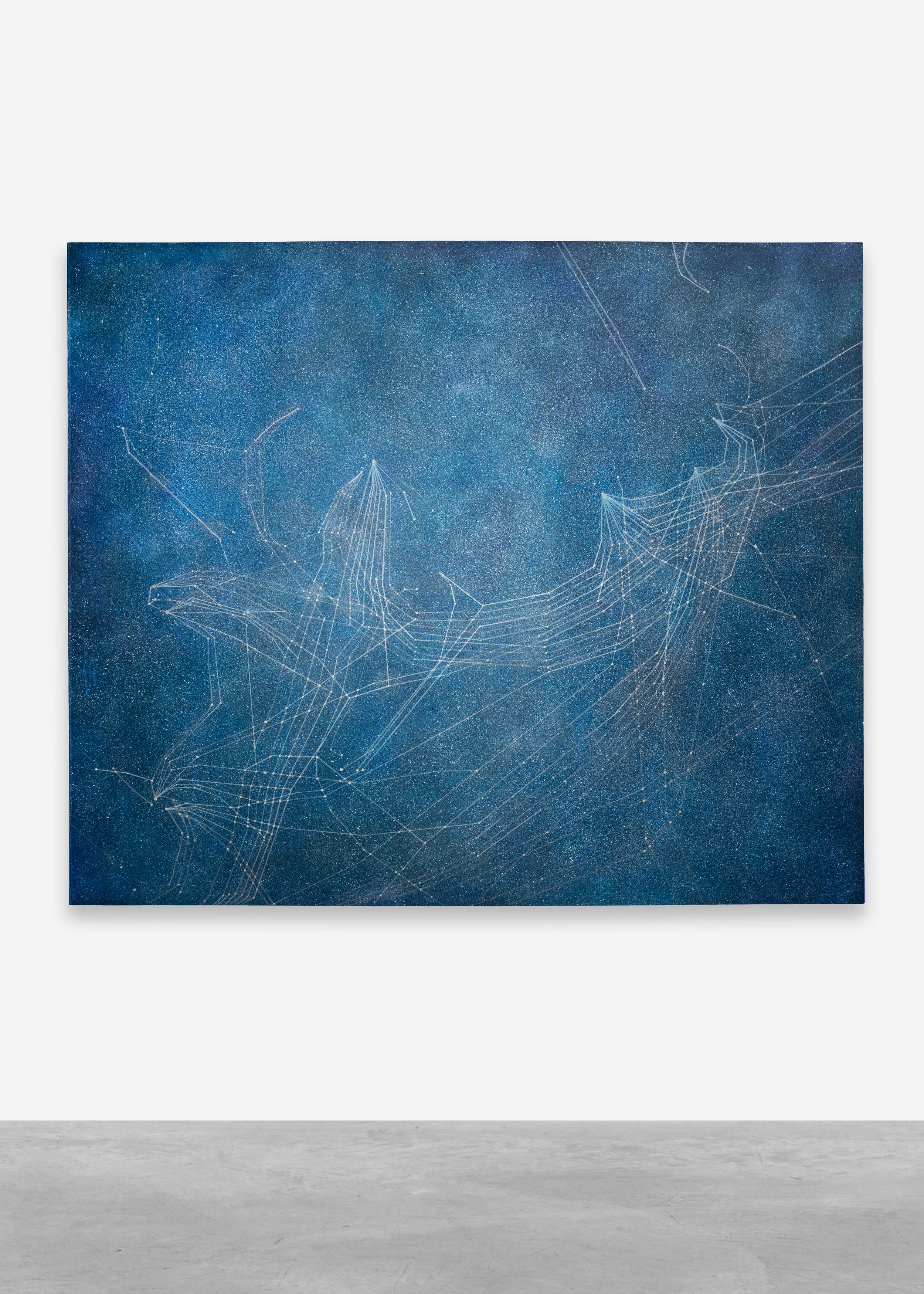
Yiren Shen, writing in 10 Magazine about Tan Mu's practice, observes that the Signal series "collapses the distance between the ocean floor and the night sky, producing a visual field in which submarine cables and constellations occupy the same register." The observation identifies the painting's most distinctive perceptual effect, and Tan Mu has explained its origin. "When you are underwater and look upward, the surface of the ocean reflects light in a way that resembles the night sky. In that moment, sea and sky collapse into a single plane. In the paintings, dots and lines function on multiple levels. They represent data flowing through cables, but they also evoke stars, pixels, and visual noise." The collapse of sea and sky is not an aesthetic choice. It is a phenomenological observation, and it comes from the artist's own body. As a freediver, Tan Mu has experienced the moment of neutral buoyancy that she describes in her Q&A: "When you reach neutral buoyancy underwater, there is a moment of suspension that feels completely detached from gravity and time. The surrounding marine life begins to resemble stars, drifting through space." The body, suspended in water, looks upward, and the surface of the ocean, filtered through the refraction of light at the boundary between water and air, produces a visual field that is indistinguishable from the night sky seen through the atmosphere. The diver floats between two infinities: the infinite depth below and the infinite distance above, and the visual field collapses them into a single plane of light and dark, dots and lines, data and stars. The painting recreates this collapse on the canvas. The dark blue ground is both the deep ocean and the night sky. The luminous lines are both submarine cables and the paths that data follows through the network. The glittering dots are both landing points and stars. The viewer, standing before the painting, occupies the position of the diver: suspended between two systems that the painting has made indistinguishable, looking at a field that could be read as a map of the ocean floor or a chart of the heavens, and recognizing that the distinction between the two readings is not a difference in the image but a difference in the viewer, a decision about which system to attend to, which structure to follow, which set of associations to activate.
The comparison to constellations is not decorative. It is a historical argument that Tan Mu has developed explicitly. "Historically, humans used stars to navigate unknown territory. Today, submarine cables guide information instead of ships. They are contemporary constellations, mapping human movement, communication, and desire." The argument connects two navigational systems across a span of millennia. The first system, the constellations, allowed sailors to determine their position on the ocean by measuring the angles between stars and the horizon. The second system, the submarine cables, allows data to find its destination on the planet by routing information through a network of fiber-optic conduits. Both systems are composed of points and lines. Both systems operate at a scale that exceeds human perception: the stars are too far away to see as points of connection, the cables are too deep to see as routes of transmission. Both systems require a mediating technology to make them legible: the astrolabe for the stars, the network operations center for the cables. And both systems, when rendered on a map, produce the same visual pattern: a field of darkness traversed by luminous points connected by thin lines, a pattern that the human eye, which evolved to find meaning in the arrangement of stars, reads instinctively as a structure, a navigation aid, a chart, a map of the territory that the system was designed to traverse. The painting activates this instinct. It presents a visual field that the eye reads as a constellation chart, and it labels that field not with the names of stars but with the geography of the British Isles, and the collision of these two readings, celestial and submarine, ancient and contemporary, produces the recognition that the two systems are not merely visually similar but structurally identical. Both are distributed networks that carry information across vast distances. Both are composed of points and lines. Both are invisible without a mediating technology. And both, when they fail, leave the traveler lost.
The Northwest Pacific, where the Signal series began, is Tan Mu's home water. The British Isles, where Network 05 turns its attention, are not. The shift in geography marks a significant expansion of the series' ambition. The first paintings mapped the cable networks that connect the artist's hometown to the region she knows best: East Asia, South Korea, Japan. The subsequent paintings moved outward: to Hong Kong, to Dubai, to the waters near those cities. Network 05 moves to a coast that Tan Mu does not know from childhood. The British Isles are a site that she approaches as a researcher, not as a native, and the painting registers this distance in its composition. The cable networks that encircle Britain are denser than the networks of the Northwest Pacific. The landing points are more numerous, the routes more closely spaced, the concentration of nodes along the Cornish and Kentish coastlines higher than anywhere else on the planet except the approaches to Singapore. The painting renders this density with a precision that can only come from cartographic study, and the density itself becomes the subject of the image. The British Isles, viewed from the ocean floor, are a nerve center, a ganglion of the planetary body, a place where more veins converge than anywhere else in the network. The painting does not depict an island. It depicts a junction, a point of extreme connectivity, and the density of the lines and dots around the coastlines of England and Scotland is the visual measure of that connectivity, the way that a brain scan shows the concentration of neural activity in the cortex by the density of the bright regions on the image. The British Isles, in Network 05, are not a landscape. They are an organ.
Signal: Submarine Network 05 does not argue that the internet is a body. It argues that we treat it like one. The language that Tan Mu uses to describe the network, veins, meridians, circulation, is not her invention. It is the language that the network's own engineers and operators use. Submarine cables are described in the industry literature as "the backbone" of the internet. Landing points are described as "nodes." Data centers are described as "the brain" of the network. The circulatory metaphor is not a poetic imposition on a technical subject. It is the technical subject's own self-description, and the painting, by rendering the network in a visual language that activates the viewer's embodied knowledge of veins and pulses and circulation, makes explicit what the industry's language already implies: that the network is understood, by the people who build and maintain it, as a living system, a body that requires care, that can be injured, that can die. The painting holds this understanding in the space between the lines and the dots, between the acrylic cables and the oil landing points, between the dark blue water and the luminous routes that cross it, and it asks the viewer to recognize that the network, for all its technological complexity, is not a machine. It is a circulatory system, and the data that flows through it is not information. It is blood, and the blood carries everything that the body needs to survive: the messages, the transactions, the conversations, the medical records, the financial data, the news, the love letters, the photographs, the video calls, all of the invisible cargo that moves through the veins beneath the water every second of every day, and that would stop flowing if the veins were cut, as the veins connecting Tonga were cut in January 2022, and as the veins connecting any coastal city could be cut, by an anchor, by an earthquake, by a volcanic eruption, by any of the events that the ocean floor produces without warning, and that the network, for all its redundancy and resilience, cannot fully protect against, because the network, like the body, is a system of flows, and a system of flows is only as strong as the narrowest passage, the thinnest vein, the single cable that connects the island to the mainland, and that carries, in its glass core, the entire circulation of the world.